Grow Lights for a Room With No Windows
A basement, an interior office, a windowless hallway: with no daylight the fixture supplies every photon rather than a winter top-up. That roughly doubles the job, and hours are the cheapest way to do it.
By Scooter M. — An enthusiast who's genuinely into this. I read the manuals, compile the published specs, and do the math. No lab coat.
Published · How we pick
Photographs on this site are licensed stock and are illustrative of the fixture type. We do not own the units we write about.
How this page is funded: the buy links here are Amazon Associates links, and we earn a commission on qualifying purchases at no extra cost to you. We have not been paid to feature anything on this page, we accept no free product, and commission plays no part in the ranking. Full disclosure.
We have not tested these units. Everything below comes from the manufacturer’s own published specifications, or from arithmetic we have shown our working for. Where a figure is not published, we say so instead of estimating one. Read the method.
Quick picks
Efficacy is photons out per joule in. Where a manufacturer publishes it we quote theirs; where they publish photon output and wattage but not efficacy, we divide and label it as ours; where they publish neither, the cell says so rather than guessing. Tap a row for the full write-up.
| # | Product | Best for | Efficacy | Price |
|---|---|---|---|---|
| 1 | 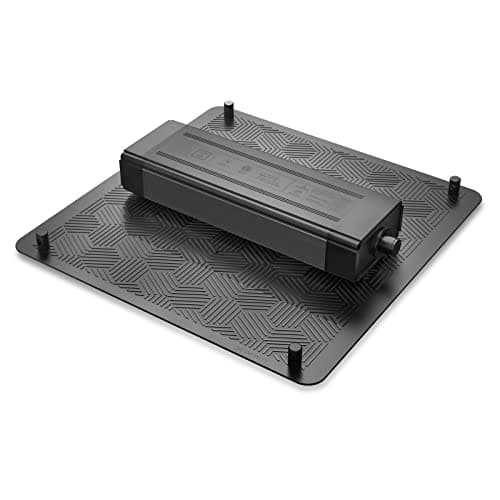 AC Infinity IONBOARD S22 The highest published efficacy of any fixture here at 2.7 umol/J, on Samsung LM301H diodes, with dimming in real 20% steps rather than a vague knob. | Long hours at the lowest cost per photon | 2.7 umol/J | |
| 2 | 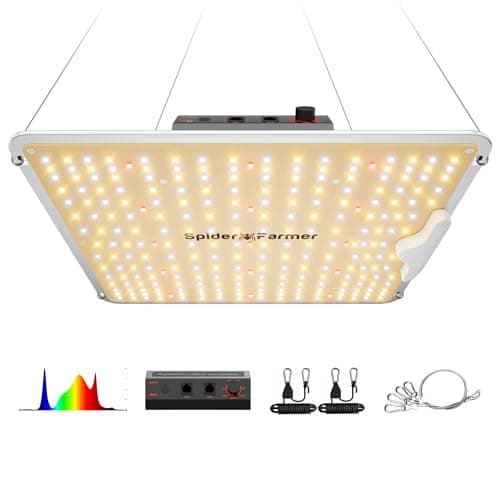 Spider Farmer SF1000 Publishes PPF to two decimal places and an efficacy figure that actually divides out of it. That internal consistency is rarer in this category than it should be. | One shelf, output you can verify | 2.5 umol/J | |
| 3 | 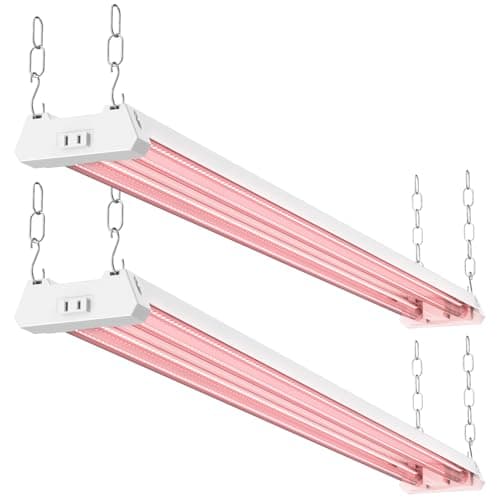 SuncoGrow 4ft 40W Grow Light The only cheap 4 ft strip we have found that publishes a PPF figure at all, which makes it the only one in its class you can size a shelf around before you buy it. | A long bench, added a strip at a time | Not published | |
| 4 | 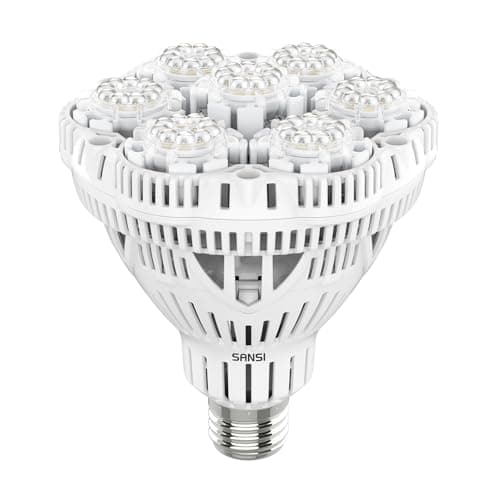 SANSI 36W BR30 Grow Light Bulb The rare grow bulb that publishes both PPF and a PPFD figure with the measurement distance attached, which is the only reason it can be sized honestly. | One plant in an interior corner | 1.82 umol/J (ours) |
The reasoning
With no window, the fixture has to deliver the plant’s entire daily light integral rather than top up what the glass already gave you — roughly twice the work a winter supplement does. Because the consequence is long hours rather than brute intensity, the fixture we would buy is the AC Infinity IONBOARD S22: at a published 2.7 µmol/J it is the cheapest thing here to run for the fourteen to sixteen hours a windowless room requires.
We have not tested these fixtures. The sizing below is published specification and extension targets, divided out in view.
What changes when the window is gone
Every other sizing page on this site solves a subtraction: your window supplies some light, the plant wants more, and the fixture covers the difference. In a basement, an interior office or a hallway, the first term is zero. The fixture is not a supplement. It is the whole supply, and it is the only thing between the plant and the dark.
That has three consequences, and only the first is obvious.
- The fixture gets bigger. If your window had been supplying half the target — a fair description of a decent north room in winter — the windowless version does exactly twice the work.
- Reliability starts to matter. A supplement that fails for a week is a dim week. A sole light source that fails for a week is a week of darkness, which is why a timer you can hear clicking and a plant you walk past daily are worth more here than anywhere else.
- Hours become the cheapest lever you have. More on this below, because it is the part that saves money.
The sizing, for a shelf
Pick the target honestly. Iowa State University Extension places low-light foliage houseplants at 3 to 6 mol/m²/day and foliage and flowering houseplants at 6 to 10. A windowless room suits the first group, and attempting the second is a decision to run a much larger fixture for longer.
Target 5 mol/m²/day over 14 hours: 5,000,000 ÷ (14 × 3600) = 99 µmol/m²/s at the leaf.
A 2 × 4 ft shelf is 8 sq ft, or 0.743 m². At the 80% capture this site assumes: 99 × 0.743 ÷ 0.8 = about 92 µmol/s of fixture output.
Two SuncoGrow 40 W strips deliver 96.84 µmol/s published. One Spider Farmer SF1000 delivers 249.21, which is two and a half times the requirement — buy it dimmed, or cover two shelves with it.
For a single plant rather than a shelf, the figure drops sharply, because the area does.
99 µmol/m²/s × 0.0929 m² ÷ 0.8 = about 11.5 µmol/s.
That is one 9 W grow bulb. The SANSI at 65.6 µmol/s is nearly six times it, which is why that bulb goes 18 to 24 inches away rather than 6.
Hours are the cheapest photons in the building
The daily total is intensity multiplied by time, and in a windowless room you control both. Time is far cheaper.
At 99 µmol/m²/s for 14 h: 99 × 14 × 3600 ÷ 1,000,000 = 4.99 mol/m²/day.
The same intensity for 16 h: 5.70 mol/m²/day — a 14% increase in light for a 14% increase in electricity.
On a 115 W board that is 55.2 kWh a month against 48.3, or $10.12 against $8.86 at the US residential average of 18.34 cents per kWh. $1.26 a month buys the same 14% that a larger fixture would have cost you $40 up front to get.
There is a limit, and it is not a cost limit. The dark period is a physiological requirement, not a courtesy: plants use it, and running a light around the clock damages many species rather than accelerating them. Fourteen to sixteen hours is the working range for foliage, and the published guidance is set out in grow light hours per day. Never twenty-four.
Which plants will accept a windowless room
A fixture reliably moves a dark room into the low-light band. It does not reliably move it into the bright one, and that distinction decides what you should put in the room.
| Group | DLI band | Windowless room verdict |
|---|---|---|
| Low-light foliage — pothos, ZZ, snake, philodendron, aglaonema | 3-6 mol/m²/day | Comfortable. One modest fixture, 14 hours. |
| Foliage and flowering houseplants | 6-10 mol/m²/day | Achievable with a board, dimmed up and run 16 hours. |
| Succulents, herbs, citrus | 12-16 mol/m²/day | Possible but expensive: three to five times the low-band fixture. |
| Fruiting vegetables | 20-30 mol/m²/day | Only over a very small area, and for a reason. See below. |
The practical reading: a windowless room is an excellent home for the plants that evolved on a forest floor, a workable one for a flowering houseplant if you are willing to run a board, and a poor one for anything you intend to eat. Flowering specifically needs a band more than surviving does, which we work through in will a grow light make my plant flower.
If the room is a basement
Basements add two variables that have nothing to do with light, and both can make a correctly sized fixture look like a failure.
Temperature. An unheated basement often sits in the mid to high fifties Fahrenheit. Tropical foliage slows markedly there regardless of how much light it receives, so a plant that stops growing in a lit basement may be cold rather than dark. This is also why a basement is a genuinely good place to overwinter dormant plants, where slow is the objective — that case has its own page.
Damp. Many basements are damp locations in the electrical sense. Of the fixtures here, the SuncoGrow strips and the GE fixture publish damp ratings; the LED boards publish nothing. If your basement has a dehumidifier running, treat the rating as a requirement rather than a nicety — the same table that governs a greenhouse applies, and it is in grow lights for a greenhouse.
If the room is a windowless office
The constraint here is not the plant, it is the person sitting next to it for eight hours.
A fixture sized for a shelf of foliage is bright enough to be unpleasant at eye level, so the two things worth paying for are dimming and a position above the sight line. A board under a shelf aimed down at the plant is comfortable; the same board on a desk aimed across one is not. On looking at the fixture itself, the published photobiological-safety position is covered in are grow lights safe for eyes and pets.
The other office-specific problem is the schedule. A plant wants fourteen hours and the building may switch the circuit off at seven. Put the light on its own plug timer rather than the room’s switch, confirm the socket is not on a lighting circuit the cleaner kills at night, and choose the schedule for the plant rather than the working day.
1. AC Infinity IONBOARD S22 — long hours, lowest cost per photon
A published 2.7 µmol/J, which clears the 2.5 µmol/J commercial efficacy minimum and is the highest figure anyone here publishes, with dimming in 20% steps. In a room where the fixture runs sixteen hours a day, twelve months a year, efficacy is not an abstraction — it is the only specification that compounds.
Best for: a 2 ft square of plants that will be lit every day indefinitely, where the running cost over years exceeds the purchase price.
The downside: AC Infinity publishes no PPF in µmol/s at all, and its “1098 PPFD” claim carries no measurement distance, so it is the one fixture here you cannot size directly — we back out roughly 311 µmol/s from the efficacy and the wattage, and label that as ours. No location rating either, which matters in a damp basement.
2. Spider Farmer SF1000 — one shelf, output you can verify
249.21 µmol/s published, at a published 2.5 µmol/J that the division confirms. Against our 92 µmol/s shelf requirement it is two and a half times oversized, which with a dimmer is the right kind of wrong: turn it down, or hang it higher and cover more shelf.
Best for: anyone who wants to compute the answer before buying, and a fixture with room to grow into.
The downside: no PPFD at any distance, so the height has to come from your own division rather than a published curve. No location rating. And at 100 W run sixteen hours it is $8.80 a month, which is the real cost of a windowless room: the light never gets a summer off.
3. SuncoGrow 4ft 40W — a long bench, a strip at a time
48.42 µmol/s published per strip, damp-rated, ETL listed, and linkable up to four from one plug. For a windowless room the incremental shape is genuinely useful: start with two strips over a shelf, measure the plants’ response, add a third if growth is thin.
Best for: wire shelving in a basement, where the shelf is long and thin and the room is damp.
The downside: 1.21 µmol/J is the lowest efficacy on this site, and in a room where the light runs all year that is the worst place to accept it — two strips at 80 W for 16 hours is $7.04 a month against $8.86 for a board producing three times the light. Non-dimmable, so height is your only control.
4. SANSI 36W BR30 — one plant in an interior corner
65.6 µmol/s and, uniquely among bulbs, a published PPFD with the distance attached — 265.58 µmol/m²/s at 1 ft. For a single plant in a hallway or a dark corner with a lamp already in it, that is the whole solution, and the only fixture here you can place by arithmetic before you buy.
Best for: one plant, one lamp, in a room with no shelf to light.
The downside: 1.82 µmol/J, well under the commercial bar, and SANSI states that it is “not recommended to be used in tightly closed fixtures” and weighs a pound — so the lamp matters, as set out in can you put a grow light bulb in a regular lamp. One bulb lights one plant; it will not rescue a collection.
The honest summary
A windowless room is a solvable problem and a surprisingly cheap one, provided you accept the band it puts you in. Take 5 mol/m²/day for foliage, run fourteen to sixteen hours on a timer, size the fixture by the area rather than the room, and spend the money on efficacy rather than output, because the thing that makes this room expensive is not brightness — it is that the light never gets to stop.
Every pick in full
AC Infinity IONBOARD S22
LED panelLong hours at the lowest cost per photon
The highest published efficacy of any fixture here at 2.7 umol/J, on Samsung LM301H diodes, with dimming in real 20% steps rather than a vague knob.
What AC Infinity publishes
- Power draw
- 115 W (source)
- Efficacy
- 2.7 umol/J (source)
- PPFD
- 1098 PPFD (no measurement distance published) (source)
- Stated coverage
- 2 x 2 ft (source)
- Spectrum
- Samsung LM301H, plus 660 nm, 730 nm, 3000 K, 6500 K (source)
- Diodes
- 272 diodes (source)
- Dimming
- Yes, 0-100% in 20% increments (source)
- Dimensions
- 30.0 x 30.0 cm board, 1.1 cm thick (source)
- Rated life
- 50,000 hours (source)
Our arithmetic
- Photon output implied by the published wattage and efficacy: about 311 umol/s
115 W x 2.7 umol/J = 310.5 umol/s. AC Infinity does not print PPF directly, so this is our arithmetic from two figures it does print.
What AC Infinity does not publish
- PPF in umol/s — only efficacy is given, so photon output has to be derived
- The measurement distance for the 1098 PPFD figure, without which the number cannot be compared to anything
Who should skip it
Skip it if you want to place it by the numbers. AC Infinity prints 1098 PPFD with no measurement distance attached, which makes that figure impossible to use or compare.
Spider Farmer SF1000
LED panelOne shelf, output you can verify
Publishes PPF to two decimal places and an efficacy figure that actually divides out of it. That internal consistency is rarer in this category than it should be.
What Spider Farmer publishes
- Power draw
- 100 W +/-5% at 100-277 V AC (source)
- PPF (photon output)
- 249.21 umol/s (source)
- Efficacy
- 2.5 umol/J (source)
- Stated coverage
- 2 x 2 ft core, 3 x 3 ft maximum (source)
- Spectrum
- 650-665 nm, 730-740 nm, 2800-3000 K, 4800-5000 K (source)
- Diodes
- Bridgelux (source)
- Dimming
- Yes, dimming knob (source)
- Dimensions
- 32.5 x 29.0 x 5.9 cm (source)
- Rated life
- 55,000 hours (source)
Our arithmetic
- Does the published efficacy check out against the published PPF?: Yes — 2.49 umol/J computed against 2.5 umol/J published
249.21 umol/s / 100 W = 2.4921 umol/J. The published 2.5 umol/J is that number rounded. Not every brand's two figures agree like this, which is exactly why we divide them. - Average PPFD across its 2 x 2 ft core footprint: about 536 umol/m2/s
2 ft x 2 ft = 4 sq ft = 0.372 m2. 249.21 / 0.372 = 670 umol/m2/s at perfect uniformity; at a 0.8 uniformity factor, about 536 umol/m2/s.
Who should skip it
Skip it if raw output is what you are buying — the TS 1000 delivers 38% more photons per second, at the cost of 50 W more draw.
SuncoGrow 4ft 40W Grow Light
LED barA long bench, added a strip at a time
The only cheap 4 ft strip we have found that publishes a PPF figure at all, which makes it the only one in its class you can size a shelf around before you buy it.
What Sunco Lighting publishes
- Power draw
- 40 W at 120 V AC; marketed as a 260 W equivalent (source)
- PPF (photon output)
- 48.42 umol/s (source)
- Spectrum
- Full spectrum, 2000 lumens, CRI 80+, 120-degree beam angle (source)
- Dimming
- No; linkable up to 4 fixtures, damp rated, ETL, FCC and RoHS listed (source)
- Dimensions
- 4 ft strip; 5 ft plug-in cord, 12 in pull chain (source)
- Rated life
- 50,000 hours, 50,000 switching cycles, 3-year warranty (source)
Our arithmetic
- Photon efficacy, computed from the published figures: 1.21 umol/J
48.42 umol/s / 40 W = 1.2105 umol/J. Sunco publishes no efficacy figure, so this one is ours. It is the lowest of any fixture on this site: the next lowest is the Soltech Aspect at 1.39 umol/J, and the LED boards run 2.3 to 2.75 umol/J. - Average PPFD from one strip over a 4 x 1 ft run of shelf: about 104 umol/m2/s
4 sq ft / 10.7639 = 0.3716 m2. 48.42 umol/s / 0.3716 m2 = 130.3 umol/m2/s at perfect uniformity; applying a 0.8 uniformity factor gives about 104 umol/m2/s. That sits in the low band, 50 to 150 umol/m2/s, on the University of Minnesota Extension's scale. - Daily light integral from one strip run 16 hours: 6.0 mol/m2/day
104 umol/m2/s x 16 h x 3600 / 1,000,000 = 6.0 mol/m2/day. That is half the roughly 12 mol/m2/day the University of New Hampshire Extension gives for seedlings, which is the arithmetic reason one strip per shelf disappoints people. - Two strips over that same 4 x 1 ft run: about 208 umol/m2/s, or 12.0 mol/m2/day at 16 hours
2 x 48.42 = 96.84 umol/s / 0.3716 m2 x 0.8 = 208.5 umol/m2/s. 208.5 x 16 h x 3600 / 1,000,000 = 12.0 mol/m2/day. Two strips land on the seedling target almost exactly, which is the configuration we would actually buy. - Electricity at 16 hours a day for 30 days: $3.52 a month per strip
40 W x 16 h x 30 d / 1000 = 19.2 kWh. 19.2 x 18.34 cents = $3.52. Two strips, 80 W, come to $7.04 a month.
What Sunco Lighting does not publish
- PPFD at any stated distance
- Photon efficacy in umol/J — PPF and wattage are given, so efficacy has to be derived
- Coverage area
- Diode manufacturer and LED count
- Fixture dimensions beyond the 4 ft length
Who should skip it
Skip it if photons per watt decide the purchase. The figure Sunco publishes works out to 1.21 umol/J, the lowest of anything on this site, so you pay for that certainty on the meter every month.
SANSI 36W BR30 Grow Light Bulb
Grow bulbOne plant in an interior corner
The rare grow bulb that publishes both PPF and a PPFD figure with the measurement distance attached, which is the only reason it can be sized honestly.
What SANSI publishes
- Power draw
- 36 W (source)
- PPF (photon output)
- 65.6 umol/s (source)
- PPFD
- 265.58 umol/m2/s at 1 ft (source)
- Spectrum
- 4000 K, 400-780 nm, CRI close to 100 (source)
- Rated life
- 25,000 hours (source)
Our arithmetic
- Efficacy, computed from the published figures: 1.82 umol/J
65.6 umol/s / 36 W = 1.82 umol/J. That is roughly a third less efficient than the panels on this page — the price of a screw-in form factor. - Electricity used at 12 hours a day for 30 days: 12.96 kWh a month
36 W x 12 h x 30 d / 1000 = 12.96 kWh.
What SANSI does not publish
- Beam angle
- Fixture dimensions
Who should skip it
Skip it if you are lighting more than one plant. 65.6 umol/s is a small amount of light spread over a cone — it lights a single specimen, not a shelf.
Questions people actually ask
+Can plants grow in a room with no windows?
+How much light do plants need with no daylight at all?
+Do grow lights work in a basement?
+How long should a grow light run in a windowless room?
+Which plants survive in a windowless office?
Sources
- Iowa State University Extension — Important Considerations for Providing Supplemental Light to Indoor Plants — consulted September 2, 2026
- University of Minnesota Extension — Lighting for indoor plants and starting seeds — consulted September 2, 2026
- Virginia Cooperative Extension — Calculating and Using Daily Light Integral (DLI), SPES-720 — consulted September 2, 2026
- AC Infinity — IONBOARD S22 published specifications — consulted September 2, 2026
- Spider Farmer — SF1000 published specification table — consulted September 2, 2026
- Sunco Lighting — SuncoGrow LED Grow Light 4ft 40W product specifications — consulted September 14, 2026
- SANSI — BR30 36W grow light bulb product page — consulted September 2, 2026
- DesignLights Consortium — Horticultural Technical Requirements V4.0, effective April 18 2025 — consulted October 30, 2026
- US Energy Information Administration — Electric Power Monthly, Table 5.3 (US residential average, June 2026) — consulted September 2, 2026
Read next
Houseplants
What Plants Benefit From Grow Lights?
Plants ranked by how much a fixture actually changes the outcome, not by their light band.
Top pick
Barrina T5 4ft Grow Light Strips
Reviews
Grow Lights for a Greenhouse
The glazing takes 35-50% before the season does. The three-month window where a greenhouse needs light, and the ratings that matter in one.
Top pick
VIVOSUN LumaLight 100W
Coverage & Sizing
Grow Light Hours Per Day, by Plant
Published photoperiod guidance by plant, plus the cost of each additional hour.
Top pick
GooingTop Clip Grow Light

Houseplants
Grow Lights for Pothos
When a pothos needs a fixture, the lamp distance that hits the low band, and the variegation exception.
Top pick
SANSI 36W BR30 Grow Light Bulb
Reviews
The Best Desktop Grow Lights
Four fixtures for a single desk plant, and why a panel is the wrong tool for one square foot.
Top pick
GooingTop Clip Grow Light
Where this sits
This page belongs to Fixture Reviews and Roundups. Every figure on it is either quoted from a named published source or derived in view — the full method is on our methodology page, and how the site is funded is on the affiliate disclosure.