The Best Grow Lights for Overwintering Plants
Keeping an outdoor plant alive until spring is a different goal from growing it — and for some plants the right amount of light is none. Here is which is which, and what to buy for the rest.
By Scooter M. — An enthusiast who's genuinely into this. I read the manuals, compile the published specs, and do the math. No lab coat.
Published · How we pick
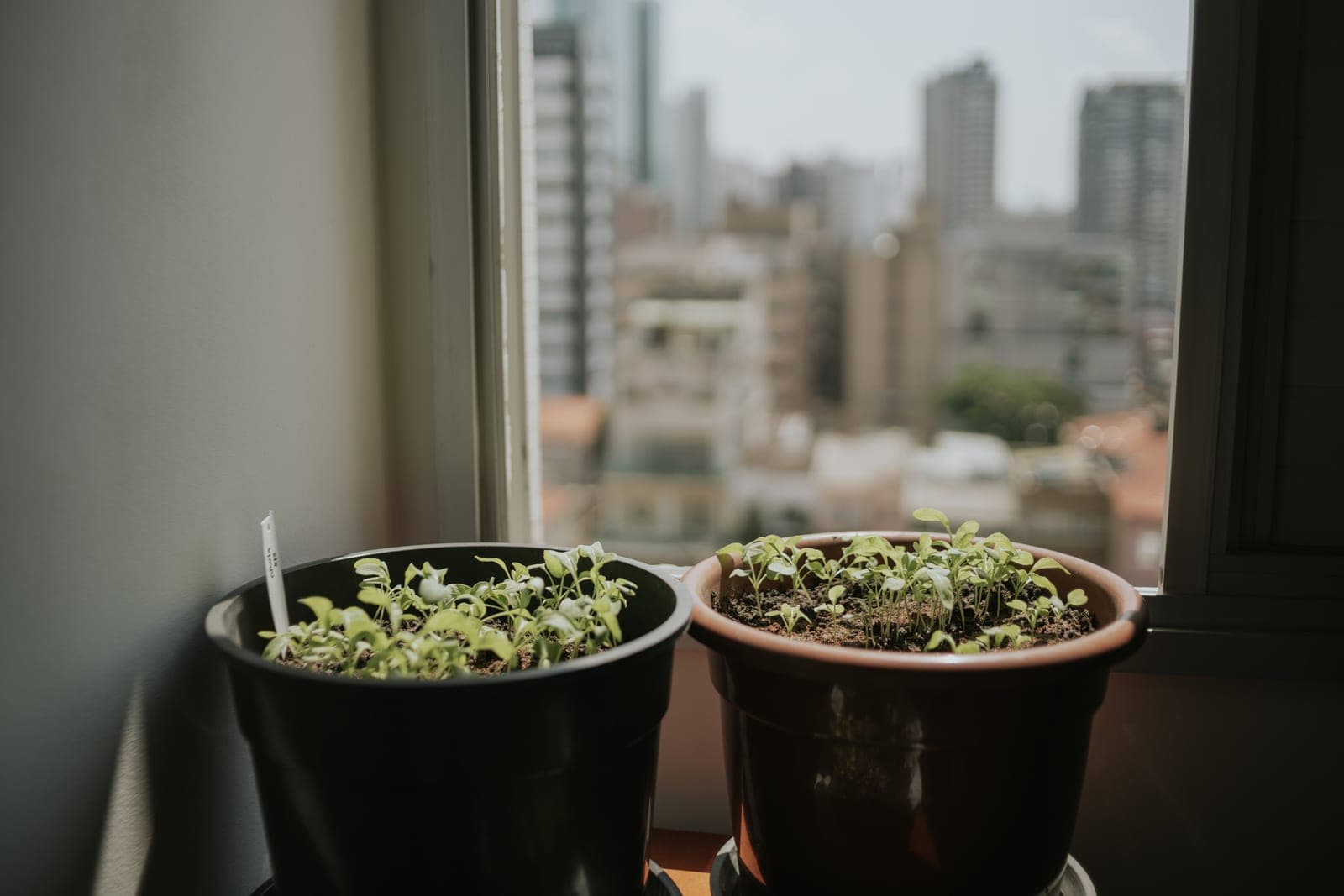
Photographs on this site are licensed stock and are illustrative of the fixture type. We do not own the units we write about.
How this page is funded: the buy links here are Amazon Associates links, and we earn a commission on qualifying purchases at no extra cost to you. We have not been paid to feature anything on this page, we accept no free product, and commission plays no part in the ranking. Full disclosure.
We have not tested these units. Everything below comes from the manufacturer’s own published specifications, or from arithmetic we have shown our working for. Where a figure is not published, we say so instead of estimating one. Read the method.
Quick picks
Efficacy is photons out per joule in. Where a manufacturer publishes it we quote theirs; where they publish photon output and wattage but not efficacy, we divide and label it as ours; where they publish neither, the cell says so rather than guessing. Tap a row for the full write-up.
| # | Product | Best for | Efficacy | Price |
|---|---|---|---|---|
| 1 | 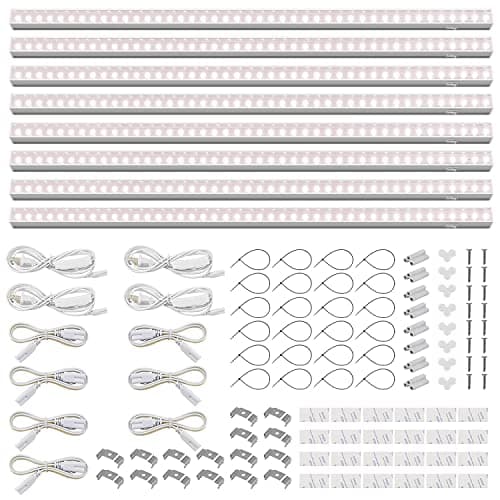 Barrina T5 4ft Grow Light Strips The default seed-starting bar for good reasons — 4 ft long, linkable in series, cheap per foot — and the reason we built a coverage calculator, because Barrina publishes no photon data whatsoever. | A shelf of pots | Not published | |
| 2 | 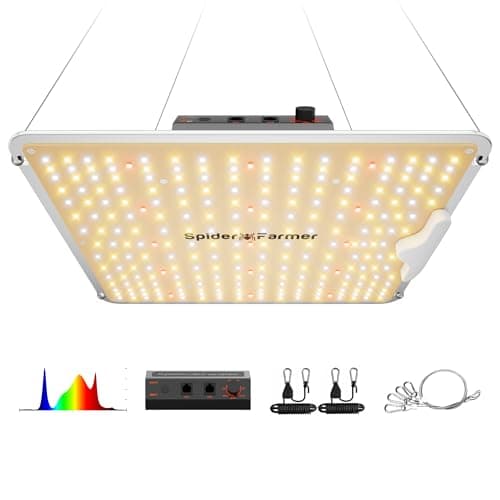 Spider Farmer SF1000 Publishes PPF to two decimal places and an efficacy figure that actually divides out of it. That internal consistency is rarer in this category than it should be. | A group under one panel | 2.5 umol/J | |
| 3 | 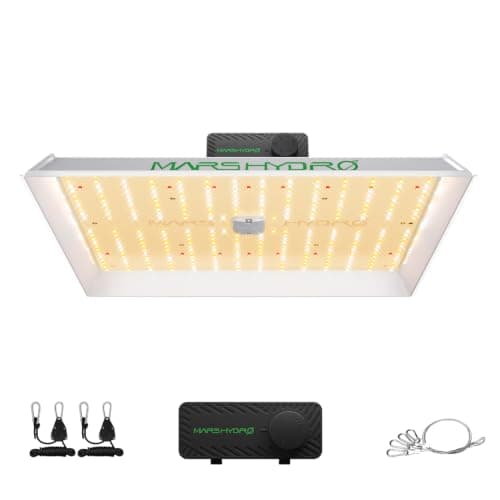 Mars Hydro TS 1000 The most photons of anything on this list, and one of only three fixtures here that publishes both PPF and efficacy so the claim can be checked against itself. | Citrus and big pots | 2.3 umol/J | |
| 4 | 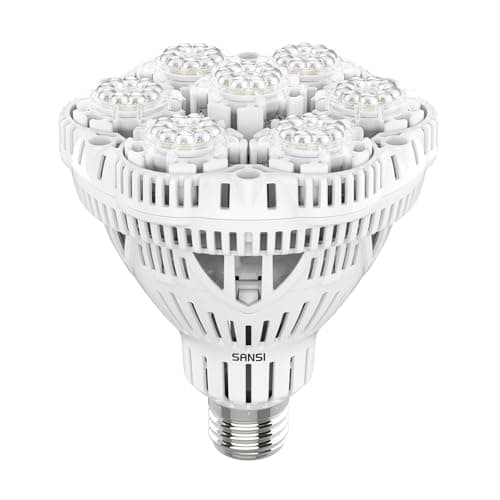 SANSI 36W BR30 Grow Light Bulb The rare grow bulb that publishes both PPF and a PPFD figure with the measurement distance attached, which is the only reason it can be sized honestly. | One prized plant | 1.82 umol/J (ours) |
The reasoning
Overwintering is not the same problem as growing indoors, and most grow-light advice treats it as though it were. When you bring a geranium, a pepper plant, a rosemary or a potted citrus inside in October, the goal is not to make it thrive. It is to make it survive until May, in reasonable shape, without taking over the house. That changes what “enough light” means — and for some plants, it changes the answer to “do I need a light at all” to no.
How we judged these
Before ranking a single fixture, the criteria — because the right fixture depends entirely on which strategy you are running:
- Which overwintering strategy does the plant want? Active (kept growing, needs light) or dormant (kept cool and dim, needs almost none). This decides whether you buy anything.
- Does the fixture suit a crowd of mismatched pots? Overwintered plants are different heights and sizes on one shelf or one floor — coverage shape matters more than peak output.
- Can it be sized in advance? Published photon output lets you compute what a group will get.
- What does five months cost? This is a seasonal purchase, so we price the season, not the month.
Active or dormant? The decision that comes first
| Plant | Strategy | Light | Why |
|---|---|---|---|
| Citrus (lemon, lime, kumquat) | Active | Yes — high | Evergreen; drops leaves in low light. Wants the high band |
| Peppers and chilies (kept as perennials) | Active, pruned back | Yes — medium | Cut back hard, they hold in the medium band and restart in spring |
| Rosemary, bay, other woody herbs | Active | Yes — medium to high | Evergreen and light-hungry; the classic winter casualty on a dim sill |
| Geraniums (pelargoniums) | Either | Optional | Grow on under medium light, or store cool and nearly dark as bare-root cuttings |
| Hibiscus, tropical flowering shrubs | Active, reduced | Yes — medium | Will hold foliage under a fixture; drop it in a dark corner |
| Fuchsias | Dormant | Minimal | Cut back and keep cool; light mostly wakes them too early |
| Dahlias, cannas, tender bulbs | Dormant | None | Lifted and stored dry. A grow light is the wrong tool entirely |
| Fig trees (deciduous) | Dormant | None | Leafless and cold is what they want. Light and warmth break dormancy |
Dahlias, deciduous figs and most fuchsias overwinter best dormant, cool and dark. A fixture over them is money spent to make the plant do the wrong thing.
That table is the most useful thing on this page. If your plant is in the dormant rows, stop here and put it in a cool garage. Everything below is for the active rows.
The active target is lower than you think
A plant being held, not grown, does not need the level it wanted in July. It needs enough to keep its leaves and not stretch. For most active-overwintered plants that is the medium band — University of Minnesota Extension’s 150 to 250 µmol/m²/s — with citrus and woody herbs at the top of it or into the high band.
Area = 8 sq ft ÷ 10.7639 = 0.743 m².
Target 200 µmol/m²/s: 200 × 0.743 ÷ 0.8 = 186 µmol/s.
Under a single Spider Farmer SF1000 (249.21 µmol/s published): 249.21 ÷ 0.743 × 0.8 = 268 µmol/m²/s — the top of the medium band, with headroom to dim.
The picks
1. Barrina T5 4ft strips — for a shelf of mismatched pots
Overwintered plants are usually crammed onto a shelf or a bench, at different heights, and a 4 ft strip runs the length of that bench rather than lighting a square in the middle of it. Link up to 8 on one plug, 20 W each, and run two per shelf.
The con: Barrina publishes no photon flux, no light density and no efficiency figure for any strip. We checked. You cannot compute what a shelf receives; you judge by whether the rosemary holds its leaves.
2. Spider Farmer SF1000 — for a group under one panel
Publishes 249.21 µmol/s and 2.5 µmol/J that confirm each other (249.21 ÷ 100 W = 2.49), and a 3 × 3 ft maximum footprint. Over a cluster of pots on the floor it delivers roughly 238 µmol/m²/s at that footprint — the medium band, which is the holding target.
The con: square, so a long bench is better served by strips; and no PPFD published at any stated distance.
3. Mars Hydro TS 1000 — for citrus and big pots
The most photons we cover at 343 µmol/s. A potted lemon or a mature hibiscus is a canopy, and this is the fixture with enough output to hold one through winter — about 328 µmol/m²/s over a 3 × 3 ft canopy.
The con: 150 W is the highest draw here, which over a season adds up (below), and it publishes no PPFD at distance.
4. SANSI 36W BR30 — for one prized plant
The rosemary you have kept for five years, or the one pepper worth saving. A bulb in a lamp you own, placeable by arithmetic from its published 265.58 µmol/m²/s at 1 ft — 14 inches for the medium band.
The con: 1.82 µmol/J is a third less efficient than a panel, and it lights one plant.
What the season costs
Two strips (40 W): 0.48 kWh a day × 182 = 87.4 kWh = $16.03.
SF1000 (100 W): 1.2 kWh a day × 182 = 218.4 kWh = $40.05.
TS 1000 (150 W): 1.8 kWh a day × 182 = 327.6 kWh = $60.08.
One bulb (36 W): 0.432 kWh a day × 182 = 78.6 kWh = $14.42.
All at the US residential average of 18.34 cents per kWh. Compare each against the cost of replacing the plants in spring.
Every one of those is a seasonal figure — you unplug it in April. The full seasonal table is in the cost to run a grow light all winter.
Practical overwintering under a fixture
- Cut back before you bring it in. Less leaf area means less light needed to support it — and less to fit under the fixture.
- Check for pests at the door. Aphids and whitefly come inside with the plant and thrive under a warm fixture.
- Run 12 hours, not 16. You are holding, not pushing. Iowa State University Extension’s 12-to-14 general guidance fits; the seedling-style 16 does not.
- Keep it cool. A cooler room slows growth and reduces how much light the plant needs. A warm room under a bright fixture means a plant that thinks it is June.
- Water less. Held plants use little. The fixture dries the pot faster than the plant drinks.
The honest verdict
First decide whether the plant wants light at all — three of the eight in our table are better off dark. For the active ones, a pair of strips over a shelf or one panel over a cluster on the floor holds most things through winter for $16 to $40 a season. Citrus and big canopies need the larger panel. And one prized plant needs only a bulb at 14 inches.
Every pick in full
Barrina T5 4ft Grow Light Strips
LED barA shelf of pots
The default seed-starting bar for good reasons — 4 ft long, linkable in series, cheap per foot — and the reason we built a coverage calculator, because Barrina publishes no photon data whatsoever.
What Barrina publishes
- Power draw
- 20 W per fixture; an 8-pack draws 160 W (source)
- Spectrum
- 5000 K (source)
- Dimming
- No; on/off switch per fixture, linkable up to 8 in series (source)
- Dimensions
- 4 ft strip, 120-degree beam angle, 120 V AC (source)
What Barrina does not publish
- PPF in umol/s — for any strip in the range
- PPFD at any stated distance
- Photon efficacy in umol/J
- LED count per strip, and rated lifespan
Who should skip it
Skip it if you need to know what you are getting before it arrives. There is no published PPF, no PPFD and no efficacy figure, so nothing about its output can be verified in advance.
Spider Farmer SF1000
LED panelA group under one panel
Publishes PPF to two decimal places and an efficacy figure that actually divides out of it. That internal consistency is rarer in this category than it should be.
What Spider Farmer publishes
- Power draw
- 100 W +/-5% at 100-277 V AC (source)
- PPF (photon output)
- 249.21 umol/s (source)
- Efficacy
- 2.5 umol/J (source)
- Stated coverage
- 2 x 2 ft core, 3 x 3 ft maximum (source)
- Spectrum
- 650-665 nm, 730-740 nm, 2800-3000 K, 4800-5000 K (source)
- Diodes
- Bridgelux (source)
- Dimming
- Yes, dimming knob (source)
- Dimensions
- 32.5 x 29.0 x 5.9 cm (source)
- Rated life
- 55,000 hours (source)
Our arithmetic
- Does the published efficacy check out against the published PPF?: Yes — 2.49 umol/J computed against 2.5 umol/J published
249.21 umol/s / 100 W = 2.4921 umol/J. The published 2.5 umol/J is that number rounded. Not every brand's two figures agree like this, which is exactly why we divide them. - Average PPFD across its 2 x 2 ft core footprint: about 536 umol/m2/s
2 ft x 2 ft = 4 sq ft = 0.372 m2. 249.21 / 0.372 = 670 umol/m2/s at perfect uniformity; at a 0.8 uniformity factor, about 536 umol/m2/s.
Who should skip it
Skip it if raw output is what you are buying — the TS 1000 delivers 38% more photons per second, at the cost of 50 W more draw.
Mars Hydro TS 1000
LED panelCitrus and big pots
The most photons of anything on this list, and one of only three fixtures here that publishes both PPF and efficacy so the claim can be checked against itself.
What Mars Hydro publishes
- Power draw
- 150 W +/-5% at 100-277 V AC (source)
- PPF (photon output)
- 343 umol/s (source)
- Efficacy
- 2.3 umol/J (source)
- Stated coverage
- 2.5 x 2.5 ft vegetative, 2.3 x 2.3 ft flowering (source)
- Spectrum
- 660-665 nm, 730-740 nm, 3000 K, 5000 K (source)
- Diodes
- Bridgelux (source)
- Dimming
- Yes, 0-100% dimmer knob (source)
- Dimensions
- 406 x 326 x 50 mm (source)
Our arithmetic
- Average PPFD across its stated 2.5 x 2.5 ft vegetative footprint: about 470 umol/m2/s
2.5 ft x 2.5 ft = 6.25 sq ft = 0.581 m2. 343 umol/s divided by 0.581 m2 = 590 umol/m2/s at perfect uniformity; applying a 0.8 uniformity factor gives about 472 umol/m2/s average. - Electricity used at 14 hours a day for 30 days: 63.0 kWh a month
150 W x 14 h x 30 d / 1000 = 63.0 kWh.
Who should skip it
Skip it if you are lighting a bookshelf. 343 umol/s concentrated into a 2.5 ft square is far more light than a monstera wants, and you pay 150 W to deliver it.
SANSI 36W BR30 Grow Light Bulb
Grow bulbOne prized plant
The rare grow bulb that publishes both PPF and a PPFD figure with the measurement distance attached, which is the only reason it can be sized honestly.
What SANSI publishes
- Power draw
- 36 W (source)
- PPF (photon output)
- 65.6 umol/s (source)
- PPFD
- 265.58 umol/m2/s at 1 ft (source)
- Spectrum
- 4000 K, 400-780 nm, CRI close to 100 (source)
- Rated life
- 25,000 hours (source)
Our arithmetic
- Efficacy, computed from the published figures: 1.82 umol/J
65.6 umol/s / 36 W = 1.82 umol/J. That is roughly a third less efficient than the panels on this page — the price of a screw-in form factor. - Electricity used at 12 hours a day for 30 days: 12.96 kWh a month
36 W x 12 h x 30 d / 1000 = 12.96 kWh.
What SANSI does not publish
- Beam angle
- Fixture dimensions
Who should skip it
Skip it if you are lighting more than one plant. 65.6 umol/s is a small amount of light spread over a cone — it lights a single specimen, not a shelf.
Questions people actually ask
+Do overwintering plants need a grow light?
+How much light do overwintered plants need?
+What is the best grow light for overwintering geraniums?
+Can I overwinter a lemon tree indoors with a grow light?
+Have you overwintered plants under these lights?
Sources
- University of Minnesota Extension — Lighting for indoor plants and starting seeds — consulted September 2, 2026
- Iowa State University Extension — Important Considerations for Providing Supplemental Light to Indoor Plants — consulted September 2, 2026
- Barrina — T5 ML20 4ft 20W product page — consulted September 2, 2026
- Spider Farmer — SF1000 published specification table — consulted September 2, 2026
- Mars Hydro — TS 1000 published specification table — consulted September 2, 2026
- SANSI — BR30 36W grow light bulb product page — consulted September 2, 2026
- US Energy Information Administration — Electric Power Monthly, Table 5.3 (US residential average, June 2026) — consulted September 2, 2026
Read next
Houseplants
The Best Grow Lights for Winter
Winter is a daily-total problem. Modest fixture, long photoperiod — sized against published targets and costed for the season.
Top pick
Barrina T5 4ft Grow Light Strips
Houseplants
Grow Lights for Lemon Trees
What indoor citrus actually demands, what one fixture delivers, and the honest shortfall.
Top pick
Mars Hydro TS 1000
Running Cost
The Cost to Run a Grow Light All Winter
Five setups priced for a full winter season, from a clip light to a three-shelf rack.
Top pick
Barrina T5 4ft Grow Light Strips
Coverage & Sizing
The Best Grow Lights for a Shelf or Rack
Picks chosen on footprint match first, because a square panel over a long shelf wastes its edges.
Top pick
Barrina T5 4ft Grow Light Strips
Where this sits
This page belongs to Grow Lights for Houseplants and Winter. Every figure on it is either quoted from a named published source or derived in view — the full method is on our methodology page, and how the site is funded is on the affiliate disclosure.