The Best Grow Lights
The main list. Ranked on published photon data where it exists, and explicit about the three fixtures where it does not exist at all.
By Scooter M. — An enthusiast who's genuinely into this. I read the manuals, compile the published specs, and do the math. No lab coat.
Published · How we pick
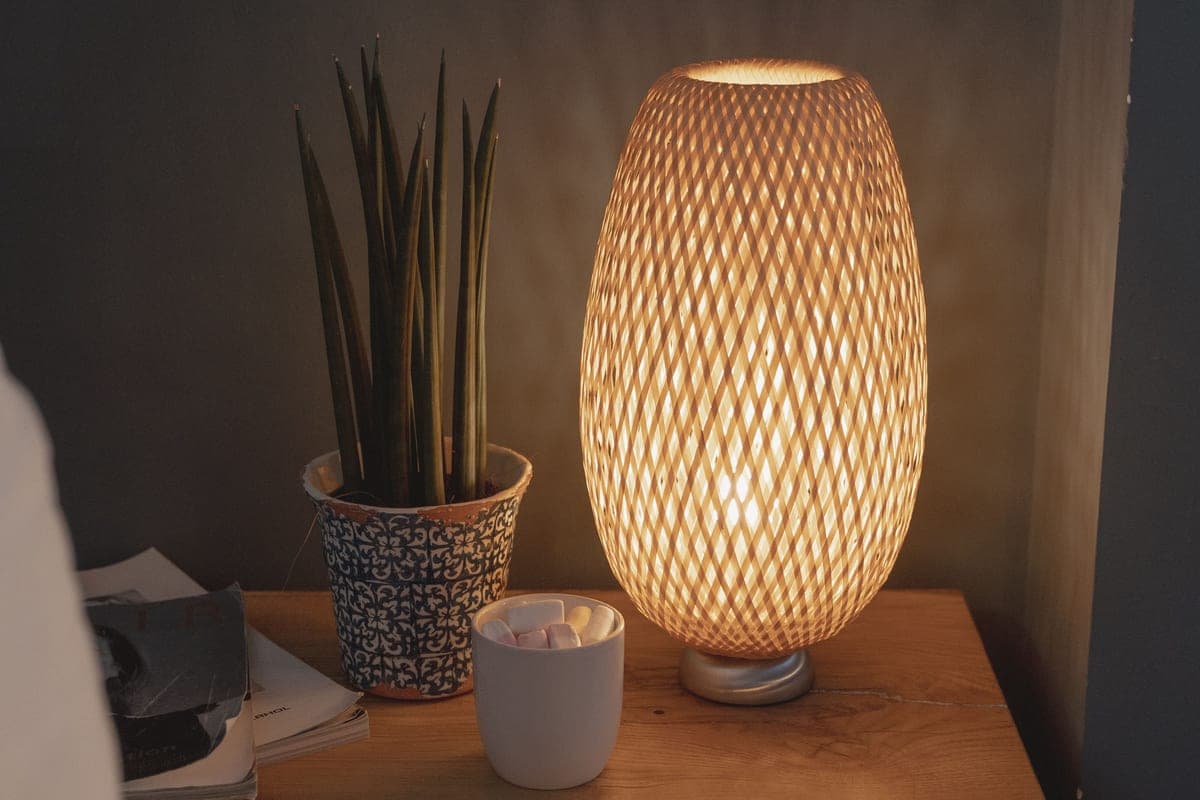
Photographs on this site are licensed stock and are illustrative of the fixture type. We do not own the units we write about.
How this page is funded: the buy links here are Amazon Associates links, and we earn a commission on qualifying purchases at no extra cost to you. We have not been paid to feature anything on this page, we accept no free product, and commission plays no part in the ranking. Full disclosure.
We have not tested these units. Everything below comes from the manufacturer’s own published specifications, or from arithmetic we have shown our working for. Where a figure is not published, we say so instead of estimating one. Read the method.
Quick picks
Efficacy is photons out per joule in. Where a manufacturer publishes it we quote theirs; where they publish photon output and wattage but not efficacy, we divide and label it as ours; where they publish neither, the cell says so rather than guessing. Tap a row for the full write-up.
| # | Product | Best for | Efficacy | Price |
|---|---|---|---|---|
| 1 | 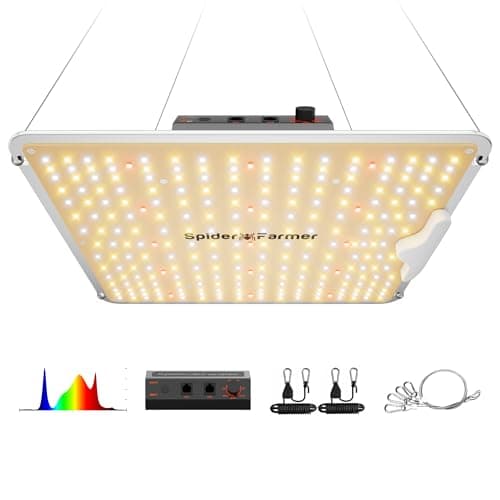 Spider Farmer SF1000 Publishes PPF to two decimal places and an efficacy figure that actually divides out of it. That internal consistency is rarer in this category than it should be. | The one to buy first | 2.5 umol/J | |
| 2 | 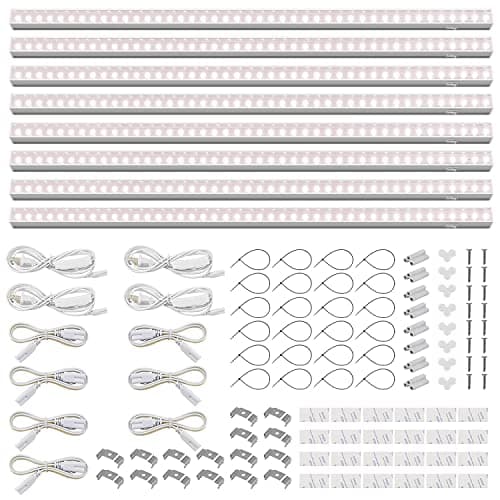 Barrina T5 4ft Grow Light Strips The default seed-starting bar for good reasons — 4 ft long, linkable in series, cheap per foot — and the reason we built a coverage calculator, because Barrina publishes no photon data whatsoever. | Shelves and seed trays | Not published | |
| 3 | 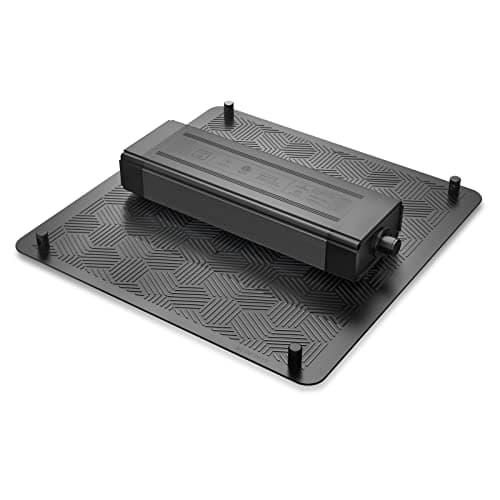 AC Infinity IONBOARD S22 The highest published efficacy of any fixture here at 2.7 umol/J, on Samsung LM301H diodes, with dimming in real 20% steps rather than a vague knob. | Lowest cost per photon | 2.7 umol/J | |
| 4 | 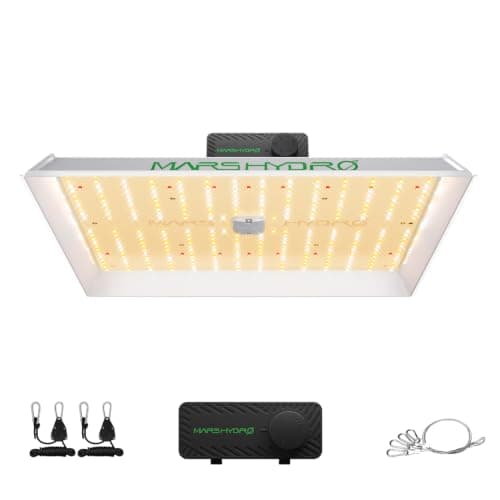 Mars Hydro TS 1000 The most photons of anything on this list, and one of only three fixtures here that publishes both PPF and efficacy so the claim can be checked against itself. | Largest areas | 2.3 umol/J | |
| 5 | 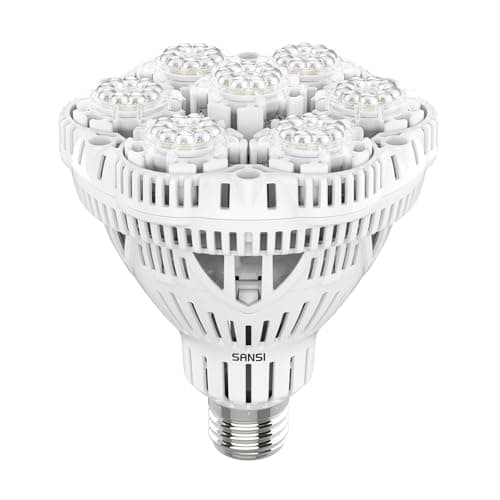 SANSI 36W BR30 Grow Light Bulb The rare grow bulb that publishes both PPF and a PPFD figure with the measurement distance attached, which is the only reason it can be sized honestly. | One plant, one lamp | 1.82 umol/J (ours) | |
| 6 | 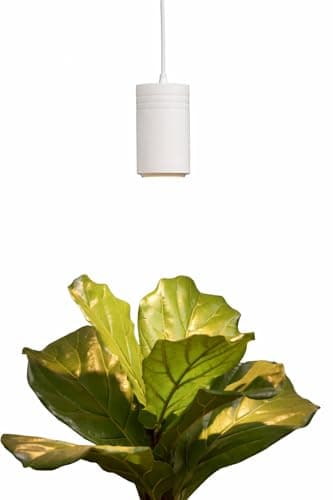 Soltech Aspect Gen 2 The only fixture here you would willingly hang in a living room, and the only one publishing PPFD at three separate distances so it can actually be placed by the numbers. | A room you sit in | 1.39 umol/J (ours) |
The reasoning
This is the site’s main list, and it is built on a rule that disqualifies a lot of popular advice: we rank on figures the manufacturer published, and where a manufacturer published nothing we say so rather than filling the gap.
We have not tested any of these fixtures. We have not owned one, plugged one in, or measured anything. What we did was read every spec sheet, divide the numbers against each other, compute coverage and running cost, and note every place the data runs out. That is a different exercise from a hands-on review and we would rather do it honestly than pretend to a lab we do not have.
Three publish neither PPF, PPFD nor efficacy — and two of those three are among the best-selling grow lights in their categories.
How the ranking works
- Does it match the shape of what you are lighting? Geometry beats specification. A square panel over a long shelf wastes more light than any efficacy difference recovers.
- Can its output be verified? A published PPF lets you compute coverage before you buy. Six of these nine give you one; three do not.
- What does it cost per photon? Efficacy across this field runs 1.39 to 2.75 µmol/J, which is close to a factor of two on your electricity bill.
The whole field, on one screen
| Fixture | Form | Power | PPF (µmol/s) | Efficacy (µmol/J) |
|---|---|---|---|---|
| Mars Hydro TS 1000 | Panel | 150 W | 343 published | 2.3 published |
| Spider Farmer SF1000 | Panel | 100 W | 249.21 published | 2.5 published |
| AC Infinity IONBOARD S22 | Board | 115 W | ~311 derived | 2.7 published |
| VIVOSUN VS1000 | Panel | 100 W | ~275 derived | 2.75 published |
| ViparSpectra P1000 | Panel | 100 W | Not published | Not published |
| SANSI 36W BR30 | Bulb | 36 W | 65.6 published | 1.82 derived |
| Soltech Aspect Gen 2 | Pendant | 36 W | 50 published | 1.39 derived |
| Barrina T5 4ft | Bar | 20 W each | Not published | Not published |
| GooingTop clip | Clip | ~10 W | Not published | Not published |
Why the SF1000 is first
Not because it is the brightest — the TS 1000 publishes 38% more photons. Not because it is the most efficient — VIVOSUN and AC Infinity both claim higher. It is first because it is the only fixture here whose two headline claims can be checked against each other and survive:
Published: 249.21 µmol/s and 2.5 µmol/J at 100 W.
249.21 ÷ 100 = 2.49 µmol/J, which is the published 2.5.
And over its stated 3 × 3 ft maximum footprint: 249.21 ÷ 0.836 × 0.8 = 238 µmol/m²/s, which at 14 hours gives a daily light integral of 12.0 mol/m²/day — the published seedling target almost exactly.
Three published numbers that agree with each other and land on an independently published target. That is as good as disclosure gets in this category.
Why Barrina is second with no data at all
Because shape decides more outcomes than specification does, and a 4 ft strip over a 4 ft shelf is the right shape. Barrina publishes no PPF, no PPFD and no efficacy for any strip in the range — we checked the product page directly — so we cannot size it, compare it, or tell you what it delivers.
We still recommend it for shelves and seed trays, because the geometry argument is strong enough to survive the missing data and because the price per linear foot is unmatched. But it is a purchase made on form factor rather than on numbers, and that distinction should be conscious. The full reasoning is in the Barrina T5 write-up.
Pick by situation, not by rank
| What you are lighting | Buy | Why |
|---|---|---|
| A 4 ft shelf or a rack of seed trays | Linked 4 ft bars | Correct shape, cheapest per foot, one plug for the whole rack |
| A 2 × 2 to 3 × 3 ft block of plants | Spider Farmer SF1000 | The output can be verified and it lands on the seedling target |
| A 2 × 4 ft area or larger | Mars Hydro TS 1000 | 343 µmol/s is the most photons here, and the figures check out |
| A shelf you run for months | AC Infinity IONBOARD S22 | 2.7 µmol/J on a named diode; repeatable step dimming |
| One plant beside a lamp | SANSI 36W BR30 | PPFD published at a stated distance, so you can place it on paper |
| A specimen plant in a living room | Soltech Aspect Gen 2 | The only one you would willingly hang where people sit |
| One plant, no socket, no shelf | GooingTop clip light | About $4 of electricity for the whole winter, and a timer built in |
What this list deliberately does not tell you
Which one is “best” in the abstract. That question has no answer without knowing the shape of your space, the plants in it, and how long you intend to run the light. What we have done instead is give you the arithmetic to answer it yourself:
- The coverage calculator turns a photon figure and your area into a light level.
- PPFD targets by plant type tells you what light level you are aiming for.
- The running-cost calculator prices whichever answer you land on.
Every pick in full
Spider Farmer SF1000
LED panelThe one to buy first
Publishes PPF to two decimal places and an efficacy figure that actually divides out of it. That internal consistency is rarer in this category than it should be.
What Spider Farmer publishes
- Power draw
- 100 W +/-5% at 100-277 V AC (source)
- PPF (photon output)
- 249.21 umol/s (source)
- Efficacy
- 2.5 umol/J (source)
- Stated coverage
- 2 x 2 ft core, 3 x 3 ft maximum (source)
- Spectrum
- 650-665 nm, 730-740 nm, 2800-3000 K, 4800-5000 K (source)
- Diodes
- Bridgelux (source)
- Dimming
- Yes, dimming knob (source)
- Dimensions
- 32.5 x 29.0 x 5.9 cm (source)
- Rated life
- 55,000 hours (source)
Our arithmetic
- Does the published efficacy check out against the published PPF?: Yes — 2.49 umol/J computed against 2.5 umol/J published
249.21 umol/s / 100 W = 2.4921 umol/J. The published 2.5 umol/J is that number rounded. Not every brand's two figures agree like this, which is exactly why we divide them. - Average PPFD across its 2 x 2 ft core footprint: about 536 umol/m2/s
2 ft x 2 ft = 4 sq ft = 0.372 m2. 249.21 / 0.372 = 670 umol/m2/s at perfect uniformity; at a 0.8 uniformity factor, about 536 umol/m2/s.
Who should skip it
Skip it if raw output is what you are buying — the TS 1000 delivers 38% more photons per second, at the cost of 50 W more draw.
Barrina T5 4ft Grow Light Strips
LED barShelves and seed trays
The default seed-starting bar for good reasons — 4 ft long, linkable in series, cheap per foot — and the reason we built a coverage calculator, because Barrina publishes no photon data whatsoever.
What Barrina publishes
- Power draw
- 20 W per fixture; an 8-pack draws 160 W (source)
- Spectrum
- 5000 K (source)
- Dimming
- No; on/off switch per fixture, linkable up to 8 in series (source)
- Dimensions
- 4 ft strip, 120-degree beam angle, 120 V AC (source)
What Barrina does not publish
- PPF in umol/s — for any strip in the range
- PPFD at any stated distance
- Photon efficacy in umol/J
- LED count per strip, and rated lifespan
Who should skip it
Skip it if you need to know what you are getting before it arrives. There is no published PPF, no PPFD and no efficacy figure, so nothing about its output can be verified in advance.
AC Infinity IONBOARD S22
LED panelLowest cost per photon
The highest published efficacy of any fixture here at 2.7 umol/J, on Samsung LM301H diodes, with dimming in real 20% steps rather than a vague knob.
What AC Infinity publishes
- Power draw
- 115 W (source)
- Efficacy
- 2.7 umol/J (source)
- PPFD
- 1098 PPFD (no measurement distance published) (source)
- Stated coverage
- 2 x 2 ft (source)
- Spectrum
- Samsung LM301H, plus 660 nm, 730 nm, 3000 K, 6500 K (source)
- Diodes
- 272 diodes (source)
- Dimming
- Yes, 0-100% in 20% increments (source)
- Dimensions
- 30.0 x 30.0 cm board, 1.1 cm thick (source)
- Rated life
- 50,000 hours (source)
Our arithmetic
- Photon output implied by the published wattage and efficacy: about 311 umol/s
115 W x 2.7 umol/J = 310.5 umol/s. AC Infinity does not print PPF directly, so this is our arithmetic from two figures it does print.
What AC Infinity does not publish
- PPF in umol/s — only efficacy is given, so photon output has to be derived
- The measurement distance for the 1098 PPFD figure, without which the number cannot be compared to anything
Who should skip it
Skip it if you want to place it by the numbers. AC Infinity prints 1098 PPFD with no measurement distance attached, which makes that figure impossible to use or compare.
Mars Hydro TS 1000
LED panelLargest areas
The most photons of anything on this list, and one of only three fixtures here that publishes both PPF and efficacy so the claim can be checked against itself.
What Mars Hydro publishes
- Power draw
- 150 W +/-5% at 100-277 V AC (source)
- PPF (photon output)
- 343 umol/s (source)
- Efficacy
- 2.3 umol/J (source)
- Stated coverage
- 2.5 x 2.5 ft vegetative, 2.3 x 2.3 ft flowering (source)
- Spectrum
- 660-665 nm, 730-740 nm, 3000 K, 5000 K (source)
- Diodes
- Bridgelux (source)
- Dimming
- Yes, 0-100% dimmer knob (source)
- Dimensions
- 406 x 326 x 50 mm (source)
Our arithmetic
- Average PPFD across its stated 2.5 x 2.5 ft vegetative footprint: about 470 umol/m2/s
2.5 ft x 2.5 ft = 6.25 sq ft = 0.581 m2. 343 umol/s divided by 0.581 m2 = 590 umol/m2/s at perfect uniformity; applying a 0.8 uniformity factor gives about 472 umol/m2/s average. - Electricity used at 14 hours a day for 30 days: 63.0 kWh a month
150 W x 14 h x 30 d / 1000 = 63.0 kWh.
Who should skip it
Skip it if you are lighting a bookshelf. 343 umol/s concentrated into a 2.5 ft square is far more light than a monstera wants, and you pay 150 W to deliver it.
SANSI 36W BR30 Grow Light Bulb
Grow bulbOne plant, one lamp
The rare grow bulb that publishes both PPF and a PPFD figure with the measurement distance attached, which is the only reason it can be sized honestly.
What SANSI publishes
- Power draw
- 36 W (source)
- PPF (photon output)
- 65.6 umol/s (source)
- PPFD
- 265.58 umol/m2/s at 1 ft (source)
- Spectrum
- 4000 K, 400-780 nm, CRI close to 100 (source)
- Rated life
- 25,000 hours (source)
Our arithmetic
- Efficacy, computed from the published figures: 1.82 umol/J
65.6 umol/s / 36 W = 1.82 umol/J. That is roughly a third less efficient than the panels on this page — the price of a screw-in form factor. - Electricity used at 12 hours a day for 30 days: 12.96 kWh a month
36 W x 12 h x 30 d / 1000 = 12.96 kWh.
What SANSI does not publish
- Beam angle
- Fixture dimensions
Who should skip it
Skip it if you are lighting more than one plant. 65.6 umol/s is a small amount of light spread over a cone — it lights a single specimen, not a shelf.
Soltech Aspect Gen 2
PendantA room you sit in
The only fixture here you would willingly hang in a living room, and the only one publishing PPFD at three separate distances so it can actually be placed by the numbers.
What Soltech publishes
- Power draw
- 36 W (source)
- PPF (photon output)
- 50 umol/s (source)
- PPFD
- about 50 umol/m2/s at 1 m, 34.9 at 4 ft, 15.5 at 6 ft (source)
- Spectrum
- 3000 K warm white, CRI 98 (source)
- Dimming
- Yes, in-line dimmer 10-100% (source)
- Dimensions
- 3.5 x 3.5 x 6.2 inches (source)
- Rated life
- 50,000 hours (source)
Our arithmetic
- Efficacy, computed from the published figures: 1.39 umol/J
50 umol/s / 36 W = 1.39 umol/J. Roughly half the efficacy of a 2.7 umol/J board — the design premium is paid twice, once at purchase and again every month on the meter.
Who should skip it
Skip it if photons per watt is the metric that matters. At 50 umol/s from 36 W it is the least efficient fixture on this page, and much of the price is industrial design.
Questions people actually ask
+What is the best grow light for indoor plants?
+Have you tested these grow lights?
+Why do you recommend a light with no published specs?
+How much should I spend on a grow light?
Sources
- Spider Farmer — SF1000 published specification table — consulted September 2, 2026
- Mars Hydro — TS 1000 published specification table — consulted September 2, 2026
- AC Infinity — IONBOARD S22 published specifications — consulted September 2, 2026
- VIVOSUN — VS1000 product page — consulted September 2, 2026
- ViparSpectra — P1000 product page — consulted September 2, 2026
- SANSI — BR30 36W grow light bulb product page — consulted September 2, 2026
- Soltech — Aspect Gen 2 published specifications — consulted September 2, 2026
- Barrina — T5 ML20 4ft 20W product page — consulted September 2, 2026
- GooingTop clip grow light — retail listing specifications (no manufacturer spec sheet published) — consulted September 2, 2026
- University of New Hampshire Extension — Growing Seedlings Under Lights — consulted September 2, 2026
- University of Minnesota Extension — Lighting for indoor plants and starting seeds — consulted September 2, 2026
Read next
Reviews
The Best Grow Lights for Beginners
Five first fixtures judged on forgiveness — computable, dimmable, cheap to run — with an honest con each.
Top pick
Spider Farmer SF1000
Reviews
Are LED Grow Lights Worth It?
Do they work, what do they cost, and when to skip one — answered with published figures.
Top pick
Spider Farmer SF1000
Reviews
The Best LED Grow Light Panels
The 100 W panel class compared on published output, efficacy and internal consistency.
Top pick
Spider Farmer SF1000
Reviews
The Best Grow Light Bars
Linear fixtures for shelves and trays, and the disclosure gap running through the category.
Top pick
Barrina T5 4ft Grow Light Strips
Coverage & Sizing
What Size Grow Light Do I Need?
Size from area and target, not from watts. The sum, plus a lookup table by area.
Top pick
SANSI 36W BR30 Grow Light Bulb
Running Cost
The Most Efficient Grow Lights by µmol/J
Every fixture we cover ranked on published photon efficacy, with derivations shown.

Reviews
Best Grow Lights Under $50
What $50 buys: bulbs, not bars. Five picks ranked on published output, and the honest ceiling.
Top pick
SANSI 36W BR30 Grow Light Bulb
Where this sits
This page belongs to Fixture Reviews and Roundups. Every figure on it is either quoted from a named published source or derived in view — the full method is on our methodology page, and how the site is funded is on the affiliate disclosure.