Are LED Grow Lights Worth It?
Usually yes, for less money than people expect — but the honest answer depends on which of three questions you are actually asking.
By Scooter M. — An enthusiast who's genuinely into this. I read the manuals, compile the published specs, and do the math. No lab coat.
Published · How we pick
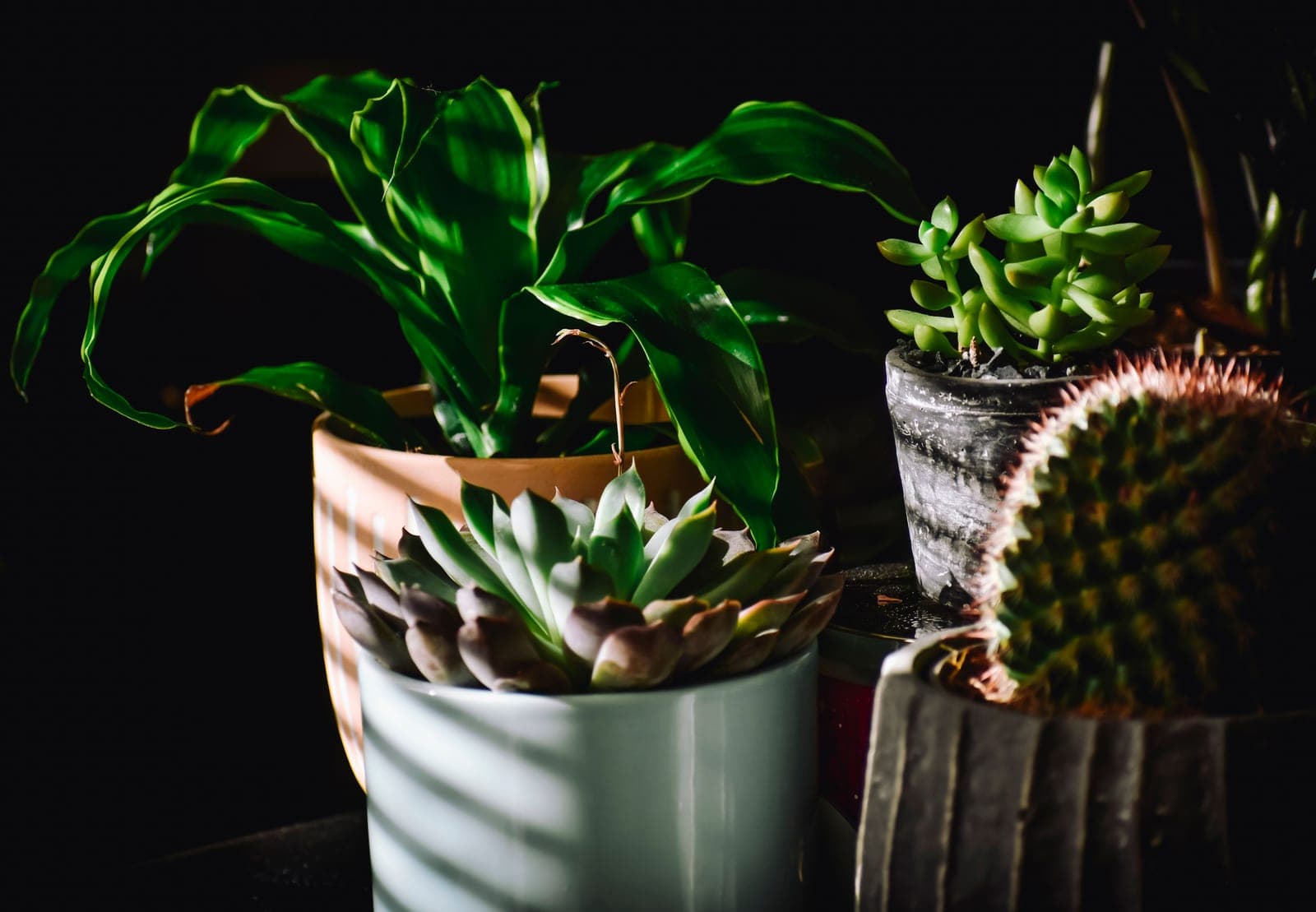
Photographs on this site are licensed stock and are illustrative of the fixture type. We do not own the units we write about.
How this page is funded: the buy links here are Amazon Associates links, and we earn a commission on qualifying purchases at no extra cost to you. We have not been paid to feature anything on this page, we accept no free product, and commission plays no part in the ranking. Full disclosure.
We have not tested these units. Everything below comes from the manufacturer’s own published specifications, or from arithmetic we have shown our working for. Where a figure is not published, we say so instead of estimating one. Read the method.
Quick picks
Efficacy is photons out per joule in. Where a manufacturer publishes it we quote theirs; where they publish photon output and wattage but not efficacy, we divide and label it as ours; where they publish neither, the cell says so rather than guessing. Tap a row for the full write-up.
| # | Product | Best for | Efficacy | Price |
|---|---|---|---|---|
| 1 | 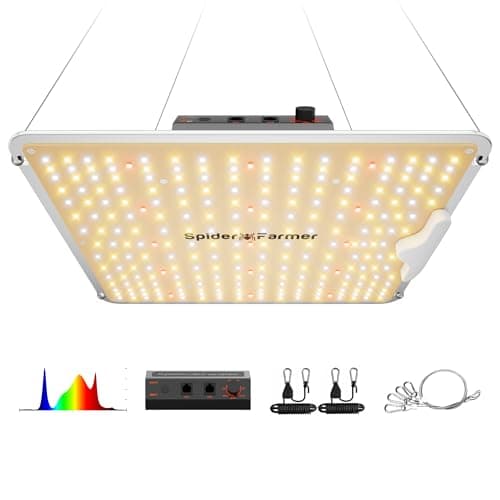 Spider Farmer SF1000 Publishes PPF to two decimal places and an efficacy figure that actually divides out of it. That internal consistency is rarer in this category than it should be. | Claims that check out | 2.5 umol/J | |
| 2 | 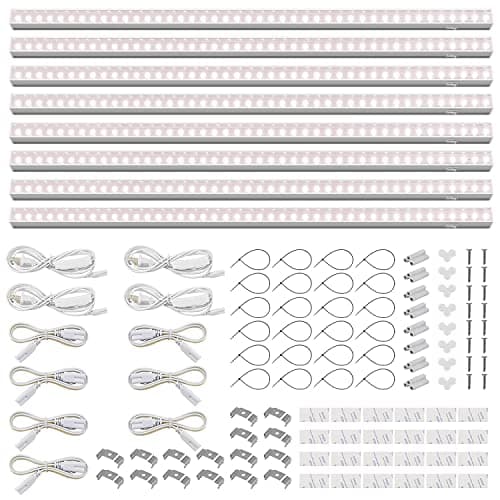 Barrina T5 4ft Grow Light Strips The default seed-starting bar for good reasons — 4 ft long, linkable in series, cheap per foot — and the reason we built a coverage calculator, because Barrina publishes no photon data whatsoever. | Cheapest per shelf-foot | Not published | |
| 3 | 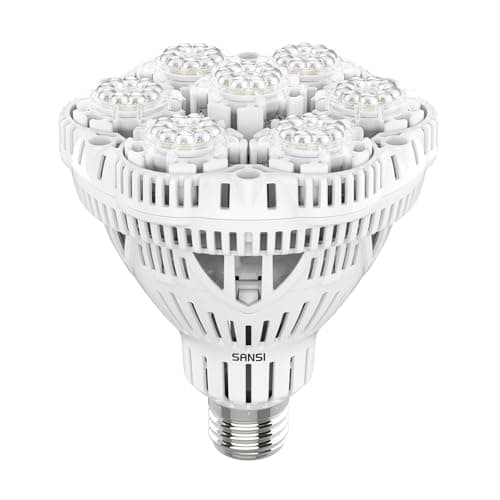 SANSI 36W BR30 Grow Light Bulb The rare grow bulb that publishes both PPF and a PPFD figure with the measurement distance attached, which is the only reason it can be sized honestly. | Lowest commitment | 1.82 umol/J (ours) | |
| 4 | 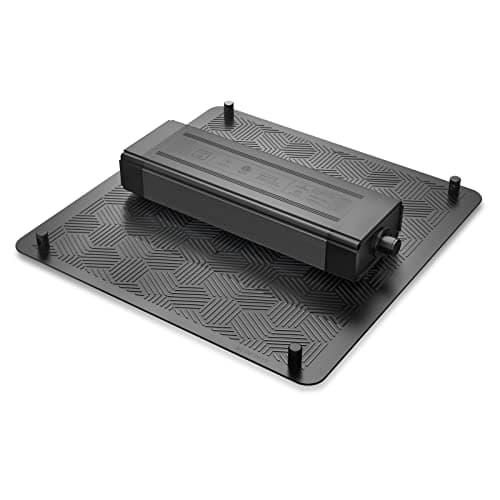 AC Infinity IONBOARD S22 The highest published efficacy of any fixture here at 2.7 umol/J, on Samsung LM301H diodes, with dimming in real 20% steps rather than a vague knob. | Long hours, months on end | 2.7 umol/J | |
| 5 | 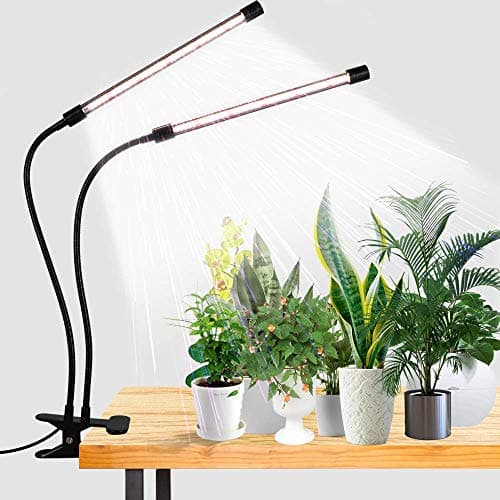 GooingTop Clip Grow Light The cheapest way to put real light on one plant on one desk, and honest about being exactly that — a 10 W clip lamp with a repeating timer. | Finding out if you care | Not published |
The reasoning
Three different questions hide behind this one phrase, and they have different answers. Sorting out which one you are asking is most of the work:
- Do they actually work? Yes, and this is not genuinely contested.
- Are they worth the money? Almost always, because the money involved is far smaller than people assume.
- Can I trust anyone telling me which to buy? This is the real problem, and it is the question this whole site exists for.
1. Do LED grow lights work?
Yes. The mechanism is not exotic: plants drive photosynthesis with photons roughly between 400 and 700 nanometers, and modern white LEDs produce those photons efficiently. There is no serious argument that supplemental light fails to grow plants indoors.
The one place there was a real debate — whether the magenta blue-plus-red arrays beat ordinary white light — has a published answer. A peer-reviewed comparison in PLOS ONE by Zhen, van Iersel and colleagues examined white LEDs against blue-plus-red radiation across plant growth, visual color quality and photosynthetic photon efficacy, and found white light performs comparably for growth while being far better for judging what you are looking at. So a good white fixture is not a compromise, which is convenient, because it is also the kind you can live with in a room.
Not the science. Whether LEDs grow plants is settled; whether a specific product delivers what its box implies is frequently unknowable, because three of the nine fixtures we cover publish no photon data at all.
That distinction matters more than anything else on this page. The technology works. Individual products may or may not do what their marketing implies, and the gap between those two statements is where people waste money.
2. The money question, with actual numbers
Running cost is the fear that stops most people, and it is consistently overestimated. It is also one of the few things in this category with an exact answer, because it is a multiplication.
Cost = kWh × your electricity rate
| Setup | Power | kWh/month | Cost/month |
|---|---|---|---|
| Clip light, one plant | about 10 W | 4.2 | $0.77 |
| Grow bulb, one specimen | 36 W | 15.1 | $2.77 |
| One 4 ft strip | 20 W | 8.4 | $1.54 |
| A 100 W panel over a shelf | 100 W | 42.0 | $7.70 |
| Three-shelf rack, six strips | 120 W | 50.4 | $9.25 |
| The largest fixture we cover | 150 W | 63.0 | $11.56 |
The entire realistic range for a home setup is roughly one to twelve dollars a month. That is the number people are worried about, and once it is on the page the worry usually resolves itself.
A 100 W grow light, 14 hours a day for 30 days: 42 kWh = $7.70.
A single 1500 W space heater, 6 hours a day for 30 days: 1500 × 6 × 30 ÷ 1000 = 270 kWh = $49.52.
The heater costs more than six times the grow light. If your winter bill jumped and you are blaming the plant shelf, the arithmetic says look elsewhere first.
The strongest value case is seed starting, where the output is something you would otherwise buy:
Three shelves, two 4 ft strips each = 120 W, run 16 hours a day for a ten-week season.
120 × 16 ÷ 1000 = 1.92 kWh a day × 70 days = 134.4 kWh.
At 18.34 cents per kWh: $24.65 for every transplant you put in the ground that year — roughly what one flat of nursery seedlings costs.
Run your own configuration through the running-cost calculator, or see the full seasonal breakdown in how much electricity grow lights use.
3. When a grow light is NOT worth it
A page like this is worthless if it only argues one way. Four situations where we would tell you not to bother:
- You have a genuinely bright window and it is not winter. From spring through autumn a good south-facing window covers most houseplants. The test is midwinter, not today — if a plant declines every January and recovers every April, that is light. If it looks fine year-round, you are solving a problem you do not have.
- The plant is low-light and already stable. A snake plant or pothos holding steady in a decent room does not need intervention. These tolerate low light genuinely well.
- You will not use a timer. Plants respond to a consistent photoperiod, and nobody is consistent by memory across a five-month winter. If the light will be switched on and off at random, most of the benefit evaporates.
- The problem is not light. Soft mushy stems, sudden leaf drop after a move, fungus gnats — none of these are light problems, and a fixture will not fix them. It may even mask overwatering by drying the pot faster.
The reverse test is simple and reliable: stretched growth with long gaps between leaves, pale small new leaves, or a plant leaning hard toward a window all mean too little light, and those are the cases where a fixture earns its money immediately.
4. The trust problem, which is the real question
People searching whether these are “any good” are usually not doubting physics. They are trying to work out who to believe. It is worth being direct about what the available sources do and do not give you.
| Source | Good for | Limitation |
|---|---|---|
| Retailer reviews | Whether the unit arrived working and survived a year | Nobody measures photon output in a review. 'Very bright' is not a specification |
| Forums and community threads | Real long-term ownership experience, and honest failure reports | Self-selected, rarely measured, and usually about a different setup from yours |
| Manufacturer spec sheets | The only published numbers that exist for most fixtures | Published by the seller; several brands publish nothing usable at all |
| Sites claiming hands-on testing | Genuinely valuable when the lab is real | Hard to verify from outside, and the claim is cheap to make |
| This site | Published specs compiled, divided against each other, arithmetic shown | We have tested nothing. Everything here is documents and math, and we say so |
Our own position belongs in that table rather than above it. We have not tested any fixture on this site. We have not owned one, plugged one in, or measured anything. What we do instead is compile every figure a manufacturer publishes, divide those figures against each other to see whether they agree, compute coverage and running cost with the working shown, and report what is missing.
That last part is the finding most worth carrying away. Of the nine fixtures we cover:
- Six publish some photon figure — enough to compute what they will deliver over your area.
- Three publish nothing usable — no photon flux, no light density, no efficiency figure. Two of those three are best-sellers.
- One publishes claims that confirm each other. Spider Farmer’s 249.21 µmol/s divided by its 100 W rating gives 2.49 µmol/J, matching its published 2.5. That internal consistency is rarer than it should be.
The full method, including the one assumption we make, is on our methodology page.
5. What to buy, by what you are actually doing
Ranked by how much of the decision you can make before spending anything. Every pick below has a real weakness stated with it.
Spider Farmer SF1000 — if you want the numbers to check out
Publishes 249.21 µmol/s, 100 W ±5%, 2.5 µmol/J and a 55,000-hour rated life. Over its stated 3 × 3 ft maximum footprint that computes to about 238 µmol/m²/s, which at 14 hours a day gives a daily light integral of 12.0 mol/m²/day — the seedling target published by University of New Hampshire Extension, almost exactly.
The con: the Mars Hydro TS 1000 publishes 38% more photons for 50 W more draw, so if you need to cover a genuinely large area this is not the most output available. It also publishes no PPFD at any stated distance, so you cannot place it by the numbers the way you can a bulb.
Barrina T5 4ft strips — if you are lighting a shelf
Geometry beats specification on a shelf. A 4 ft strip over a 4 ft shelf puts emitters along the shape you are actually lighting; a square panel lights the middle and misses the ends. They link up to 8 in series from one plug, draw 20 W each, and cost less per linear foot than anything else we cover.
The con, and it is a large one: Barrina publishes no photon flux, no light density and no efficiency figure for any strip in the range. We checked the product page directly. You cannot size these in advance, cannot compare them to a panel on output, and are buying on shape and price. That is a legitimate decision — it is our pick for shelves — but it should be a conscious one.
SANSI 36W BR30 — if you want the smallest possible commitment
A screw-in bulb for a lamp you already own, and the only fixture we cover that publishes a light-density figure with the distance it was measured at: 265.58 µmol/m²/s at 1 ft. That single detail means you can work out the lamp height on paper before buying — about 12 inches for a succulent, 18 for a pothos.
The con: 65.6 µmol/s from 36 W works out to 1.82 µmol/J, roughly a third less efficient than the panels. It also lights one plant. By the third or fourth bulb you have spent more than a panel would have cost and are running at two-thirds the efficiency.
AC Infinity IONBOARD S22 — if it runs long hours for months
The highest efficiency we can attribute to a named component: 2.7 µmol/J on Samsung LM301H diodes, dimming in stated 20% increments rather than an unmarked knob, passively cooled at 1.1 cm thick with no fan to fail.
The con: it publishes a light-density figure of 1098 with no measurement distance attached, which makes that particular number impossible to use or compare with anything. It also publishes no photon flux directly, so its ~311 µmol/s is our arithmetic from its wattage and efficiency, not its measurement.
GooingTop clip light — if you want to find out whether you care
About 10 W, clamps to anything, five brightness levels, a repeating timer built in, and roughly $4.00 of electricity across an entire October-to-March winter. As a way to test whether indoor growing is something you will stick with, the downside is close to zero.
The con: there is no manufacturer spec sheet at all. The figures we can report come from the retail listing, which is a materially weaker source, and nothing about its output can be computed or compared. It also lights one small plant and no more.
6. How to not waste the money
Most disappointment with grow lights is a setup problem rather than a product problem. Three things account for nearly all of it:
- Size it before you buy. A 2 × 3 ft area at a useful light level needs roughly 200 µmol/s — a 60 to 100 W fixture. If you are looking at listings claiming 1000 W, you are looking at either commercial equipment or an inflated diode-sum figure. Work yours out in the sizing guide.
- Hang it closer than feels right. Light density falls with roughly the square of distance, so doubling the height quarters the light. This is the single most common reason a perfectly good fixture underperforms.
- Put it on a timer. Twelve to sixteen hours, consistently. Iowa State University Extension suggests 12 to 14 hours generally with 10 as a floor and 16 as a ceiling; University of Minnesota Extension recommends 16 to 18 for seedlings. Hours are also the cheapest light you can buy — two extra hours a day on a 100 W fixture is about $5.50 across a whole winter.
The honest verdict
For anyone growing seedlings, keeping herbs alive indoors, or watching houseplants stall every winter, a grow light is worth it and costs less than the worry attached to it — typically a few dollars a month, and about $25 for an entire seed-starting season.
For someone with a bright window and a stable low-light plant in September, it is not worth it, and we would rather say so.
The part actually worth your attention is not whether to buy but which, and there the useful filter is disclosure: prefer a fixture that publishes enough for you to compute what it will deliver over your space. Six of the nine we cover do. Where you buy one that does not — and sometimes the right answer is exactly that — do it knowing that is the trade you are making.
Every pick in full
Spider Farmer SF1000
LED panelClaims that check out
Publishes PPF to two decimal places and an efficacy figure that actually divides out of it. That internal consistency is rarer in this category than it should be.
What Spider Farmer publishes
- Power draw
- 100 W +/-5% at 100-277 V AC (source)
- PPF (photon output)
- 249.21 umol/s (source)
- Efficacy
- 2.5 umol/J (source)
- Stated coverage
- 2 x 2 ft core, 3 x 3 ft maximum (source)
- Spectrum
- 650-665 nm, 730-740 nm, 2800-3000 K, 4800-5000 K (source)
- Diodes
- Bridgelux (source)
- Dimming
- Yes, dimming knob (source)
- Dimensions
- 32.5 x 29.0 x 5.9 cm (source)
- Rated life
- 55,000 hours (source)
Our arithmetic
- Does the published efficacy check out against the published PPF?: Yes — 2.49 umol/J computed against 2.5 umol/J published
249.21 umol/s / 100 W = 2.4921 umol/J. The published 2.5 umol/J is that number rounded. Not every brand's two figures agree like this, which is exactly why we divide them. - Average PPFD across its 2 x 2 ft core footprint: about 536 umol/m2/s
2 ft x 2 ft = 4 sq ft = 0.372 m2. 249.21 / 0.372 = 670 umol/m2/s at perfect uniformity; at a 0.8 uniformity factor, about 536 umol/m2/s.
Who should skip it
Skip it if raw output is what you are buying — the TS 1000 delivers 38% more photons per second, at the cost of 50 W more draw.
Barrina T5 4ft Grow Light Strips
LED barCheapest per shelf-foot
The default seed-starting bar for good reasons — 4 ft long, linkable in series, cheap per foot — and the reason we built a coverage calculator, because Barrina publishes no photon data whatsoever.
What Barrina publishes
- Power draw
- 20 W per fixture; an 8-pack draws 160 W (source)
- Spectrum
- 5000 K (source)
- Dimming
- No; on/off switch per fixture, linkable up to 8 in series (source)
- Dimensions
- 4 ft strip, 120-degree beam angle, 120 V AC (source)
What Barrina does not publish
- PPF in umol/s — for any strip in the range
- PPFD at any stated distance
- Photon efficacy in umol/J
- LED count per strip, and rated lifespan
Who should skip it
Skip it if you need to know what you are getting before it arrives. There is no published PPF, no PPFD and no efficacy figure, so nothing about its output can be verified in advance.
SANSI 36W BR30 Grow Light Bulb
Grow bulbLowest commitment
The rare grow bulb that publishes both PPF and a PPFD figure with the measurement distance attached, which is the only reason it can be sized honestly.
What SANSI publishes
- Power draw
- 36 W (source)
- PPF (photon output)
- 65.6 umol/s (source)
- PPFD
- 265.58 umol/m2/s at 1 ft (source)
- Spectrum
- 4000 K, 400-780 nm, CRI close to 100 (source)
- Rated life
- 25,000 hours (source)
Our arithmetic
- Efficacy, computed from the published figures: 1.82 umol/J
65.6 umol/s / 36 W = 1.82 umol/J. That is roughly a third less efficient than the panels on this page — the price of a screw-in form factor. - Electricity used at 12 hours a day for 30 days: 12.96 kWh a month
36 W x 12 h x 30 d / 1000 = 12.96 kWh.
What SANSI does not publish
- Beam angle
- Fixture dimensions
Who should skip it
Skip it if you are lighting more than one plant. 65.6 umol/s is a small amount of light spread over a cone — it lights a single specimen, not a shelf.
AC Infinity IONBOARD S22
LED panelLong hours, months on end
The highest published efficacy of any fixture here at 2.7 umol/J, on Samsung LM301H diodes, with dimming in real 20% steps rather than a vague knob.
What AC Infinity publishes
- Power draw
- 115 W (source)
- Efficacy
- 2.7 umol/J (source)
- PPFD
- 1098 PPFD (no measurement distance published) (source)
- Stated coverage
- 2 x 2 ft (source)
- Spectrum
- Samsung LM301H, plus 660 nm, 730 nm, 3000 K, 6500 K (source)
- Diodes
- 272 diodes (source)
- Dimming
- Yes, 0-100% in 20% increments (source)
- Dimensions
- 30.0 x 30.0 cm board, 1.1 cm thick (source)
- Rated life
- 50,000 hours (source)
Our arithmetic
- Photon output implied by the published wattage and efficacy: about 311 umol/s
115 W x 2.7 umol/J = 310.5 umol/s. AC Infinity does not print PPF directly, so this is our arithmetic from two figures it does print.
What AC Infinity does not publish
- PPF in umol/s — only efficacy is given, so photon output has to be derived
- The measurement distance for the 1098 PPFD figure, without which the number cannot be compared to anything
Who should skip it
Skip it if you want to place it by the numbers. AC Infinity prints 1098 PPFD with no measurement distance attached, which makes that figure impossible to use or compare.
GooingTop Clip Grow Light
Clip lightFinding out if you care
The cheapest way to put real light on one plant on one desk, and honest about being exactly that — a 10 W clip lamp with a repeating timer.
What GooingTop publishes
- Power draw
- About 10 W (source)
- Spectrum
- 6000 K, 74 white plus 10 red LEDs, CRI 95 (source)
- Dimming
- Five brightness levels; repeating 4 / 8 / 12 hour timer (source)
What GooingTop does not publish
- PPF in umol/s
- PPFD at any distance
- Photon efficacy in umol/J
- The manufacturer publishes no spec sheet at all; the figures above come from the retail listing
Who should skip it
Skip it if the plant is more than about a foot across, or if you want any number at all before you buy — nobody publishes photon data for this fixture.
Questions people actually ask
+Are LED grow lights actually effective?
+How much does it cost to run a grow light?
+When is a grow light not worth buying?
+Which grow light should I buy first?
+Can I trust grow light reviews online?
+Have you tested these grow lights?
Sources
- Zhen & van Iersel et al., PLOS ONE — Spectral effects of LEDs on plant growth, visual color quality and photosynthetic photon efficacy: white versus blue plus red radiation — consulted September 2, 2026
- University of Minnesota Extension — Lighting for indoor plants and starting seeds — consulted September 2, 2026
- Iowa State University Extension — Important Considerations for Providing Supplemental Light to Indoor Plants — consulted September 2, 2026
- University of New Hampshire Extension — Growing Seedlings Under Lights — consulted September 2, 2026
- Spider Farmer — SF1000 published specification table — consulted September 2, 2026
- Barrina — T5 ML20 4ft 20W product page — consulted September 2, 2026
- SANSI — BR30 36W grow light bulb product page — consulted September 2, 2026
- AC Infinity — IONBOARD S22 published specifications — consulted September 2, 2026
- GooingTop clip grow light — retail listing specifications (no manufacturer spec sheet published) — consulted September 2, 2026
- Mars Hydro — TS 1000 published specification table — consulted September 2, 2026
- US Energy Information Administration — Electric Power Monthly, Table 5.3 (US residential average, June 2026) — consulted September 2, 2026
Read next
Reviews
The Best Grow Lights for Beginners
Five first fixtures judged on forgiveness — computable, dimmable, cheap to run — with an honest con each.
Top pick
Spider Farmer SF1000
Reviews
The Best Grow Lights
The main ranking: nine fixtures sorted on published data, with every gap named.
Top pick
Spider Farmer SF1000
Running Cost
How Much Electricity Do Grow Lights Use?
Monthly kWh and cost per fixture, and how that compares with household appliances.
Top pick
Barrina T5 4ft Grow Light Strips
Spectrum & PPFD
Grow Light vs Window Light
Sunlight against fixtures, and how to find the month your window stops being enough.
Top pick
SANSI 36W BR30 Grow Light Bulb
Coverage & Sizing
What Size Grow Light Do I Need?
Size from area and target, not from watts. The sum, plus a lookup table by area.
Top pick
SANSI 36W BR30 Grow Light Bulb
Where this sits
This page belongs to Fixture Reviews and Roundups. Every figure on it is either quoted from a named published source or derived in view — the full method is on our methodology page, and how the site is funded is on the affiliate disclosure.