Grow Light vs Window Light
Sunlight wins on any summer day and loses badly in midwinter. The useful question is not which is better, but what your window is short by.
By Scooter M. — An enthusiast who's genuinely into this. I read the manuals, compile the published specs, and do the math. No lab coat.
Published · How we pick
Photographs on this site are licensed stock and are illustrative of the fixture type. We do not own the units we write about.
How this page is funded: the buy links here are Amazon Associates links, and we earn a commission on qualifying purchases at no extra cost to you. We have not been paid to feature anything on this page, we accept no free product, and commission plays no part in the ranking. Full disclosure.
We have not tested these units. Everything below comes from the manufacturer’s own published specifications, or from arithmetic we have shown our working for. Where a figure is not published, we say so instead of estimating one. Read the method.
Quick picks
Efficacy is photons out per joule in. Where a manufacturer publishes it we quote theirs; where they publish photon output and wattage but not efficacy, we divide and label it as ours; where they publish neither, the cell says so rather than guessing. Tap a row for the full write-up.
| # | Product | Best for | Efficacy | Price |
|---|---|---|---|---|
| 1 | 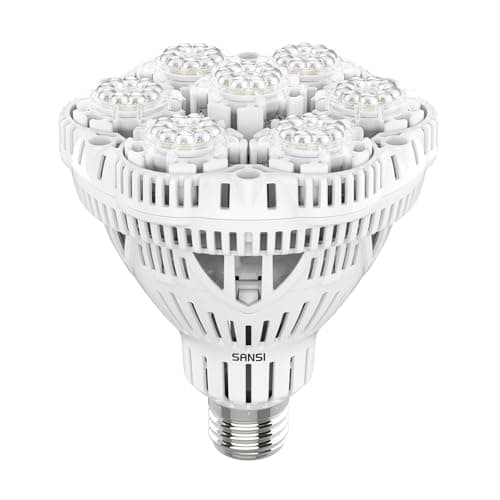 SANSI 36W BR30 Grow Light Bulb The rare grow bulb that publishes both PPF and a PPFD figure with the measurement distance attached, which is the only reason it can be sized honestly. | Topping up one sill plant | 1.82 umol/J (ours) | |
| 2 | 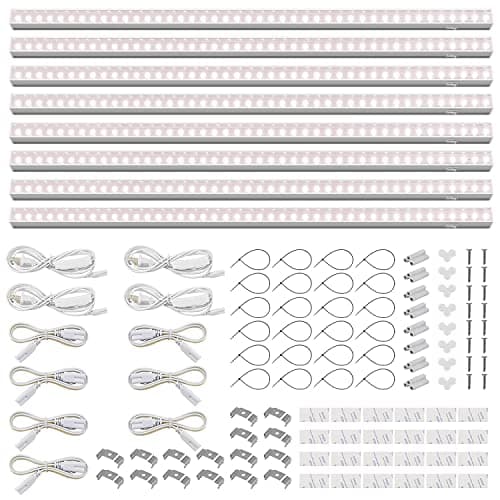 Barrina T5 4ft Grow Light Strips The default seed-starting bar for good reasons — 4 ft long, linkable in series, cheap per foot — and the reason we built a coverage calculator, because Barrina publishes no photon data whatsoever. | A whole windowsill run | Not published | |
| 3 | 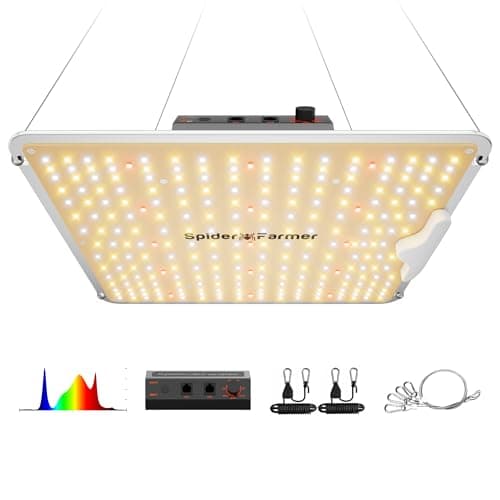 Spider Farmer SF1000 Publishes PPF to two decimal places and an efficacy figure that actually divides out of it. That internal consistency is rarer in this category than it should be. | A window that gets nothing | 2.5 umol/J |
The reasoning
Every comparison of grow lights with sunlight that opens on “nothing beats natural light” is technically true and practically useless, because it does not tell you what to do in January. The productive framing is arithmetic: your window delivers a certain daily light integral, your plant wants a certain daily light integral, and a fixture exists to close whatever gap there is.
Direct sun is not the comparison you think it is
Full midday summer sun is a very large number by grow-light standards, far beyond what any consumer fixture produces over the same area. Nobody is beating it and nobody needs to. The relevant number is not peak sun; it is the light your plant actually receives, in the position it actually occupies, over the whole day.
Three things cut that down hard: the window is glass, the plant is usually not in the beam for the whole day, and in winter the sun is both lower and up for fewer hours. Those effects multiply.
| Factor | Window light | Grow light |
|---|---|---|
| Peak intensity | Enormous in direct summer sun; small in a north-facing room | Fixed, and known if PPF is published |
| Hours per day | Varies by season and weather; nothing you control | Exactly what your timer says |
| Consistency | Different every day | Identical every day |
| Predictability before you commit | Requires measurement or a full season of observation | Computable from published specs |
| Running cost | Free | Computable, and usually far less than expected |
The variable people miss: hours, not brightness
DLI is intensity multiplied by time, so a modest fixture running 14 hours can out-deliver a bright window that only catches sun for three. This is the most useful consequence of thinking in DLI rather than in brightness.
Window: suppose a plant sits in a patch reaching 400 µmol/m²/s, but only for 3 hours before the sun moves off it, plus about 40 µmol/m²/s of ambient for another 6.
DLI = (400 × 3 + 40 × 6) × 3600 ÷ 1,000,000 = (1200 + 240) × 0.0036 = 5.2 mol/m²/day.
Fixture: a SANSI BR30 delivering its published 265.58 µmol/m²/s at 1 ft, run 12 hours.
DLI = 265.58 × 12 × 3600 ÷ 1,000,000 = 11.5 mol/m²/day, over the small area it covers.
The far dimmer fixture more than doubles the window’s daily total, purely by being on longer. The window figures here illustrate the arithmetic — they are not a measurement of your room, which is exactly why the next section matters.
How to find out what your window actually gives
Without a quantum meter you cannot measure PPFD directly, and we will not pretend a phone app substitutes for one. What you can do is observational and reliable:
- Time the direct sun. Check the plant hourly on a clear day and note how long it is actually in the beam. Most people substantially overestimate this.
- Use the shadow test. Extension guidance on indoor plant lighting uses shadow sharpness as a rough proxy for light level: a hard-edged shadow means high light, a soft one medium, and barely any shadow means low.
- Repeat it in December. The whole point is that the June answer does not predict the January one.
The seasonal collapse is covered properly in winter daylight loss and what to add.
What to do with the answer
If your window is genuinely bright for six or more hours in midwinter, you likely need nothing for a low-light houseplant. If it is a north aspect, or blocked, or you are looking at a plant that has been slowly getting worse every winter for three years, add a fixture and stop hoping. Size it against the gap rather than against a product page: the coverage calculator takes hours and area and tells you what a given fixture will add.
Every pick in full
SANSI 36W BR30 Grow Light Bulb
Grow bulbTopping up one sill plant
The rare grow bulb that publishes both PPF and a PPFD figure with the measurement distance attached, which is the only reason it can be sized honestly.
What SANSI publishes
- Power draw
- 36 W (source)
- PPF (photon output)
- 65.6 umol/s (source)
- PPFD
- 265.58 umol/m2/s at 1 ft (source)
- Spectrum
- 4000 K, 400-780 nm, CRI close to 100 (source)
- Rated life
- 25,000 hours (source)
Our arithmetic
- Efficacy, computed from the published figures: 1.82 umol/J
65.6 umol/s / 36 W = 1.82 umol/J. That is roughly a third less efficient than the panels on this page — the price of a screw-in form factor. - Electricity used at 12 hours a day for 30 days: 12.96 kWh a month
36 W x 12 h x 30 d / 1000 = 12.96 kWh.
What SANSI does not publish
- Beam angle
- Fixture dimensions
Who should skip it
Skip it if you are lighting more than one plant. 65.6 umol/s is a small amount of light spread over a cone — it lights a single specimen, not a shelf.
Barrina T5 4ft Grow Light Strips
LED barA whole windowsill run
The default seed-starting bar for good reasons — 4 ft long, linkable in series, cheap per foot — and the reason we built a coverage calculator, because Barrina publishes no photon data whatsoever.
What Barrina publishes
- Power draw
- 20 W per fixture; an 8-pack draws 160 W (source)
- Spectrum
- 5000 K (source)
- Dimming
- No; on/off switch per fixture, linkable up to 8 in series (source)
- Dimensions
- 4 ft strip, 120-degree beam angle, 120 V AC (source)
What Barrina does not publish
- PPF in umol/s — for any strip in the range
- PPFD at any stated distance
- Photon efficacy in umol/J
- LED count per strip, and rated lifespan
Who should skip it
Skip it if you need to know what you are getting before it arrives. There is no published PPF, no PPFD and no efficacy figure, so nothing about its output can be verified in advance.
Spider Farmer SF1000
LED panelA window that gets nothing
Publishes PPF to two decimal places and an efficacy figure that actually divides out of it. That internal consistency is rarer in this category than it should be.
What Spider Farmer publishes
- Power draw
- 100 W +/-5% at 100-277 V AC (source)
- PPF (photon output)
- 249.21 umol/s (source)
- Efficacy
- 2.5 umol/J (source)
- Stated coverage
- 2 x 2 ft core, 3 x 3 ft maximum (source)
- Spectrum
- 650-665 nm, 730-740 nm, 2800-3000 K, 4800-5000 K (source)
- Diodes
- Bridgelux (source)
- Dimming
- Yes, dimming knob (source)
- Dimensions
- 32.5 x 29.0 x 5.9 cm (source)
- Rated life
- 55,000 hours (source)
Our arithmetic
- Does the published efficacy check out against the published PPF?: Yes — 2.49 umol/J computed against 2.5 umol/J published
249.21 umol/s / 100 W = 2.4921 umol/J. The published 2.5 umol/J is that number rounded. Not every brand's two figures agree like this, which is exactly why we divide them. - Average PPFD across its 2 x 2 ft core footprint: about 536 umol/m2/s
2 ft x 2 ft = 4 sq ft = 0.372 m2. 249.21 / 0.372 = 670 umol/m2/s at perfect uniformity; at a 0.8 uniformity factor, about 536 umol/m2/s.
Who should skip it
Skip it if raw output is what you are buying — the TS 1000 delivers 38% more photons per second, at the cost of 50 W more draw.
Questions people actually ask
+Is a grow light as good as sunlight?
+Do I still need a grow light if I have a south-facing window?
+Does glass block the light plants need?
+Can I just move the plant closer to the window?
Sources
- University of Minnesota Extension — Lighting for indoor plants and starting seeds — consulted September 2, 2026
- Iowa State University Extension — Important Considerations for Providing Supplemental Light to Indoor Plants — consulted September 2, 2026
- Virginia Cooperative Extension — Calculating and Using Daily Light Integral (DLI), SPES-720 — consulted September 2, 2026
- SANSI — BR30 36W grow light bulb product page — consulted September 2, 2026
Read next
Reviews
Are LED Grow Lights Worth It?
Do they work, what do they cost, and when to skip one — answered with published figures.
Top pick
Spider Farmer SF1000
Houseplants
How Much Light Do Houseplants Need in Winter?
Published DLI bands by plant type, and how to work out what your winter window is short by.
Top pick
SANSI 36W BR30 Grow Light Bulb
Houseplants
Winter Daylight Loss, and What to Add Back
Why the winter deficit compounds, and how to size the supplement that closes it.
Top pick
Barrina T5 4ft Grow Light Strips
Spectrum & PPFD
PAR, PPFD and DLI, Explained
The three photon units, what each measures, and the conversions between them, shown.
Top pick
Spider Farmer SF1000
Houseplants
The Best Grow Lights for Winter
Winter is a daily-total problem. Modest fixture, long photoperiod — sized against published targets and costed for the season.
Top pick
Barrina T5 4ft Grow Light Strips
Where this sits
This page belongs to Spectrum and PPFD, Honestly. Every figure on it is either quoted from a named published source or derived in view — the full method is on our methodology page, and how the site is funded is on the affiliate disclosure.