PAR, PPFD and DLI, Explained
Three terms, one idea measured at three scales: which light is usable, how much lands per second, and how much accumulates over a day.
By Scooter M. — An enthusiast who's genuinely into this. I read the manuals, compile the published specs, and do the math. No lab coat.
Published · How we pick
Photographs on this site are licensed stock and are illustrative of the fixture type. We do not own the units we write about.
How this page is funded: the buy links here are Amazon Associates links, and we earn a commission on qualifying purchases at no extra cost to you. We have not been paid to feature anything on this page, we accept no free product, and commission plays no part in the ranking. Full disclosure.
We have not tested these units. Everything below comes from the manufacturer’s own published specifications, or from arithmetic we have shown our working for. Where a figure is not published, we say so instead of estimating one. Read the method.
Quick picks
Efficacy is photons out per joule in. Where a manufacturer publishes it we quote theirs; where they publish photon output and wattage but not efficacy, we divide and label it as ours; where they publish neither, the cell says so rather than guessing. Tap a row for the full write-up.
| # | Product | Best for | Efficacy | Price |
|---|---|---|---|---|
| 1 | 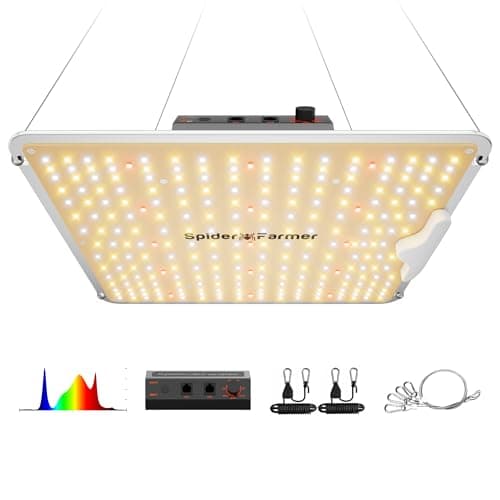 Spider Farmer SF1000 Publishes PPF to two decimal places and an efficacy figure that actually divides out of it. That internal consistency is rarer in this category than it should be. | PPF to two decimals | 2.5 umol/J | |
| 2 | 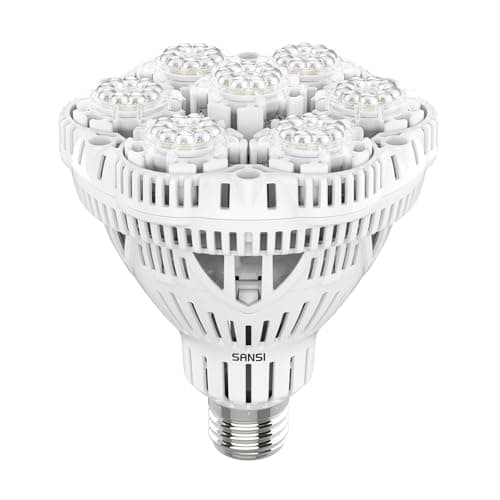 SANSI 36W BR30 Grow Light Bulb The rare grow bulb that publishes both PPF and a PPFD figure with the measurement distance attached, which is the only reason it can be sized honestly. | PPFD at a stated distance | 1.82 umol/J (ours) | |
| 3 | 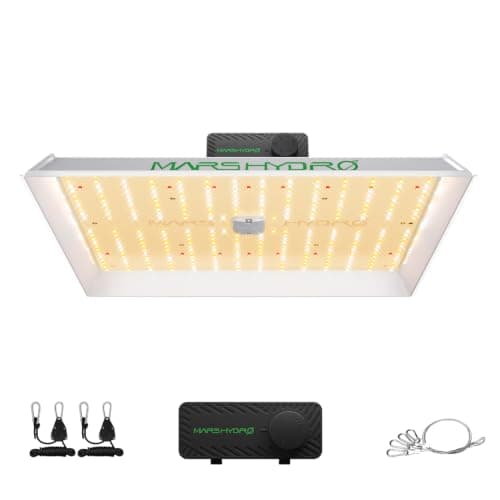 Mars Hydro TS 1000 The most photons of anything on this list, and one of only three fixtures here that publishes both PPF and efficacy so the claim can be checked against itself. | PPF plus a footprint | 2.3 umol/J |
The reasoning
These three acronyms do most of the real work in horticultural lighting, and they are all the same underlying quantity — photons a plant can use — counted at different scales. Once the relationship is clear, sizing a grow light stops being a matter of opinion.
PAR: which photons count
PAR stands for photosynthetically active radiation, and it is a band, not a measurement: roughly 400 to 700 nanometers, the range of wavelengths a plant can drive photosynthesis with. PAR is not a number, and a fixture cannot “have 500 PAR,” despite what a great many product listings say. It answers one question only: does this photon count?
PPF: how many photons leave the fixture
Photosynthetic photon flux, measured in micromoles per second (µmol/s). This is the total count of PAR photons the fixture emits every second, in every direction. It is a property of the light itself, independent of where you hang it.
PPF is the figure you want on a spec sheet, because it is the only one you can divide by an area. Spider Farmer publishes 249.21 µmol/s for the SF1000; Mars Hydro publishes 343 µmol/s for the TS 1000. Those two numbers can be compared directly. Several of the consumer fixtures we cover do not publish one at all.
PPFD: how many photons arrive at the leaf
Photosynthetic photon flux density, in micromoles per square meter per second (µmol/m²/s). This is PPF spread over an area — what actually lands on your plants. It is the figure extension services write light-level bands against.
The uniformity factor accounts for a real fixture being brighter in the middle than at the corners. We use 0.8 as a conservative default across this site and say so wherever it appears; it is an assumption, not a measurement, and it is the one place our arithmetic is not purely mechanical.
µmol/m²/s. Their low band is 50–150 and their high band is 250–450. These are the numbers our coverage calculator scores your result against.
DLI: how many photons accumulate in a day
Daily light integral, in moles per square meter per day (mol/m²/day). PPFD is a rate; DLI is the total. A plant does not care about the instantaneous intensity nearly as much as it cares about the daily dose, which is why DLI is the figure horticultural research usually reports targets in.
The 3600 converts hours to seconds; the 1,000,000 converts micromoles to moles. That is the entire conversion. Virginia Cooperative Extension’s publication on calculating and using DLI is the reference we work from.
A Mars Hydro TS 1000 publishes 343 µmol/s. Hang it over a 2 × 4 ft shelf: 8 sq ft = 0.743 m².
PPFD = 343 ÷ 0.743 × 0.8 = 369 µmol/m²/s — inside Minnesota’s high-light band.
Run it 14 hours: DLI = 369 × 14 × 3600 ÷ 1,000,000 = 18.6 mol/m²/day.
Seedlings want about 12 mol/m²/day per University of New Hampshire Extension, so this is comfortably over target — meaning you could run it fewer hours, or spread it over more shelf, and save electricity either way.
The one conversion you cannot do
Lumens to PPFD. Lumens weight light by the sensitivity of the human eye, which peaks in green — precisely where plants are least responsive. There is no fixed conversion factor between lumens and photon flux, because the ratio depends entirely on the spectrum of the particular light. Anyone selling you a single multiplier is selling you an approximation whose error depends on the fixture.
This is why a shop light specified only in lumens cannot be sized arithmetically, and why we treat “publishes PPF” as a real differentiator rather than a formality.
Put it to work
The coverage calculator runs both formulas on your own numbers and scores the result against the extension bands. If you would rather read the targets first, they are tabulated in PPFD targets by plant type.
Every pick in full
Spider Farmer SF1000
LED panelPPF to two decimals
Publishes PPF to two decimal places and an efficacy figure that actually divides out of it. That internal consistency is rarer in this category than it should be.
What Spider Farmer publishes
- Power draw
- 100 W +/-5% at 100-277 V AC (source)
- PPF (photon output)
- 249.21 umol/s (source)
- Efficacy
- 2.5 umol/J (source)
- Stated coverage
- 2 x 2 ft core, 3 x 3 ft maximum (source)
- Spectrum
- 650-665 nm, 730-740 nm, 2800-3000 K, 4800-5000 K (source)
- Diodes
- Bridgelux (source)
- Dimming
- Yes, dimming knob (source)
- Dimensions
- 32.5 x 29.0 x 5.9 cm (source)
- Rated life
- 55,000 hours (source)
Our arithmetic
- Does the published efficacy check out against the published PPF?: Yes — 2.49 umol/J computed against 2.5 umol/J published
249.21 umol/s / 100 W = 2.4921 umol/J. The published 2.5 umol/J is that number rounded. Not every brand's two figures agree like this, which is exactly why we divide them. - Average PPFD across its 2 x 2 ft core footprint: about 536 umol/m2/s
2 ft x 2 ft = 4 sq ft = 0.372 m2. 249.21 / 0.372 = 670 umol/m2/s at perfect uniformity; at a 0.8 uniformity factor, about 536 umol/m2/s.
Who should skip it
Skip it if raw output is what you are buying — the TS 1000 delivers 38% more photons per second, at the cost of 50 W more draw.
SANSI 36W BR30 Grow Light Bulb
Grow bulbPPFD at a stated distance
The rare grow bulb that publishes both PPF and a PPFD figure with the measurement distance attached, which is the only reason it can be sized honestly.
What SANSI publishes
- Power draw
- 36 W (source)
- PPF (photon output)
- 65.6 umol/s (source)
- PPFD
- 265.58 umol/m2/s at 1 ft (source)
- Spectrum
- 4000 K, 400-780 nm, CRI close to 100 (source)
- Rated life
- 25,000 hours (source)
Our arithmetic
- Efficacy, computed from the published figures: 1.82 umol/J
65.6 umol/s / 36 W = 1.82 umol/J. That is roughly a third less efficient than the panels on this page — the price of a screw-in form factor. - Electricity used at 12 hours a day for 30 days: 12.96 kWh a month
36 W x 12 h x 30 d / 1000 = 12.96 kWh.
What SANSI does not publish
- Beam angle
- Fixture dimensions
Who should skip it
Skip it if you are lighting more than one plant. 65.6 umol/s is a small amount of light spread over a cone — it lights a single specimen, not a shelf.
Mars Hydro TS 1000
LED panelPPF plus a footprint
The most photons of anything on this list, and one of only three fixtures here that publishes both PPF and efficacy so the claim can be checked against itself.
What Mars Hydro publishes
- Power draw
- 150 W +/-5% at 100-277 V AC (source)
- PPF (photon output)
- 343 umol/s (source)
- Efficacy
- 2.3 umol/J (source)
- Stated coverage
- 2.5 x 2.5 ft vegetative, 2.3 x 2.3 ft flowering (source)
- Spectrum
- 660-665 nm, 730-740 nm, 3000 K, 5000 K (source)
- Diodes
- Bridgelux (source)
- Dimming
- Yes, 0-100% dimmer knob (source)
- Dimensions
- 406 x 326 x 50 mm (source)
Our arithmetic
- Average PPFD across its stated 2.5 x 2.5 ft vegetative footprint: about 470 umol/m2/s
2.5 ft x 2.5 ft = 6.25 sq ft = 0.581 m2. 343 umol/s divided by 0.581 m2 = 590 umol/m2/s at perfect uniformity; applying a 0.8 uniformity factor gives about 472 umol/m2/s average. - Electricity used at 14 hours a day for 30 days: 63.0 kWh a month
150 W x 14 h x 30 d / 1000 = 63.0 kWh.
Who should skip it
Skip it if you are lighting a bookshelf. 343 umol/s concentrated into a 2.5 ft square is far more light than a monstera wants, and you pay 150 W to deliver it.
Questions people actually ask
+What is the difference between PPF and PPFD?
+How do I convert lumens to PPFD?
+What DLI do my plants need?
+Is a higher PPFD always better?
Sources
- Virginia Cooperative Extension — Calculating and Using Daily Light Integral (DLI), SPES-720 — consulted September 2, 2026
- University of Minnesota Extension — Lighting for indoor plants and starting seeds — consulted September 2, 2026
- University of New Hampshire Extension — Growing Seedlings Under Lights — consulted September 2, 2026
- Mars Hydro — TS 1000 published specification table — consulted September 2, 2026
- Spider Farmer — SF1000 published specification table — consulted September 2, 2026
Read next
Spectrum & PPFD
What “Full Spectrum” Actually Means
The phrase is unregulated and carries no threshold. These are the numbers that replace it.
Top pick
Spider Farmer SF1000

Coverage & Sizing
Grow Light Coverage Calculator
Put in PPF, area and hours; get PPFD and DLI scored against published extension bands.
Top pick
Mars Hydro TS 1000
Coverage & Sizing
PPFD Targets by Plant Type
Published light bands mapped to common indoor plants, with the DLI each implies.
Top pick
GooingTop Clip Grow Light
Seed Starting
How Much Light Do Seedlings Actually Need?
The 12 mol/m2/day seedling target, converted into the PPFD and hours you can actually set.
Top pick
Spider Farmer SF1000
Where this sits
This page belongs to Spectrum and PPFD, Honestly. Every figure on it is either quoted from a named published source or derived in view — the full method is on our methodology page, and how the site is funded is on the affiliate disclosure.