The Best Grow Light Bars
The right shape for shelves and trays, and the corner of this category with the least published data. Both things are worth knowing before you buy.
By Scooter M. — An enthusiast who's genuinely into this. I read the manuals, compile the published specs, and do the math. No lab coat.
Published · How we pick
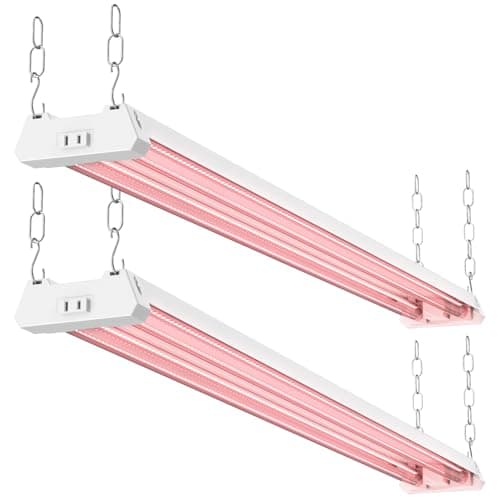
Photographs on this site are licensed stock and are illustrative of the fixture type. We do not own the units we write about.
How this page is funded: the buy links here are Amazon Associates links, and we earn a commission on qualifying purchases at no extra cost to you. We have not been paid to feature anything on this page, we accept no free product, and commission plays no part in the ranking. Full disclosure.
We have not tested these units. Everything below comes from the manufacturer’s own published specifications, or from arithmetic we have shown our working for. Where a figure is not published, we say so instead of estimating one. Read the method.
Quick picks
Efficacy is photons out per joule in. Where a manufacturer publishes it we quote theirs; where they publish photon output and wattage but not efficacy, we divide and label it as ours; where they publish neither, the cell says so rather than guessing. Tap a row for the full write-up.
| # | Product | Best for | Efficacy | Price |
|---|---|---|---|---|
| 1 | 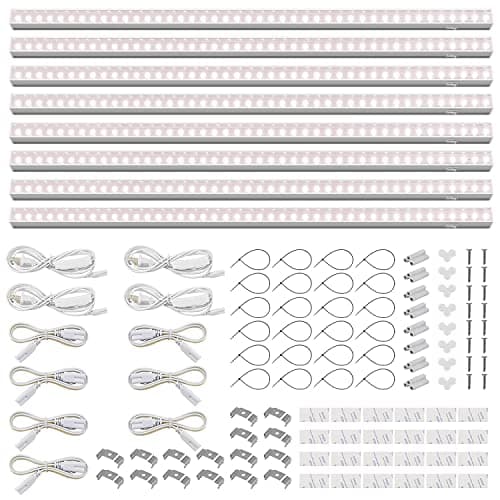 Barrina T5 4ft Grow Light Strips The default seed-starting bar for good reasons — 4 ft long, linkable in series, cheap per foot — and the reason we built a coverage calculator, because Barrina publishes no photon data whatsoever. | The default 4 ft strip | Not published | |
| 2 | 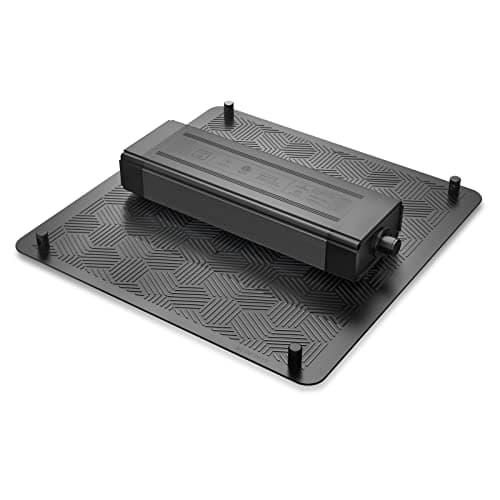 AC Infinity IONBOARD S22 The highest published efficacy of any fixture here at 2.7 umol/J, on Samsung LM301H diodes, with dimming in real 20% steps rather than a vague knob. | Flat-mount alternative | 2.7 umol/J | |
| 3 | 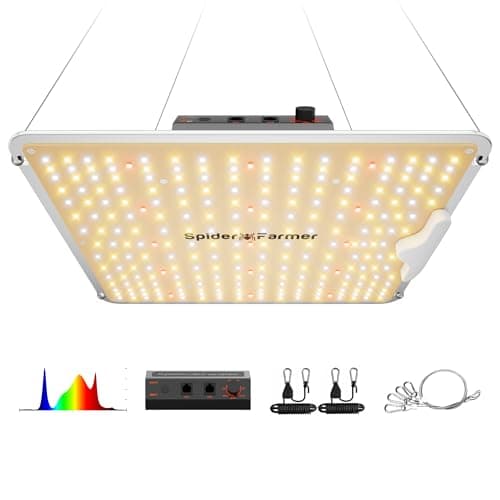 Spider Farmer SF1000 Publishes PPF to two decimal places and an efficacy figure that actually divides out of it. That internal consistency is rarer in this category than it should be. | When a panel fits better | 2.5 umol/J |
The reasoning
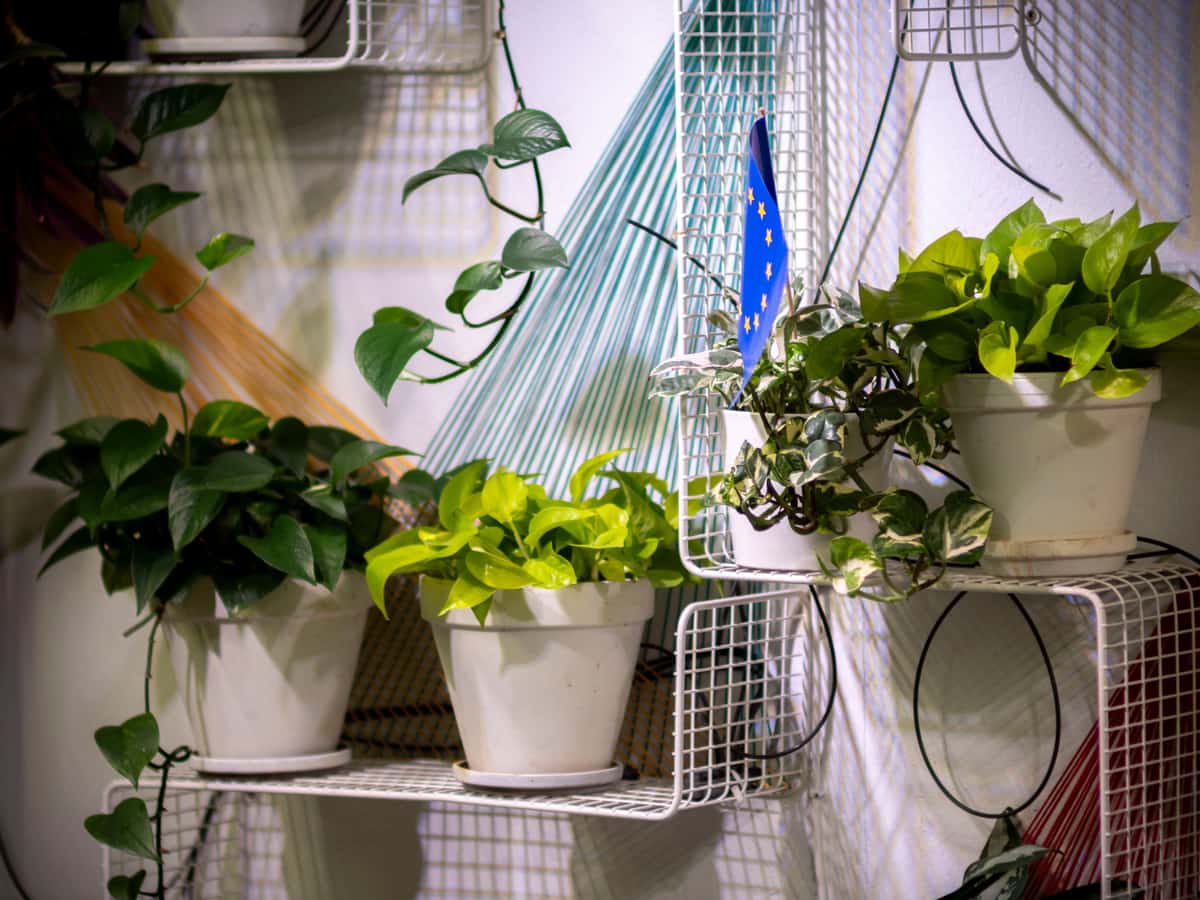
Grow light bars solve a geometry problem that panels cannot. A shelf is a long shallow rectangle; a bar is a long shallow fixture. Putting one over the other means every point on the shelf sits under a run of diodes, rather than under the falling edge of a cone.
They are also, as a category, the worst-documented corner of consumer horticultural lighting, and that is the tension this page is about.
Barrina publishes no PPF, no PPFD and no efficacy for any strip in its T5 range. We checked the product pages directly. It remains our first pick for shelves anyway, and this page explains why.
Why the shape argument wins anyway
A 4 × 1.5 ft shelf is 6 sq ft. A panel with a published 2 × 2 ft footprint covers 4 sq ft of it — and that 4 sq ft is a square, while the shelf is a long strip, so the overlap is worse than the numbers suggest: the panel spills off the front and back edges while leaving roughly a foot dark at each end.
Two 4 ft bars laid along the shelf put emitters across the entire 4 ft length. The area-average calculation reports the same PPFD in both cases. Your plants at the ends of the shelf report something very different.
No efficacy advantage recovers light that landed on the wall.
What the bar category actually offers
| Property | What it means in use |
|---|---|
| 20 W per 4 ft strip | Low draw per fixture; you add strips rather than dim one |
| Linkable in series | Barrina links up to 8 from one outlet — a three-shelf rack on one plug and one timer |
| Mounts flat | Ties or clips to the underside of a wire shelf; no hanging hardware, no crossbar |
| Low clearance | Works in the 8 to 12 inches a shelf gives you, where a panel makes a hotspot |
| No dimming | On or off per fixture; you control level by how many strips you run |
| Cheapest per linear foot | By a wide margin, which is why they dominate seed-starting setups |
The honest limitation
You cannot size a bar you cannot get a photon figure for. It cannot go into the coverage calculator, cannot be compared with a panel on output, and cannot be checked against a PPFD target. Anyone quoting you a PPFD for a Barrina strip is quoting a number the manufacturer has never published.
What you can do instead is use the plants as the instrument. Seedlings report within days: stretching means add a strip or lower the run. That is a slower and cruder loop than arithmetic, and for a shelf of seed trays it is adequate.
The alternative worth knowing about
If the missing data bothers you — and it reasonably might — the AC Infinity IONBOARD S22 is a flat 30 × 30 cm board 1.1 cm thick, designed to mount flat under a shelf rather than hang. It is not linear, so it does not solve the long-shelf geometry problem, but it does mount the way a bar does while publishing an efficacy figure and a named diode.
On a shallow shelf under about 2 ft wide, that is a genuine third option between the two form factors.
What we would build
- A seed-starting rack: two 4 ft strips per shelf, linked in series, hung 2 to 4 inches above the trays and raised as the seedlings grow. The full build is in the shelf setup for seed trays.
- A houseplant shelf you look at: one strip run, or a flat board if you want dimming — a full-output strip in a living room is brighter than you will want in the evening.
- A 2 × 2 ft block: not bars. That is panel geometry, and the panels publish more.
Running cost
Six 20 W strips = 120 W. At 16 hours: 1.92 kWh a day.
Over a ten-week season (70 days): 134.4 kWh.
At 18.34 cents per kWh: $24.65 for the whole season — roughly the cost of the transplants it replaces.
Every pick in full
Barrina T5 4ft Grow Light Strips
LED barThe default 4 ft strip
The default seed-starting bar for good reasons — 4 ft long, linkable in series, cheap per foot — and the reason we built a coverage calculator, because Barrina publishes no photon data whatsoever.
What Barrina publishes
- Power draw
- 20 W per fixture; an 8-pack draws 160 W (source)
- Spectrum
- 5000 K (source)
- Dimming
- No; on/off switch per fixture, linkable up to 8 in series (source)
- Dimensions
- 4 ft strip, 120-degree beam angle, 120 V AC (source)
What Barrina does not publish
- PPF in umol/s — for any strip in the range
- PPFD at any stated distance
- Photon efficacy in umol/J
- LED count per strip, and rated lifespan
Who should skip it
Skip it if you need to know what you are getting before it arrives. There is no published PPF, no PPFD and no efficacy figure, so nothing about its output can be verified in advance.
AC Infinity IONBOARD S22
LED panelFlat-mount alternative
The highest published efficacy of any fixture here at 2.7 umol/J, on Samsung LM301H diodes, with dimming in real 20% steps rather than a vague knob.
What AC Infinity publishes
- Power draw
- 115 W (source)
- Efficacy
- 2.7 umol/J (source)
- PPFD
- 1098 PPFD (no measurement distance published) (source)
- Stated coverage
- 2 x 2 ft (source)
- Spectrum
- Samsung LM301H, plus 660 nm, 730 nm, 3000 K, 6500 K (source)
- Diodes
- 272 diodes (source)
- Dimming
- Yes, 0-100% in 20% increments (source)
- Dimensions
- 30.0 x 30.0 cm board, 1.1 cm thick (source)
- Rated life
- 50,000 hours (source)
Our arithmetic
- Photon output implied by the published wattage and efficacy: about 311 umol/s
115 W x 2.7 umol/J = 310.5 umol/s. AC Infinity does not print PPF directly, so this is our arithmetic from two figures it does print.
What AC Infinity does not publish
- PPF in umol/s — only efficacy is given, so photon output has to be derived
- The measurement distance for the 1098 PPFD figure, without which the number cannot be compared to anything
Who should skip it
Skip it if you want to place it by the numbers. AC Infinity prints 1098 PPFD with no measurement distance attached, which makes that figure impossible to use or compare.
Spider Farmer SF1000
LED panelWhen a panel fits better
Publishes PPF to two decimal places and an efficacy figure that actually divides out of it. That internal consistency is rarer in this category than it should be.
What Spider Farmer publishes
- Power draw
- 100 W +/-5% at 100-277 V AC (source)
- PPF (photon output)
- 249.21 umol/s (source)
- Efficacy
- 2.5 umol/J (source)
- Stated coverage
- 2 x 2 ft core, 3 x 3 ft maximum (source)
- Spectrum
- 650-665 nm, 730-740 nm, 2800-3000 K, 4800-5000 K (source)
- Diodes
- Bridgelux (source)
- Dimming
- Yes, dimming knob (source)
- Dimensions
- 32.5 x 29.0 x 5.9 cm (source)
- Rated life
- 55,000 hours (source)
Our arithmetic
- Does the published efficacy check out against the published PPF?: Yes — 2.49 umol/J computed against 2.5 umol/J published
249.21 umol/s / 100 W = 2.4921 umol/J. The published 2.5 umol/J is that number rounded. Not every brand's two figures agree like this, which is exactly why we divide them. - Average PPFD across its 2 x 2 ft core footprint: about 536 umol/m2/s
2 ft x 2 ft = 4 sq ft = 0.372 m2. 249.21 / 0.372 = 670 umol/m2/s at perfect uniformity; at a 0.8 uniformity factor, about 536 umol/m2/s.
Who should skip it
Skip it if raw output is what you are buying — the TS 1000 delivers 38% more photons per second, at the cost of 50 W more draw.
Questions people actually ask
+Are grow light bars better than panels?
+How many light bars do I need per shelf?
+Can I link grow light bars together?
+Why don't grow light bars publish PPF?
Sources
- Barrina — T5 ML20 4ft 20W product page — consulted September 2, 2026
- AC Infinity — IONBOARD S22 published specifications — consulted September 2, 2026
- Spider Farmer — SF1000 published specification table — consulted September 2, 2026
- US Energy Information Administration — Electric Power Monthly, Table 5.3 (US residential average, June 2026) — consulted September 2, 2026
- University of Minnesota Extension — Lighting for indoor plants and starting seeds — consulted September 2, 2026
Read next
Reviews
The Best Under-Cabinet Grow Lights
Fixtures that fit under a cabinet, and the honest gap between that space and what herbs want.
Top pick
Barrina T5 4ft Grow Light Strips
Reviews
Barrina T5 4ft Grow Light Strips
The default shelf bar. Correct form factor, unbeatable price per foot, zero published output.
Top pick
Barrina T5 4ft Grow Light Strips
Reviews
Sunco Grow Lights
48.42 µmol/s on the 40 W works out to 1.21 µmol/J. The 80 W publishes nothing.
Top pick
SuncoGrow 4ft 40W Grow Light
Coverage & Sizing
Bar vs Panel Coverage and Uniformity
How the two form factors distribute light, and which shapes each one suits.
Top pick
Barrina T5 4ft Grow Light Strips
Coverage & Sizing
The Best Grow Lights for a Shelf or Rack
Picks chosen on footprint match first, because a square panel over a long shelf wastes its edges.
Top pick
Barrina T5 4ft Grow Light Strips
Seed Starting
Grow Light Shelf Setup for Seed Trays
The build: rack, fixtures, chains, timer — with the measurements that make it work and the mistakes that waste a season.
Top pick
Barrina T5 4ft Grow Light Strips
Where this sits
This page belongs to Fixture Reviews and Roundups. Every figure on it is either quoted from a named published source or derived in view — the full method is on our methodology page, and how the site is funded is on the affiliate disclosure.