Sunco Grow Lights
Sunco publishes a photon figure for one fixture in the range and nothing at all for the other. That split is the whole review, and it decides which one we would buy.
By Scooter M. — An enthusiast who's genuinely into this. I read the manuals, compile the published specs, and do the math. No lab coat.
Published · How we pick
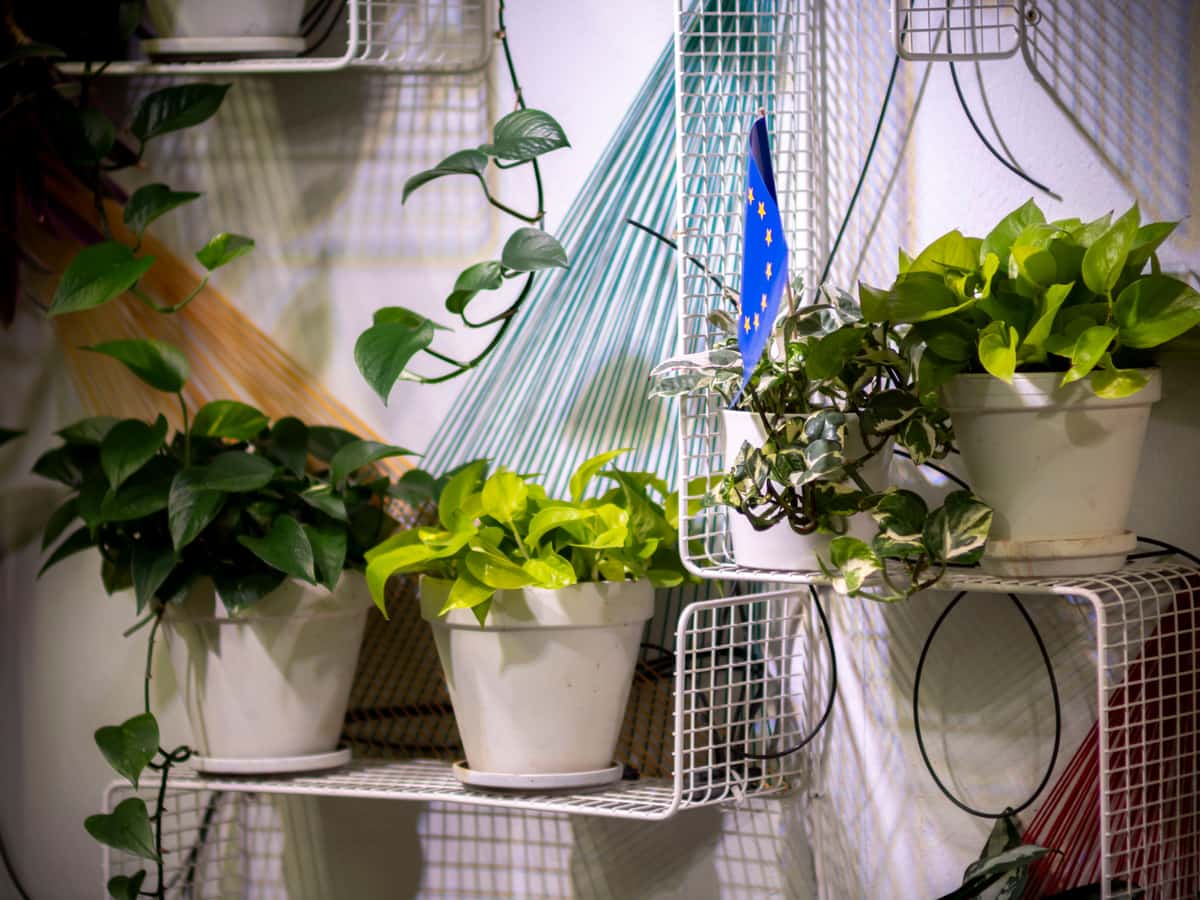
Photographs on this site are licensed stock and are illustrative of the fixture type. We do not own the units we write about.
How this page is funded: the buy links here are Amazon Associates links, and we earn a commission on qualifying purchases at no extra cost to you. We have not been paid to feature anything on this page, we accept no free product, and commission plays no part in the ranking. Full disclosure.
We have not tested these units. Everything below comes from the manufacturer’s own published specifications, or from arithmetic we have shown our working for. Where a figure is not published, we say so instead of estimating one. Read the method.
Quick picks
Efficacy is photons out per joule in. Where a manufacturer publishes it we quote theirs; where they publish photon output and wattage but not efficacy, we divide and label it as ours; where they publish neither, the cell says so rather than guessing. Tap a row for the full write-up.
| # | Product | Best for | Efficacy | Price |
|---|---|---|---|---|
| 1 | 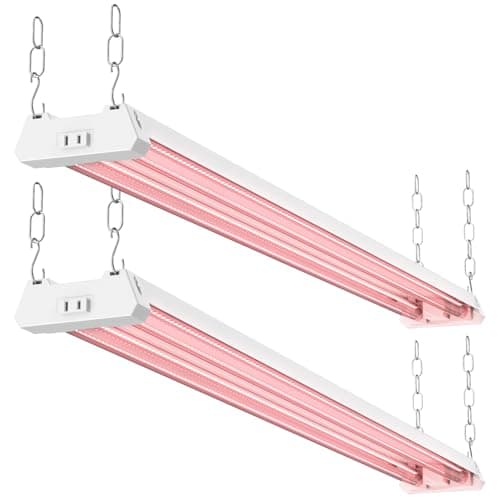 SuncoGrow 4ft 40W Grow Light The only cheap 4 ft strip we have found that publishes a PPF figure at all, which makes it the only one in its class you can size a shelf around before you buy it. | A shelf you can size in advance | Not published | |
| 2 | 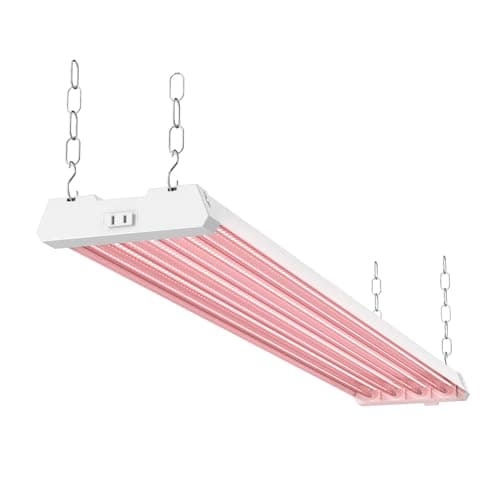 SuncoGrow 4ft 80W Grow Light Twice the wattage of its 40 W sibling and, oddly, less information: Sunco publishes a PPF for the smaller fixture and none at all for this one. | More watts, no photon data | Not published |
The reasoning
We have not tested these fixtures. We own none of them and have measured none of them. What follows is the specification Sunco publishes, collected in one place, our own arithmetic run on top of it, and an explicit list of what Sunco does not publish.
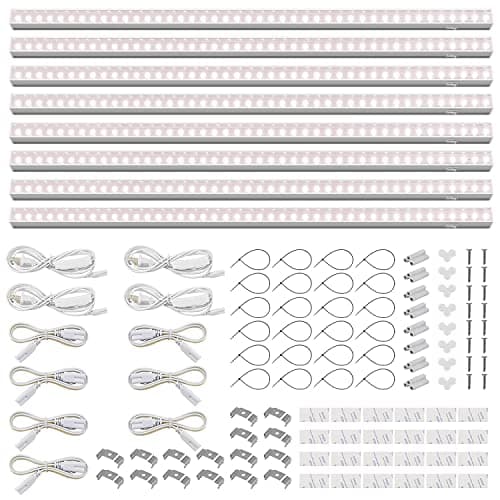
Sunco sells mostly ordinary household and commercial lighting — shop lights, flood bulbs, downlights — with a small grow-light line called SuncoGrow sitting alongside it. That lineage shows up in the fixtures themselves, which are 4 ft linkable strips with a pull chain, and it shows up in the paperwork, which is written to the standards of general lighting rather than horticulture.
The one photon figure in the range
Almost every cheap 4 ft grow strip on the market publishes lumens, watts, a Kelvin number and nothing else. Sunco mostly does the same. But on one fixture it does something the rest of the category does not: the 4 ft 40 W model lists a PPF.
The 4 ft 40 W lists PPF 48.42 µmol/s. The 4 ft 80 W lists no PPF, no PPFD and no efficacy. We read both product specification tables directly.
That single number is worth more than everything else on both spec sheets combined, because photon output is the quantity plants respond to and it is the one figure you cannot infer from anything else. Lumens cannot be converted into it. Lumens are weighted by the sensitivity of the human eye, which peaks in the green where plants are least responsive and falls away in the deep red where they are most, so the conversion factor depends entirely on a fixture's spectrum — a spectrum Sunco does not publish either. Anyone who quotes you a PPFD for a fixture that publishes only lumens has invented it.
What 48.42 µmol/s actually buys
48.42 µmol/s ÷ 40 W = 1.21 µmol/J.
This is our figure, not Sunco's. It is also the lowest photon efficacy of any fixture on this site, and by a clear margin.
| Fixture | Efficacy (µmol/J) | Published or derived |
|---|---|---|
| VIVOSUN VS1000 | 2.75 | Published |
| AC Infinity IONBOARD S22 | 2.7 | Published |
| Spider Farmer SF1000 | 2.5 | Published |
| Mars Hydro TS 1000 | 2.3 | Published |
| SANSI 36W BR30 bulb | 1.82 | Derived from published PPF and watts |
| Soltech Aspect Gen 2 | 1.39 | Derived from published PPF and watts |
| SuncoGrow 4ft 40W | 1.21 | Derived from published PPF and watts |
A board at 2.7 µmol/J delivers rather more than twice the photons per watt. Over a season that difference is paid on the electricity meter every month, and it does not diminish. This is the trade the whole strip-light category asks you to make, and Sunco is the only one in it honest enough to let you see the size of the trade before you commit — which is a real point in its favor, even though the number itself is poor. The full ranking is in most efficient grow lights by µmol/J.
Sizing a shelf with the one number you have
This is the payoff. Because Sunco published a PPF, the 40 W strip can be put through the same arithmetic as a panel costing five times as much, and you can know roughly what you are getting before you order it. Take a standard 4 ft run of shelf, about a foot deep — the shape most seed trays and houseplant collections actually occupy.
4 sq ft ÷ 10.7639 = 0.3716 m². 48.42 µmol/s ÷ 0.3716 m² = 130.3 µmol/m²/s at perfect uniformity. Real fixtures are not uniform, so applying the 0.8 factor this site uses throughout gives about 104 µmol/m²/s average.
Run 16 hours: 104 × 16 × 3600 ÷ 1,000,000 = 6.0 mol/m²/day.
104 µmol/m²/s falls in the low band — 50 to 150 µmol/m²/s — on the University of Minnesota Extension's scale. That is enough for a pothos or a snake plant and not enough for a seed tray. The University of New Hampshire Extension puts seedlings at roughly 12 mol/m²/day, and one strip delivers half of that even run 16 hours. This is the arithmetic behind a complaint people make constantly about cheap strips: they bought one, hung it over a tray, and got leggy seedlings anyway.
2 × 48.42 = 96.84 µmol/s ÷ 0.3716 m² × 0.8 = about 208 µmol/m²/s.
At 16 hours: 208 × 16 × 3600 ÷ 1,000,000 = 12.0 mol/m²/day — the seedling target, almost exactly.
Two strips per shelf is therefore the configuration to buy, and it is not a guess: it is the published figure doubled and divided by the area you are lighting. No other budget strip in this category lets you reach that conclusion before your money is spent. The general argument for running bars in pairs rather than raising one higher is in bar versus panel coverage.
The 80 W publishes nothing, and we will not fill it in
The obvious thing to do with the 80 W is to carry the 40 W's efficacy across, multiply, and report 96.8 µmol/s. We are not going to, and it is worth saying why, because the arithmetic is tempting and wrong.
Photon efficacy is a property of the diodes, the driver and the optics in a specific fixture. Two models in one product line can share a name and a housing and still use different emitters — and the published figures for these two suggest exactly that, since Sunco lists a CRI for the 40 W and none for the 80 W. A fixture that reports a different set of optical properties is not guaranteed to share the one property that was not reported. Multiplying across models produces a number that looks computed but rests on an assumption nobody has tested. That is a fabricated figure wearing a formula, and this site does not publish those.
So the honest statement about the 80 W is the flat one: its photon output is unknown, it cannot be sized, and it cannot be compared with anything here on output. What it publishes is 80 W, 4000 lumens, a 120-degree beam angle and a 600 W equivalence claim — and equivalence claims are a separate problem, dismantled in watts versus equivalent watts.
What both fixtures cost to run
40 W strip: 40 × 16 × 30 ÷ 1000 = 19.2 kWh a month = $3.52. Two of them: $7.04.
80 W strip: 80 × 16 × 30 ÷ 1000 = 38.4 kWh a month = $7.04.
Over a ten-week seed season, two 40 W strips run 16 hours a day come to 134.4 kWh, or $24.65.
Note that two 40 W strips and one 80 W strip draw identical power and cost identically to run. The difference is that you know what the pair delivers and you do not know what the single one delivers, and the pair spreads its output along eight feet of emitter rather than four, which is better for uniformity on a shelf.
Sunco against Barrina, which is the real comparison
Nobody cross-shops a SuncoGrow strip against a $150 board. They cross-shop it against the other cheap 4 ft strips, and in practice that means Barrina's T5 bars.
| SuncoGrow 4ft 40W | Barrina T5 4ft | |
|---|---|---|
| Wattage per fixture | 40 W | 20 W |
| PPF published | 48.42 µmol/s | None, for any strip in the range |
| Efficacy | 1.21 µmol/J, derived | Cannot be computed |
| Can you size it before buying? | Yes | No |
| Linkable | Up to 4 | Up to 8 |
| Spectrum | Full spectrum, CRI 80+ | 5000 K |
Barrina remains our first pick for a shelf, because 20 W fixtures linkable eight-deep give finer control over how much light lands where, and because the price per linear foot is lower. But Barrina publishes nothing, so buying it means finding out what you got after it arrives. Sunco costs more per photon and links only four-deep, and in exchange it tells you what one fixture emits. Which of those matters more is a genuine judgment call rather than a ranking, and it depends on whether you would rather plan or iterate.
Who should buy which
- Buy two of the 40 W if you want a 4 ft shelf lit to a seedling-adequate level and you want that settled by arithmetic before you order. This is the only recommendation on this page we would make without qualification.
- Buy one of the 40 W only for foliage houseplants — pothos, snake plants, philodendrons — where the low band is the correct target rather than a shortfall.
- Buy the 80 W only if you are comfortable buying unmeasured, the way most of this category is bought. It draws the same power as two 40 W strips and costs the same to run, so the only reason to prefer it is if one fixture suits the space better than two.
- Buy neither if photons per watt is what decides it. At 1.21 µmol/J you are paying roughly twice the running cost of a board for the same light, and over several seasons that gap exceeds the difference in purchase price.
What Sunco does not publish
For the 40 W: no PPFD at any distance, no efficacy figure, no coverage area, no diode manufacturer or LED count, and no fixture dimensions beyond the 4 ft length. For the 80 W: all of that, plus the PPF itself and the CRI. Both fixtures are ETL, FCC and RoHS listed, rated at 50,000 hours, damp rated and carry a three-year warranty, which is a more complete reliability picture than most of this category offers.
The pattern across this site is that fixtures which publish photon data tend to publish it because it is competitive. Sunco published a figure that is not competitive, which is a small act of candor worth noting even while we report that the figure is low.
Every pick in full
SuncoGrow 4ft 40W Grow Light
LED barA shelf you can size in advance
The only cheap 4 ft strip we have found that publishes a PPF figure at all, which makes it the only one in its class you can size a shelf around before you buy it.
What Sunco Lighting publishes
- Power draw
- 40 W at 120 V AC; marketed as a 260 W equivalent (source)
- PPF (photon output)
- 48.42 umol/s (source)
- Spectrum
- Full spectrum, 2000 lumens, CRI 80+, 120-degree beam angle (source)
- Dimming
- No; linkable up to 4 fixtures, damp rated, ETL, FCC and RoHS listed (source)
- Dimensions
- 4 ft strip; 5 ft plug-in cord, 12 in pull chain (source)
- Rated life
- 50,000 hours, 50,000 switching cycles, 3-year warranty (source)
Our arithmetic
- Photon efficacy, computed from the published figures: 1.21 umol/J
48.42 umol/s / 40 W = 1.2105 umol/J. Sunco publishes no efficacy figure, so this one is ours. It is the lowest of any fixture on this site: the next lowest is the Soltech Aspect at 1.39 umol/J, and the LED boards run 2.3 to 2.75 umol/J. - Average PPFD from one strip over a 4 x 1 ft run of shelf: about 104 umol/m2/s
4 sq ft / 10.7639 = 0.3716 m2. 48.42 umol/s / 0.3716 m2 = 130.3 umol/m2/s at perfect uniformity; applying a 0.8 uniformity factor gives about 104 umol/m2/s. That sits in the low band, 50 to 150 umol/m2/s, on the University of Minnesota Extension's scale. - Daily light integral from one strip run 16 hours: 6.0 mol/m2/day
104 umol/m2/s x 16 h x 3600 / 1,000,000 = 6.0 mol/m2/day. That is half the roughly 12 mol/m2/day the University of New Hampshire Extension gives for seedlings, which is the arithmetic reason one strip per shelf disappoints people. - Two strips over that same 4 x 1 ft run: about 208 umol/m2/s, or 12.0 mol/m2/day at 16 hours
2 x 48.42 = 96.84 umol/s / 0.3716 m2 x 0.8 = 208.5 umol/m2/s. 208.5 x 16 h x 3600 / 1,000,000 = 12.0 mol/m2/day. Two strips land on the seedling target almost exactly, which is the configuration we would actually buy. - Electricity at 16 hours a day for 30 days: $3.52 a month per strip
40 W x 16 h x 30 d / 1000 = 19.2 kWh. 19.2 x 18.34 cents = $3.52. Two strips, 80 W, come to $7.04 a month.
What Sunco Lighting does not publish
- PPFD at any stated distance
- Photon efficacy in umol/J — PPF and wattage are given, so efficacy has to be derived
- Coverage area
- Diode manufacturer and LED count
- Fixture dimensions beyond the 4 ft length
Who should skip it
Skip it if photons per watt decide the purchase. The figure Sunco publishes works out to 1.21 umol/J, the lowest of anything on this site, so you pay for that certainty on the meter every month.
SuncoGrow 4ft 80W Grow Light
LED barMore watts, no photon data
Twice the wattage of its 40 W sibling and, oddly, less information: Sunco publishes a PPF for the smaller fixture and none at all for this one.
What Sunco Lighting publishes
- Power draw
- 80 W at 120 V AC; marketed as a 600 W equivalent (source)
- Spectrum
- Full spectrum, 4000 lumens, 120-degree beam angle (source)
- Dimming
- No; linkable up to 4 fixtures, damp rated, ETL, FCC and RoHS listed (source)
- Dimensions
- 4 ft strip; 60 in power cord, 24 in pull chain (source)
- Rated life
- 50,000 hours, 50,000 switching cycles, 3-year warranty (source)
Our arithmetic
- Electricity at 16 hours a day for 30 days: $7.04 a month
80 W x 16 h x 30 d / 1000 = 38.4 kWh. 38.4 x 18.34 cents = $7.04. Wattage is the only published figure on this fixture that supports any arithmetic at all.
What Sunco Lighting does not publish
- PPF in umol/s — published for the 40 W in the same range, but not for this one
- PPFD at any stated distance
- Photon efficacy in umol/J
- CRI
- Coverage area
- Diode manufacturer and LED count
Who should skip it
Skip it if you want to know the output before it arrives. We will not carry the 40 W's photon figure across to this fixture, so there is nothing here to size a shelf with except watts.
Questions people actually ask
+What is the PPF of a Sunco grow light?
+How efficient are Sunco grow lights?
+Is one Sunco 40W strip enough for a tray of seedlings?
+How much do Sunco grow lights cost to run?
+Can you convert the Sunco lumens figure into PPFD?
Sources
- Sunco Lighting — SuncoGrow LED Grow Light 4ft 40W product specifications — consulted September 14, 2026
- Sunco Lighting — SuncoGrow Full Spectrum LED Grow Light 4ft 80W product specifications — consulted September 14, 2026
- US Energy Information Administration — Electric Power Monthly, Table 5.3 (US residential average, June 2026) — consulted September 2, 2026
- University of Minnesota Extension — Lighting for indoor plants and starting seeds — consulted September 2, 2026
- University of New Hampshire Extension — Growing Seedlings Under Lights — consulted September 2, 2026
Read next
Reviews
Barrina T5 4ft Grow Light Strips
The default shelf bar. Correct form factor, unbeatable price per foot, zero published output.
Top pick
Barrina T5 4ft Grow Light Strips
Reviews
The Best Grow Light Bars
Linear fixtures for shelves and trays, and the disclosure gap running through the category.
Top pick
Barrina T5 4ft Grow Light Strips
Running Cost
The Most Efficient Grow Lights by µmol/J
Every fixture we cover ranked on published photon efficacy, with derivations shown.
Coverage & Sizing
Bar vs Panel Coverage and Uniformity
How the two form factors distribute light, and which shapes each one suits.
Top pick
Barrina T5 4ft Grow Light Strips
Where this sits
This page belongs to Fixture Reviews and Roundups. Every figure on it is either quoted from a named published source or derived in view — the full method is on our methodology page, and how the site is funded is on the affiliate disclosure.