GE Grow Lights
GE is the rare mainstream lighting brand that prints photon output on everything in its grow range. It prints nothing that tells you how much of that output reaches the plant, and that gap is what this review fills with arithmetic.
By Scooter M. — An enthusiast who's genuinely into this. I read the manuals, compile the published specs, and do the math. No lab coat.
Published · How we pick
Photographs on this site are licensed stock and are illustrative of the fixture type. We do not own the units we write about.
How this page is funded: the buy links here are Amazon Associates links, and we earn a commission on qualifying purchases at no extra cost to you. We have not been paid to feature anything on this page, we accept no free product, and commission plays no part in the ranking. Full disclosure.
We have not tested these units. Everything below comes from the manufacturer’s own published specifications, or from arithmetic we have shown our working for. Where a figure is not published, we say so instead of estimating one. Read the method.
Quick picks
Efficacy is photons out per joule in. Where a manufacturer publishes it we quote theirs; where they publish photon output and wattage but not efficacy, we divide and label it as ours; where they publish neither, the cell says so rather than guessing. Tap a row for the full write-up.
| # | Product | Best for | Efficacy | Price |
|---|---|---|---|---|
| 1 | 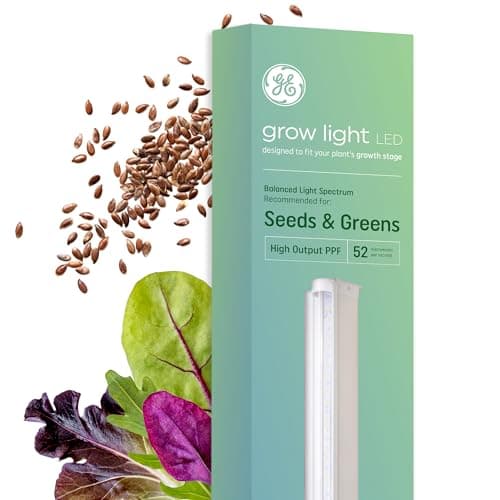 GE Grow Light 48in LED Fixture, Seeds and Greens A 4 ft shelf fixture that publishes its photon output, 52 umol/s from 30 W, so a shelf can be sized around it before it arrives rather than after. | A shelf or a seed tray | Not published | |
| 2 | 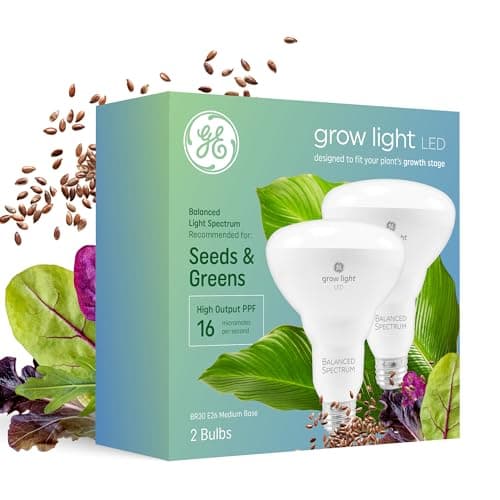 GE Grow Light BR30 Bulb, Seeds and Greens (2-pack) A mainstream-brand grow bulb that prints its photon output on the box: 16 umol/s from 9 W, which is enough for one low- or medium-light plant under a lamp you already own, and not much more. | One plant under a lamp | Not published | |
| 3 | 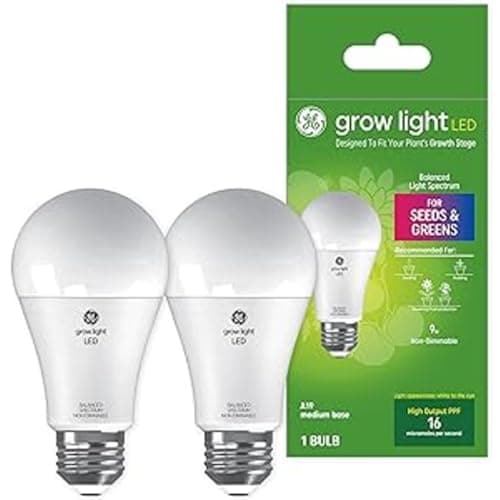 GE Grow A19 Bulb, Seeds and Greens (2-pack) The same published output as GE's BR30, 16 umol/s from 9 W, in the ordinary household bulb shape, for lamps and pendants that will not take a reflector flood. | A lamp that won't take a BR30 | Not published |
The reasoning
We have not tested these lights. We own none of them and have measured none of them. What follows is the specification GE publishes, collected in one place, our own arithmetic run on top of it, and an explicit list of what GE leaves out.
GE Grow is a line of screw-in bulbs and plug-in fixtures sold through the same hardware-store and online channels as the rest of GE's household lighting. It is aimed squarely at the reader of this site: someone with a shelf of seedlings, a pot of herbs or a houseplant that sulks through winter, who would rather buy a bulb from a name they recognize than a panel from a brand they have never heard of.
What GE publishes, and what it does not
Most lighting brands that move into grow lights bring the paperwork of household lighting with them: watts, lumens, an equivalent-wattage claim and a color temperature. GE does something better. Every GE Grow product page we read states a PPF, the number of photons the light emits each second, in micromoles per second.
Three bulb shapes and two fixture lengths, including both spectrum variants of the BR30 and the PAR38. None of the seven publishes a PPFD, a beam angle or a spectral distribution. We read each manufacturer page directly.
That is a real distinction. Among the brands on this site, a published PPF is the exception at the budget end of the market. It is the one figure that cannot be reconstructed from anything else on a box, and GE states it even on its least expensive bulbs.
The whole range, by GE's own numbers
| GE Grow product | Power | PPF (µmol/s) | Efficacy (µmol/J) | CRI |
|---|---|---|---|---|
| 24 in fixture, Seeds and Greens | 40 W | 72 | 1.80 | 90 |
| A19 bulb, Seeds and Greens | 9 W | 16 | 1.78 | 90 |
| BR30 bulb, Seeds and Greens | 9 W | 16 | 1.78 | 90 |
| 48 in fixture, Seeds and Greens | 30 W | 52 | 1.73 | 90 |
| BR30 bulb, Flowers and Fruit | 9 W | 15 | 1.67 | 60 |
| PAR38 bulb, Flowers and Fruit | 30 W | 50 | 1.67 | 70 |
| PAR38 bulb, Seeds and Greens | 32 W | 50 | 1.56 | 80 |
Three things stand out. First, the efficacy band is narrow: 1.56 to 1.80 µmol/J across seven products and five form factors. That places the whole range in the middle of this site's table, well clear of the SuncoGrow 40 W at 1.21 and the Soltech Aspect at 1.39, and well short of the LED boards at 2.3 to 2.75. The full ranking is in most efficient grow lights by µmol/J.
Second, the two integrated fixtures both publish 2000 lumens, and one emits 52 µmol/s while the other emits 72. Identical lumens, a 38% difference in photons. There is no cleaner demonstration from a single manufacturer that lumens cannot be converted into plant light: lumens are weighted by the sensitivity of the human eye, and two spectra can look equally bright to you while delivering very different photon counts to a leaf.
Third, the Flowers and Fruit versions never publish more photons than their Seeds and Greens counterparts, and they always carry a lower color rendering index. More on what that means further down.
One small warning about GE's spec tables: they list bulb diameters of 94 and 122 under an inches label, which cannot be right for bulbs that fit a household lamp. We quote no bulb dimensions for that reason.
Why two of the best numbers are not picks
The 24 in fixture has the highest efficacy and the most photons per foot in the range, and the PAR38 is GE's brightest single bulb. When we checked Amazon's catalog on September 17, 2026, the 24 in fixture and both PAR38 variants were listed as currently unavailable. This site only recommends products you can actually buy, so they appear in the table above and nowhere in the picks. If either returns, the arithmetic below applies to it in exactly the same way.
The PPFD question GE does not answer
People search for the PPFD of GE grow lights because PPFD is the figure plant guidance is written in, and GE does not publish one for any product we checked. What GE does publish is a hanging distance: 6 to 9 inches for the BR30, 9 inches for the A19, 24 to 30 inches for the PAR38, and 6 to 12 inches for the 24 in fixture.
A distance and a PPF are not enough to produce a PPFD. The missing ingredient is the beam angle, which decides how widely those photons spread before they land. The same 16 µmol/s poured into a narrow cone and a wide one produces very different intensity at 9 inches, and GE publishes the angle for neither bulb. So any specific PPFD figure you see quoted for a GE bulb was either measured by someone with a meter or made up. What arithmetic can do honestly is set bounds and area averages, which is what the next two sections do. The underlying quantities are explained in PAR, PPFD and DLI explained, and the general case for placement is in how far a grow light should be from plants.
The 48 in fixture on a shelf
A 4 ft fixture over a 4 ft shelf about a foot deep is the setup most seed starters actually build, so that is the area we use, with the same 0.8 uniformity factor applied to every bar on this site.
4 sq ft ÷ 10.7639 = 0.3716 m². 52 µmol/s ÷ 0.3716 m² = 139.9 µmol/m²/s at perfect uniformity; × 0.8 = about 112 µmol/m²/s.
At 16 hours: 112 × 16 × 3600 ÷ 1,000,000 = 6.4 mol/m²/day. At GE's recommended 18 hours, 7.3.
112 µmol/m²/s sits in the low band, 50 to 150, on the University of Minnesota Extension's scale. That suits foliage houseplants on a shelf. It does not suit seedlings: the University of New Hampshire Extension puts them at roughly 12 mol/m²/day, and one fixture delivers about half that even at GE's 18 hours.
104 µmol/s ÷ 0.3716 m² × 0.8 = about 224 µmol/m²/s.
At 16 hours: 224 × 16 × 3600 ÷ 1,000,000 = 12.9 mol/m²/day, clear of the seedling target without needing GE's 18 hours.
Two per shelf is the configuration to buy for seedlings. It is worth setting beside the other 4 ft light on this site that publishes a PPF. One SuncoGrow 40 W strip averages about 104 µmol/m²/s over the same run while drawing 40 W; one GE fixture averages about 112 while drawing 30. Both numbers come from the manufacturers' own PPF figures run through identical arithmetic, so the comparison is fair, and it favors GE on light and on the electricity bill.
The BR30 on one plant
A bulb has no natural footprint the way a 4 ft bar does, and without a beam angle we cannot compute its spread. What we can compute is a ceiling: the average intensity if every photon the bulb emits landed inside one square foot. No bulb achieves that, so the real figure is always lower.
1 sq ft = 0.0929 m². 16 µmol/s ÷ 0.0929 m² = at most 172 µmol/m²/s.
At GE's 18 hours: 172 × 18 × 3600 ÷ 1,000,000 = at most 11.2 mol/m²/day.
Even under an assumption that flatters it, a single GE bulb lands just inside the medium band and short of a seedling's daily target. That makes it a light for one plant that is content with low to medium light — a pothos, a philodendron, a snake plant — placed close, as GE says, at 6 to 9 inches. It is not a light for a seed tray, and it is nowhere near enough for a plant that wants the high band, such as an indoor citrus tree. Typical targets by plant are collected in PPFD targets by plant type.
BR30 or A19
GE publishes identical figures for the two Seeds and Greens bulbs: 9 W, 16 µmol/s, 500 lumens, CRI 90. The difference is the shape. A BR30 is a reflector flood that pushes its output forward, which is what you want in a lamp aimed down at a plant. An A19 is the ordinary household bulb shape and sends light out in every direction, so in an open socket more of its output lights the ceiling and the wall. Buy the BR30 if your lamp takes one. Buy the A19 only when it will not: a table lamp with a narrow harp, or a pendant designed around a standard bulb.
About GE's 18 hours
Every GE page we read that gives a schedule gives the same one: leave the light on for 18 hours a day. For seedlings that sits at the top of the University of Minnesota Extension's 16 to 18 hour guidance. For houseplants and herbs it runs past Iowa State University Extension's general advice of 12 to 14 hours with a 16 hour ceiling. We would run seedlings at 16 and follow the plant-specific figures in grow light hours per day by plant for everything else. The electricity difference is trivial either way.
One BR30 or A19, 9 W: 9 × 16 × 30 ÷ 1000 = 4.32 kWh a month = $0.79. At 18 hours, $0.89.
One 48 in fixture, 30 W: 14.4 kWh a month = $2.64. At 18 hours, $2.97.
Two 48 in fixtures at 16 hours: $5.28 a month. Two SuncoGrow 40 W strips on the same schedule come to $7.04.
Seeds and Greens or Flowers and Fruit
GE sells each shape in two spectra and describes the Flowers and Fruit version as having an advanced red spectrum for plants in their flowering or fruiting stage. GE publishes no spectral distribution for either, so that claim cannot be checked against anything. What can be checked is GE's own photon count. On the BR30, Flowers and Fruit emits 15 µmol/s against 16 for Seeds and Greens at the same 9 W. On the PAR38 both emit 50, with Flowers and Fruit drawing 2 W less.
The consistent difference is color rendering: CRI 60 against 90 on the BR30, 70 against 80 on the PAR38. CRI describes how natural colors look to you under the light, not what the plant receives, but in a living room it is the difference between a plant that looks green and one that looks faintly off. For herbs, greens, seedlings and houseplants, which is nearly everything readers here are growing, we would buy Seeds and Greens. The research on white light against blue-plus-red is summarized in full spectrum versus red and blue.
Who should buy which
- Two 48 in fixtures per shelf for seedlings. The arithmetic lands above the seedling target at 16 hours, and GE's published PPF is what lets you know that before ordering.
- One 48 in fixture for a shelf of foliage houseplants, where the low band is the right target rather than a shortfall.
- A BR30 for a single low- or medium-light plant under a lamp you already own, placed close.
- An A19 only when the lamp will not take a BR30.
- None of them for a plant that needs high light, or if photons per watt decide the purchase. At 1.73 to 1.78 µmol/J you get roughly two-thirds of the light per watt that a good LED board delivers.
What GE does not publish
For every product we checked: no PPFD at any distance, no beam angle, no color temperature, no spectral distribution and no efficacy figure. The absence of a beam angle matters most, because it is the one number that would turn GE's hanging distances into intensities. Against that, GE publishes more than most mainstream competitors: a PPF and a CRI on every product we checked, and on most of them a hanging distance and a daily schedule. That is enough to size a shelf honestly, and it is why this range can be recommended on arithmetic rather than on the name on the box.
Every pick in full
GE Grow Light 48in LED Fixture, Seeds and Greens
LED barA shelf or a seed tray
A 4 ft shelf fixture that publishes its photon output, 52 umol/s from 30 W, so a shelf can be sized around it before it arrives rather than after.
What GE Lighting publishes
- Power draw
- 30 W at 120 V AC (source)
- PPF (photon output)
- 52 umol/s (source)
- Spectrum
- 2000 lumens, CRI 90; no color temperature or spectral distribution published (source)
- Dimming
- No; damp humidity rating, not rated for outdoor use (source)
- Dimensions
- 48.2 x 2.8 x 2.4 in; 5 ft cord, 8 in mounting chains (source)
Our arithmetic
- Photon efficacy, computed from the published figures: 1.73 umol/J
52 umol/s / 30 W = 1.73 umol/J. GE publishes no efficacy figure, so this one is ours. It sits mid-table on this site: above the Soltech Aspect at 1.39 umol/J, below the LED boards at 2.3 to 2.75. - Average PPFD from one fixture over a 4 x 1 ft run of shelf: about 112 umol/m2/s
4 sq ft / 10.7639 = 0.3716 m2. 52 umol/s / 0.3716 m2 = 139.9 umol/m2/s at perfect uniformity; a 0.8 uniformity factor gives about 112 umol/m2/s. That is the low band, 50 to 150 umol/m2/s, on the University of Minnesota Extension's scale. - Daily light integral from one fixture: 6.4 mol/m2/day at 16 hours; 7.3 at GE's recommended 18
112 umol/m2/s x 16 h x 3600 / 1,000,000 = 6.4 mol/m2/day. At 18 hours, 7.3. Both are short of the roughly 12 mol/m2/day the University of New Hampshire Extension gives for seedlings. - Two fixtures over the same 4 x 1 ft run: about 224 umol/m2/s, or 12.9 mol/m2/day at 16 hours
104 umol/s / 0.3716 m2 x 0.8 = 223.9 umol/m2/s. 223.9 x 16 h x 3600 / 1,000,000 = 12.9 mol/m2/day, which clears the seedling target without needing GE's 18 hours. - Electricity at 16 hours a day for 30 days: $2.64 a month
30 W x 16 h x 30 d / 1000 = 14.4 kWh. 14.4 x 18.34 cents = $2.64. At GE's 18 hours: 16.2 kWh = $2.97.
What GE Lighting does not publish
- PPFD at any stated distance
- Beam angle
- Color temperature and spectral distribution
- Photon efficacy in umol/J — PPF and wattage are given, so efficacy has to be derived
Who should skip it
Skip it if you want one fixture to carry a seed tray. A single unit averages about 112 umol/m2/s over a 4 x 1 ft run, which is the low band, and it does not dim.
GE Grow Light BR30 Bulb, Seeds and Greens (2-pack)
Grow bulbOne plant under a lamp
A mainstream-brand grow bulb that prints its photon output on the box: 16 umol/s from 9 W, which is enough for one low- or medium-light plant under a lamp you already own, and not much more.
What GE Lighting publishes
- Power draw
- 9 W per bulb at 120 V; medium E26 base (source)
- PPF (photon output)
- 16 umol/s per bulb (source)
- Spectrum
- 500 lumens, CRI 90; described as full spectrum with blue and red, no spectral distribution published (source)
- Dimming
- No (source)
- Rated life
- Up to 25,000 hours; 3-year warranty (source)
Our arithmetic
- Photon efficacy, computed from the published figures: 1.78 umol/J
16 umol/s / 9 W = 1.78 umol/J. Ours, not GE's. Just below the SANSI 36W BR30 at 1.82 umol/J, which puts it with the better grow bulbs on this site. - The ceiling over one square foot: at most 172 umol/m2/s
1 sq ft = 0.0929 m2. 16 umol/s / 0.0929 m2 = 172 umol/m2/s. That average holds only if every photon the bulb emits lands inside that square foot, so the real figure is lower. GE publishes no beam angle, so the actual spread cannot be computed. - The daily light ceiling at GE's recommended 18 hours: at most 11.2 mol/m2/day
172 umol/m2/s x 18 h x 3600 / 1,000,000 = 11.2 mol/m2/day. Under an assumption that flatters the bulb, that is still short of the roughly 12 mol/m2/day the University of New Hampshire Extension gives for seedlings. - Electricity at 16 hours a day for 30 days: $0.79 a month per bulb
9 W x 16 h x 30 d / 1000 = 4.32 kWh. 4.32 x 18.34 cents = $0.79. At GE's 18 hours: 4.86 kWh = $0.89.
What GE Lighting does not publish
- PPFD at any stated distance
- Beam angle
- Color temperature and spectral distribution
- Photon efficacy in umol/J
Who should skip it
Skip it for a seed tray or a plant that wants bright light. Even if every photon it emits landed inside one square foot, which no bulb manages, the average would top out around 172 umol/m2/s.
GE Grow A19 Bulb, Seeds and Greens (2-pack)
Grow bulbA lamp that won't take a BR30
The same published output as GE's BR30, 16 umol/s from 9 W, in the ordinary household bulb shape, for lamps and pendants that will not take a reflector flood.
What GE Lighting publishes
- Power draw
- 9 W per bulb at 120 V; medium base (source)
- PPF (photon output)
- 16 umol/s per bulb (source)
- Spectrum
- 500 lumens, CRI 90; no spectral distribution published (source)
- Dimming
- No (source)
Our arithmetic
- Photon efficacy, computed from the published figures: 1.78 umol/J
16 umol/s / 9 W = 1.78 umol/J, identical to the BR30. The difference between the two is where the light goes, not how much of it there is. - Electricity at 16 hours a day for 30 days: $0.79 a month per bulb
9 W x 16 h x 30 d / 1000 = 4.32 kWh. 4.32 x 18.34 cents = $0.79. At GE's 18 hours: $0.89.
What GE Lighting does not publish
- PPFD at any stated distance
- Beam angle
- Color temperature and spectral distribution
- Photon efficacy in umol/J
Who should skip it
Skip it if your fixture takes a BR30. An A19 sends its light out in every direction rather than forward, so in an open socket more of those 16 umol/s miss the plant.
Questions people actually ask
+Does GE publish a PPFD for its grow lights?
+What is the PPF of GE grow light bulbs?
+Is a GE grow light bulb enough for seedlings?
+Should I buy GE Seeds and Greens or Flowers and Fruit?
+How much do GE grow lights cost to run?
Sources
- GE Lighting — GE Grow Light LED plant light fixture for Seeds and Greens, 52 PPF, 48in (specifications) — consulted September 17, 2026
- GE Lighting shop — 48in Seeds and Greens integrated fixture (PPF, dimensions, cord, humidity rating) — consulted September 17, 2026
- GE Lighting — GE Grow Light BR30 LED bulb for Seeds and Greens, 16 PPF (specifications) — consulted September 17, 2026
- GE Lighting — GE Grow LED A19 bulb for Seeds and Greens, 16 PPF (specifications) — consulted September 17, 2026
- GE Lighting — GE Grow Light BR30 LED bulb for Flowers and Fruit, 15 PPF (specifications) — consulted September 17, 2026
- GE Lighting — GE Grow LED PAR38 flood for Seeds and Greens, 50 PPF (specifications) — consulted September 17, 2026
- GE Lighting — GE Grow LED PAR38 flood for Fruits and Flowers, 50 PPF (specifications) — consulted September 17, 2026
- GE Lighting — GE Grow Light LED plant light fixture for Seeds and Greens, 72 PPF, 24in (specifications) — consulted September 17, 2026
- University of Minnesota Extension — Lighting for indoor plants and starting seeds — consulted September 2, 2026
- University of New Hampshire Extension — Growing Seedlings Under Lights — consulted September 2, 2026
- Iowa State University Extension — Important Considerations for Providing Supplemental Light to Indoor Plants — consulted September 2, 2026
- US Energy Information Administration — Electric Power Monthly, Table 5.3 (US residential average, June 2026) — consulted September 2, 2026
Read next
Reviews
The Best Grow Light Bulbs
Screw-in fixtures for single plants, what the form factor costs, and how to place one.
Top pick
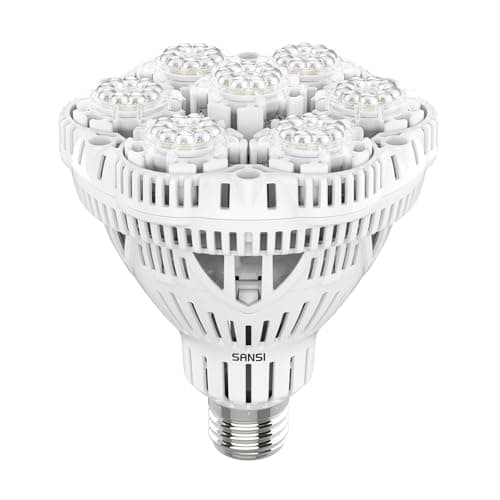
SANSI 36W BR30 Grow Light Bulb
Reviews
SANSI 36W BR30 Grow Light Bulb
65.6 µmol/s and a PPFD at a stated 1 ft — enough to place it by arithmetic.
Top pick
SANSI 36W BR30 Grow Light Bulb
Reviews
Sunco Grow Lights
48.42 µmol/s on the 40 W works out to 1.21 µmol/J. The 80 W publishes nothing.
Top pick
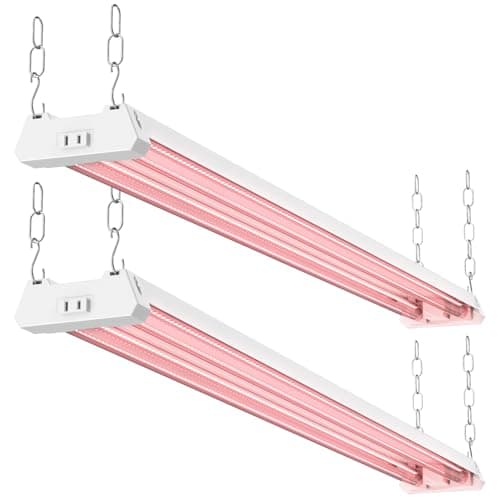
SuncoGrow 4ft 40W Grow Light
Spectrum & PPFD
Full Spectrum vs Red and Blue
White versus blue-plus-red on the published comparison, and why visibility settles it at home.
Top pick
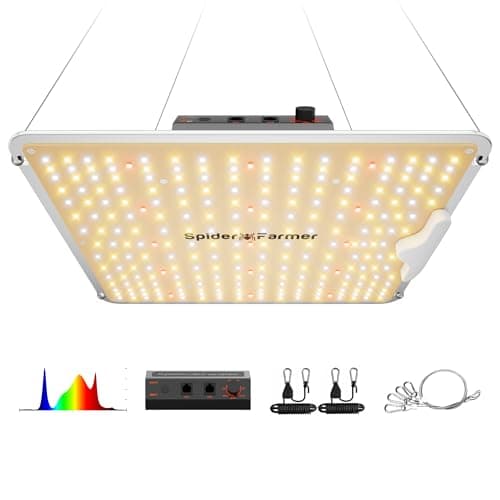
Spider Farmer SF1000
Where this sits
This page belongs to Fixture Reviews and Roundups. Every figure on it is either quoted from a named published source or derived in view — the full method is on our methodology page, and how the site is funded is on the affiliate disclosure.