How Far Should a Grow Light Be From Plants?
Distance is the free adjustment that changes intensity faster than anything else you control. Here is the relationship, and the published numbers.
By Scooter M. — An enthusiast who's genuinely into this. I read the manuals, compile the published specs, and do the math. No lab coat.
Published · How we pick
Photographs on this site are licensed stock and are illustrative of the fixture type. We do not own the units we write about.
How this page is funded: the buy links here are Amazon Associates links, and we earn a commission on qualifying purchases at no extra cost to you. We have not been paid to feature anything on this page, we accept no free product, and commission plays no part in the ranking. Full disclosure.
We have not tested these units. Everything below comes from the manufacturer’s own published specifications, or from arithmetic we have shown our working for. Where a figure is not published, we say so instead of estimating one. Read the method.
Quick picks
Efficacy is photons out per joule in. Where a manufacturer publishes it we quote theirs; where they publish photon output and wattage but not efficacy, we divide and label it as ours; where they publish neither, the cell says so rather than guessing. Tap a row for the full write-up.
| # | Product | Best for | Efficacy | Price |
|---|---|---|---|---|
| 1 | 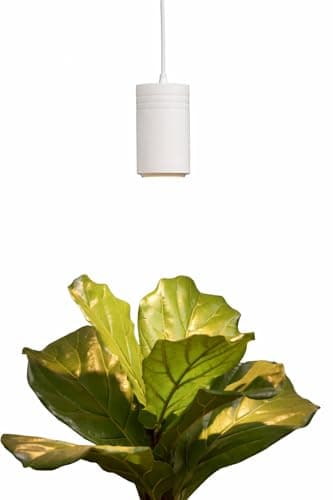 Soltech Aspect Gen 2 The only fixture here you would willingly hang in a living room, and the only one publishing PPFD at three separate distances so it can actually be placed by the numbers. | PPFD at three distances | 1.39 umol/J (ours) | |
| 2 | 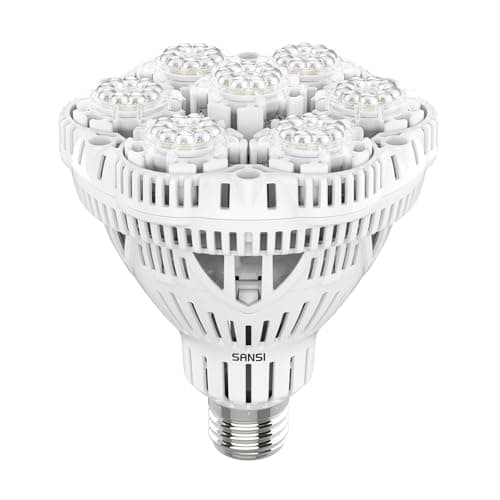 SANSI 36W BR30 Grow Light Bulb The rare grow bulb that publishes both PPF and a PPFD figure with the measurement distance attached, which is the only reason it can be sized honestly. | PPFD at a stated 1 ft | 1.82 umol/J (ours) | |
| 3 | 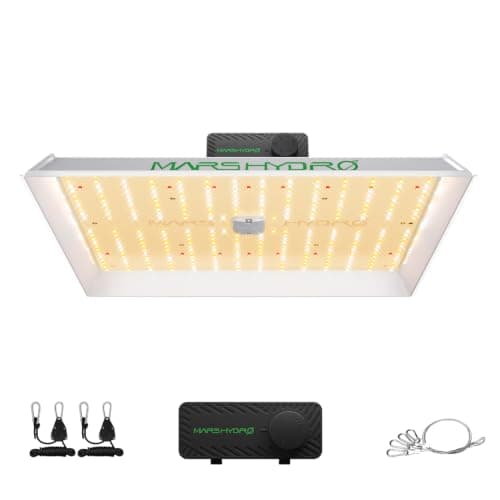 Mars Hydro TS 1000 The most photons of anything on this list, and one of only three fixtures here that publishes both PPF and efficacy so the claim can be checked against itself. | Dimmable instead of raised | 2.3 umol/J |
The reasoning
Hanging height is the most powerful adjustment available to you, it costs nothing, and it is the one most people set once and never revisit. Move a fixture from 12 inches to 6 and the intensity beneath it roughly quadruples. No other free change comes close.
The relationship, and its limits
Light from a compact source spreads over an area that grows with the square of distance, so intensity falls with the square of distance. Double the height, quarter the intensity.
Two honest caveats. First, this holds well for a compact source and less well for a large panel or a long bar close to the plants, where the fixture is not behaving like a point at all. Second, it describes the center of the footprint; the edges change differently, because raising a fixture also widens what it covers.
Where published data exists, it broadly agrees
Soltech is the only manufacturer we cover that publishes PPFD at more than one distance for the Aspect Gen 2: about 50 µmol/m²/s at 1 m, 34.9 at 4 ft (1.22 m), and 15.5 at 6 ft (1.83 m).
From 1.22 m to 1.83 m, the ratio of distances is 1.83 ÷ 1.22 = 1.5, so intensity should fall by 1.5² = 2.25×.
34.9 ÷ 2.25 = 15.5 µmol/m²/s. Soltech publishes 15.5.
The published figures follow the rule essentially exactly across that span, which is a useful confirmation that the arithmetic is not just theory. It also means you can extrapolate their published numbers to a height they did not publish.
Working distances by situation
There is no single correct height; there is a target intensity and a fixture, and the height follows. The table below gives the practical starting points, and the reasoning behind each.
| Situation | Typical height | Why |
|---|---|---|
| Seedlings under bars | 2–4 in | Seedlings stretch permanently within days if intensity is short; bars run cool enough to sit close |
| Seedlings under a panel | 12–18 in | Panels concentrate output; too close creates a bleached hotspot in the middle of the tray |
| Leafy herbs and greens | 8–14 in | High-band targets, but mature tissue tolerates variation far better than a seedling does |
| Foliage houseplants | 12–24 in | Low to medium band; the extra height buys a wider, gentler footprint |
| A tall specimen plant | 24–36 in | You are lighting a canopy, not a point; height buys coverage down the sides |
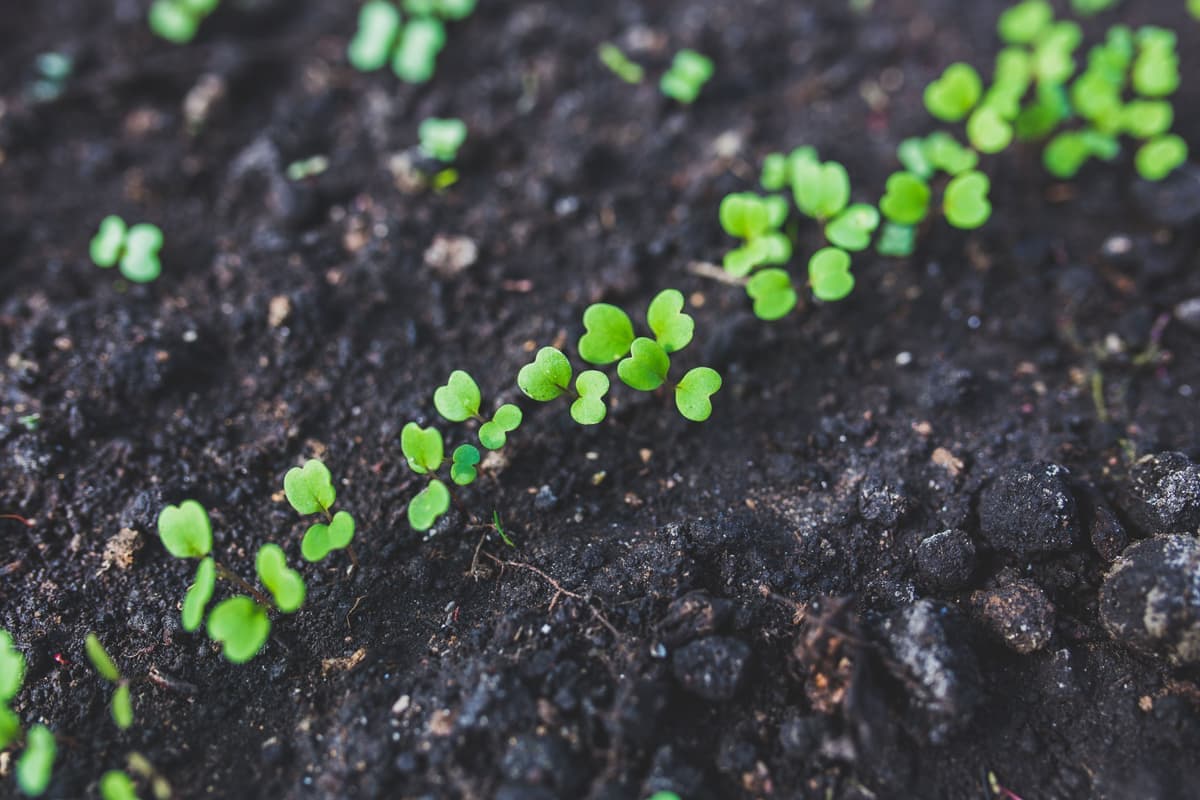
Seedlings are the case where getting this wrong is fastest and most visible, and they have their own page: how far grow lights should be from seedlings.
Dim instead of raise, when you can
Raising a fixture reduces intensity and widens coverage at the same time. Sometimes you want both; often you only want the first. A dimmable fixture lets you cut intensity while keeping the footprint, which is a genuinely better tool for a fixed shelf.
Most panels we cover dim: AC Infinity in 20% steps, VIVOSUN in four levels, Mars Hydro and Spider Farmer via a knob. Barrina strips do not — they are on or off — which on a shelf is fine, because you can simply run fewer strips.
Signs you have it wrong
- Too far: stretched, leggy growth reaching toward the fixture; pale new leaves; wide spacing between leaf nodes. On a seedling this happens within days and does not reverse.
- Too close: bleached or whitened patches directly under the brightest part; crisping at the leaf tips; soil drying much faster in the center of the tray than at the edges.
- Uneven: plants at the edge of the footprint leaning inward while the center grows straight. That is a coverage problem rather than a height one — see bar versus panel coverage.
Every pick in full
Soltech Aspect Gen 2
PendantPPFD at three distances
The only fixture here you would willingly hang in a living room, and the only one publishing PPFD at three separate distances so it can actually be placed by the numbers.
What Soltech publishes
- Power draw
- 36 W (source)
- PPF (photon output)
- 50 umol/s (source)
- PPFD
- about 50 umol/m2/s at 1 m, 34.9 at 4 ft, 15.5 at 6 ft (source)
- Spectrum
- 3000 K warm white, CRI 98 (source)
- Dimming
- Yes, in-line dimmer 10-100% (source)
- Dimensions
- 3.5 x 3.5 x 6.2 inches (source)
- Rated life
- 50,000 hours (source)
Our arithmetic
- Efficacy, computed from the published figures: 1.39 umol/J
50 umol/s / 36 W = 1.39 umol/J. Roughly half the efficacy of a 2.7 umol/J board — the design premium is paid twice, once at purchase and again every month on the meter.
Who should skip it
Skip it if photons per watt is the metric that matters. At 50 umol/s from 36 W it is the least efficient fixture on this page, and much of the price is industrial design.
SANSI 36W BR30 Grow Light Bulb
Grow bulbPPFD at a stated 1 ft
The rare grow bulb that publishes both PPF and a PPFD figure with the measurement distance attached, which is the only reason it can be sized honestly.
What SANSI publishes
- Power draw
- 36 W (source)
- PPF (photon output)
- 65.6 umol/s (source)
- PPFD
- 265.58 umol/m2/s at 1 ft (source)
- Spectrum
- 4000 K, 400-780 nm, CRI close to 100 (source)
- Rated life
- 25,000 hours (source)
Our arithmetic
- Efficacy, computed from the published figures: 1.82 umol/J
65.6 umol/s / 36 W = 1.82 umol/J. That is roughly a third less efficient than the panels on this page — the price of a screw-in form factor. - Electricity used at 12 hours a day for 30 days: 12.96 kWh a month
36 W x 12 h x 30 d / 1000 = 12.96 kWh.
What SANSI does not publish
- Beam angle
- Fixture dimensions
Who should skip it
Skip it if you are lighting more than one plant. 65.6 umol/s is a small amount of light spread over a cone — it lights a single specimen, not a shelf.
Mars Hydro TS 1000
LED panelDimmable instead of raised
The most photons of anything on this list, and one of only three fixtures here that publishes both PPF and efficacy so the claim can be checked against itself.
What Mars Hydro publishes
- Power draw
- 150 W +/-5% at 100-277 V AC (source)
- PPF (photon output)
- 343 umol/s (source)
- Efficacy
- 2.3 umol/J (source)
- Stated coverage
- 2.5 x 2.5 ft vegetative, 2.3 x 2.3 ft flowering (source)
- Spectrum
- 660-665 nm, 730-740 nm, 3000 K, 5000 K (source)
- Diodes
- Bridgelux (source)
- Dimming
- Yes, 0-100% dimmer knob (source)
- Dimensions
- 406 x 326 x 50 mm (source)
Our arithmetic
- Average PPFD across its stated 2.5 x 2.5 ft vegetative footprint: about 470 umol/m2/s
2.5 ft x 2.5 ft = 6.25 sq ft = 0.581 m2. 343 umol/s divided by 0.581 m2 = 590 umol/m2/s at perfect uniformity; applying a 0.8 uniformity factor gives about 472 umol/m2/s average. - Electricity used at 14 hours a day for 30 days: 63.0 kWh a month
150 W x 14 h x 30 d / 1000 = 63.0 kWh.
Who should skip it
Skip it if you are lighting a bookshelf. 343 umol/s concentrated into a 2.5 ft square is far more light than a monstera wants, and you pay 150 W to deliver it.
Questions people actually ask
+How far should an LED grow light be from plants?
+Does light intensity really drop that fast with distance?
+Is it better to raise the light or dim it?
+Can a grow light burn my plants?
Sources
- Soltech — Aspect Gen 2 published specifications — consulted September 2, 2026
- SANSI — BR30 36W grow light bulb product page — consulted September 2, 2026
- University of Minnesota Extension — Lighting for indoor plants and starting seeds — consulted September 2, 2026
- AC Infinity — IONBOARD S22 published specifications — consulted September 2, 2026
- Mars Hydro — TS 1000 published specification table — consulted September 2, 2026
Read next
Seed Starting
How Far Should Grow Lights Be From Seedlings?
Distance by fixture type, in a table, with the inverse-square arithmetic that explains why an inch matters so much.
Top pick
Barrina T5 4ft Grow Light Strips
Coverage & Sizing
PPFD Targets by Plant Type
Published light bands mapped to common indoor plants, with the DLI each implies.
Top pick
GooingTop Clip Grow Light

Coverage & Sizing
Grow Light Coverage Calculator
Put in PPF, area and hours; get PPFD and DLI scored against published extension bands.
Top pick
Mars Hydro TS 1000
Spectrum & PPFD
PAR, PPFD and DLI, Explained
The three photon units, what each measures, and the conversions between them, shown.
Top pick
Spider Farmer SF1000
Where this sits
This page belongs to Coverage and Sizing Math. Every figure on it is either quoted from a named published source or derived in view — the full method is on our methodology page, and how the site is funded is on the affiliate disclosure.