Where to Buy Grow Lights
The listing you buy from is usually not the page with the specification on it. Here is how to shop this category without losing the numbers.
By Scooter M. — An enthusiast who's genuinely into this. I read the manuals, compile the published specs, and do the math. No lab coat.
Published · How we pick
Photographs on this site are licensed stock and are illustrative of the fixture type. We do not own the units we write about.
How this page is funded: the buy links here are Amazon Associates links, and we earn a commission on qualifying purchases at no extra cost to you. We have not been paid to feature anything on this page, we accept no free product, and commission plays no part in the ranking. Full disclosure.
We have not tested these units. Everything below comes from the manufacturer’s own published specifications, or from arithmetic we have shown our working for. Where a figure is not published, we say so instead of estimating one. Read the method.
Quick picks
Efficacy is photons out per joule in. Where a manufacturer publishes it we quote theirs; where they publish photon output and wattage but not efficacy, we divide and label it as ours; where they publish neither, the cell says so rather than guessing. Tap a row for the full write-up.
| # | Product | Best for | Efficacy | Price |
|---|---|---|---|---|
| 1 | 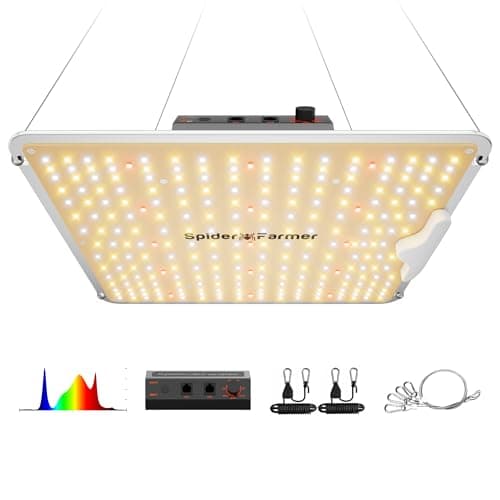 Spider Farmer SF1000 Publishes PPF to two decimal places and an efficacy figure that actually divides out of it. That internal consistency is rarer in this category than it should be. | Full specs on the brand site | 2.5 umol/J | |
| 2 | 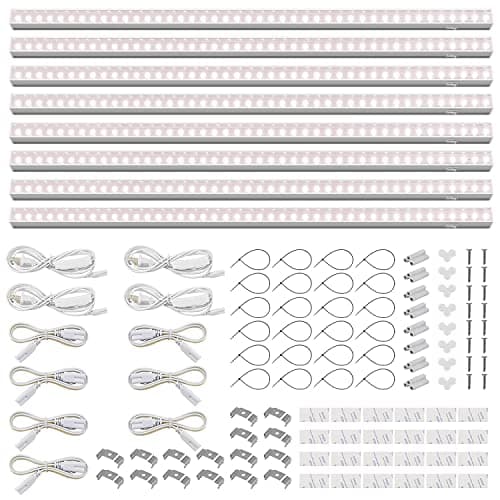 Barrina T5 4ft Grow Light Strips The default seed-starting bar for good reasons — 4 ft long, linkable in series, cheap per foot — and the reason we built a coverage calculator, because Barrina publishes no photon data whatsoever. | Widely stocked | Not published | |
| 3 | 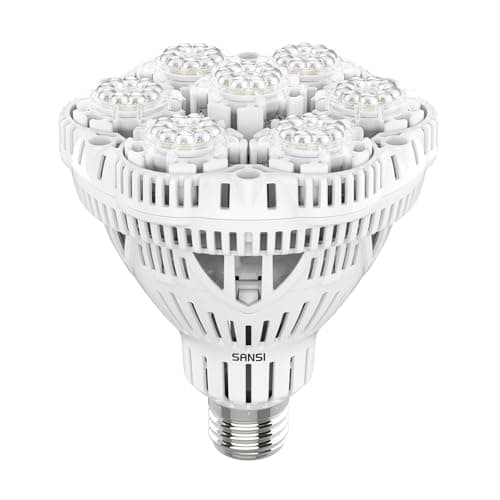 SANSI 36W BR30 Grow Light Bulb The rare grow bulb that publishes both PPF and a PPFD figure with the measurement distance attached, which is the only reason it can be sized honestly. | Standard socket, easy to find | 1.82 umol/J (ours) |
The reasoning
Before anything else: we earn a commission when you buy through the links on this site, at no cost to you. That is how the site is funded and it is stated on every page that carries a link, at the top, before the first one. The full arrangement is on our affiliate disclosure page. It does not change what we rank or what we say is missing from a spec sheet — three of the nine fixtures we cover publish no photon data at all and we say so on every page they appear on, including the ones we recommend.
The problem with buying from a listing
Retail listings are optimized for conversion, not for specification. The figures that actually let you size a fixture — PPF in µmol/s, efficacy in µmol/J, PPFD with a measurement distance — are usually on the manufacturer’s own product page and frequently absent from the retail listing entirely.
What listings substitute instead is the wattage inflation covered in watts versus equivalent watts: a title claiming 1000W attached to a fixture drawing 100 W. Every figure on this site comes from the manufacturer page for exactly this reason, and each is linked at the bottom of the page it appears on.
Manufacturer product pages, linked from the sources block on each page — not retail listings. One exception is the GooingTop clip light, which has no manufacturer spec sheet at all, and we flag that wherever it appears.
How the channels differ
| Channel | Strengths | Weaknesses |
|---|---|---|
| Large online marketplaces | Widest selection, fast returns, most of this category's volume | Listing specs are unreliable; near-identical unbranded fixtures are hard to tell apart |
| Manufacturer direct | The full spec sheet, correct model numbers, first-party warranty | Fewer models, and the price is rarely better |
| Home improvement retailers | You can see the fixture; easy in-person returns | Narrow selection, usually bulbs and shop lights rather than horticultural panels |
| Garden centers | Advice from people who grow things | Very limited stock, and usually the more expensive end |
| Hydroponics specialists | The best product knowledge in the category | Oriented toward tents and commercial scale, not a shelf in a spare room |
How to shop this category properly
- Find the manufacturer’s product page first. Get the PPF and the efficacy from there. If neither exists, you now know something important about the fixture before you have spent anything.
- Size it in the coverage calculator against your actual area, and check the result against your plant’s target.
- Then find the model number wherever it is cheapest. A model number is the thing that carries the specification; the retailer does not change it.
- Check the return window before you buy. With three of nine fixtures publishing no output data, the returns policy is the only recourse if a light turns out to be inadequate.
Watch for these
- Unbranded fixtures with no manufacturer page. If there is no brand site with a spec sheet, there is no specification — only a listing. The GooingTop clip light is in this position, and we say so on its page.
- Model numbers that differ by one character. Brands revise fixtures without renaming them prominently. Match the model exactly to the spec sheet you read.
- Bundles that inflate the price. A hanging kit and a timer are inexpensive separately; check the bundle is actually saving you something.
- Wattage in the title. Covered above. It is almost never the draw.
What we do and do not have a stake in
We link to Amazon, and we earn a commission on qualifying purchases. We are not paid by any manufacturer, we have not been given any product, and nobody has paid for a placement or a ranking on this site — there are no sponsored positions to sell. Where we recommend something whose data is missing, we say the data is missing in the same paragraph. That is the whole arrangement, and it is set out in full on the affiliate disclosure and the editorial policy.
Every pick in full
Spider Farmer SF1000
LED panelFull specs on the brand site
Publishes PPF to two decimal places and an efficacy figure that actually divides out of it. That internal consistency is rarer in this category than it should be.
What Spider Farmer publishes
- Power draw
- 100 W +/-5% at 100-277 V AC (source)
- PPF (photon output)
- 249.21 umol/s (source)
- Efficacy
- 2.5 umol/J (source)
- Stated coverage
- 2 x 2 ft core, 3 x 3 ft maximum (source)
- Spectrum
- 650-665 nm, 730-740 nm, 2800-3000 K, 4800-5000 K (source)
- Diodes
- Bridgelux (source)
- Dimming
- Yes, dimming knob (source)
- Dimensions
- 32.5 x 29.0 x 5.9 cm (source)
- Rated life
- 55,000 hours (source)
Our arithmetic
- Does the published efficacy check out against the published PPF?: Yes — 2.49 umol/J computed against 2.5 umol/J published
249.21 umol/s / 100 W = 2.4921 umol/J. The published 2.5 umol/J is that number rounded. Not every brand's two figures agree like this, which is exactly why we divide them. - Average PPFD across its 2 x 2 ft core footprint: about 536 umol/m2/s
2 ft x 2 ft = 4 sq ft = 0.372 m2. 249.21 / 0.372 = 670 umol/m2/s at perfect uniformity; at a 0.8 uniformity factor, about 536 umol/m2/s.
Who should skip it
Skip it if raw output is what you are buying — the TS 1000 delivers 38% more photons per second, at the cost of 50 W more draw.
Barrina T5 4ft Grow Light Strips
LED barWidely stocked
The default seed-starting bar for good reasons — 4 ft long, linkable in series, cheap per foot — and the reason we built a coverage calculator, because Barrina publishes no photon data whatsoever.
What Barrina publishes
- Power draw
- 20 W per fixture; an 8-pack draws 160 W (source)
- Spectrum
- 5000 K (source)
- Dimming
- No; on/off switch per fixture, linkable up to 8 in series (source)
- Dimensions
- 4 ft strip, 120-degree beam angle, 120 V AC (source)
What Barrina does not publish
- PPF in umol/s — for any strip in the range
- PPFD at any stated distance
- Photon efficacy in umol/J
- LED count per strip, and rated lifespan
Who should skip it
Skip it if you need to know what you are getting before it arrives. There is no published PPF, no PPFD and no efficacy figure, so nothing about its output can be verified in advance.
SANSI 36W BR30 Grow Light Bulb
Grow bulbStandard socket, easy to find
The rare grow bulb that publishes both PPF and a PPFD figure with the measurement distance attached, which is the only reason it can be sized honestly.
What SANSI publishes
- Power draw
- 36 W (source)
- PPF (photon output)
- 65.6 umol/s (source)
- PPFD
- 265.58 umol/m2/s at 1 ft (source)
- Spectrum
- 4000 K, 400-780 nm, CRI close to 100 (source)
- Rated life
- 25,000 hours (source)
Our arithmetic
- Efficacy, computed from the published figures: 1.82 umol/J
65.6 umol/s / 36 W = 1.82 umol/J. That is roughly a third less efficient than the panels on this page — the price of a screw-in form factor. - Electricity used at 12 hours a day for 30 days: 12.96 kWh a month
36 W x 12 h x 30 d / 1000 = 12.96 kWh.
What SANSI does not publish
- Beam angle
- Fixture dimensions
Who should skip it
Skip it if you are lighting more than one plant. 65.6 umol/s is a small amount of light spread over a cone — it lights a single specimen, not a shelf.
Questions people actually ask
+Where is the cheapest place to buy grow lights?
+Should I buy direct from the manufacturer?
+Are grow lights from big box stores any good?
+Do you get paid for these recommendations?
Sources
- Spider Farmer — SF1000 published specification table — consulted September 2, 2026
- Mars Hydro — TS 1000 published specification table — consulted September 2, 2026
- Barrina — T5 ML20 4ft 20W product page — consulted September 2, 2026
- GooingTop clip grow light — retail listing specifications (no manufacturer spec sheet published) — consulted September 2, 2026
- AC Infinity — IONBOARD S22 published specifications — consulted September 2, 2026
Read next
Reviews
T5 vs T8 Grow Lights
What T5 and T8 actually mean, why most are now LED, and how to tell what you are buying.
Top pick
Barrina T5 4ft Grow Light Strips
Reviews
The Best Grow Lights
The main ranking: nine fixtures sorted on published data, with every gap named.
Top pick
Spider Farmer SF1000
Spectrum & PPFD
What “Full Spectrum” Actually Means
The phrase is unregulated and carries no threshold. These are the numbers that replace it.
Top pick
Spider Farmer SF1000

Running Cost
Watts vs Equivalent Watts on Listings
How to find real draw on a listing, and why the headline wattage is usually not it.
Top pick
Spider Farmer SF1000
Reviews
Grow Light Troubleshooting
A diagnostic checklist for failing fixtures and for plants that say something is wrong.
Where this sits
This page belongs to Fixture Reviews and Roundups. Every figure on it is either quoted from a named published source or derived in view — the full method is on our methodology page, and how the site is funded is on the affiliate disclosure.