Watts vs Equivalent Watts on Listings
The number in the product title is frequently not the number your electricity meter will see. Here is how to find the one that is.
By Scooter M. — An enthusiast who's genuinely into this. I read the manuals, compile the published specs, and do the math. No lab coat.
Published · How we pick

Photographs on this site are licensed stock and are illustrative of the fixture type. We do not own the units we write about.
How this page is funded: the buy links here are Amazon Associates links, and we earn a commission on qualifying purchases at no extra cost to you. We have not been paid to feature anything on this page, we accept no free product, and commission plays no part in the ranking. Full disclosure.
We have not tested these units. Everything below comes from the manufacturer’s own published specifications, or from arithmetic we have shown our working for. Where a figure is not published, we say so instead of estimating one. Read the method.
Quick picks
Efficacy is photons out per joule in. Where a manufacturer publishes it we quote theirs; where they publish photon output and wattage but not efficacy, we divide and label it as ours; where they publish neither, the cell says so rather than guessing. Tap a row for the full write-up.
| # | Product | Best for | Efficacy | Price |
|---|---|---|---|---|
| 1 | 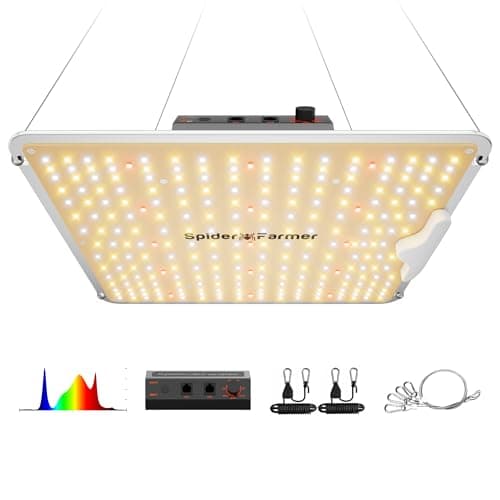 Spider Farmer SF1000 Publishes PPF to two decimal places and an efficacy figure that actually divides out of it. That internal consistency is rarer in this category than it should be. | States 100 W plainly | 2.5 umol/J | |
| 2 | 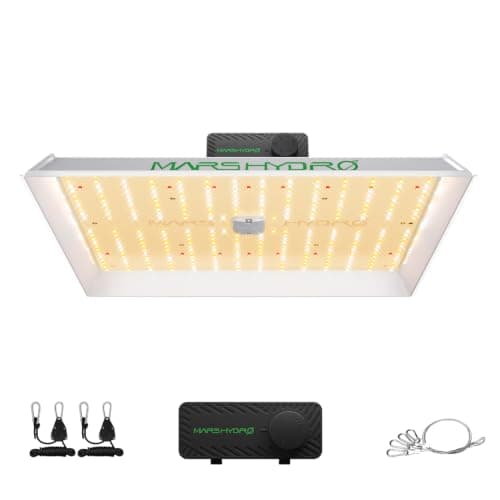 Mars Hydro TS 1000 The most photons of anything on this list, and one of only three fixtures here that publishes both PPF and efficacy so the claim can be checked against itself. | Tolerance published too | 2.3 umol/J | |
| 3 | 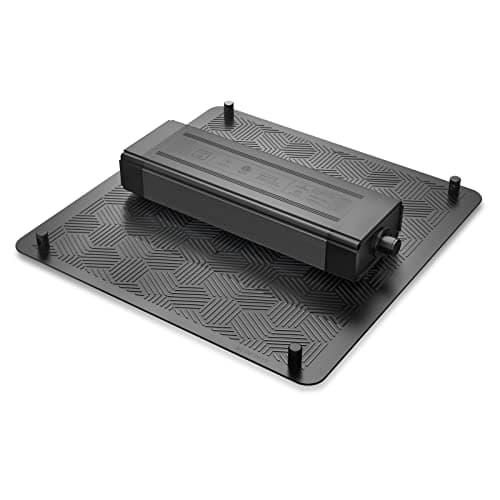 AC Infinity IONBOARD S22 The highest published efficacy of any fixture here at 2.7 umol/J, on Samsung LM301H diodes, with dimming in real 20% steps rather than a vague knob. | 115 W, no ambiguity | 2.7 umol/J |
The reasoning
Search for a grow light and you will find listings titled 1000W, 2000W and 4000W attached to fixtures that draw a small fraction of those numbers. This is not always deceptive — there is a legitimate practice buried in it — but it makes the wattage in a product title useless for the two things you would want it for: predicting your bill and comparing two fixtures.
The three numbers that get called “watts”
| Figure | What it is | Useful for |
|---|---|---|
| Actual draw (rated power) | What the fixture pulls from the outlet | Your bill, and every cost calculation on this site |
| Diode sum | The nominal rating of every diode added together, run well below capacity | Nothing a buyer needs |
| HID-equivalent | A marketing comparison to an HPS or metal halide lamp | Nothing verifiable, unless photon figures accompany it |
The diode sum is where the biggest headline numbers come from: a panel with 100 diodes each nominally rated 10 W might be titled 1000W while drawing 100 W, because the diodes are deliberately run far below their maximum. Running LEDs below capacity is genuinely good engineering — it raises efficacy and extends life — but the resulting number describes a component rating rather than the product.
How to find the real number
- Look for a specification table, not the title. The brands we cover state it clearly there: Spider Farmer publishes 100 W ±5% at 100–277 V, Mars Hydro 150 W ±5%, AC Infinity 115 W.
- Look for the voltage range beside it. A figure quoted with an input voltage range is a real electrical specification. A figure in a title with no units around it usually is not.
- Watch for the word “equivalent.” ViparSpectra describes the P1000 as comparable to a 250 W HPS while the fixture draws 100 W. Both numbers are on the page; only one is electrical.
- Sanity-check against efficacy. If a fixture publishes both PPF and efficacy, PPF divided by efficacy gives the draw. Spider Farmer: 249.21 ÷ 2.5 = 99.7 W, which matches its published 100 W.
Suppose a listing claims 1000 W and also publishes 250 µmol/s of photon output.
250 ÷ 1000 = 0.25 µmol/J — roughly a tenth of what current LED panels achieve, and far below every fixture we cover.
An efficacy that implausible means the wattage is not a draw figure. Working the other way: at a realistic 2.5 µmol/J, 250 µmol/s implies about 100 W of actual draw, which is almost certainly the real number.
Why this matters beyond the bill
Two reasons, and the second is the important one.
First, cost. Every calculation in the running-cost calculator takes actual draw. Enter a headline 1000W and you will get a figure ten times too high and talk yourself out of a purchase that costs eight dollars a month.
Second, sizing. People use wattage as a proxy for output — the old “30 watts per square foot” rule — and inflated wattages break that proxy completely. A 1000W-titled fixture drawing 100 W will underdeliver against that rule by a factor of ten, and you will not find out until the plants tell you. Size on photons instead, as in what size grow light do I need.
What good disclosure looks like
For contrast, the specification lines we would call unambiguous, quoted as published: “100 W ±5% at 100–277 V AC” (Spider Farmer SF1000), “150 W ±5% at 100–277 V AC” (Mars Hydro TS 1000), “115 W” (AC Infinity IONBOARD S22). Each of those is an electrical rating with a tolerance or a voltage range, and each divides sensibly against the brand’s own photon figures.
When you find that, you can compute everything else. When you find only a number in a product title, you have been given a marketing figure and should keep looking.
Every pick in full
Spider Farmer SF1000
LED panelStates 100 W plainly
Publishes PPF to two decimal places and an efficacy figure that actually divides out of it. That internal consistency is rarer in this category than it should be.
What Spider Farmer publishes
- Power draw
- 100 W +/-5% at 100-277 V AC (source)
- PPF (photon output)
- 249.21 umol/s (source)
- Efficacy
- 2.5 umol/J (source)
- Stated coverage
- 2 x 2 ft core, 3 x 3 ft maximum (source)
- Spectrum
- 650-665 nm, 730-740 nm, 2800-3000 K, 4800-5000 K (source)
- Diodes
- Bridgelux (source)
- Dimming
- Yes, dimming knob (source)
- Dimensions
- 32.5 x 29.0 x 5.9 cm (source)
- Rated life
- 55,000 hours (source)
Our arithmetic
- Does the published efficacy check out against the published PPF?: Yes — 2.49 umol/J computed against 2.5 umol/J published
249.21 umol/s / 100 W = 2.4921 umol/J. The published 2.5 umol/J is that number rounded. Not every brand's two figures agree like this, which is exactly why we divide them. - Average PPFD across its 2 x 2 ft core footprint: about 536 umol/m2/s
2 ft x 2 ft = 4 sq ft = 0.372 m2. 249.21 / 0.372 = 670 umol/m2/s at perfect uniformity; at a 0.8 uniformity factor, about 536 umol/m2/s.
Who should skip it
Skip it if raw output is what you are buying — the TS 1000 delivers 38% more photons per second, at the cost of 50 W more draw.
Mars Hydro TS 1000
LED panelTolerance published too
The most photons of anything on this list, and one of only three fixtures here that publishes both PPF and efficacy so the claim can be checked against itself.
What Mars Hydro publishes
- Power draw
- 150 W +/-5% at 100-277 V AC (source)
- PPF (photon output)
- 343 umol/s (source)
- Efficacy
- 2.3 umol/J (source)
- Stated coverage
- 2.5 x 2.5 ft vegetative, 2.3 x 2.3 ft flowering (source)
- Spectrum
- 660-665 nm, 730-740 nm, 3000 K, 5000 K (source)
- Diodes
- Bridgelux (source)
- Dimming
- Yes, 0-100% dimmer knob (source)
- Dimensions
- 406 x 326 x 50 mm (source)
Our arithmetic
- Average PPFD across its stated 2.5 x 2.5 ft vegetative footprint: about 470 umol/m2/s
2.5 ft x 2.5 ft = 6.25 sq ft = 0.581 m2. 343 umol/s divided by 0.581 m2 = 590 umol/m2/s at perfect uniformity; applying a 0.8 uniformity factor gives about 472 umol/m2/s average. - Electricity used at 14 hours a day for 30 days: 63.0 kWh a month
150 W x 14 h x 30 d / 1000 = 63.0 kWh.
Who should skip it
Skip it if you are lighting a bookshelf. 343 umol/s concentrated into a 2.5 ft square is far more light than a monstera wants, and you pay 150 W to deliver it.
AC Infinity IONBOARD S22
LED panel115 W, no ambiguity
The highest published efficacy of any fixture here at 2.7 umol/J, on Samsung LM301H diodes, with dimming in real 20% steps rather than a vague knob.
What AC Infinity publishes
- Power draw
- 115 W (source)
- Efficacy
- 2.7 umol/J (source)
- PPFD
- 1098 PPFD (no measurement distance published) (source)
- Stated coverage
- 2 x 2 ft (source)
- Spectrum
- Samsung LM301H, plus 660 nm, 730 nm, 3000 K, 6500 K (source)
- Diodes
- 272 diodes (source)
- Dimming
- Yes, 0-100% in 20% increments (source)
- Dimensions
- 30.0 x 30.0 cm board, 1.1 cm thick (source)
- Rated life
- 50,000 hours (source)
Our arithmetic
- Photon output implied by the published wattage and efficacy: about 311 umol/s
115 W x 2.7 umol/J = 310.5 umol/s. AC Infinity does not print PPF directly, so this is our arithmetic from two figures it does print.
What AC Infinity does not publish
- PPF in umol/s — only efficacy is given, so photon output has to be derived
- The measurement distance for the 1098 PPFD figure, without which the number cannot be compared to anything
Who should skip it
Skip it if you want to place it by the numbers. AC Infinity prints 1098 PPFD with no measurement distance attached, which makes that figure impossible to use or compare.
Questions people actually ask
+Why do grow lights say 1000W when they only use 100W?
+What wattage should I use for cost calculations?
+How can I tell the real wattage of a grow light?
+Is a higher wattage grow light better?
Sources
- Spider Farmer — SF1000 published specification table — consulted September 2, 2026
- Mars Hydro — TS 1000 published specification table — consulted September 2, 2026
- AC Infinity — IONBOARD S22 published specifications — consulted September 2, 2026
- ViparSpectra — P1000 product page — consulted September 2, 2026
- US Energy Information Administration — Electric Power Monthly, Table 5.3 (US residential average, June 2026) — consulted September 2, 2026
Read next
Running Cost
How Much Electricity Do Grow Lights Use?
Monthly kWh and cost per fixture, and how that compares with household appliances.
Top pick
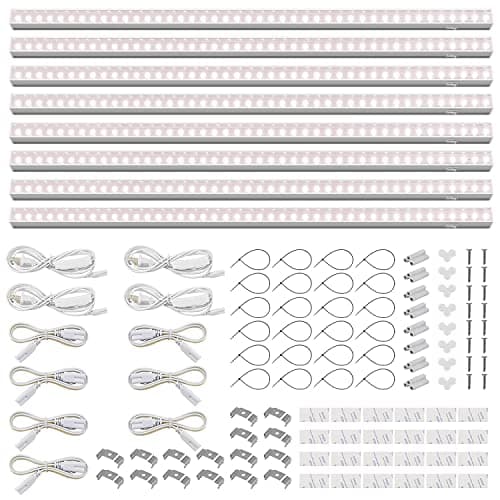
Barrina T5 4ft Grow Light Strips

Running Cost
Grow Light Electricity Cost Calculator
Watts, hours and your own electricity rate, turned into monthly and seasonal cost.
Top pick
AC Infinity IONBOARD S22
Coverage & Sizing
What Size Grow Light Do I Need?
Size from area and target, not from watts. The sum, plus a lookup table by area.
Top pick
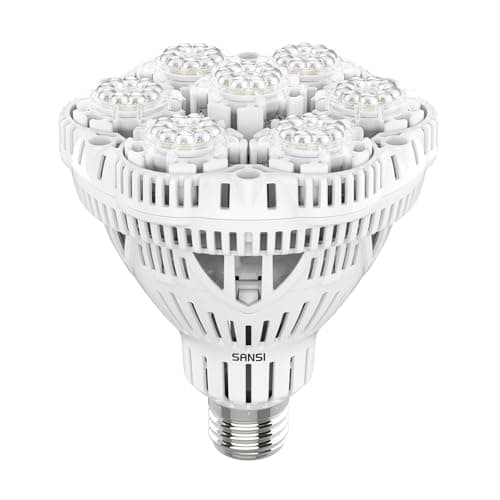
SANSI 36W BR30 Grow Light Bulb
Spectrum & PPFD
What “Full Spectrum” Actually Means
The phrase is unregulated and carries no threshold. These are the numbers that replace it.
Top pick
Spider Farmer SF1000
Where this sits
This page belongs to Running Cost and Efficiency. Every figure on it is either quoted from a named published source or derived in view — the full method is on our methodology page, and how the site is funded is on the affiliate disclosure.