What Size Grow Light Do I Need?
Not a wattage. Start from the area you are lighting and the target your plants want, and the fixture size is the answer to one division.
By Scooter M. — An enthusiast who's genuinely into this. I read the manuals, compile the published specs, and do the math. No lab coat.
Published · How we pick
Photographs on this site are licensed stock and are illustrative of the fixture type. We do not own the units we write about.
How this page is funded: the buy links here are Amazon Associates links, and we earn a commission on qualifying purchases at no extra cost to you. We have not been paid to feature anything on this page, we accept no free product, and commission plays no part in the ranking. Full disclosure.
We have not tested these units. Everything below comes from the manufacturer’s own published specifications, or from arithmetic we have shown our working for. Where a figure is not published, we say so instead of estimating one. Read the method.
Quick picks
Efficacy is photons out per joule in. Where a manufacturer publishes it we quote theirs; where they publish photon output and wattage but not efficacy, we divide and label it as ours; where they publish neither, the cell says so rather than guessing. Tap a row for the full write-up.
| # | Product | Best for | Efficacy | Price |
|---|---|---|---|---|
| 1 | 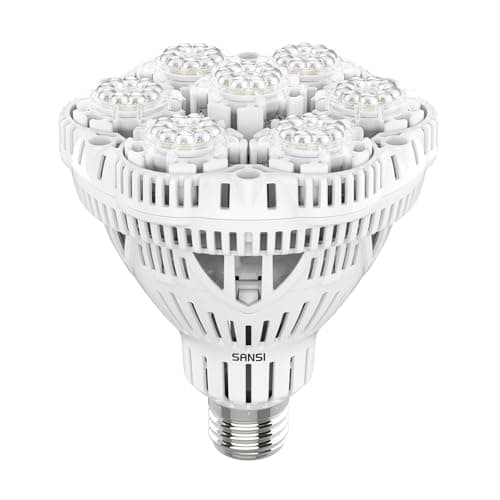 SANSI 36W BR30 Grow Light Bulb The rare grow bulb that publishes both PPF and a PPFD figure with the measurement distance attached, which is the only reason it can be sized honestly. | Up to 1 sq ft | 1.82 umol/J (ours) | |
| 2 | 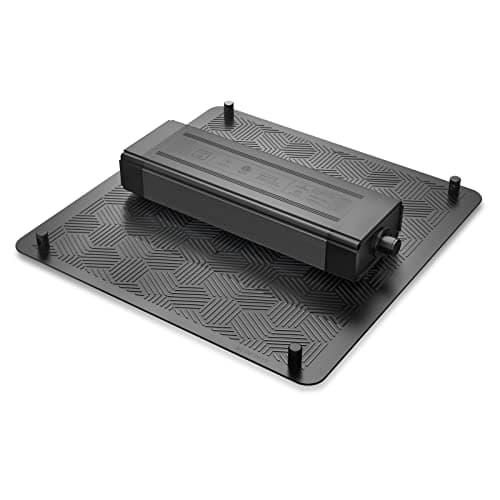 AC Infinity IONBOARD S22 The highest published efficacy of any fixture here at 2.7 umol/J, on Samsung LM301H diodes, with dimming in real 20% steps rather than a vague knob. | 2 × 2 ft | 2.7 umol/J | |
| 3 | 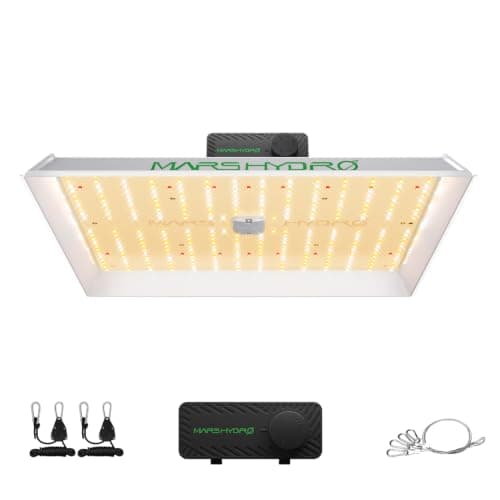 Mars Hydro TS 1000 The most photons of anything on this list, and one of only three fixtures here that publishes both PPF and efficacy so the claim can be checked against itself. | 2 × 3 ft and up | 2.3 umol/J | |
| 4 | 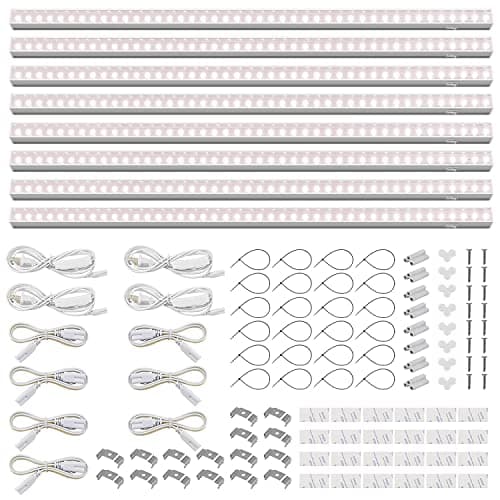 Barrina T5 4ft Grow Light Strips The default seed-starting bar for good reasons — 4 ft long, linkable in series, cheap per foot — and the reason we built a coverage calculator, because Barrina publishes no photon data whatsoever. | Long and shallow | Not published |
The reasoning
Almost every answer to this question online is a wattage: “30 to 50 watts per square foot.” That rule of thumb is a fossil from the era when everyone used the same technology, and it has been unreliable ever since LED efficacy started varying by a factor of two between products. Across the fixtures on this site, efficacy runs from 1.39 to 2.75 µmol/J. A watt from one is worth half a watt from another.
Size on photons instead. The sum is short and it works for every fixture that publishes the one figure you need.
The sizing sum, backwards
The coverage calculator runs the arithmetic forward: photon output in, PPFD out. To size a fixture you run it backwards — start from what you want and solve for the output you need.
Target PPFD from a DLI goal = DLI × 1,000,000 ÷ (hours × 3600)
Area: 6 sq ft = 0.557 m². Herbs sit at the high end of Minnesota’s bands; target 300 µmol/m²/s.
Required PPF = 300 × 0.557 ÷ 0.8 = 209 µmol/s.
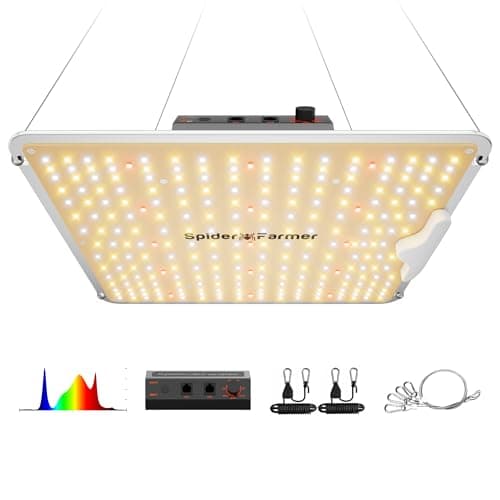
A Spider Farmer SF1000 publishes 249.21 µmol/s, so one covers it with margin. A SANSI BR30 publishes 65.6 µmol/s, so you would need three or four — which is when you stop buying bulbs and buy a panel.
A lookup table, if you would rather not do the sum
Every figure below is computed with the formula above at a 0.8 uniformity factor. Nothing here is a manufacturer claim; it is arithmetic you can repeat.
| Area | m² | Low (100 µmol/m²/s) | Medium (200) | High (350) |
|---|---|---|---|---|
| 1 × 1 ft | 0.093 | 12 µmol/s | 23 µmol/s | 41 µmol/s |
| 2 × 2 ft | 0.372 | 47 µmol/s | 93 µmol/s | 163 µmol/s |
| 2 × 3 ft | 0.557 | 70 µmol/s | 139 µmol/s | 244 µmol/s |
| 2 × 4 ft | 0.743 | 93 µmol/s | 186 µmol/s | 325 µmol/s |
| 3 × 3 ft | 0.836 | 105 µmol/s | 209 µmol/s | 366 µmol/s |
| 4 × 4 ft | 1.486 | 186 µmol/s | 372 µmol/s | 650 µmol/s |
Read across to your target and you have the photon output to shop for. Then check candidate fixtures against what each one actually publishes.
Where the wattage rule goes wrong
The 30 W-per-square-foot rule on a 2 × 3 ft shelf says 180 W.
At 2.7 µmol/J that is 486 µmol/s — more than double the 209 µmol/s our sum called for, so you would buy an oversized fixture and pay to run it.
At 1.39 µmol/J the same 180 W is 250 µmol/s, which is about right.
The rule is not wrong so much as calibrated to an efficacy nobody states. It gives an answer that is off by a factor of two depending on which fixture you buy, and you cannot tell which case you are in without the efficacy figure — at which point you may as well do the photon sum properly.
Three things that change the answer
- Hours. DLI is intensity multiplied by time, so running longer lets you buy less fixture. Going from 12 to 16 hours is a third more daily light with no extra hardware. The cost side is in how much electricity grow lights use.
- Shape. A square panel over a long shelf under-delivers at the ends regardless of what the area sum says. See bar versus panel coverage.
- The plant. A pothos and a chili plant are separated by a factor of four in what they want. The published targets are in PPFD targets by plant type.
The short answer
For most home situations — a shelf, a windowsill, a couple of trays — you need far less fixture than the marketing implies. Something in the 150 to 250 µmol/s range covers a 2 × 3 ft area at a genuinely useful light level, and that is a 60 to 100 W LED. If you have been looking at 1000 W listings, you have been looking at commercial equipment.
Every pick in full
SANSI 36W BR30 Grow Light Bulb
Grow bulbUp to 1 sq ft
The rare grow bulb that publishes both PPF and a PPFD figure with the measurement distance attached, which is the only reason it can be sized honestly.
What SANSI publishes
- Power draw
- 36 W (source)
- PPF (photon output)
- 65.6 umol/s (source)
- PPFD
- 265.58 umol/m2/s at 1 ft (source)
- Spectrum
- 4000 K, 400-780 nm, CRI close to 100 (source)
- Rated life
- 25,000 hours (source)
Our arithmetic
- Efficacy, computed from the published figures: 1.82 umol/J
65.6 umol/s / 36 W = 1.82 umol/J. That is roughly a third less efficient than the panels on this page — the price of a screw-in form factor. - Electricity used at 12 hours a day for 30 days: 12.96 kWh a month
36 W x 12 h x 30 d / 1000 = 12.96 kWh.
What SANSI does not publish
- Beam angle
- Fixture dimensions
Who should skip it
Skip it if you are lighting more than one plant. 65.6 umol/s is a small amount of light spread over a cone — it lights a single specimen, not a shelf.
AC Infinity IONBOARD S22
LED panel2 × 2 ft
The highest published efficacy of any fixture here at 2.7 umol/J, on Samsung LM301H diodes, with dimming in real 20% steps rather than a vague knob.
What AC Infinity publishes
- Power draw
- 115 W (source)
- Efficacy
- 2.7 umol/J (source)
- PPFD
- 1098 PPFD (no measurement distance published) (source)
- Stated coverage
- 2 x 2 ft (source)
- Spectrum
- Samsung LM301H, plus 660 nm, 730 nm, 3000 K, 6500 K (source)
- Diodes
- 272 diodes (source)
- Dimming
- Yes, 0-100% in 20% increments (source)
- Dimensions
- 30.0 x 30.0 cm board, 1.1 cm thick (source)
- Rated life
- 50,000 hours (source)
Our arithmetic
- Photon output implied by the published wattage and efficacy: about 311 umol/s
115 W x 2.7 umol/J = 310.5 umol/s. AC Infinity does not print PPF directly, so this is our arithmetic from two figures it does print.
What AC Infinity does not publish
- PPF in umol/s — only efficacy is given, so photon output has to be derived
- The measurement distance for the 1098 PPFD figure, without which the number cannot be compared to anything
Who should skip it
Skip it if you want to place it by the numbers. AC Infinity prints 1098 PPFD with no measurement distance attached, which makes that figure impossible to use or compare.
Mars Hydro TS 1000
LED panel2 × 3 ft and up
The most photons of anything on this list, and one of only three fixtures here that publishes both PPF and efficacy so the claim can be checked against itself.
What Mars Hydro publishes
- Power draw
- 150 W +/-5% at 100-277 V AC (source)
- PPF (photon output)
- 343 umol/s (source)
- Efficacy
- 2.3 umol/J (source)
- Stated coverage
- 2.5 x 2.5 ft vegetative, 2.3 x 2.3 ft flowering (source)
- Spectrum
- 660-665 nm, 730-740 nm, 3000 K, 5000 K (source)
- Diodes
- Bridgelux (source)
- Dimming
- Yes, 0-100% dimmer knob (source)
- Dimensions
- 406 x 326 x 50 mm (source)
Our arithmetic
- Average PPFD across its stated 2.5 x 2.5 ft vegetative footprint: about 470 umol/m2/s
2.5 ft x 2.5 ft = 6.25 sq ft = 0.581 m2. 343 umol/s divided by 0.581 m2 = 590 umol/m2/s at perfect uniformity; applying a 0.8 uniformity factor gives about 472 umol/m2/s average. - Electricity used at 14 hours a day for 30 days: 63.0 kWh a month
150 W x 14 h x 30 d / 1000 = 63.0 kWh.
Who should skip it
Skip it if you are lighting a bookshelf. 343 umol/s concentrated into a 2.5 ft square is far more light than a monstera wants, and you pay 150 W to deliver it.
Barrina T5 4ft Grow Light Strips
LED barLong and shallow
The default seed-starting bar for good reasons — 4 ft long, linkable in series, cheap per foot — and the reason we built a coverage calculator, because Barrina publishes no photon data whatsoever.
What Barrina publishes
- Power draw
- 20 W per fixture; an 8-pack draws 160 W (source)
- Spectrum
- 5000 K (source)
- Dimming
- No; on/off switch per fixture, linkable up to 8 in series (source)
- Dimensions
- 4 ft strip, 120-degree beam angle, 120 V AC (source)
What Barrina does not publish
- PPF in umol/s — for any strip in the range
- PPFD at any stated distance
- Photon efficacy in umol/J
- LED count per strip, and rated lifespan
Who should skip it
Skip it if you need to know what you are getting before it arrives. There is no published PPF, no PPFD and no efficacy figure, so nothing about its output can be verified in advance.
Questions people actually ask
+How many watts per square foot do I need for a grow light?
+What size grow light for a 2x2 ft space?
+Is a bigger grow light always safer to buy?
+What if my fixture only lists a coverage area?
Sources
- University of Minnesota Extension — Lighting for indoor plants and starting seeds — consulted September 2, 2026
- Virginia Cooperative Extension — Calculating and Using Daily Light Integral (DLI), SPES-720 — consulted September 2, 2026
- Spider Farmer — SF1000 published specification table — consulted September 2, 2026
- SANSI — BR30 36W grow light bulb product page — consulted September 2, 2026
- AC Infinity — IONBOARD S22 published specifications — consulted September 2, 2026
Read next
Reviews
The Best Grow Lights for Beginners
Five first fixtures judged on forgiveness — computable, dimmable, cheap to run — with an honest con each.
Top pick
Spider Farmer SF1000

Coverage & Sizing
Grow Light Coverage Calculator
Put in PPF, area and hours; get PPFD and DLI scored against published extension bands.
Top pick
Mars Hydro TS 1000
Coverage & Sizing
PPFD Targets by Plant Type
Published light bands mapped to common indoor plants, with the DLI each implies.
Top pick
GooingTop Clip Grow Light
Coverage & Sizing
How Many Grow Lights for a 4 × 4 Area?
The photon requirement for a 4 × 4 ft area, and how many of each fixture covers it.
Top pick
Mars Hydro TS 1000
Spectrum & PPFD
PAR, PPFD and DLI, Explained
The three photon units, what each measures, and the conversions between them, shown.
Top pick
Spider Farmer SF1000
Where this sits
This page belongs to Coverage and Sizing Math. Every figure on it is either quoted from a named published source or derived in view — the full method is on our methodology page, and how the site is funded is on the affiliate disclosure.