The Best Grow Lights for Beginners
A first fixture should be forgiving: sizable on paper, dimmable if you overshoot, cheap to run. Judged on that, the field sorts itself out quickly.
By Scooter M. — An enthusiast who's genuinely into this. I read the manuals, compile the published specs, and do the math. No lab coat.
Published · How we pick
Photographs on this site are licensed stock and are illustrative of the fixture type. We do not own the units we write about.
How this page is funded: the buy links here are Amazon Associates links, and we earn a commission on qualifying purchases at no extra cost to you. We have not been paid to feature anything on this page, we accept no free product, and commission plays no part in the ranking. Full disclosure.
We have not tested these units. Everything below comes from the manufacturer’s own published specifications, or from arithmetic we have shown our working for. Where a figure is not published, we say so instead of estimating one. Read the method.
Quick picks
Efficacy is photons out per joule in. Where a manufacturer publishes it we quote theirs; where they publish photon output and wattage but not efficacy, we divide and label it as ours; where they publish neither, the cell says so rather than guessing. Tap a row for the full write-up.
| # | Product | Best for | Efficacy | Price |
|---|---|---|---|---|
| 1 | 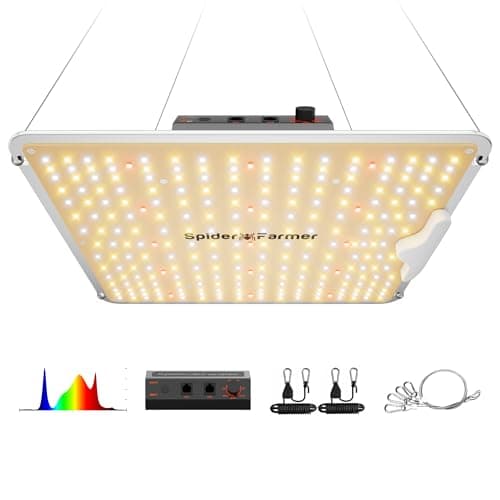 Spider Farmer SF1000 Publishes PPF to two decimal places and an efficacy figure that actually divides out of it. That internal consistency is rarer in this category than it should be. | The first real fixture | 2.5 umol/J | |
| 2 | 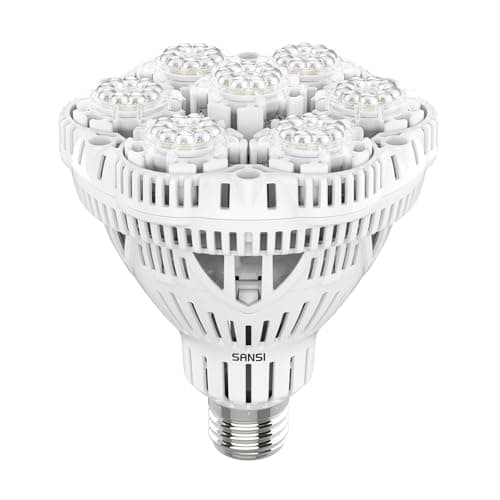 SANSI 36W BR30 Grow Light Bulb The rare grow bulb that publishes both PPF and a PPFD figure with the measurement distance attached, which is the only reason it can be sized honestly. | Lowest commitment | 1.82 umol/J (ours) | |
| 3 | 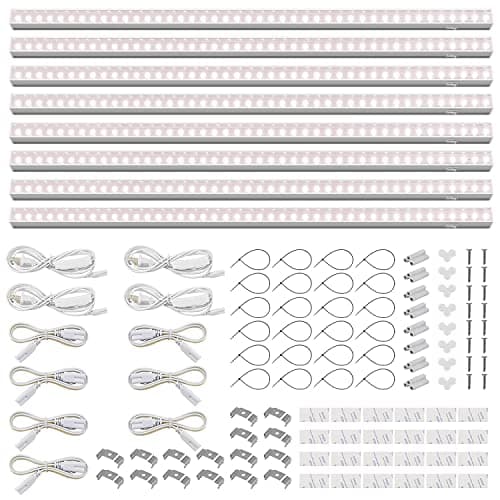 Barrina T5 4ft Grow Light Strips The default seed-starting bar for good reasons — 4 ft long, linkable in series, cheap per foot — and the reason we built a coverage calculator, because Barrina publishes no photon data whatsoever. | First seed shelf | Not published | |
| 4 | 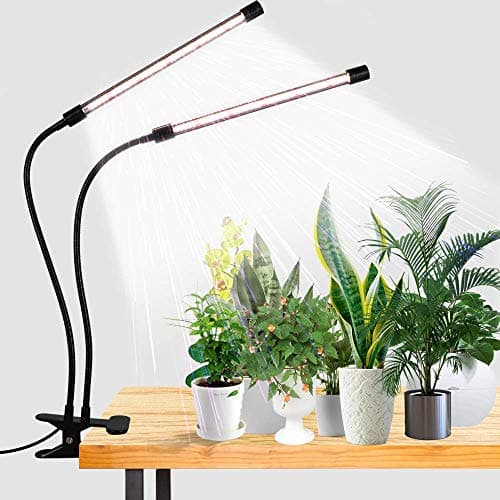 GooingTop Clip Grow Light The cheapest way to put real light on one plant on one desk, and honest about being exactly that — a 10 W clip lamp with a repeating timer. | Trying before deciding | Not published | |
| 5 | 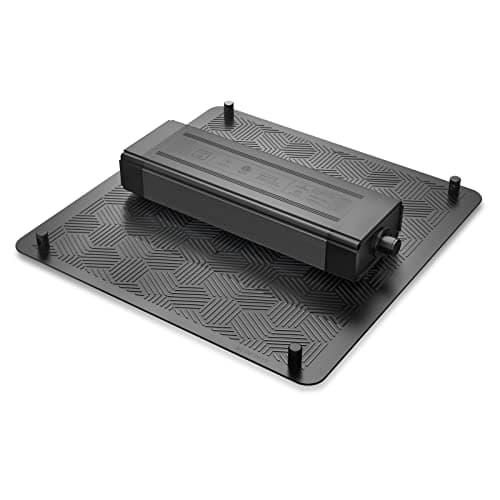 AC Infinity IONBOARD S22 The highest published efficacy of any fixture here at 2.7 umol/J, on Samsung LM301H diodes, with dimming in real 20% steps rather than a vague knob. | If you already know you'll run it all winter | 2.7 umol/J |
The reasoning
A beginner does not need the best grow light. A beginner needs the one that is hardest to get wrong — and that is a different list, because “hard to get wrong” is a property of the disclosure and the controls, not of the output.
Most first-fixture regret comes from three mistakes: buying far more light than the shelf needs, hanging it at the wrong height, and having no way to tell which of those happened. So the criteria below are built around removing those three.
How we judged a first fixture
- Can you size it before you buy? A fixture that publishes photon output can be put into a calculator with your area and checked against a target. One that publishes only a wattage and the words “full spectrum” has to be guessed at, and guessing is how beginners over-buy.
- Can you correct a mistake without buying again? Dimming, or a form factor that adjusts by adding and removing units, means an over-sized fixture is a setting rather than a return.
- Does it fit a space you already have? A beginner has a shelf, a sill or a desk — not a tent with a hanging bar.
- What does a season cost? The running cost should be small enough that the fixture is not a recurring worry.
The SF1000, the SANSI bulb and the AC Infinity board publish enough to compute. The strips and the clip light do not — they are on the list for other reasons, stated plainly.
The three beginner mistakes, and what each costs
| Mistake | What happens | The number |
|---|---|---|
| Buying by wattage | A '1000 W' listing draws 100 W; a 150 W panel over one plant is ten times too much | One square foot at a medium level needs about 23 µmol/s. A 100 W panel publishes ~250 |
| Hanging it too high | Seedlings stretch within days; houseplants slowly stall | Light density falls with the square of distance — 12 in delivers about 1/9 of 4 in |
| No timer | Inconsistent photoperiod; the plant never settles | Iowa State University Extension: 12–14 h generally, 10 floor, 16 ceiling |
1. Spider Farmer SF1000 — the first real fixture
If a beginner is buying one proper panel, this is the one, and the reason is disclosure. Spider Farmer publishes 249.21 µmol/s, 100 W ±5% and 2.5 µmol/J — and those figures confirm each other: 249.21 ÷ 100 = 2.49. That means a beginner can put the number into the coverage calculator with their shelf dimensions and know, before paying, whether it fits.
Over a 2 × 3 ft shelf (0.557 m²): 249.21 ÷ 0.557 × 0.8 = 358 µmol/m²/s — the high band. Right for herbs and greens; too much for foliage plants, so dim it.
Over its full 3 × 3 ft footprint (0.836 m²): 238 µmol/m²/s — which at 14 hours is 12.0 mol/m²/day, the published seedling target almost exactly.
Running cost: 100 W × 14 h × 30 ÷ 1000 = 42 kWh a month = $7.70 at 18.34 cents per kWh.
The con: it has a dimming knob, not stated steps, so “where I had it” is a memory rather than a setting. It also publishes no light density at any stated distance, so height is set by the general rule (12 to 18 inches over seedlings) rather than computed. And it is a square panel — over a long shelf it lights the middle and misses the ends.
2. SANSI 36W BR30 — the lowest commitment
A screw-in bulb for a lamp you already own, which removes mounting from the problem entirely. It is also the only bulb we cover that publishes light density with the measurement distance — 265.58 µmol/m²/s at 1 ft — so a beginner can set the lamp height on paper: 12 inches for a succulent, 18 for a pothos, 14 for a violet.
At 36 W and about $2.38 a month it is the cheapest way to find out whether a plant responds to light before buying anything larger.
The con: 65.6 µmol/s from 36 W is 1.82 µmol/J — a third less efficient than the panels. And it lights one plant. By the third bulb a panel would have been cheaper and better.
3. Barrina T5 4ft strips — the first seed shelf
For a beginner whose project is seedlings on a wire shelf, strips are the right shape: a 4 ft strip over a 4 ft shelf puts light along the whole tray. They link up to 8 on one plug, draw 20 W each, and run cool enough to sit 2 inches from the seedlings. The whole rack, ten weeks, comes to about $25 in electricity.
The con, and for a beginner it is a real one: Barrina publishes no photon flux, no light density and no efficiency figure for any strip. You cannot size them, cannot check them against a target, and cannot compare them to a panel. You buy on shape, hang them close, and judge by the seedlings — which is fine for seedlings, because they report within days, and less fine for a beginner who wants to know what they are getting first.
4. GooingTop clip light — trying before deciding
About 10 W, a gooseneck, a clamp, and a built-in repeating timer. Roughly $4.00 of electricity across an entire October-to-March winter. If the question is “will I actually keep this up,” this answers it for the price of a takeout meal.
The con: there is no manufacturer spec sheet at all. The figures we can report come from the retail listing, which is a weaker source, and nothing about its output can be computed or compared. It lights one small plant, and the built-in timer counts from power-on rather than tracking a clock, so a power cut shifts the schedule.
5. AC Infinity IONBOARD S22 — if you already know
Not the usual first fixture, but the right one for a specific beginner: someone who already knows the light will run 14 hours a day from October to March. It publishes 2.7 µmol/J on named Samsung LM301H diodes — the highest we can attribute to a component — and it dims in stated 20% steps, which is the one dimming spec on this list a beginner can write down and return to.
The con: it publishes a light-density figure of 1098 with no measurement distance, which makes that number unusable, and it publishes no photon flux directly — its ~311 µmol/s is our arithmetic. For one plant it is far too much light; it earns its place over a shelf, not a pot.
Which one, by what you are doing
| Your project | Start with | Why |
|---|---|---|
| One houseplant that is struggling | SANSI BR30 | A lamp you own, placeable by arithmetic, $2.38 a month |
| Not sure yet | GooingTop clip light | Cheapest way to find out whether you will keep it up |
| A shelf of houseplants | Spider Farmer SF1000 | The numbers check out, so you can size the shelf first |
| Seed trays on a wire rack | Barrina T5 strips | Right shape, sits close, one plug for the rack |
| A shelf you will run all winter | AC Infinity IONBOARD S22 | Best efficiency and repeatable dimming |
The beginner setup, in five lines
- Measure the area. Put it and the fixture’s published output into the sizing guide.
- Hang it closer than feels right: 2 to 4 inches for strips over seedlings, 12 to 18 for a panel, 12 to 24 for a bulb over a houseplant.
- Put it on a timer. Twelve to fourteen hours, sixteen for seedlings.
- Step a plant up gradually if it has been in low light — leaves grown in the dark bleach under sudden intensity.
- Watch for stretch (too little) and bleaching (too much), and adjust height before anything else.
The honest verdict
For most beginners, the SF1000 if the project is a shelf and the SANSI bulb if it is a plant. Both can be sized before you pay, which is the thing that separates a first fixture you keep from one you return. The strips are the right answer for seed trays despite publishing nothing, and the clip light is the right answer for “I do not know yet.” Whether any of them is worth buying at all is a fair prior question, and it is answered in are LED grow lights worth it.
Every pick in full
Spider Farmer SF1000
LED panelThe first real fixture
Publishes PPF to two decimal places and an efficacy figure that actually divides out of it. That internal consistency is rarer in this category than it should be.
What Spider Farmer publishes
- Power draw
- 100 W +/-5% at 100-277 V AC (source)
- PPF (photon output)
- 249.21 umol/s (source)
- Efficacy
- 2.5 umol/J (source)
- Stated coverage
- 2 x 2 ft core, 3 x 3 ft maximum (source)
- Spectrum
- 650-665 nm, 730-740 nm, 2800-3000 K, 4800-5000 K (source)
- Diodes
- Bridgelux (source)
- Dimming
- Yes, dimming knob (source)
- Dimensions
- 32.5 x 29.0 x 5.9 cm (source)
- Rated life
- 55,000 hours (source)
Our arithmetic
- Does the published efficacy check out against the published PPF?: Yes — 2.49 umol/J computed against 2.5 umol/J published
249.21 umol/s / 100 W = 2.4921 umol/J. The published 2.5 umol/J is that number rounded. Not every brand's two figures agree like this, which is exactly why we divide them. - Average PPFD across its 2 x 2 ft core footprint: about 536 umol/m2/s
2 ft x 2 ft = 4 sq ft = 0.372 m2. 249.21 / 0.372 = 670 umol/m2/s at perfect uniformity; at a 0.8 uniformity factor, about 536 umol/m2/s.
Who should skip it
Skip it if raw output is what you are buying — the TS 1000 delivers 38% more photons per second, at the cost of 50 W more draw.
SANSI 36W BR30 Grow Light Bulb
Grow bulbLowest commitment
The rare grow bulb that publishes both PPF and a PPFD figure with the measurement distance attached, which is the only reason it can be sized honestly.
What SANSI publishes
- Power draw
- 36 W (source)
- PPF (photon output)
- 65.6 umol/s (source)
- PPFD
- 265.58 umol/m2/s at 1 ft (source)
- Spectrum
- 4000 K, 400-780 nm, CRI close to 100 (source)
- Rated life
- 25,000 hours (source)
Our arithmetic
- Efficacy, computed from the published figures: 1.82 umol/J
65.6 umol/s / 36 W = 1.82 umol/J. That is roughly a third less efficient than the panels on this page — the price of a screw-in form factor. - Electricity used at 12 hours a day for 30 days: 12.96 kWh a month
36 W x 12 h x 30 d / 1000 = 12.96 kWh.
What SANSI does not publish
- Beam angle
- Fixture dimensions
Who should skip it
Skip it if you are lighting more than one plant. 65.6 umol/s is a small amount of light spread over a cone — it lights a single specimen, not a shelf.
Barrina T5 4ft Grow Light Strips
LED barFirst seed shelf
The default seed-starting bar for good reasons — 4 ft long, linkable in series, cheap per foot — and the reason we built a coverage calculator, because Barrina publishes no photon data whatsoever.
What Barrina publishes
- Power draw
- 20 W per fixture; an 8-pack draws 160 W (source)
- Spectrum
- 5000 K (source)
- Dimming
- No; on/off switch per fixture, linkable up to 8 in series (source)
- Dimensions
- 4 ft strip, 120-degree beam angle, 120 V AC (source)
What Barrina does not publish
- PPF in umol/s — for any strip in the range
- PPFD at any stated distance
- Photon efficacy in umol/J
- LED count per strip, and rated lifespan
Who should skip it
Skip it if you need to know what you are getting before it arrives. There is no published PPF, no PPFD and no efficacy figure, so nothing about its output can be verified in advance.
GooingTop Clip Grow Light
Clip lightTrying before deciding
The cheapest way to put real light on one plant on one desk, and honest about being exactly that — a 10 W clip lamp with a repeating timer.
What GooingTop publishes
- Power draw
- About 10 W (source)
- Spectrum
- 6000 K, 74 white plus 10 red LEDs, CRI 95 (source)
- Dimming
- Five brightness levels; repeating 4 / 8 / 12 hour timer (source)
What GooingTop does not publish
- PPF in umol/s
- PPFD at any distance
- Photon efficacy in umol/J
- The manufacturer publishes no spec sheet at all; the figures above come from the retail listing
Who should skip it
Skip it if the plant is more than about a foot across, or if you want any number at all before you buy — nobody publishes photon data for this fixture.
AC Infinity IONBOARD S22
LED panelIf you already know you'll run it all winter
The highest published efficacy of any fixture here at 2.7 umol/J, on Samsung LM301H diodes, with dimming in real 20% steps rather than a vague knob.
What AC Infinity publishes
- Power draw
- 115 W (source)
- Efficacy
- 2.7 umol/J (source)
- PPFD
- 1098 PPFD (no measurement distance published) (source)
- Stated coverage
- 2 x 2 ft (source)
- Spectrum
- Samsung LM301H, plus 660 nm, 730 nm, 3000 K, 6500 K (source)
- Diodes
- 272 diodes (source)
- Dimming
- Yes, 0-100% in 20% increments (source)
- Dimensions
- 30.0 x 30.0 cm board, 1.1 cm thick (source)
- Rated life
- 50,000 hours (source)
Our arithmetic
- Photon output implied by the published wattage and efficacy: about 311 umol/s
115 W x 2.7 umol/J = 310.5 umol/s. AC Infinity does not print PPF directly, so this is our arithmetic from two figures it does print.
What AC Infinity does not publish
- PPF in umol/s — only efficacy is given, so photon output has to be derived
- The measurement distance for the 1098 PPFD figure, without which the number cannot be compared to anything
Who should skip it
Skip it if you want to place it by the numbers. AC Infinity prints 1098 PPFD with no measurement distance attached, which makes that figure impossible to use or compare.
Questions people actually ask
+What is the best grow light for a beginner?
+What size grow light should a beginner buy?
+What mistakes do beginners make with grow lights?
+Should a beginner buy a cheap grow light first?
+Have you tested these lights?
Sources
- Spider Farmer — SF1000 published specification table — consulted September 2, 2026
- SANSI — BR30 36W grow light bulb product page — consulted September 2, 2026
- Barrina — T5 ML20 4ft 20W product page — consulted September 2, 2026
- GooingTop clip grow light — retail listing specifications (no manufacturer spec sheet published) — consulted September 2, 2026
- AC Infinity — IONBOARD S22 published specifications — consulted September 2, 2026
- University of New Hampshire Extension — Growing Seedlings Under Lights — consulted September 2, 2026
- Iowa State University Extension — Important Considerations for Providing Supplemental Light to Indoor Plants — consulted September 2, 2026
- University of Minnesota Extension — Lighting for indoor plants and starting seeds — consulted September 2, 2026
- US Energy Information Administration — Electric Power Monthly, Table 5.3 (US residential average, June 2026) — consulted September 2, 2026
Read next
Reviews
Are LED Grow Lights Worth It?
Do they work, what do they cost, and when to skip one — answered with published figures.
Top pick
Spider Farmer SF1000
Coverage & Sizing
What Size Grow Light Do I Need?
Size from area and target, not from watts. The sum, plus a lookup table by area.
Top pick
SANSI 36W BR30 Grow Light Bulb
Reviews
The Best Grow Lights
The main ranking: nine fixtures sorted on published data, with every gap named.
Top pick
Spider Farmer SF1000
Coverage & Sizing
Grow Light Coverage Calculator
Put in PPF, area and hours; get PPFD and DLI scored against published extension bands.
Top pick
Mars Hydro TS 1000
Where this sits
This page belongs to Fixture Reviews and Roundups. Every figure on it is either quoted from a named published source or derived in view — the full method is on our methodology page, and how the site is funded is on the affiliate disclosure.