The Best Full Spectrum Grow Lights
Every light in this category claims the same label. These are ranked on the numbers underneath it, and on whether the manufacturer publishes any numbers at all.
By Scooter M. — An enthusiast who's genuinely into this. I read the manuals, compile the published specs, and do the math. No lab coat.
Published · How we pick
Photographs on this site are licensed stock and are illustrative of the fixture type. We do not own the units we write about.
How this page is funded: the buy links here are Amazon Associates links, and we earn a commission on qualifying purchases at no extra cost to you. We have not been paid to feature anything on this page, we accept no free product, and commission plays no part in the ranking. Full disclosure.
We have not tested these units. Everything below comes from the manufacturer’s own published specifications, or from arithmetic we have shown our working for. Where a figure is not published, we say so instead of estimating one. Read the method.
Quick picks
Efficacy is photons out per joule in. Where a manufacturer publishes it we quote theirs; where they publish photon output and wattage but not efficacy, we divide and label it as ours; where they publish neither, the cell says so rather than guessing. Tap a row for the full write-up.
| # | Product | Best for | Efficacy | Price |
|---|---|---|---|---|
| 1 | 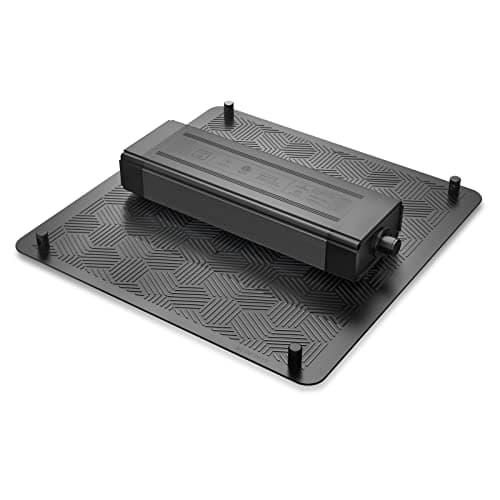 AC Infinity IONBOARD S22 The highest published efficacy of any fixture here at 2.7 umol/J, on Samsung LM301H diodes, with dimming in real 20% steps rather than a vague knob. | Most photons per watt | 2.7 umol/J | |
| 2 | 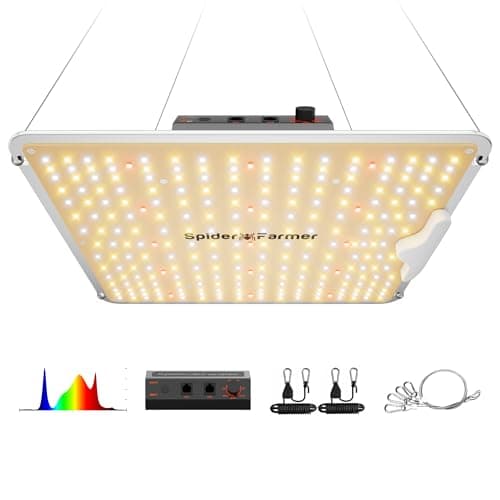 Spider Farmer SF1000 Publishes PPF to two decimal places and an efficacy figure that actually divides out of it. That internal consistency is rarer in this category than it should be. | Numbers that check out | 2.5 umol/J | |
| 3 | 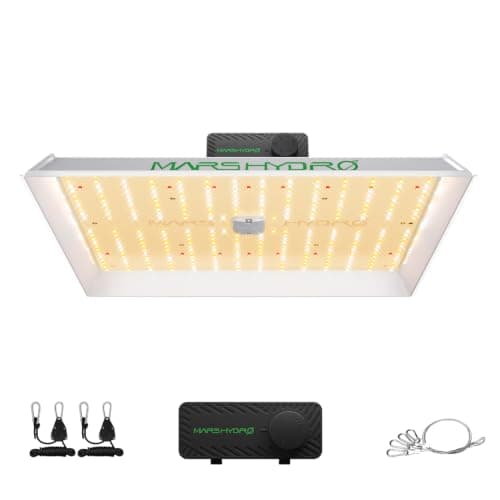 Mars Hydro TS 1000 The most photons of anything on this list, and one of only three fixtures here that publishes both PPF and efficacy so the claim can be checked against itself. | Raw output | 2.3 umol/J | |
| 4 | 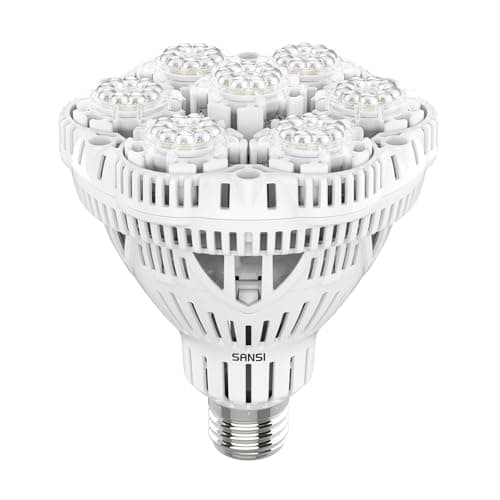 SANSI 36W BR30 Grow Light Bulb The rare grow bulb that publishes both PPF and a PPFD figure with the measurement distance attached, which is the only reason it can be sized honestly. | One plant, one socket | 1.82 umol/J (ours) | |
| 5 | 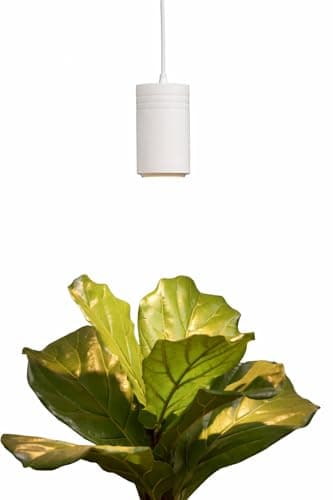 Soltech Aspect Gen 2 The only fixture here you would willingly hang in a living room, and the only one publishing PPFD at three separate distances so it can actually be placed by the numbers. | A room you sit in | 1.39 umol/J (ours) |
The reasoning
“Full spectrum” appears on the box of every fixture on this page, which makes it useless as a way of choosing between them. It is not a regulated term, there is no threshold a light has to clear to use it, and nothing about it tells you how much light arrives at your plant. We take that apart at length in what full spectrum actually means.
So this ranking ignores the phrase entirely and sorts on three things that genuinely differ between these products: how many photons come out per second, how many photons come out per joule of electricity, and — the one that separates the field fastest — whether the manufacturer publishes either figure.
The fifth publishes a wattage and a color temperature and nothing else. That is not a small omission: with no photon figure, no coverage calculation is possible before purchase.
What we ranked on
- Photon efficacy (µmol/J) — photons delivered per joule of electricity. This is the single most useful number on a grow light spec sheet, because it decides both how much light you get and what it costs to keep getting it. Across this page it runs from 1.39 to 2.75, close to a factor of two.
- Photon flux (PPF, µmol/s) — total photons out of the fixture per second. It is the only figure you can divide by an area to predict PPFD, which is why a light that omits it cannot be sized in advance.
- Internal consistency. When a brand publishes both PPF and efficacy, you can divide one by the wattage and see whether it produces the other. Sometimes it does. Sometimes there is no second figure to check against.
The efficacy spread, in one table
Every figure below is either published by the manufacturer or divided out of two figures the manufacturer published, and the arithmetic is shown in the second case.
| Fixture | Rated power | Efficacy (µmol/J) | Where the number comes from |
|---|---|---|---|
| VIVOSUN VS1000 | 100 W | 2.75 | Published by VIVOSUN |
| AC Infinity IONBOARD S22 | 115 W | 2.7 | Published by AC Infinity |
| Spider Farmer SF1000 | 100 W | 2.5 | Published, and it checks out: 249.21 ÷ 100 = 2.49 |
| Mars Hydro TS 1000 | 150 W | 2.3 | Published by Mars Hydro |
| SANSI 36W BR30 | 36 W | 1.82 | Derived by us: 65.6 µmol/s ÷ 36 W |
| Soltech Aspect Gen 2 | 36 W | 1.39 | Derived by us: 50 µmol/s ÷ 36 W |
| Barrina T5 4ft | 20 W per strip | Not published | Barrina publishes no photon data at all |
Why the top pick is not the brightest one
The Mars Hydro TS 1000 puts out more photons per second than anything else here — a published 343 µmol/s against the IONBOARD’s implied 311. It is still third, because the buyer this site is written for is lighting a shelf in a house, not a commercial tent, and at that scale the binding constraint is almost never “can I get enough light.” It is “what does this cost to run from October to March, and can I trust the number on the box.”
VIVOSUN publishes the highest efficacy figure of the lot at 2.75 µmol/J, and it sits below AC Infinity in our order for one reason: VIVOSUN publishes no PPF, so there is no second figure to divide against and the claim has to be taken on trust. AC Infinity’s 2.7 comes with a diode part number and a dimming spec, and its weakness is a different one — a PPFD figure printed with no measurement distance attached, which makes that particular number unusable.
Take two fixtures delivering the same photons: one at 2.7 µmol/J and one at 1.39 µmol/J. To deliver 300 µmol/s, the first draws 300 ÷ 2.7 = 111 W; the second draws 300 ÷ 1.39 = 216 W.
Run both 14 hours a day for five months: 111 × 14 × 150 ÷ 1000 = 233 kWh, against 216 × 14 × 150 ÷ 1000 = 454 kWh.
At the US residential average of 18.34 cents per kWh that is $42.73 against $83.26 — about $40 of difference for the same amount of light, in a single winter. Efficacy is not an abstraction.
Run the same sum against your own tariff in the running-cost calculator, or see the whole field sorted by efficiency in the most efficient grow lights by µmol/J.
The one we cannot rank
Barrina’s 4 ft T5 strips are the most-bought seed-starting fixture in this whole category, and they do not appear in the ranking above because there is nothing to rank them on. We checked the product page directly: no PPF, no PPFD, no efficacy, for any strip in the range. The hardware may well be good — the form factor is right and the price per linear foot is unmatched — but a light whose output is unpublished cannot be compared with one whose output is published, and pretending otherwise would mean inventing data. It is still our top pick for whole shelves of seed trays, on form factor alone, and we say the same thing there.
Does the spectrum itself matter at all?
Less than the marketing implies and more than zero. A peer-reviewed comparison in PLOS ONE by Zhen, van Iersel and colleagues examined white LEDs against blue-plus-red radiation and found white light performs comparably for plant growth while being far easier for a human to work under and judge plant health by. The practical finding for a home grower: a good white LED is not a compromise. The full argument is in full spectrum versus red and blue.
Intensity is the variable that actually decides whether your plant grows, and intensity is a number you can compute. Start with the coverage calculator and check the result against published PPFD targets by plant type.
Every pick in full
AC Infinity IONBOARD S22
LED panelMost photons per watt
The highest published efficacy of any fixture here at 2.7 umol/J, on Samsung LM301H diodes, with dimming in real 20% steps rather than a vague knob.
What AC Infinity publishes
- Power draw
- 115 W (source)
- Efficacy
- 2.7 umol/J (source)
- PPFD
- 1098 PPFD (no measurement distance published) (source)
- Stated coverage
- 2 x 2 ft (source)
- Spectrum
- Samsung LM301H, plus 660 nm, 730 nm, 3000 K, 6500 K (source)
- Diodes
- 272 diodes (source)
- Dimming
- Yes, 0-100% in 20% increments (source)
- Dimensions
- 30.0 x 30.0 cm board, 1.1 cm thick (source)
- Rated life
- 50,000 hours (source)
Our arithmetic
- Photon output implied by the published wattage and efficacy: about 311 umol/s
115 W x 2.7 umol/J = 310.5 umol/s. AC Infinity does not print PPF directly, so this is our arithmetic from two figures it does print.
What AC Infinity does not publish
- PPF in umol/s — only efficacy is given, so photon output has to be derived
- The measurement distance for the 1098 PPFD figure, without which the number cannot be compared to anything
Who should skip it
Skip it if you want to place it by the numbers. AC Infinity prints 1098 PPFD with no measurement distance attached, which makes that figure impossible to use or compare.
Spider Farmer SF1000
LED panelNumbers that check out
Publishes PPF to two decimal places and an efficacy figure that actually divides out of it. That internal consistency is rarer in this category than it should be.
What Spider Farmer publishes
- Power draw
- 100 W +/-5% at 100-277 V AC (source)
- PPF (photon output)
- 249.21 umol/s (source)
- Efficacy
- 2.5 umol/J (source)
- Stated coverage
- 2 x 2 ft core, 3 x 3 ft maximum (source)
- Spectrum
- 650-665 nm, 730-740 nm, 2800-3000 K, 4800-5000 K (source)
- Diodes
- Bridgelux (source)
- Dimming
- Yes, dimming knob (source)
- Dimensions
- 32.5 x 29.0 x 5.9 cm (source)
- Rated life
- 55,000 hours (source)
Our arithmetic
- Does the published efficacy check out against the published PPF?: Yes — 2.49 umol/J computed against 2.5 umol/J published
249.21 umol/s / 100 W = 2.4921 umol/J. The published 2.5 umol/J is that number rounded. Not every brand's two figures agree like this, which is exactly why we divide them. - Average PPFD across its 2 x 2 ft core footprint: about 536 umol/m2/s
2 ft x 2 ft = 4 sq ft = 0.372 m2. 249.21 / 0.372 = 670 umol/m2/s at perfect uniformity; at a 0.8 uniformity factor, about 536 umol/m2/s.
Who should skip it
Skip it if raw output is what you are buying — the TS 1000 delivers 38% more photons per second, at the cost of 50 W more draw.
Mars Hydro TS 1000
LED panelRaw output
The most photons of anything on this list, and one of only three fixtures here that publishes both PPF and efficacy so the claim can be checked against itself.
What Mars Hydro publishes
- Power draw
- 150 W +/-5% at 100-277 V AC (source)
- PPF (photon output)
- 343 umol/s (source)
- Efficacy
- 2.3 umol/J (source)
- Stated coverage
- 2.5 x 2.5 ft vegetative, 2.3 x 2.3 ft flowering (source)
- Spectrum
- 660-665 nm, 730-740 nm, 3000 K, 5000 K (source)
- Diodes
- Bridgelux (source)
- Dimming
- Yes, 0-100% dimmer knob (source)
- Dimensions
- 406 x 326 x 50 mm (source)
Our arithmetic
- Average PPFD across its stated 2.5 x 2.5 ft vegetative footprint: about 470 umol/m2/s
2.5 ft x 2.5 ft = 6.25 sq ft = 0.581 m2. 343 umol/s divided by 0.581 m2 = 590 umol/m2/s at perfect uniformity; applying a 0.8 uniformity factor gives about 472 umol/m2/s average. - Electricity used at 14 hours a day for 30 days: 63.0 kWh a month
150 W x 14 h x 30 d / 1000 = 63.0 kWh.
Who should skip it
Skip it if you are lighting a bookshelf. 343 umol/s concentrated into a 2.5 ft square is far more light than a monstera wants, and you pay 150 W to deliver it.
SANSI 36W BR30 Grow Light Bulb
Grow bulbOne plant, one socket
The rare grow bulb that publishes both PPF and a PPFD figure with the measurement distance attached, which is the only reason it can be sized honestly.
What SANSI publishes
- Power draw
- 36 W (source)
- PPF (photon output)
- 65.6 umol/s (source)
- PPFD
- 265.58 umol/m2/s at 1 ft (source)
- Spectrum
- 4000 K, 400-780 nm, CRI close to 100 (source)
- Rated life
- 25,000 hours (source)
Our arithmetic
- Efficacy, computed from the published figures: 1.82 umol/J
65.6 umol/s / 36 W = 1.82 umol/J. That is roughly a third less efficient than the panels on this page — the price of a screw-in form factor. - Electricity used at 12 hours a day for 30 days: 12.96 kWh a month
36 W x 12 h x 30 d / 1000 = 12.96 kWh.
What SANSI does not publish
- Beam angle
- Fixture dimensions
Who should skip it
Skip it if you are lighting more than one plant. 65.6 umol/s is a small amount of light spread over a cone — it lights a single specimen, not a shelf.
Soltech Aspect Gen 2
PendantA room you sit in
The only fixture here you would willingly hang in a living room, and the only one publishing PPFD at three separate distances so it can actually be placed by the numbers.
What Soltech publishes
- Power draw
- 36 W (source)
- PPF (photon output)
- 50 umol/s (source)
- PPFD
- about 50 umol/m2/s at 1 m, 34.9 at 4 ft, 15.5 at 6 ft (source)
- Spectrum
- 3000 K warm white, CRI 98 (source)
- Dimming
- Yes, in-line dimmer 10-100% (source)
- Dimensions
- 3.5 x 3.5 x 6.2 inches (source)
- Rated life
- 50,000 hours (source)
Our arithmetic
- Efficacy, computed from the published figures: 1.39 umol/J
50 umol/s / 36 W = 1.39 umol/J. Roughly half the efficacy of a 2.7 umol/J board — the design premium is paid twice, once at purchase and again every month on the meter.
Who should skip it
Skip it if photons per watt is the metric that matters. At 50 umol/s from 36 W it is the least efficient fixture on this page, and much of the price is industrial design.
Questions people actually ask
+Is a full spectrum grow light better than a purple one?
+Does 'full spectrum' mean it includes UV?
+Which of these is the best value?
+Have you tested these lights?
Sources
- Zhen & van Iersel et al., PLOS ONE — Spectral effects of LEDs on plant growth, visual color quality and photosynthetic photon efficacy: white versus blue plus red radiation — consulted September 2, 2026
- AC Infinity — IONBOARD S22 published specifications — consulted September 2, 2026
- Spider Farmer — SF1000 published specification table — consulted September 2, 2026
- Mars Hydro — TS 1000 published specification table — consulted September 2, 2026
- VIVOSUN — VS1000 product page — consulted September 2, 2026
- SANSI — BR30 36W grow light bulb product page — consulted September 2, 2026
- Soltech — Aspect Gen 2 published specifications — consulted September 2, 2026
- Barrina — T5 ML20 4ft 20W product page — consulted September 2, 2026
- US Energy Information Administration — Electric Power Monthly, Table 5.3 (US residential average, June 2026) — consulted September 2, 2026
Read next
Spectrum & PPFD
What “Full Spectrum” Actually Means
The phrase is unregulated and carries no threshold. These are the numbers that replace it.
Top pick
Spider Farmer SF1000
Spectrum & PPFD
Full Spectrum vs Red and Blue
White versus blue-plus-red on the published comparison, and why visibility settles it at home.
Top pick
Spider Farmer SF1000

Coverage & Sizing
Grow Light Coverage Calculator
Put in PPF, area and hours; get PPFD and DLI scored against published extension bands.
Top pick
Mars Hydro TS 1000
Running Cost
The Most Efficient Grow Lights by µmol/J
Every fixture we cover ranked on published photon efficacy, with derivations shown.
Where this sits
This page belongs to Spectrum and PPFD, Honestly. Every figure on it is either quoted from a named published source or derived in view — the full method is on our methodology page, and how the site is funded is on the affiliate disclosure.