Full Spectrum vs Red and Blue
White light against the magenta arrays, on the evidence rather than the packaging — and on the one practical difference that decides it for most homes.
By Scooter M. — An enthusiast who's genuinely into this. I read the manuals, compile the published specs, and do the math. No lab coat.
Published · How we pick
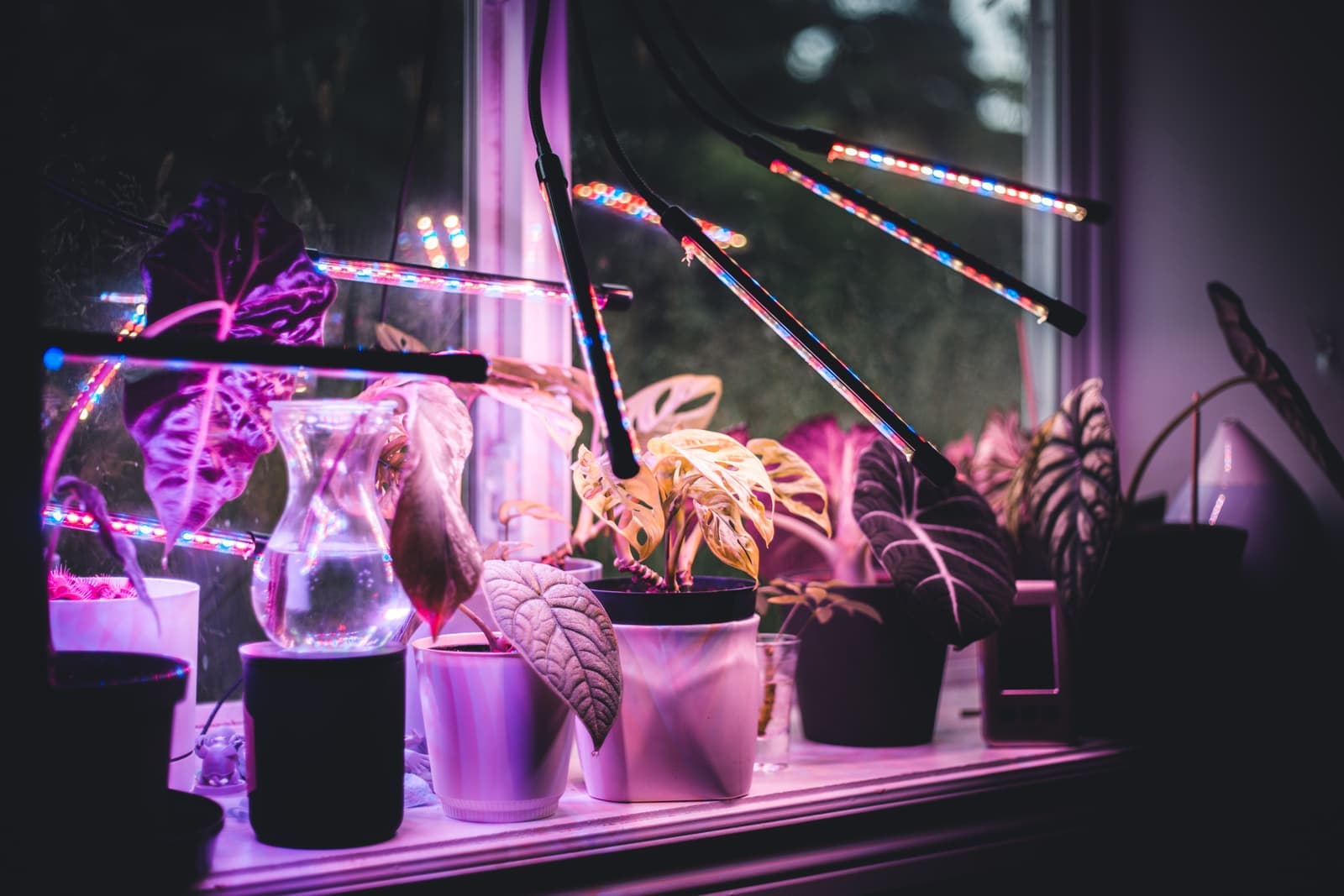
Photographs on this site are licensed stock and are illustrative of the fixture type. We do not own the units we write about.
How this page is funded: the buy links here are Amazon Associates links, and we earn a commission on qualifying purchases at no extra cost to you. We have not been paid to feature anything on this page, we accept no free product, and commission plays no part in the ranking. Full disclosure.
We have not tested these units. Everything below comes from the manufacturer’s own published specifications, or from arithmetic we have shown our working for. Where a figure is not published, we say so instead of estimating one. Read the method.
Quick picks
Efficacy is photons out per joule in. Where a manufacturer publishes it we quote theirs; where they publish photon output and wattage but not efficacy, we divide and label it as ours; where they publish neither, the cell says so rather than guessing. Tap a row for the full write-up.
| # | Product | Best for | Efficacy | Price |
|---|---|---|---|---|
| 1 | 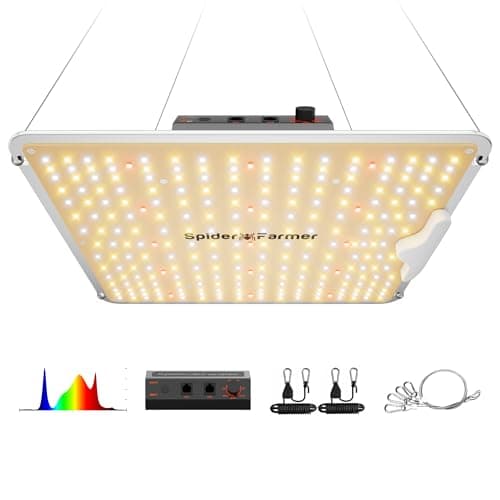 Spider Farmer SF1000 Publishes PPF to two decimal places and an efficacy figure that actually divides out of it. That internal consistency is rarer in this category than it should be. | White, and checkable | 2.5 umol/J | |
| 2 | 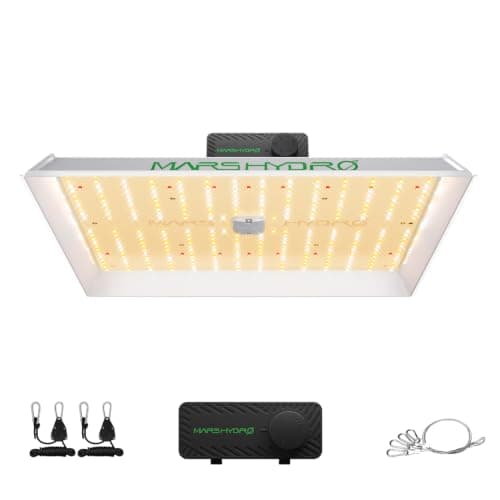 Mars Hydro TS 1000 The most photons of anything on this list, and one of only three fixtures here that publishes both PPF and efficacy so the claim can be checked against itself. | White with far red | 2.3 umol/J | |
| 3 | 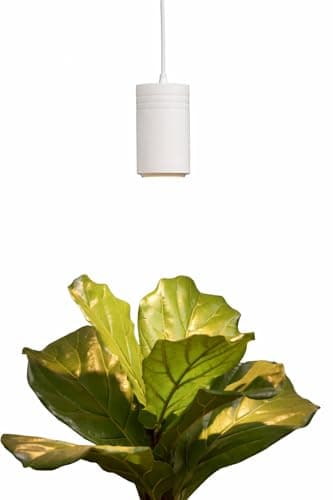 Soltech Aspect Gen 2 The only fixture here you would willingly hang in a living room, and the only one publishing PPFD at three separate distances so it can actually be placed by the numbers. | Warm white in a living room | 1.39 umol/J (ours) |
The reasoning
The two families look completely different and are marketed as though they belong to different technologies. They do not. Both are LEDs; the difference is whether a blue emitter is left bare and paired with red diodes, or covered with a phosphor that converts some of the blue into broad white output.
What the published comparison found
The most useful piece of evidence for a home grower is the PLOS ONE study by Zhen, van Iersel and colleagues, which compared white LEDs with blue-plus-red radiation across plant growth, visual color quality and photosynthetic photon efficacy. Its finding, in the terms that matter here: white light performs comparably for growth while being dramatically better for visual color quality.
That reframes the whole decision. If the growth outcome is broadly a wash, the tiebreakers are practical ones — can you see under it, does it look acceptable in the room, and what does it cost per photon.
| Criterion | White (so-called full spectrum) | Blue + red array |
|---|---|---|
| Growth outcome | Comparable, per the published white-vs-blue+red comparison | Comparable |
| Seeing plant health | Natural color; chlorosis, mites and rot are visible | Effectively impossible — everything reads magenta |
| Living with it in a room | Acceptable in a kitchen, office or living room | A tent product; the glow carries through a house |
| Efficacy on current fixtures | 1.39 to 2.75 µmol/J across the fixtures we cover | Historically higher; the gap has largely closed on modern white diodes |
| Photographing your plants | Fine | Color cast beyond correction |
Where the purple arrays retain an argument
Two, honestly stated. First, a bare blue diode does not lose energy in a phosphor conversion, so narrow-band fixtures historically posted higher efficacy figures; that lead has narrowed as white diodes improved, and the best white board we cover publishes 2.7 µmol/J. Second, if the fixture lives inside a closed tent where nobody looks at it, the visibility argument evaporates and you are buying purely on photons per dollar and per watt.
For the buyer this site is written for — a shelf in a spare room, a windowsill in January, a rack of seed trays in a basement — neither argument applies. You will be looking at these plants.
What most modern fixtures actually do
The interesting development is that the distinction is dissolving. The Mars Hydro TS 1000 publishes a spectrum of 660–665 nm and 730–740 nm alongside 3000 K and 5000 K white; the Spider Farmer SF1000 publishes 650–665 nm and 730–740 nm with 2800–3000 K and 4800–5000 K white. Both are white fixtures with extra red diodes added back in. You are not choosing between families any more; you are choosing how much supplementary red rides along with the white.
“660–665 nm, 730–740 nm, 3000 K, 5000 K” unpacks as: deep red diodes, far-red diodes, warm white phosphor diodes, cool white phosphor diodes.
The two Kelvin figures are white channels — a color temperature, not a wavelength. The two nanometer ranges are discrete red emitters.
What the line does not tell you is the proportion of each, which is what a spectral distribution chart would show. Consumer brands almost never publish one, and we will not estimate the shape of a curve that has not been published.
The decision, compressed
- Plants in a room you use: white, every time. Buy on efficacy and output, not on the phrase. Our picks are in the best full spectrum grow lights.
- A sealed tent nobody looks into: either; buy on µmol/J and µmol/s per dollar.
- Seedlings: intensity dominates the spectrum question completely. See Kelvin versus spectrum for seedlings.
Every pick in full
Spider Farmer SF1000
LED panelWhite, and checkable
Publishes PPF to two decimal places and an efficacy figure that actually divides out of it. That internal consistency is rarer in this category than it should be.
What Spider Farmer publishes
- Power draw
- 100 W +/-5% at 100-277 V AC (source)
- PPF (photon output)
- 249.21 umol/s (source)
- Efficacy
- 2.5 umol/J (source)
- Stated coverage
- 2 x 2 ft core, 3 x 3 ft maximum (source)
- Spectrum
- 650-665 nm, 730-740 nm, 2800-3000 K, 4800-5000 K (source)
- Diodes
- Bridgelux (source)
- Dimming
- Yes, dimming knob (source)
- Dimensions
- 32.5 x 29.0 x 5.9 cm (source)
- Rated life
- 55,000 hours (source)
Our arithmetic
- Does the published efficacy check out against the published PPF?: Yes — 2.49 umol/J computed against 2.5 umol/J published
249.21 umol/s / 100 W = 2.4921 umol/J. The published 2.5 umol/J is that number rounded. Not every brand's two figures agree like this, which is exactly why we divide them. - Average PPFD across its 2 x 2 ft core footprint: about 536 umol/m2/s
2 ft x 2 ft = 4 sq ft = 0.372 m2. 249.21 / 0.372 = 670 umol/m2/s at perfect uniformity; at a 0.8 uniformity factor, about 536 umol/m2/s.
Who should skip it
Skip it if raw output is what you are buying — the TS 1000 delivers 38% more photons per second, at the cost of 50 W more draw.
Mars Hydro TS 1000
LED panelWhite with far red
The most photons of anything on this list, and one of only three fixtures here that publishes both PPF and efficacy so the claim can be checked against itself.
What Mars Hydro publishes
- Power draw
- 150 W +/-5% at 100-277 V AC (source)
- PPF (photon output)
- 343 umol/s (source)
- Efficacy
- 2.3 umol/J (source)
- Stated coverage
- 2.5 x 2.5 ft vegetative, 2.3 x 2.3 ft flowering (source)
- Spectrum
- 660-665 nm, 730-740 nm, 3000 K, 5000 K (source)
- Diodes
- Bridgelux (source)
- Dimming
- Yes, 0-100% dimmer knob (source)
- Dimensions
- 406 x 326 x 50 mm (source)
Our arithmetic
- Average PPFD across its stated 2.5 x 2.5 ft vegetative footprint: about 470 umol/m2/s
2.5 ft x 2.5 ft = 6.25 sq ft = 0.581 m2. 343 umol/s divided by 0.581 m2 = 590 umol/m2/s at perfect uniformity; applying a 0.8 uniformity factor gives about 472 umol/m2/s average. - Electricity used at 14 hours a day for 30 days: 63.0 kWh a month
150 W x 14 h x 30 d / 1000 = 63.0 kWh.
Who should skip it
Skip it if you are lighting a bookshelf. 343 umol/s concentrated into a 2.5 ft square is far more light than a monstera wants, and you pay 150 W to deliver it.
Soltech Aspect Gen 2
PendantWarm white in a living room
The only fixture here you would willingly hang in a living room, and the only one publishing PPFD at three separate distances so it can actually be placed by the numbers.
What Soltech publishes
- Power draw
- 36 W (source)
- PPF (photon output)
- 50 umol/s (source)
- PPFD
- about 50 umol/m2/s at 1 m, 34.9 at 4 ft, 15.5 at 6 ft (source)
- Spectrum
- 3000 K warm white, CRI 98 (source)
- Dimming
- Yes, in-line dimmer 10-100% (source)
- Dimensions
- 3.5 x 3.5 x 6.2 inches (source)
- Rated life
- 50,000 hours (source)
Our arithmetic
- Efficacy, computed from the published figures: 1.39 umol/J
50 umol/s / 36 W = 1.39 umol/J. Roughly half the efficacy of a 2.7 umol/J board — the design premium is paid twice, once at purchase and again every month on the meter.
Who should skip it
Skip it if photons per watt is the metric that matters. At 50 umol/s from 36 W it is the least efficient fixture on this page, and much of the price is industrial design.
Questions people actually ask
+Do plants grow better under purple light?
+Why do commercial growers use pink or purple lights then?
+Is a white LED shop light the same as a white grow light?
Sources
- Zhen & van Iersel et al., PLOS ONE — Spectral effects of LEDs on plant growth, visual color quality and photosynthetic photon efficacy: white versus blue plus red radiation — consulted September 2, 2026
- Mars Hydro — TS 1000 published specification table — consulted September 2, 2026
- Spider Farmer — SF1000 published specification table — consulted September 2, 2026
- AC Infinity — IONBOARD S22 published specifications — consulted September 2, 2026
- University of Minnesota Extension — Lighting for indoor plants and starting seeds — consulted September 2, 2026
Read next
Spectrum & PPFD
What “Full Spectrum” Actually Means
The phrase is unregulated and carries no threshold. These are the numbers that replace it.
Top pick
Spider Farmer SF1000
Spectrum & PPFD
The Best Full Spectrum Grow Lights
Five fixtures ranked on published photon output and efficacy, because the words on the box are identical.
Top pick
AC Infinity IONBOARD S22
Spectrum & PPFD
Kelvin vs Spectrum for Seedlings
What Kelvin measures, what it does not, and why intensity settles the seedling question.
Top pick
Barrina T5 4ft Grow Light Strips
Houseplants
The Best Grow Lights for Indoor Plants
Sized to a 3-10 mol/m2/day houseplant target rather than a grow-tent target, with running cost for each.
Top pick
SANSI 36W BR30 Grow Light Bulb
Where this sits
This page belongs to Spectrum and PPFD, Honestly. Every figure on it is either quoted from a named published source or derived in view — the full method is on our methodology page, and how the site is funded is on the affiliate disclosure.