Grow Light Hours Per Day, by Plant
What the extension services actually recommend, why the dark period is not optional, and what each extra hour costs you.
By Scooter M. — An enthusiast who's genuinely into this. I read the manuals, compile the published specs, and do the math. No lab coat.
Published · How we pick
Photographs on this site are licensed stock and are illustrative of the fixture type. We do not own the units we write about.
How this page is funded: the buy links here are Amazon Associates links, and we earn a commission on qualifying purchases at no extra cost to you. We have not been paid to feature anything on this page, we accept no free product, and commission plays no part in the ranking. Full disclosure.
We have not tested these units. Everything below comes from the manufacturer’s own published specifications, or from arithmetic we have shown our working for. Where a figure is not published, we say so instead of estimating one. Read the method.
Quick picks
Efficacy is photons out per joule in. Where a manufacturer publishes it we quote theirs; where they publish photon output and wattage but not efficacy, we divide and label it as ours; where they publish neither, the cell says so rather than guessing. Tap a row for the full write-up.
| # | Product | Best for | Efficacy | Price |
|---|---|---|---|---|
| 1 | 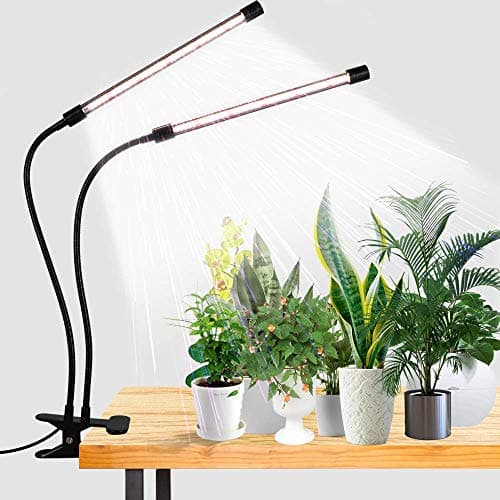 GooingTop Clip Grow Light The cheapest way to put real light on one plant on one desk, and honest about being exactly that — a 10 W clip lamp with a repeating timer. | Built-in repeating timer | Not published | |
| 2 | 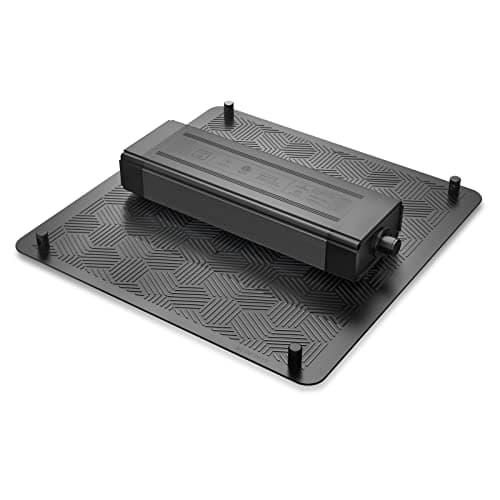 AC Infinity IONBOARD S22 The highest published efficacy of any fixture here at 2.7 umol/J, on Samsung LM301H diodes, with dimming in real 20% steps rather than a vague knob. | Dim and schedule | 2.7 umol/J | |
| 3 | 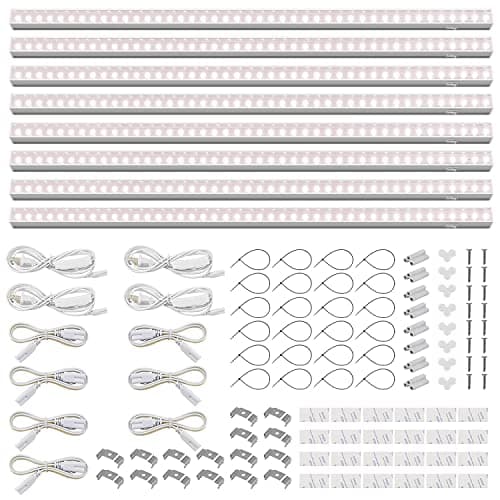 Barrina T5 4ft Grow Light Strips The default seed-starting bar for good reasons — 4 ft long, linkable in series, cheap per foot — and the reason we built a coverage calculator, because Barrina publishes no photon data whatsoever. | One timer, eight strips | Not published |
The reasoning
Photoperiod is the cheapest lever you have. Adding two hours to a fixture’s run time raises the daily light integral by the same proportion as buying a substantially larger light, and costs a few dollars a season instead of a purchase. It is also the setting most people never touch after installing a timer once.
What the published guidance says
Three extension services give figures for indoor lighting, and they overlap rather than agree exactly — which is worth stating plainly rather than averaging away.
| Source | Guidance | Applies to |
|---|---|---|
| University of Minnesota Extension | 16 to 18 hours a day | Seedlings |
| Iowa State University Extension | 12 to 14 hours generally; 10 hours as a floor, 16 as a ceiling for home growers | Indoor plants under supplemental light |
| University of New Hampshire Extension | About 12 mol/m²/day as a target, which sets the hours once you know your intensity | Seedlings under lights |
The reconciliation is straightforward: seedlings want the top of the range, established foliage plants want the middle, and every plant wants a genuine dark period.
Practical settings by plant
| Plant | Hours | Reasoning |
|---|---|---|
| Seedlings and transplants | 14–16 | Highest daily-total demand of anything a home grower runs; extension guidance clusters at the top of the range |
| Leafy herbs and salad greens | 14–16 | Growth rate is the whole point; long photoperiods suit them |
| Microgreens | 12–16 | A short crop; the hours mostly decide how fast you harvest |
| Foliage houseplants | 10–12 | Supplementing rather than replacing daylight; more than this is usually wasted |
| Succulents and cacti | 12–14 | High intensity matters more than long hours for these |
| Winter supplementation of a windowsill | 6–10 | You are topping up daylight, not substituting for it; run it around the natural day |
The dark period is not optional
Running a light 24 hours a day is a mistake people make in good faith, reasoning that more light means more growth. Plants carry out processes during darkness that do not happen in light, and continuous illumination is a stressor rather than a bonus. It also doubles your electricity cost against a 12-hour schedule for no gain.
Consistency matters too: plants respond to the length and regularity of the photoperiod, so a timer beats remembering. The cheapest mechanical timer works. Some fixtures include one — the GooingTop clip light has a repeating 4, 8 and 12-hour cycle built in.
What an extra hour costs
A 100 W fixture, run for an extra 2 hours a day: 100 × 2 ÷ 1000 = 0.2 kWh a day.
Over a five-month winter (about 150 days): 0.2 × 150 = 30 kWh.
At the US residential average of 18.34 cents per kWh: $5.50 for the season.
Those two hours are a 14% to 20% increase in daily light integral depending on your baseline. There is no hardware purchase that buys that much extra light for $5.50.
Price your own schedule in the running-cost calculator, and see how hours convert into daily light integral in PPFD targets by plant type.
When to run them
For plants that get no daylight, the schedule is arbitrary — pick hours that suit you and keep them consistent. Running overnight is worth considering if your utility has time-of-use pricing, and it also keeps a bright fixture out of your eyes during the evening.
For supplementing a window, extend the natural day rather than overlapping it: an hour or two before sunrise and after sunset adds more than running at midday, when the window is already delivering.
Every pick in full
GooingTop Clip Grow Light
Clip lightBuilt-in repeating timer
The cheapest way to put real light on one plant on one desk, and honest about being exactly that — a 10 W clip lamp with a repeating timer.
What GooingTop publishes
- Power draw
- About 10 W (source)
- Spectrum
- 6000 K, 74 white plus 10 red LEDs, CRI 95 (source)
- Dimming
- Five brightness levels; repeating 4 / 8 / 12 hour timer (source)
What GooingTop does not publish
- PPF in umol/s
- PPFD at any distance
- Photon efficacy in umol/J
- The manufacturer publishes no spec sheet at all; the figures above come from the retail listing
Who should skip it
Skip it if the plant is more than about a foot across, or if you want any number at all before you buy — nobody publishes photon data for this fixture.
AC Infinity IONBOARD S22
LED panelDim and schedule
The highest published efficacy of any fixture here at 2.7 umol/J, on Samsung LM301H diodes, with dimming in real 20% steps rather than a vague knob.
What AC Infinity publishes
- Power draw
- 115 W (source)
- Efficacy
- 2.7 umol/J (source)
- PPFD
- 1098 PPFD (no measurement distance published) (source)
- Stated coverage
- 2 x 2 ft (source)
- Spectrum
- Samsung LM301H, plus 660 nm, 730 nm, 3000 K, 6500 K (source)
- Diodes
- 272 diodes (source)
- Dimming
- Yes, 0-100% in 20% increments (source)
- Dimensions
- 30.0 x 30.0 cm board, 1.1 cm thick (source)
- Rated life
- 50,000 hours (source)
Our arithmetic
- Photon output implied by the published wattage and efficacy: about 311 umol/s
115 W x 2.7 umol/J = 310.5 umol/s. AC Infinity does not print PPF directly, so this is our arithmetic from two figures it does print.
What AC Infinity does not publish
- PPF in umol/s — only efficacy is given, so photon output has to be derived
- The measurement distance for the 1098 PPFD figure, without which the number cannot be compared to anything
Who should skip it
Skip it if you want to place it by the numbers. AC Infinity prints 1098 PPFD with no measurement distance attached, which makes that figure impossible to use or compare.
Barrina T5 4ft Grow Light Strips
LED barOne timer, eight strips
The default seed-starting bar for good reasons — 4 ft long, linkable in series, cheap per foot — and the reason we built a coverage calculator, because Barrina publishes no photon data whatsoever.
What Barrina publishes
- Power draw
- 20 W per fixture; an 8-pack draws 160 W (source)
- Spectrum
- 5000 K (source)
- Dimming
- No; on/off switch per fixture, linkable up to 8 in series (source)
- Dimensions
- 4 ft strip, 120-degree beam angle, 120 V AC (source)
What Barrina does not publish
- PPF in umol/s — for any strip in the range
- PPFD at any stated distance
- Photon efficacy in umol/J
- LED count per strip, and rated lifespan
Who should skip it
Skip it if you need to know what you are getting before it arrives. There is no published PPF, no PPFD and no efficacy figure, so nothing about its output can be verified in advance.
Questions people actually ask
+How many hours a day should a grow light be on?
+Can I leave a grow light on 24 hours a day?
+Do I need a timer?
+Is it better to run a light for longer or make it brighter?
Sources
- University of Minnesota Extension — Lighting for indoor plants and starting seeds — consulted September 2, 2026
- Iowa State University Extension — Important Considerations for Providing Supplemental Light to Indoor Plants — consulted September 2, 2026
- University of New Hampshire Extension — Growing Seedlings Under Lights — consulted September 2, 2026
- US Energy Information Administration — Electric Power Monthly, Table 5.3 (US residential average, June 2026) — consulted September 2, 2026
- GooingTop clip grow light — retail listing specifications (no manufacturer spec sheet published) — consulted September 2, 2026
Read next
Coverage & Sizing
Grow Lights With Timers
Built-in versus external timers, the failure mode nobody mentions, and what to set.
Top pick
GooingTop Clip Grow Light
Coverage & Sizing
PPFD Targets by Plant Type
Published light bands mapped to common indoor plants, with the DLI each implies.
Top pick
GooingTop Clip Grow Light
Running Cost
Grow Light Electricity Cost Calculator
Watts, hours and your own electricity rate, turned into monthly and seasonal cost.
Top pick
AC Infinity IONBOARD S22
Seed Starting
How Much Light Do Seedlings Actually Need?
The 12 mol/m2/day seedling target, converted into the PPFD and hours you can actually set.
Top pick
Spider Farmer SF1000
Coverage & Sizing
Grow Light Coverage Calculator
Put in PPF, area and hours; get PPFD and DLI scored against published extension bands.
Top pick
Mars Hydro TS 1000
Where this sits
This page belongs to Coverage and Sizing Math. Every figure on it is either quoted from a named published source or derived in view — the full method is on our methodology page, and how the site is funded is on the affiliate disclosure.