Grow Lights With Timers
A built-in timer sounds like the obvious feature to buy for. For anything larger than one plant, the cheap external one is genuinely better — here is the reasoning.
By Scooter M. — An enthusiast who's genuinely into this. I read the manuals, compile the published specs, and do the math. No lab coat.
Published · How we pick
Photographs on this site are licensed stock and are illustrative of the fixture type. We do not own the units we write about.
How this page is funded: the buy links here are Amazon Associates links, and we earn a commission on qualifying purchases at no extra cost to you. We have not been paid to feature anything on this page, we accept no free product, and commission plays no part in the ranking. Full disclosure.
We have not tested these units. Everything below comes from the manufacturer’s own published specifications, or from arithmetic we have shown our working for. Where a figure is not published, we say so instead of estimating one. Read the method.
Quick picks
Efficacy is photons out per joule in. Where a manufacturer publishes it we quote theirs; where they publish photon output and wattage but not efficacy, we divide and label it as ours; where they publish neither, the cell says so rather than guessing. Tap a row for the full write-up.
| # | Product | Best for | Efficacy | Price |
|---|---|---|---|---|
| 1 | 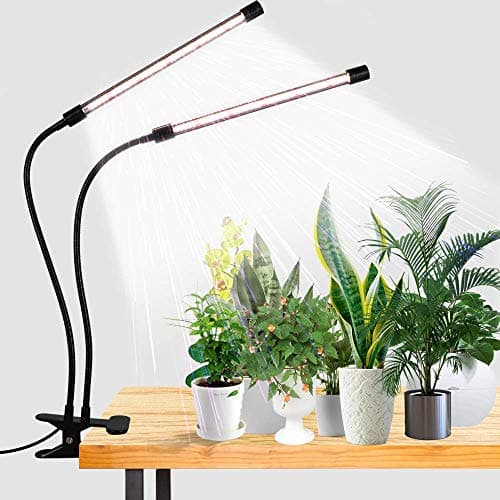 GooingTop Clip Grow Light The cheapest way to put real light on one plant on one desk, and honest about being exactly that — a 10 W clip lamp with a repeating timer. | Timer in the fixture | Not published | |
| 2 | 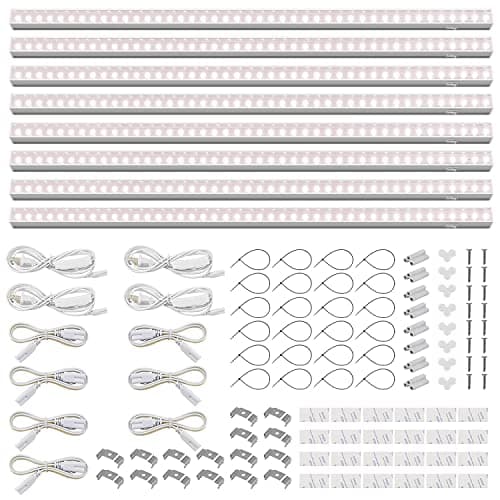 Barrina T5 4ft Grow Light Strips The default seed-starting bar for good reasons — 4 ft long, linkable in series, cheap per foot — and the reason we built a coverage calculator, because Barrina publishes no photon data whatsoever. | One timer, eight strips | Not published | |
| 3 | 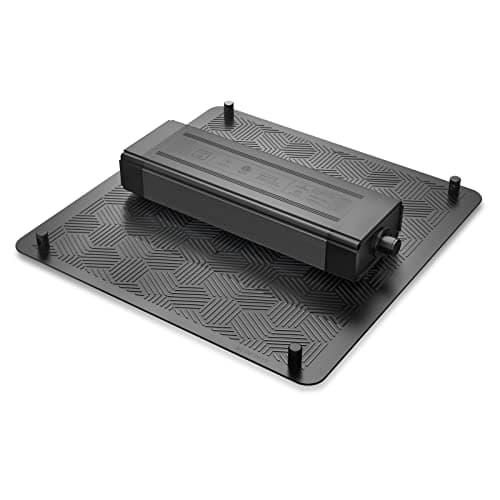 AC Infinity IONBOARD S22 The highest published efficacy of any fixture here at 2.7 umol/J, on Samsung LM301H diodes, with dimming in real 20% steps rather than a vague knob. | Repeatable dim levels | 2.7 umol/J |
The reasoning
Timing is the one part of running a grow light that no human does reliably. Plants respond to a consistent photoperiod, and consistency over a five-month winter is not something anyone achieves by remembering. So a timer is not an accessory — it is the part that makes the rest work.
What is worth questioning is where the timer should live.
The GooingTop clip light, with a repeating 4, 8 or 12-hour cycle. Every other fixture we cover expects you to supply the timing externally.
The built-in timer, and its one real flaw
The GooingTop clip light publishes a repeating 4, 8 and 12-hour cycle. For its actual use case — one plant on a desk, no shelf to mount under, no socket free — that is genuinely convenient. Nothing extra to buy, nothing extra to plug in.
The flaw is structural rather than a defect: a repeating cycle counts from the moment you switch it on, rather than tracking a clock. Turn it on at 8am and the cycle runs from 8am. Have a power interruption at 3pm, and when the power returns the whole schedule has shifted by however long the outage lasted. Nothing warns you; the plant simply gets a different photoperiod from then on.
For one plant that drift is harmless. For a rack of seedlings, where photoperiod consistency is doing real work, it is the kind of silent change you would rather not have.
Why the external timer usually wins
| Built-in (repeating cycle) | External plug timer | |
|---|---|---|
| Schedule type | Counts from power-on; drifts after any interruption | Tracks a clock; the same hours every day |
| Fixtures controlled | One — the fixture it is built into | Everything on the outlet. Barrina links up to 8 strips on one plug |
| Choice of hours | Whatever the manufacturer chose (4 / 8 / 12) | Any schedule you like, including split periods |
| If the fixture is replaced | The timer goes with it | You keep it |
| Cost | Included | A few dollars, once |
| Failure mode | Timer fails, fixture is scrap | Timer fails, swap it — the fixture is fine |
That last row is the underrated one. Cheap mechanical timers fail more often than grow lights do — it is the first thing we tell people to bypass when a light will not turn on, in grow light troubleshooting. When the timer is a separate object, that is a two-dollar problem. When it is inside the fixture, it is a new fixture.
Where a linked run makes it decisive
The strongest case for external timing is a rack. Barrina publishes a limit of 8 strips in series, which is 160 W on a single plug. One timer on that outlet controls the entire three-shelf setup.
ViparSpectra publishes a daisy chain of up to 20 fixtures, which is the same idea at panel scale. In both cases the timing problem collapses to a single device — which is precisely the arrangement a per-fixture built-in timer cannot give you.
What to actually set it to
The published guidance clusters rather than agreeing exactly, so here is what each source says and how we read it.
| Source | Guidance | Applies to |
|---|---|---|
| University of Minnesota Extension | 16 to 18 hours a day | Seedlings |
| Iowa State University Extension | 12 to 14 hours; 10 as a floor, 16 as a ceiling | Indoor plants under supplemental light |
| University of New Hampshire Extension | About 12 mol/m²/day as the target, which sets the hours once intensity is known | Seedlings under lights |
Our practical settings: 14 to 16 hours for seedlings and leafy greens, 12 for foliage houseplants, 6 to 10 when supplementing a window rather than replacing it. The by-plant breakdown is in grow light hours per day by plant.
Never 24 hours
It is a mistake people make in good faith — more light, more growth. Plants carry out processes during darkness that do not happen in light, so continuous illumination is a stressor rather than a bonus, and it doubles your electricity cost against a 12-hour schedule for nothing in return.
Hours are the cheapest light you can buy
Because daily light integral is intensity multiplied by time, adding hours is interchangeable with buying a bigger fixture — and far cheaper.
A 100 W fixture, two additional hours: 100 × 2 ÷ 1000 = 0.2 kWh a day.
Over a five-month winter (about 150 days): 30 kWh.
At 18.34 cents per kWh: $5.50 for the season.
Those two hours raise daily light integral by 14 to 20% depending on your baseline. There is no hardware purchase that buys that much extra light for $5.50 — which is the entire argument for setting the timer generously before buying a larger light.
When to run it
- Plants with no daylight: the schedule is arbitrary. Pick hours that suit you and keep them consistent.
- Supplementing a window: extend the natural day rather than overlapping it. An hour or two before sunrise and after sunset adds more than running at midday, when the window is already delivering.
- Time-of-use electricity: shift to the cheap window. Plants are indifferent to which hours they get, as long as the cycle is consistent.
- A bright fixture in a living room: run it while the room is empty. That also removes the eye-exposure question covered in are grow lights safe for eyes and pets.
The honest summary
Do not choose a grow light on whether it has a timer. Choose it on whether it fits your space and publishes enough for you to size it, then spend a few dollars on an external timer that tracks a clock and controls everything on the outlet. The one exception is a single desk plant, where the built-in cycle on a clip light is genuinely the simplest thing that works.
Every pick in full
GooingTop Clip Grow Light
Clip lightTimer in the fixture
The cheapest way to put real light on one plant on one desk, and honest about being exactly that — a 10 W clip lamp with a repeating timer.
What GooingTop publishes
- Power draw
- About 10 W (source)
- Spectrum
- 6000 K, 74 white plus 10 red LEDs, CRI 95 (source)
- Dimming
- Five brightness levels; repeating 4 / 8 / 12 hour timer (source)
What GooingTop does not publish
- PPF in umol/s
- PPFD at any distance
- Photon efficacy in umol/J
- The manufacturer publishes no spec sheet at all; the figures above come from the retail listing
Who should skip it
Skip it if the plant is more than about a foot across, or if you want any number at all before you buy — nobody publishes photon data for this fixture.
Barrina T5 4ft Grow Light Strips
LED barOne timer, eight strips
The default seed-starting bar for good reasons — 4 ft long, linkable in series, cheap per foot — and the reason we built a coverage calculator, because Barrina publishes no photon data whatsoever.
What Barrina publishes
- Power draw
- 20 W per fixture; an 8-pack draws 160 W (source)
- Spectrum
- 5000 K (source)
- Dimming
- No; on/off switch per fixture, linkable up to 8 in series (source)
- Dimensions
- 4 ft strip, 120-degree beam angle, 120 V AC (source)
What Barrina does not publish
- PPF in umol/s — for any strip in the range
- PPFD at any stated distance
- Photon efficacy in umol/J
- LED count per strip, and rated lifespan
Who should skip it
Skip it if you need to know what you are getting before it arrives. There is no published PPF, no PPFD and no efficacy figure, so nothing about its output can be verified in advance.
AC Infinity IONBOARD S22
LED panelRepeatable dim levels
The highest published efficacy of any fixture here at 2.7 umol/J, on Samsung LM301H diodes, with dimming in real 20% steps rather than a vague knob.
What AC Infinity publishes
- Power draw
- 115 W (source)
- Efficacy
- 2.7 umol/J (source)
- PPFD
- 1098 PPFD (no measurement distance published) (source)
- Stated coverage
- 2 x 2 ft (source)
- Spectrum
- Samsung LM301H, plus 660 nm, 730 nm, 3000 K, 6500 K (source)
- Diodes
- 272 diodes (source)
- Dimming
- Yes, 0-100% in 20% increments (source)
- Dimensions
- 30.0 x 30.0 cm board, 1.1 cm thick (source)
- Rated life
- 50,000 hours (source)
Our arithmetic
- Photon output implied by the published wattage and efficacy: about 311 umol/s
115 W x 2.7 umol/J = 310.5 umol/s. AC Infinity does not print PPF directly, so this is our arithmetic from two figures it does print.
What AC Infinity does not publish
- PPF in umol/s — only efficacy is given, so photon output has to be derived
- The measurement distance for the 1098 PPFD figure, without which the number cannot be compared to anything
Who should skip it
Skip it if you want to place it by the numbers. AC Infinity prints 1098 PPFD with no measurement distance attached, which makes that figure impossible to use or compare.
Questions people actually ask
+Do I need a grow light with a built-in timer?
+What is wrong with a repeating built-in timer?
+How many hours should I set the timer for?
+Can I run grow lights 24 hours a day?
+Is it cheaper to run the light longer or buy a bigger one?
Sources
- University of Minnesota Extension — Lighting for indoor plants and starting seeds — consulted September 2, 2026
- Iowa State University Extension — Important Considerations for Providing Supplemental Light to Indoor Plants — consulted September 2, 2026
- University of New Hampshire Extension — Growing Seedlings Under Lights — consulted September 2, 2026
- GooingTop clip grow light — retail listing specifications (no manufacturer spec sheet published) — consulted September 2, 2026
- Barrina — T5 ML20 4ft 20W product page — consulted September 2, 2026
- ViparSpectra — P1000 product page — consulted September 2, 2026
- US Energy Information Administration — Electric Power Monthly, Table 5.3 (US residential average, June 2026) — consulted September 2, 2026
Read next
Coverage & Sizing
Grow Light Hours Per Day, by Plant
Published photoperiod guidance by plant, plus the cost of each additional hour.
Top pick
GooingTop Clip Grow Light
Running Cost
Grow Light Electricity Cost Calculator
Watts, hours and your own electricity rate, turned into monthly and seasonal cost.
Top pick
AC Infinity IONBOARD S22
Seed Starting
How Much Light Do Seedlings Actually Need?
The 12 mol/m2/day seedling target, converted into the PPFD and hours you can actually set.
Top pick
Spider Farmer SF1000
Coverage & Sizing
Grow Light Coverage Calculator
Put in PPF, area and hours; get PPFD and DLI scored against published extension bands.
Top pick
Mars Hydro TS 1000
Where this sits
This page belongs to Coverage and Sizing Math. Every figure on it is either quoted from a named published source or derived in view — the full method is on our methodology page, and how the site is funded is on the affiliate disclosure.