SANSI 36W BR30 Grow Light Bulb
The only bulb we cover that publishes a PPFD figure with the measurement distance attached, which is the only thing that makes a PPFD figure useful.
By Scooter M. — An enthusiast who's genuinely into this. I read the manuals, compile the published specs, and do the math. No lab coat.
Published · How we pick
Photographs on this site are licensed stock and are illustrative of the fixture type. We do not own the units we write about.
How this page is funded: the buy links here are Amazon Associates links, and we earn a commission on qualifying purchases at no extra cost to you. We have not been paid to feature anything on this page, we accept no free product, and commission plays no part in the ranking. Full disclosure.
We have not tested these units. Everything below comes from the manufacturer’s own published specifications, or from arithmetic we have shown our working for. Where a figure is not published, we say so instead of estimating one. Read the method.
The reasoning
We have not tested this bulb. SANSI, unusually for the bulb segment, publishes enough that we do not entirely need to: 36 W, 65.6 µmol/s of photon output, and — the important one — 265.58 µmol/m²/s at 1 ft, with the distance stated.
Why the stated distance is the whole story
A PPFD figure without a distance is decoration. AC Infinity publishes “1098 PPFD” for a board with no measurement distance; that number cannot be used to place the fixture or compare it to anything. SANSI publishes a smaller number with the distance attached, which makes it a tool.
Published: 265.58 µmol/m²/s at 1 ft. Intensity falls with roughly the square of distance.
At 18 in (1.5 ft): 265.58 × (1 ÷ 1.5)² = 118.
At 2 ft: 265.58 × (1 ÷ 2)² = 66.
At 6 in (0.5 ft): 265.58 × (1 ÷ 0.5)² = 1,062.
So: a foot away puts a plant at the top of Minnesota Extension’s high band; eighteen inches puts it in the low band; two feet is barely above the floor of the low band. That is a placement decision you can make before you buy anything.
265.58 µmol/m²/s at 1 ft, scaled by the inverse-square relationship, crosses 200 µmol/m²/s at about 13 inches and 150 at about 15 inches.
The efficacy trade-off
65.6 µmol/s ÷ 36 W = 1.82 µmol/J.
The panels we cover publish 2.3 to 2.75. So the bulb is roughly a third less efficient than a panel, per watt.
That is the price of an E26 socket. You are paying it in exchange for being able to use a lamp you already own, and for not hanging a fixture.
What it is genuinely for
One plant. 65.6 µmol/s is a small amount of light spread into a cone: enough to properly serve a single specimen at close range, and not enough to light a shelf. Trying to cover a collection with several of these is how people end up spending more than a panel would have cost, at two-thirds the efficiency.
| Situation | Verdict | Why |
|---|---|---|
| One houseplant beside a lamp you own | Ideal | No new fixture, no hanging, computable placement |
| A specimen plant in a living room | Good | 4000 K with CRI close to 100 looks like ordinary light |
| Three or four plants on a shelf | Poor | You need three or four bulbs; a panel is cheaper and more efficient |
| Seed trays | No | Wrong shape entirely — a cone over a rectangle |
The color rendering detail
SANSI publishes 4000 K across 400–780 nm with a CRI close to 100. That is a genuine practical advantage in a living room: the light looks normal, and you can see the actual color of your plants, which is how you notice problems. It is the same argument that runs through full spectrum versus red and blue.
Running cost
36 W at 12 hours a day is 12.96 kWh a month, about $2.38 at the US residential average. Across an October-to-March winter, roughly $14.42. At that level running cost is not a consideration.
Who should buy it
Anyone with one plant and a lamp. It is the lowest-friction way to add real, computable light to a single specimen, and the only bulb we cover whose placement you can work out on paper first.
The fixture in full
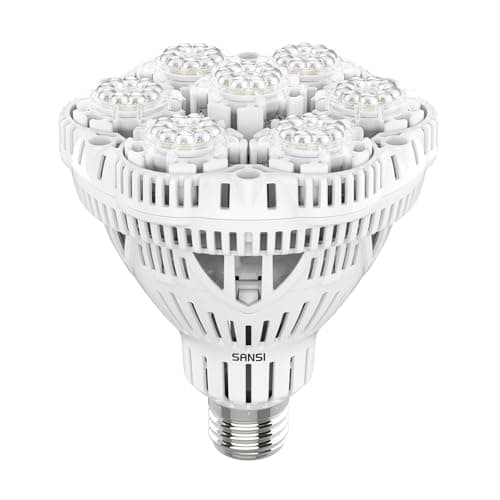
SANSI 36W BR30 Grow Light Bulb
Grow bulbThe rare grow bulb that publishes both PPF and a PPFD figure with the measurement distance attached, which is the only reason it can be sized honestly.
What SANSI publishes
- Power draw
- 36 W (source)
- PPF (photon output)
- 65.6 umol/s (source)
- PPFD
- 265.58 umol/m2/s at 1 ft (source)
- Spectrum
- 4000 K, 400-780 nm, CRI close to 100 (source)
- Rated life
- 25,000 hours (source)
Our arithmetic
- Efficacy, computed from the published figures: 1.82 umol/J
65.6 umol/s / 36 W = 1.82 umol/J. That is roughly a third less efficient than the panels on this page — the price of a screw-in form factor. - Electricity used at 12 hours a day for 30 days: 12.96 kWh a month
36 W x 12 h x 30 d / 1000 = 12.96 kWh.
What SANSI does not publish
- Beam angle
- Fixture dimensions
Who should skip it
Skip it if you are lighting more than one plant. 65.6 umol/s is a small amount of light spread over a cone — it lights a single specimen, not a shelf.
Questions people actually ask
+How far should the SANSI BR30 be from a plant?
+Is a grow bulb as good as a panel?
+How many plants can one SANSI bulb light?
+Will the SANSI bulb look strange in a living room?
Sources
- SANSI — BR30 36W grow light bulb product page — consulted September 2, 2026
- AC Infinity — IONBOARD S22 published specifications — consulted September 2, 2026
- University of Minnesota Extension — Lighting for indoor plants and starting seeds — consulted September 2, 2026
- US Energy Information Administration — Electric Power Monthly, Table 5.3 (US residential average, June 2026) — consulted September 2, 2026
- Zhen & van Iersel et al., PLOS ONE — Spectral effects of LEDs on plant growth, visual color quality and photosynthetic photon efficacy: white versus blue plus red radiation — consulted September 2, 2026
Read next
Reviews
The Best Grow Light Bulbs
Screw-in fixtures for single plants, what the form factor costs, and how to place one.
Top pick
SANSI 36W BR30 Grow Light Bulb
Reviews
Feit Electric Grow Lights
14.2 printed as mol/s would be megawatts. Read as µmol/s it is 1.58 µmol/J.
Top pick
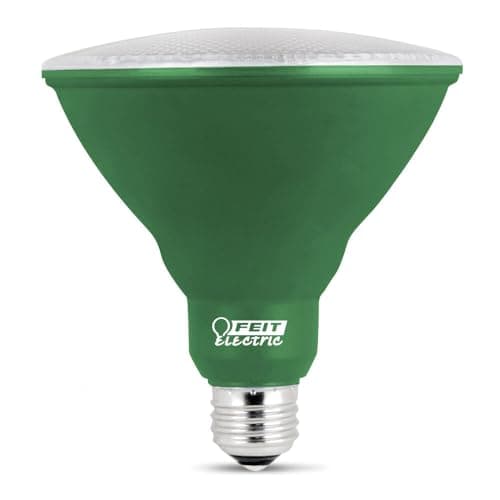
Feit Electric 16W PAR38 Grow Bulb
Reviews
GE Grow Lights
PPF published on all seven GE Grow products we checked, 1.56 to 1.80 µmol/J. No PPFD on any of them.
Top pick
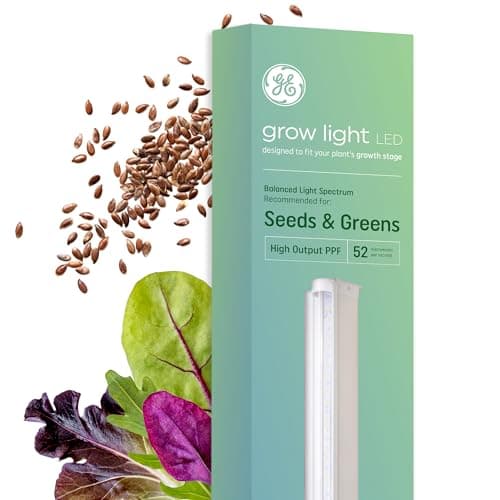
GE Grow Light 48in LED Fixture, Seeds and Greens
Reviews
Barrina T5 vs SANSI Grow Bulb
A 4 ft strip against a screw-in bulb: different shapes, different data, different jobs.
Top pick
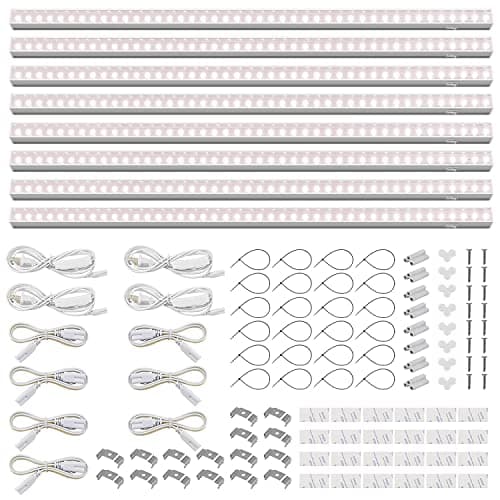
Barrina T5 4ft Grow Light Strips
Spectrum & PPFD
Grow Light vs Regular LED Bulb
Household bulbs emit usable light but cannot be sized. Where the line actually falls.
Top pick
SANSI 36W BR30 Grow Light Bulb
Coverage & Sizing
How Far Should a Grow Light Be From Plants?
The inverse-square rule, published PPFD-at-distance figures, and a by-plant table.
Top pick
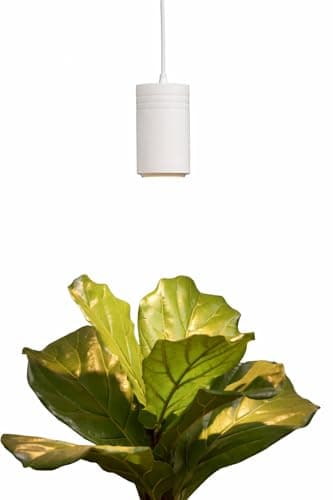
Soltech Aspect Gen 2
Reviews
SANSI vs GE Grow Light Bulbs
65.6 against 16 umol/s, at 1.82 against 1.78 umol/J. Four times the light for four times the watts.
Top pick
SANSI 36W BR30 Grow Light Bulb
Where this sits
This page belongs to Fixture Reviews and Roundups. Every figure on it is either quoted from a named published source or derived in view — the full method is on our methodology page, and how the site is funded is on the affiliate disclosure.