Barrina T5 vs SANSI Grow Bulb
These get compared constantly and they are not really rivals. One lights a line and one lights a point; the question is which you have.
By Scooter M. — An enthusiast who's genuinely into this. I read the manuals, compile the published specs, and do the math. No lab coat.
Published · How we pick
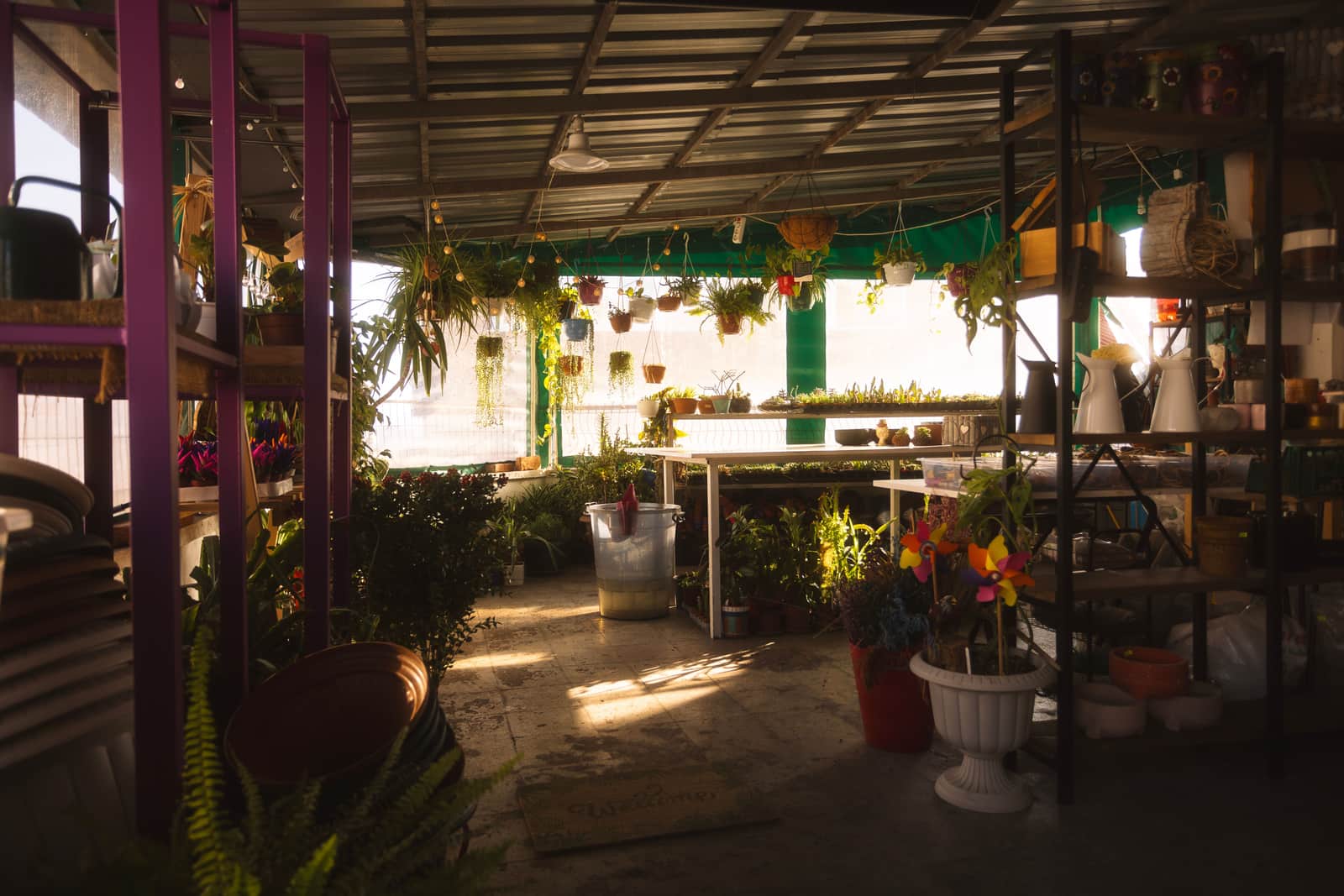
Photographs on this site are licensed stock and are illustrative of the fixture type. We do not own the units we write about.
How this page is funded: the buy links here are Amazon Associates links, and we earn a commission on qualifying purchases at no extra cost to you. We have not been paid to feature anything on this page, we accept no free product, and commission plays no part in the ranking. Full disclosure.
We have not tested these units. Everything below comes from the manufacturer’s own published specifications, or from arithmetic we have shown our working for. Where a figure is not published, we say so instead of estimating one. Read the method.
Quick picks
Efficacy is photons out per joule in. Where a manufacturer publishes it we quote theirs; where they publish photon output and wattage but not efficacy, we divide and label it as ours; where they publish neither, the cell says so rather than guessing. Tap a row for the full write-up.
| # | Product | Best for | Efficacy | Price |
|---|---|---|---|---|
| 1 | 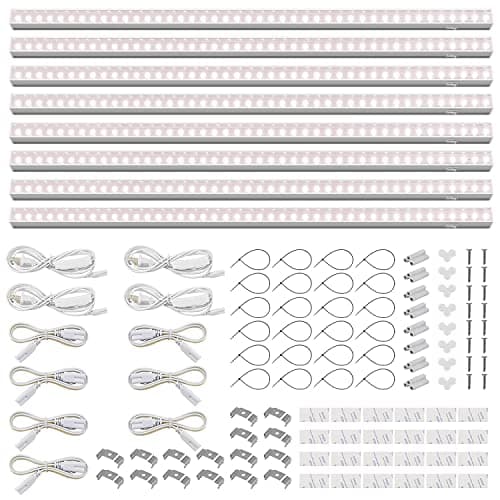 Barrina T5 4ft Grow Light Strips The default seed-starting bar for good reasons — 4 ft long, linkable in series, cheap per foot — and the reason we built a coverage calculator, because Barrina publishes no photon data whatsoever. | A shelf or a tray | Not published | |
| 2 | 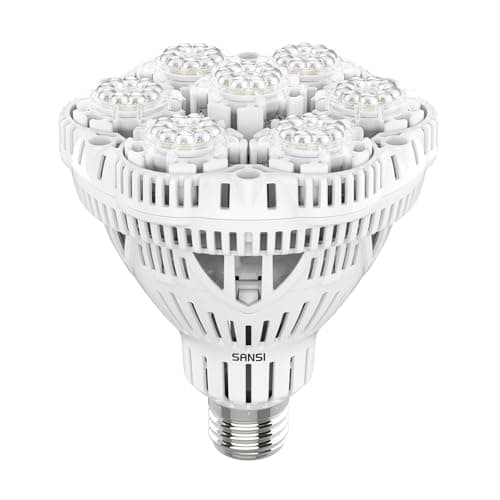 SANSI 36W BR30 Grow Light Bulb The rare grow bulb that publishes both PPF and a PPFD figure with the measurement distance attached, which is the only reason it can be sized honestly. | One plant and a lamp | 1.82 umol/J (ours) |
The reasoning
These two show up on the same shortlists because they occupy a similar price bracket, which is close to the only thing they have in common. One is a 4 ft linear fixture for lighting a length of shelf; the other is a screw-in bulb for lighting one plant. Choosing between them is a question about your shelf, not about the products.
The shape question, which settles most cases
| What you are lighting | Barrina strip | SANSI bulb |
|---|---|---|
| A 4 ft shelf of plants | Correct shape | Would need four or five bulbs |
| A tray of seedlings | Correct shape, sits close | Wrong shape — a cone over a rectangle |
| One plant beside a lamp | Overkill and needs mounting | Exactly the job |
| A specimen plant in a room | Looks like a workshop | Reads as a normal lamp at 4000 K |
| A three-shelf rack | Links up to 8 in series | Impractical |
The data question, which settles the rest
This is where they differ most sharply, and it is the more interesting axis.
Barrina publishes no PPF, PPFD or efficacy for any strip in the range. SANSI publishes 65.6 µmol/s, 265.58 µmol/m²/s at a stated 1 ft, and enough to derive 1.82 µmol/J.
With the SANSI you can decide the lamp height before you buy: 265.58 at 1 ft scales to about 170 at 15 in and 118 at 18 in, so you pick the height that matches your plant’s target band.
With the Barrina you cannot make any equivalent decision in advance. You hang the strips 2 to 4 inches above the seedlings because that is what experience says, and you adjust based on whether they stretch.
Neither approach is wrong. They are different kinds of purchase, and the second one only works when the plants give you fast feedback — which seedlings do and a mature houseplant does not.
Efficiency, where it can be computed
SANSI: 65.6 µmol/s ÷ 36 W = 1.82 µmol/J, which is modest — the price of a screw-in fitting. Barrina: unknown, because no photon figure exists. We are not going to estimate one to fill the row.
What can be said about cost: one Barrina strip is 20 W, so eight linked strips draw 160 W. A SANSI bulb is 36 W. At 14 hours a day that is $12.32 a month for a full linked run against $2.77 for a single bulb — but those are lighting completely different amounts of space, so the comparison is not meaningful on its own.
Where each one fails
- Barrina fails if you need to know what you are getting before it arrives, if you want to dim it, or if it is going somewhere it will be seen — a bare linked strip run reads as a workshop fixture.
- SANSI fails from about the second plant onward. The economics of buying three or four bulbs are worse than a single panel, at two-thirds the efficiency.
The answer
Measure what you are lighting. A line — a shelf, a tray, a windowsill run — takes strips. A point — one plant, one lamp — takes the bulb. If you are somewhere between, the honest third option is a small panel, which is covered in the best grow light panels.
Every pick in full
Barrina T5 4ft Grow Light Strips
LED barA shelf or a tray
The default seed-starting bar for good reasons — 4 ft long, linkable in series, cheap per foot — and the reason we built a coverage calculator, because Barrina publishes no photon data whatsoever.
What Barrina publishes
- Power draw
- 20 W per fixture; an 8-pack draws 160 W (source)
- Spectrum
- 5000 K (source)
- Dimming
- No; on/off switch per fixture, linkable up to 8 in series (source)
- Dimensions
- 4 ft strip, 120-degree beam angle, 120 V AC (source)
What Barrina does not publish
- PPF in umol/s — for any strip in the range
- PPFD at any stated distance
- Photon efficacy in umol/J
- LED count per strip, and rated lifespan
Who should skip it
Skip it if you need to know what you are getting before it arrives. There is no published PPF, no PPFD and no efficacy figure, so nothing about its output can be verified in advance.
SANSI 36W BR30 Grow Light Bulb
Grow bulbOne plant and a lamp
The rare grow bulb that publishes both PPF and a PPFD figure with the measurement distance attached, which is the only reason it can be sized honestly.
What SANSI publishes
- Power draw
- 36 W (source)
- PPF (photon output)
- 65.6 umol/s (source)
- PPFD
- 265.58 umol/m2/s at 1 ft (source)
- Spectrum
- 4000 K, 400-780 nm, CRI close to 100 (source)
- Rated life
- 25,000 hours (source)
Our arithmetic
- Efficacy, computed from the published figures: 1.82 umol/J
65.6 umol/s / 36 W = 1.82 umol/J. That is roughly a third less efficient than the panels on this page — the price of a screw-in form factor. - Electricity used at 12 hours a day for 30 days: 12.96 kWh a month
36 W x 12 h x 30 d / 1000 = 12.96 kWh.
What SANSI does not publish
- Beam angle
- Fixture dimensions
Who should skip it
Skip it if you are lighting more than one plant. 65.6 umol/s is a small amount of light spread over a cone — it lights a single specimen, not a shelf.
Questions people actually ask
+Barrina or SANSI for seedlings?
+Which is cheaper to run, a strip or a bulb?
+Can I use a SANSI bulb for a shelf of plants?
+Why does SANSI publish data and Barrina not?
Sources
- Barrina — T5 ML20 4ft 20W product page — consulted September 2, 2026
- SANSI — BR30 36W grow light bulb product page — consulted September 2, 2026
- US Energy Information Administration — Electric Power Monthly, Table 5.3 (US residential average, June 2026) — consulted September 2, 2026
- University of Minnesota Extension — Lighting for indoor plants and starting seeds — consulted September 2, 2026
Read next
Reviews
Barrina T5 4ft Grow Light Strips
The default shelf bar. Correct form factor, unbeatable price per foot, zero published output.
Top pick
Barrina T5 4ft Grow Light Strips
Reviews
SANSI 36W BR30 Grow Light Bulb
65.6 µmol/s and a PPFD at a stated 1 ft — enough to place it by arithmetic.
Top pick
SANSI 36W BR30 Grow Light Bulb
Coverage & Sizing
Bar vs Panel Coverage and Uniformity
How the two form factors distribute light, and which shapes each one suits.
Top pick
Barrina T5 4ft Grow Light Strips
Houseplants
Clip Light vs Panel vs Bar
Form factor decides more than brand. Which shape suits which setup, and where each stops working.
Top pick
Barrina T5 4ft Grow Light Strips
Reviews
SANSI vs Soltech Aspect
65.6 against 50 umol/s at identical wattage. What the design premium buys, and when it is worth paying.
Top pick
SANSI 36W BR30 Grow Light Bulb
Where this sits
This page belongs to Fixture Reviews and Roundups. Every figure on it is either quoted from a named published source or derived in view — the full method is on our methodology page, and how the site is funded is on the affiliate disclosure.