SANSI vs Soltech Aspect
Two 36 W fixtures where one costs several times the other. The photon figures do not justify that gap, and this page explains what does.
By Scooter M. — An enthusiast who's genuinely into this. I read the manuals, compile the published specs, and do the math. No lab coat.
Published · How we pick
Photographs on this site are licensed stock and are illustrative of the fixture type. We do not own the units we write about.
How this page is funded: the buy links here are Amazon Associates links, and we earn a commission on qualifying purchases at no extra cost to you. We have not been paid to feature anything on this page, we accept no free product, and commission plays no part in the ranking. Full disclosure.
We have not tested these units. Everything below comes from the manufacturer’s own published specifications, or from arithmetic we have shown our working for. Where a figure is not published, we say so instead of estimating one. Read the method.
Quick picks
Efficacy is photons out per joule in. Where a manufacturer publishes it we quote theirs; where they publish photon output and wattage but not efficacy, we divide and label it as ours; where they publish neither, the cell says so rather than guessing. Tap a row for the full write-up.
| # | Product | Best for | Efficacy | Price |
|---|---|---|---|---|
| 1 | 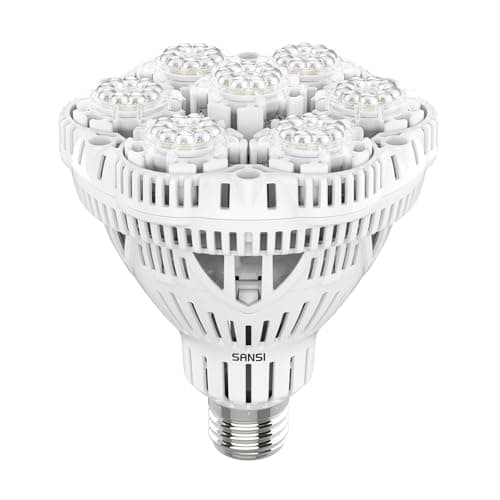 SANSI 36W BR30 Grow Light Bulb The rare grow bulb that publishes both PPF and a PPFD figure with the measurement distance attached, which is the only reason it can be sized honestly. | More light, far less money | 1.82 umol/J (ours) | |
| 2 | 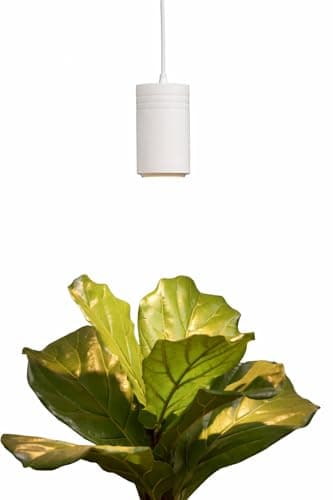 Soltech Aspect Gen 2 The only fixture here you would willingly hang in a living room, and the only one publishing PPFD at three separate distances so it can actually be placed by the numbers. | A fixture you will leave switched on | 1.39 umol/J (ours) |
The reasoning
We have not tested either fixture. What follows is published specification, our arithmetic, and a judgment at the end that is explicitly ours rather than a number.
This is the most uncomfortable comparison on the site, because the published figures point one way and we still think the expensive fixture has a legitimate case. Both draw 36 W. One emits nearly a third more photons and costs a fraction as much. If specifications were the whole story this page would be three sentences long.
What each publishes
| SANSI 36W BR30 | Soltech Aspect Gen 2 | |
|---|---|---|
| Power | 36 W | 36 W |
| PPF published | 65.6 µmol/s | 50 µmol/s |
| Efficacy (derived) | 1.82 µmol/J | 1.39 µmol/J |
| PPFD published | 265.58 µmol/m²/s at 1 ft | About 50 at 1 m, 34.9 at 4 ft, 15.5 at 6 ft |
| Spectrum | 4000 K, 400-780 nm, CRI close to 100 | 3000 K warm white, CRI 98 |
| Dimming | None | In-line dimmer, 10-100% |
| Rated life | 25,000 hours | 50,000 hours |
| Form | A bulb for a lamp you own | A pendant, cord and canopy included |
On photons, it is not close
SANSI: 65.6 µmol/s from 36 W = 1.82 µmol/J.
Soltech: 50 µmol/s from 36 W = 1.39 µmol/J.
The SANSI emits 31% more photons from the same electricity, and the two cost exactly the same to run — 12.96 kWh a month at 12 hours a day, about $2.38 each.
Identical running cost, 31% more light, at a small fraction of the purchase price. On the metric this site was built around — photons per watt — the Soltech is the weakest fixture we cover apart from the SuncoGrow 40 W strip.
Where the Soltech earns its place
Three things, and only one of them is about light.
It publishes PPFD at three distances. About 50 µmol/m²/s at 1 m, 34.9 at 4 ft, 15.5 at 6 ft — and those figures obey the inverse-square relationship to within rounding, which means the company measured rather than estimated them. SANSI publishes one distance. For a pendant hung over a tall plant, having the falloff curve stated is genuinely useful.
It is a complete fixture. The SANSI is a bulb; it needs a lamp, and the lamp has to point down at a plant, which most lamps in a home do not. The Soltech arrives as a pendant with a cord and a canopy, designed to hang above a plant. Some of the price gap is a lamp you are not buying separately.
It dims, and it is rated for twice the life. 10-100% on an in-line dimmer and 50,000 hours against the SANSI’s 25,000. Over the SANSI’s rated life you would buy two bulbs.
The argument we actually find persuasive
None of the above closes a price gap this size. What does, for some buyers, is simpler and harder to put in a table.
A grow light only delivers the light it is switched on for. A bulb in a clamp lamp pointed at a fiddle leaf fig in a sitting room is a thing people unplug when guests come, move when they vacuum, and eventually stop using. A pendant that reads as a light fixture stays up and stays on.
Soltech at 200 µmol/m²/s (hung about 20 in) for 12 hours, every day: 8.6 mol/m²/day.
SANSI at 265 µmol/m²/s at 1 ft, but run 4 hours a day because the lamp is in the way the rest of the time: 3.8 mol/m²/day.
The better fixture on paper loses badly to the worse fixture that actually runs. This is not an argument for the Soltech so much as an argument against buying a fixture you will not tolerate.
At identical 36 W draw the SANSI emits 65.6 µmol/s against the Soltech's 50, and both cost about $2.38 a month to run. The premium buys a complete pendant fixture, a published falloff curve, a dimmer, twice the rated life, and something you will leave switched on in a living room.
Where each one wins
| Situation | Pick | Why |
|---|---|---|
| A plant in a spare room, an office, a shelf | SANSI | 31% more light for a fraction of the price; nobody has to look at it |
| A specimen plant in a living room | Soltech | The fixture stays up, so the plant gets the hours |
| You already own a suitable directional lamp | SANSI | You are buying photons, not a fixture |
| You need to dim it | Soltech | The SANSI has no dimming at all; distance is the only control |
| A tall plant where falloff matters | Soltech | Three published distances rather than one |
| Maximum light per dollar | SANSI | Not close, on either purchase price or output |
The honest downside of each
SANSI: it is a bare bulb, so it needs a lamp that aims down and looks acceptable in the room; it does not dim, so distance is your only intensity control; and 25,000 rated hours is half what the Soltech claims. Aesthetically it is a bulb in a clamp lamp, which in a sitting room is exactly as attractive as it sounds.
Soltech: 1.39 µmol/J is second-worst on this site, it emits only 50 µmol/s in total, and a great deal of the price is industrial design rather than photons. At its published 50 µmol/m²/s at 1 m it delivers just 2.2 mol/m²/day at 12 hours — below the low-light band — so it must be hung far lower than pendants usually are to do real work. We say the same thing on the bird of paradise page, where it cannot reach the target at all.
The short answer
Buy the SANSI unless the room is the constraint. It emits more, costs the same to run, and costs far less to buy. Buy the Soltech when the plant lives somewhere you entertain, when you need to dim, or when a bulb in a clamp lamp would quietly get unplugged within a month — because the light a fixture delivers over a year depends more on whether it stays switched on than on 15 µmol/s.
Using the Soltech falloff curve properly
The most useful thing Soltech publishes is three PPFD figures at three distances, and they deserve to be used rather than admired.
Published: about 50 µmol/m²/s at 1 m (39 in), 34.9 at 4 ft, 15.5 at 6 ft.
Those obey the inverse-square relationship to within rounding, so the same relationship gives the closer heights the company does not list. At about 28 in: 50 × (39 ÷ 28)² = about 97 µmol/m²/s. At about 20 in: 50 × (39 ÷ 20)² = about 190 µmol/m²/s.
At 12 hours a day, 20 in gives 8.2 mol/m²/day — inside Iowa State University Extension’s 6-to-10 band for foliage and flowering houseplants. At the 1 m the company quotes, it gives 2.2, which is below the low-light band entirely.
That is the single most important practical fact about this fixture and it is not on the box: hung where pendants normally hang, it is a decorative light. Hung at about 20 inches above the foliage, it is a working grow light for one plant. The SANSI, by comparison, reaches the same band at roughly 15 to 20 inches — similar heights, but from a fixture that emits 31% more.
The fixture you are not buying with the SANSI
Comparing a bulb price to a pendant price is not quite fair, and it is worth being explicit about what closes part of the gap.
The Soltech arrives as a complete hanging fixture: cord, canopy, ceiling mount, in-line dimmer. The SANSI arrives as a bulb, and it needs a lamp that aims down, sits at a workable height and is tolerable to look at. If you already own one, that cost is zero. If you do not, a decent adjustable lamp is a real purchase, and the clamp lamps that do this job best are the least attractive option in any room with furniture.
The rest of the gap is design, and this page is not going to pretend otherwise. You are paying several times the price for a fixture that emits less light. Whether that is sensible depends entirely on whether the alternative would actually stay plugged in.
What neither of them publishes
- Neither publishes a spectral distribution. SANSI states 4000 K across 400-780 nm with a CRI close to 100; Soltech states 3000 K warm white with CRI 98. Both are descriptions rather than curves.
- Neither publishes a beam angle. For the Soltech this matters less, because the three published PPFD distances describe the falloff directly. For the SANSI it means the one-foot figure is the only anchor you have.
- Neither publishes a location rating, so neither has a documented case for a humid room.
Between them, though, these two are among the better-documented fixtures on this site. Most of the category publishes lumens and a color temperature and calls it a specification.
Rated life, and what replacement does to the comparison
One figure on the table above quietly changes the money argument. Soltech publishes 50,000 hours; SANSI publishes 25,000.
At 12 hours a day, 25,000 hours is about 5.7 years. 50,000 hours is about 11.4 years.
So across the Soltech’s rated life you would expect to buy two SANSI bulbs, plus whatever lamp you put them in.
That narrows the purchase-price gap without closing it, and neither figure is verifiable by a buyer. It is worth weighing less heavily than it first appears: an LED rarely fails on schedule, both numbers are manufacturer claims rather than measurements, and only one fixture on this site — the VIVOSUN LumaLight, at 36,000 hours to Q90 — states what its hours figure actually measures.
What happens when you want to light a second plant
Neither fixture scales gracefully, and they fail to scale in different ways.
A second SANSI is a second bulb, a second lamp and a second socket — cheap in absolute terms, but the clutter compounds and each plant needs its own well-positioned lamp. A second Soltech is a second pendant at the full price, which for most people is simply not on the table.
Past two plants, the answer stops being a bulb or a pendant. A single bar over a shelf covers a run evenly for less money and less power than either, which is the argument in best grow light bars.
Every pick in full
SANSI 36W BR30 Grow Light Bulb
Grow bulbMore light, far less money
The rare grow bulb that publishes both PPF and a PPFD figure with the measurement distance attached, which is the only reason it can be sized honestly.
What SANSI publishes
- Power draw
- 36 W (source)
- PPF (photon output)
- 65.6 umol/s (source)
- PPFD
- 265.58 umol/m2/s at 1 ft (source)
- Spectrum
- 4000 K, 400-780 nm, CRI close to 100 (source)
- Rated life
- 25,000 hours (source)
Our arithmetic
- Efficacy, computed from the published figures: 1.82 umol/J
65.6 umol/s / 36 W = 1.82 umol/J. That is roughly a third less efficient than the panels on this page — the price of a screw-in form factor. - Electricity used at 12 hours a day for 30 days: 12.96 kWh a month
36 W x 12 h x 30 d / 1000 = 12.96 kWh.
What SANSI does not publish
- Beam angle
- Fixture dimensions
Who should skip it
Skip it if you are lighting more than one plant. 65.6 umol/s is a small amount of light spread over a cone — it lights a single specimen, not a shelf.
Soltech Aspect Gen 2
PendantA fixture you will leave switched on
The only fixture here you would willingly hang in a living room, and the only one publishing PPFD at three separate distances so it can actually be placed by the numbers.
What Soltech publishes
- Power draw
- 36 W (source)
- PPF (photon output)
- 50 umol/s (source)
- PPFD
- about 50 umol/m2/s at 1 m, 34.9 at 4 ft, 15.5 at 6 ft (source)
- Spectrum
- 3000 K warm white, CRI 98 (source)
- Dimming
- Yes, in-line dimmer 10-100% (source)
- Dimensions
- 3.5 x 3.5 x 6.2 inches (source)
- Rated life
- 50,000 hours (source)
Our arithmetic
- Efficacy, computed from the published figures: 1.39 umol/J
50 umol/s / 36 W = 1.39 umol/J. Roughly half the efficacy of a 2.7 umol/J board — the design premium is paid twice, once at purchase and again every month on the meter.
Who should skip it
Skip it if photons per watt is the metric that matters. At 50 umol/s from 36 W it is the least efficient fixture on this page, and much of the price is industrial design.
Questions people actually ask
+Is the Soltech Aspect worth the money over a SANSI bulb?
+Which puts out more light, SANSI or Soltech?
+How low does the Soltech Aspect need to hang?
+Can you dim a SANSI grow bulb?
Sources
- SANSI — BR30 36W grow light bulb product page — consulted September 2, 2026
- Soltech — Aspect Gen 2 published specifications — consulted September 2, 2026
- University of Minnesota Extension — Lighting for indoor plants and starting seeds — consulted September 2, 2026
- Iowa State University Extension — Important Considerations for Providing Supplemental Light to Indoor Plants — consulted September 2, 2026
- US Energy Information Administration — Electric Power Monthly, Table 5.3 (US residential average, June 2026) — consulted September 2, 2026
Read next
Reviews
SANSI 36W BR30 Grow Light Bulb
65.6 µmol/s and a PPFD at a stated 1 ft — enough to place it by arithmetic.
Top pick
SANSI 36W BR30 Grow Light Bulb
Reviews
Soltech Aspect Gen 2
A living-room pendant with genuinely usable placement data and the lowest efficacy here.
Top pick
Soltech Aspect Gen 2
Houseplants
The Best Grow Lights for Large Indoor Plants
Height, not brightness, is the constraint on a big plant. Published PPFD-at-distance figures are what decide it.
Top pick
Soltech Aspect Gen 2
Reviews
The Best Grow Light Bulbs
Screw-in fixtures for single plants, what the form factor costs, and how to place one.
Top pick
SANSI 36W BR30 Grow Light Bulb
Where this sits
This page belongs to Fixture Reviews and Roundups. Every figure on it is either quoted from a named published source or derived in view — the full method is on our methodology page, and how the site is funded is on the affiliate disclosure.