Soltech Aspect Gen 2
The only grow light here you would willingly hang in a living room, the only one with PPFD published at three distances, and the least efficient of the lot.
By Scooter M. — An enthusiast who's genuinely into this. I read the manuals, compile the published specs, and do the math. No lab coat.
Published · How we pick
Photographs on this site are licensed stock and are illustrative of the fixture type. We do not own the units we write about.
How this page is funded: the buy links here are Amazon Associates links, and we earn a commission on qualifying purchases at no extra cost to you. We have not been paid to feature anything on this page, we accept no free product, and commission plays no part in the ranking. Full disclosure.
We have not tested these units. Everything below comes from the manufacturer’s own published specifications, or from arithmetic we have shown our working for. Where a figure is not published, we say so instead of estimating one. Read the method.
The reasoning
We have not tested this fixture. Soltech publishes more placement data than anyone else we cover, which makes the arithmetic on this page unusually solid — and the arithmetic is not entirely flattering.
The best disclosure on this site
Soltech publishes PPFD at three distances for the Aspect Gen 2: about 50 µmol/m²/s at 1 m, 34.9 at 4 ft, and 15.5 at 6 ft. Nobody else in our set publishes more than one, and several publish none.
From 4 ft (1.22 m) to 6 ft (1.83 m), the distance ratio is 1.5, so intensity should fall by 1.5² = 2.25×.
34.9 ÷ 2.25 = 15.5. Soltech publishes 15.5.
The two figures are consistent with each other to the precision given, which means you can extrapolate to a height they did not publish and trust the result.
What those numbers actually say
They say this is a modest light. 34.9 µmol/m²/s at 4 ft is below University of Minnesota Extension’s low band floor of 50. At 1 m (about 3.3 ft) the published 50 sits exactly at that floor.
So the Aspect Gen 2 is a fixture for a low-light plant, hung reasonably close. Hung at ceiling height over a large specimen it is contributing real but small light. That is a genuinely useful thing to know before buying, and you only know it because Soltech published the figures — which is a point in their favor, not against.
Its published 50 µmol/m²/s at 1 m is exactly the 50 µmol/m²/s bottom of the low band. Closer than that and it moves up the band; further and it drops below it.
The efficiency cost
50 µmol/s ÷ 36 W = 1.39 µmol/J.
That is the lowest of anything we cover — roughly half the 2.7 µmol/J of an AC Infinity board.
Concretely: to deliver the same photons as a 2.7 µmol/J fixture you would draw about double the power. Over a five-month winter at 14 hours that is the difference between roughly $42 and $83.
The design premium is paid twice — once at purchase and again every month on the meter. Whether that is worth it depends entirely on whether the fixture is visible.
What you are actually buying
A 3.5 × 3.5 × 6.2 inch pendant with 3000 K warm white at CRI 98, an in-line dimmer from 10 to 100%, and a 50,000-hour rated life. In other words: a light fitting that happens to grow plants, rather than a grow light you tolerate the look of.
Every other fixture on this site is a shed or shelf product. This is the one you hang over a fiddle-leaf fig in a room where people sit, and the CRI 98 warm white means it reads as a normal lamp. That is the entire value proposition and it is a real one.
| Situation | Verdict | Why |
|---|---|---|
| A large plant in a living room | The reason it exists | Looks like a light fitting; warm white at CRI 98 |
| A low-light plant hung within about 3 ft | Good | Published PPFD puts it at the low band, which suits those plants |
| Herbs, greens or seedlings | No | 50 µmol/s is far short of what those need |
| Anywhere nobody looks | No | You are paying a design premium and double the electricity for nothing |
Running cost
36 W at 12 hours is 12.96 kWh a month, about $2.38 — trivial in absolute terms. The efficiency argument only bites when you compare it against what the same electricity would buy in photons elsewhere, which for a decorative fixture may simply not be the relevant comparison.
The fixture in full
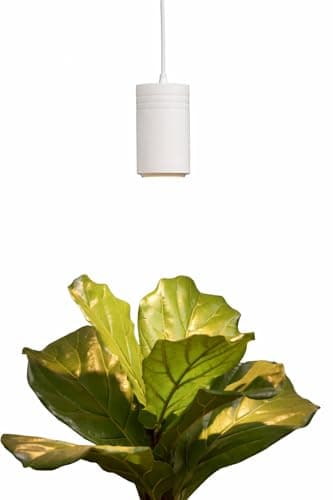
Soltech Aspect Gen 2
PendantThe only fixture here you would willingly hang in a living room, and the only one publishing PPFD at three separate distances so it can actually be placed by the numbers.
What Soltech publishes
- Power draw
- 36 W (source)
- PPF (photon output)
- 50 umol/s (source)
- PPFD
- about 50 umol/m2/s at 1 m, 34.9 at 4 ft, 15.5 at 6 ft (source)
- Spectrum
- 3000 K warm white, CRI 98 (source)
- Dimming
- Yes, in-line dimmer 10-100% (source)
- Dimensions
- 3.5 x 3.5 x 6.2 inches (source)
- Rated life
- 50,000 hours (source)
Our arithmetic
- Efficacy, computed from the published figures: 1.39 umol/J
50 umol/s / 36 W = 1.39 umol/J. Roughly half the efficacy of a 2.7 umol/J board — the design premium is paid twice, once at purchase and again every month on the meter.
Who should skip it
Skip it if photons per watt is the metric that matters. At 50 umol/s from 36 W it is the least efficient fixture on this page, and much of the price is industrial design.
Questions people actually ask
+How much light does the Soltech Aspect actually produce?
+Is the Soltech Aspect worth the money?
+Why is the Aspect less efficient than a panel?
+Can the Soltech Aspect grow herbs or vegetables?
Sources
- Soltech — Aspect Gen 2 published specifications — consulted September 2, 2026
- University of Minnesota Extension — Lighting for indoor plants and starting seeds — consulted September 2, 2026
- AC Infinity — IONBOARD S22 published specifications — consulted September 2, 2026
- US Energy Information Administration — Electric Power Monthly, Table 5.3 (US residential average, June 2026) — consulted September 2, 2026
Read next
Reviews
The Best Grow Lights
The main ranking: nine fixtures sorted on published data, with every gap named.
Top pick
Spider Farmer SF1000
Houseplants
The Best Grow Lights for Large Indoor Plants
Height, not brightness, is the constraint on a big plant. Published PPFD-at-distance figures are what decide it.
Top pick
Soltech Aspect Gen 2
Coverage & Sizing
How Far Should a Grow Light Be From Plants?
The inverse-square rule, published PPFD-at-distance figures, and a by-plant table.
Top pick
Soltech Aspect Gen 2
Running Cost
The Most Efficient Grow Lights by µmol/J
Every fixture we cover ranked on published photon efficacy, with derivations shown.
Houseplants
Grow Lights for Bonsai
Indoor bonsai sit in the 6-10 mol/m2/day band. The target, the distance, and why junipers indoors fail anyway.
Top pick
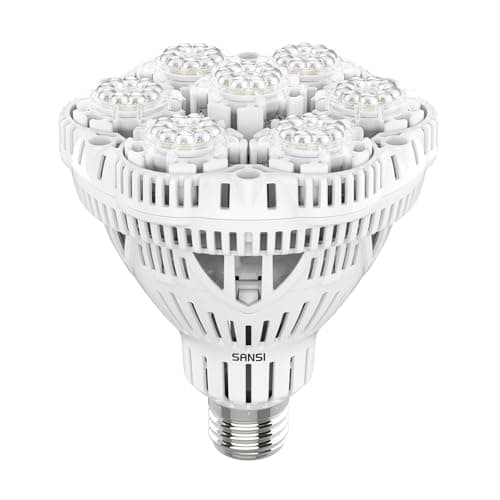
SANSI 36W BR30 Grow Light Bulb
Reviews
SANSI vs Soltech Aspect
65.6 against 50 umol/s at identical wattage. What the design premium buys, and when it is worth paying.
Top pick
SANSI 36W BR30 Grow Light Bulb
Where this sits
This page belongs to Fixture Reviews and Roundups. Every figure on it is either quoted from a named published source or derived in view — the full method is on our methodology page, and how the site is funded is on the affiliate disclosure.