Barrina T5 4ft Grow Light Strips
Our first pick for a shelf, and the fixture we can tell you least about. Both of those things are true at once, and this page explains why.
By Scooter M. — An enthusiast who's genuinely into this. I read the manuals, compile the published specs, and do the math. No lab coat.
Published · How we pick
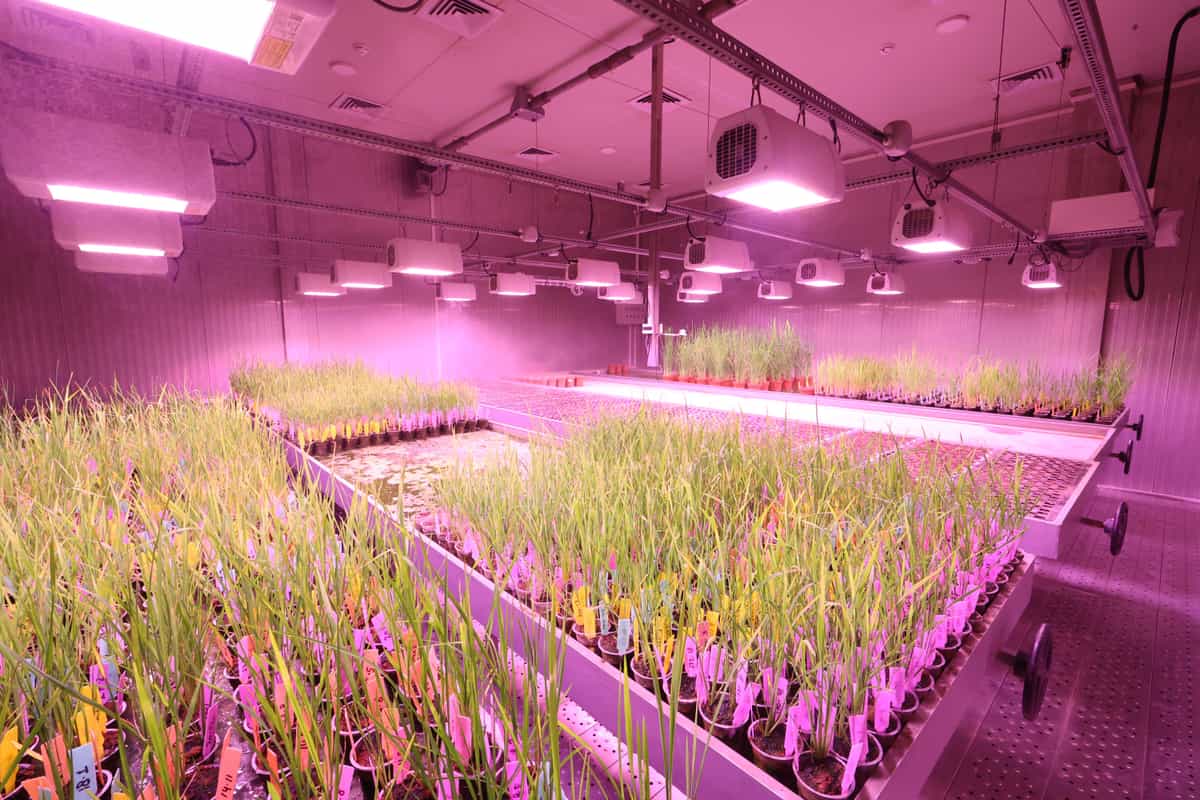
Photographs on this site are licensed stock and are illustrative of the fixture type. We do not own the units we write about.
How this page is funded: the buy links here are Amazon Associates links, and we earn a commission on qualifying purchases at no extra cost to you. We have not been paid to feature anything on this page, we accept no free product, and commission plays no part in the ranking. Full disclosure.
We have not tested these units. Everything below comes from the manufacturer’s own published specifications, or from arithmetic we have shown our working for. Where a figure is not published, we say so instead of estimating one. Read the method.
The reasoning
We have not tested these strips. That statement is on every page of this site, and here it matters more than usual, because Barrina has not published anything that would let us compute what they do either.
What is published
20 W per 4 ft fixture. 5000 K. A 120-degree beam angle. 120 V AC. An on/off switch per fixture, and linkable up to 8 in series. That is the complete useful specification.
No PPF, no PPFD, no efficacy. We checked the product page directly. This is the most-bought seed-starting fixture in the category and its light output cannot be verified in advance.
Why we still recommend it
Because the thing that decides success on a shelf is form factor, and the form factor here is exactly right. A 4 ft strip matches a 4 ft shelf. Its emitters run the length of what you are lighting, so distribution follows the shape of the problem rather than fighting it. A square panel over the same shelf lights the middle well and the ends poorly, regardless of what its published specs say — the argument is laid out in bar versus panel coverage.
It also links in series, so a three-shelf rack with two strips per shelf is one plug and one timer. And it is the cheapest way to light a linear foot of shelf that we are aware of.
What buying it actually means
It means accepting that you cannot size it. You cannot put it into the coverage calculator, cannot predict the PPFD at your seedlings, and cannot compare it on output with the panels on this site. You are buying on shape, price and the accumulated experience of a very large number of gardeners, and finding out what you got after it arrives.
That is a legitimate purchase. It is not the same kind of purchase as one you can compute in advance, and anybody presenting it as though it were — by quoting a PPFD that Barrina has never published — is making a number up.
The one thing we can compute
One strip: 20 W × 16 h ÷ 1000 = 0.32 kWh a day = 9.6 kWh a month = $1.76 at 18.34 cents per kWh.
Eight linked strips (160 W): 2.56 kWh a day = 76.8 kWh a month = $14.08.
A three-shelf rack with two strips per shelf, 120 W, run 16 hours a day for a ten-week seed season: 134.4 kWh = $24.65 for the season.
How to use them well, given what you cannot know
- Run them close. 2 to 4 inches above seedlings. Low output per strip means distance is not your friend, and these run cool enough to sit there.
- Use more strips rather than more height. Two runs per shelf beats one run raised higher, because you cannot dim them and distribution is the thing they are good at.
- Judge by the plants. Stretching means add a strip or drop the height. With no numbers available, the seedlings are your instrument — and on seedlings they report within days.
Who should buy it
Anyone lighting shelves or seed trays who wants the correct shape at the lowest price and is comfortable without published data. That is most home seed starters, and it is why this is our first pick in the seed-starting roundup.
Anyone who wants to know what they are getting first should buy a panel that publishes PPF instead, and accept the geometry compromise.
The fixture in full
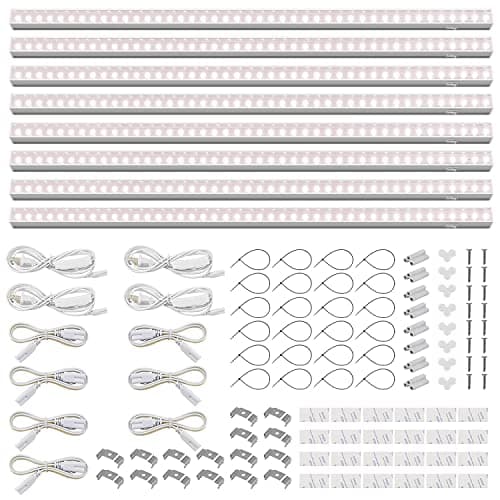
Barrina T5 4ft Grow Light Strips
LED barThe default seed-starting bar for good reasons — 4 ft long, linkable in series, cheap per foot — and the reason we built a coverage calculator, because Barrina publishes no photon data whatsoever.
What Barrina publishes
- Power draw
- 20 W per fixture; an 8-pack draws 160 W (source)
- Spectrum
- 5000 K (source)
- Dimming
- No; on/off switch per fixture, linkable up to 8 in series (source)
- Dimensions
- 4 ft strip, 120-degree beam angle, 120 V AC (source)
What Barrina does not publish
- PPF in umol/s — for any strip in the range
- PPFD at any stated distance
- Photon efficacy in umol/J
- LED count per strip, and rated lifespan
Who should skip it
Skip it if you need to know what you are getting before it arrives. There is no published PPF, no PPFD and no efficacy figure, so nothing about its output can be verified in advance.
Questions people actually ask
+What is the PPF of a Barrina T5 grow light?
+Are Barrina T5 lights good for seedlings?
+How much do Barrina strips cost to run?
+Is a Barrina T5 fluorescent or LED?
Sources
- Barrina — T5 ML20 4ft 20W product page — consulted September 2, 2026
- US Energy Information Administration — Electric Power Monthly, Table 5.3 (US residential average, June 2026) — consulted September 2, 2026
- University of Minnesota Extension — Lighting for indoor plants and starting seeds — consulted September 2, 2026
- University of New Hampshire Extension — Growing Seedlings Under Lights — consulted September 2, 2026
Read next
Reviews
The Best Grow Light Bars
Linear fixtures for shelves and trays, and the disclosure gap running through the category.
Top pick
Barrina T5 4ft Grow Light Strips
Reviews
Barrina T5 vs SANSI Grow Bulb
A 4 ft strip against a screw-in bulb: different shapes, different data, different jobs.
Top pick
Barrina T5 4ft Grow Light Strips
Reviews
Sunco Grow Lights
48.42 µmol/s on the 40 W works out to 1.21 µmol/J. The 80 W publishes nothing.
Top pick
SuncoGrow 4ft 40W Grow Light
Seed Starting
Grow Light Shelf Setup for Seed Trays
The build: rack, fixtures, chains, timer — with the measurements that make it work and the mistakes that waste a season.
Top pick
Barrina T5 4ft Grow Light Strips
Coverage & Sizing
Bar vs Panel Coverage and Uniformity
How the two form factors distribute light, and which shapes each one suits.
Top pick
Barrina T5 4ft Grow Light Strips
Where this sits
This page belongs to Fixture Reviews and Roundups. Every figure on it is either quoted from a named published source or derived in view — the full method is on our methodology page, and how the site is funded is on the affiliate disclosure.