Grow Light Shelf Setup for Seed Trays
A wire rack, one light run per shelf, adjustable chains and one timer. The whole thing takes an afternoon and lasts years.
By Scooter M. — An enthusiast who's genuinely into this. I read the manuals, compile the published specs, and do the math. No lab coat.
Published · How we pick
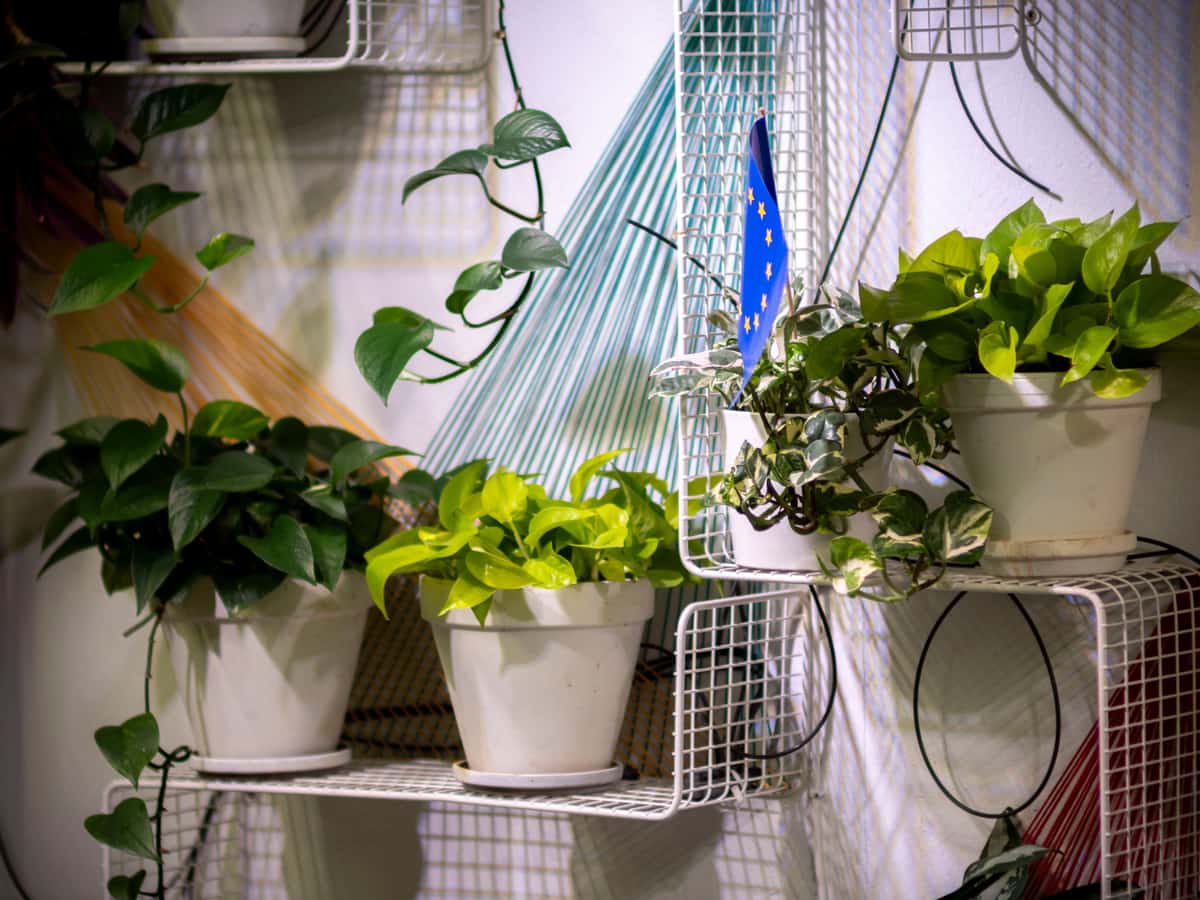
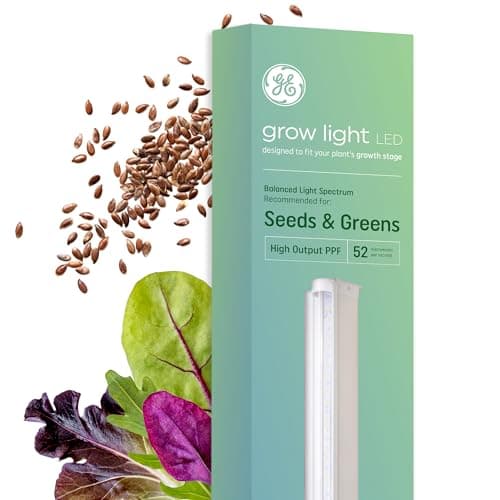
Photographs on this site are licensed stock and are illustrative of the fixture type. We do not own the units we write about.
How this page is funded: the buy links here are Amazon Associates links, and we earn a commission on qualifying purchases at no extra cost to you. We have not been paid to feature anything on this page, we accept no free product, and commission plays no part in the ranking. Full disclosure.
We have not tested these units. Everything below comes from the manufacturer’s own published specifications, or from arithmetic we have shown our working for. Where a figure is not published, we say so instead of estimating one. Read the method.
Quick picks
Efficacy is photons out per joule in. Where a manufacturer publishes it we quote theirs; where they publish photon output and wattage but not efficacy, we divide and label it as ours; where they publish neither, the cell says so rather than guessing. Tap a row for the full write-up.
| # | Product | Best for | Efficacy | Price |
|---|---|---|---|---|
| 1 | 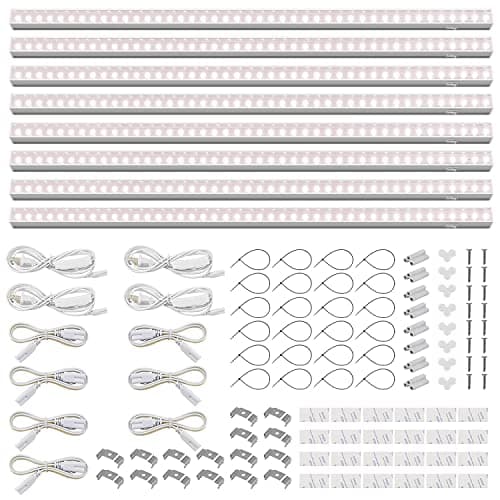 Barrina T5 4ft Grow Light Strips The default seed-starting bar for good reasons — 4 ft long, linkable in series, cheap per foot — and the reason we built a coverage calculator, because Barrina publishes no photon data whatsoever. | Per-shelf runs | Not published | |
| 2 | 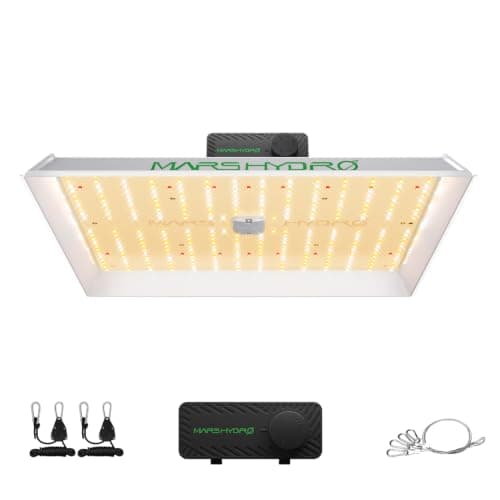 Mars Hydro TS 1000 The most photons of anything on this list, and one of only three fixtures here that publishes both PPF and efficacy so the claim can be checked against itself. | Single dense shelf | 2.3 umol/J |
The reasoning
The standard seed-starting setup has been the same for thirty years because it works: a wire shelving unit, one run of lights under each shelf, everything on one timer. What has changed is the fixture, and a couple of measurements worth getting right the first time.
What you need
| Item | Spec that matters | Why |
|---|---|---|
| Wire shelving unit | 48 in wide, 18 in deep, adjustable shelves | 48 in matches standard 4 ft light bars exactly. 18 in deep takes two 1020 trays side by side. |
| Light fixtures | Two to four 4 ft bars per shelf | Two bars light a tray adequately; four give margin at the shelf edges where output falls off. |
| Chains or ratchet hangers | Adjustable in 1 in steps | You will raise the lights weekly. If it is fiddly you will skip it, and the seedlings will stretch. |
| Plug-in timer | One outlet, daily repeat | 14–16 hours on. One timer for the whole rack, not one per shelf. |
| Power strip | Surge protected, mounted to an upright | Keeps the cabling off the floor, away from spilled water. |
| Heat mat (optional) | Sized to the tray | Does more for germination speed than any fixture. Only needed until emergence. |
The build
- Set the shelf spacing before anything else. Allow about 16 to 18 inches of vertical clearance per growing shelf. That is enough for a tray, a dome, seedlings up to transplant height and the fixture hanging above them with room to be raised.
- Mount the fixtures to the underside of the shelf above. Hang them from chains or ratchet hangers rather than fixing them flush. A fixed fixture is a fixture at the wrong height for six of the eight weeks.
- Link the bars per shelf, then run one lead to the strip. Most 4 ft LED bars daisy-chain — Barrina’s strips link up to eight in series. That gives you one plug per shelf instead of four.
- Set the timer to 14 to 16 hours. University of Minnesota Extension recommends 16 to 18 hours for seedlings; Iowa State University Extension suggests 12 to 14 generally, with 16 as the ceiling for home growers. Sixteen is a defensible middle.
- Start the lights at 4 to 6 inches above the soil surface and raise them as the seedlings grow, keeping the gap constant.
Two measurements people get wrong
Shelf depth versus fixture coverage
An 18-inch-deep shelf holds two 1020 trays front to back, so you are lighting a 48 × 18 inch rectangle — 6 sq ft, or 0.557 m². A square panel is the wrong shape for that; bars running the full 48 inches are the right one. This is the geometry argument for bars over panels on a rack, and it does not depend on brand.
A 48 × 18 in shelf is 0.557 m². Targeting 250 µmol/m²/s at the canopy, at a 0.8 uniformity factor:
0.557 × 250 = 139 µmol/s landing on the trays.
139 ÷ 0.8 = about 174 µmol/s the fixtures need to produce. At 16 hours a day that is a DLI of 250 × 16 × 3600 ÷ 1,000,000 = 14.4 mol/m²/day, above the 12 mol seedling target.
The edges of the shelf
Output is always lowest at the perimeter. Trays at the front and back edges of a deep shelf get measurably less than the middle, and the seedlings will tell you by leaning. The cheap fix is to rotate trays weekly, which costs nothing. The better fix is to run one more bar than you think you need, positioned toward the edges rather than the center.
What it costs to run
Four 20 W bars per shelf × 3 shelves = 240 W. At 16 hours a day for 56 days, at 18.34 cents per kWh:
240 × 16 ÷ 1000 = 3.84 kWh a day.
3.84 × 56 = 215 kWh for the season.
215 × $0.1834 = about $39 for the whole rack, for the season.
Run the figures for your own build in the running-cost calculator.
Mistakes that cost a season
- Fixing the lights at a permanent height. The gap has to shrink and grow with the plants. Hang everything adjustable.
- One fixture for a whole 48-inch shelf. It will light the middle 18 inches and the rest will stretch.
- No timer. Manual switching means inconsistent photoperiods, which is worse for uniformity than a slightly low intensity.
- Leaving domes on after emergence. A humidity dome scatters and absorbs light, and it invites damping off. Off or vented as soon as the seedlings are up.
Every pick in full
Barrina T5 4ft Grow Light Strips
LED barPer-shelf runs
The default seed-starting bar for good reasons — 4 ft long, linkable in series, cheap per foot — and the reason we built a coverage calculator, because Barrina publishes no photon data whatsoever.
What Barrina publishes
- Power draw
- 20 W per fixture; an 8-pack draws 160 W (source)
- Spectrum
- 5000 K (source)
- Dimming
- No; on/off switch per fixture, linkable up to 8 in series (source)
- Dimensions
- 4 ft strip, 120-degree beam angle, 120 V AC (source)
What Barrina does not publish
- PPF in umol/s — for any strip in the range
- PPFD at any stated distance
- Photon efficacy in umol/J
- LED count per strip, and rated lifespan
Who should skip it
Skip it if you need to know what you are getting before it arrives. There is no published PPF, no PPFD and no efficacy figure, so nothing about its output can be verified in advance.
Mars Hydro TS 1000
LED panelSingle dense shelf
The most photons of anything on this list, and one of only three fixtures here that publishes both PPF and efficacy so the claim can be checked against itself.
What Mars Hydro publishes
- Power draw
- 150 W +/-5% at 100-277 V AC (source)
- PPF (photon output)
- 343 umol/s (source)
- Efficacy
- 2.3 umol/J (source)
- Stated coverage
- 2.5 x 2.5 ft vegetative, 2.3 x 2.3 ft flowering (source)
- Spectrum
- 660-665 nm, 730-740 nm, 3000 K, 5000 K (source)
- Diodes
- Bridgelux (source)
- Dimming
- Yes, 0-100% dimmer knob (source)
- Dimensions
- 406 x 326 x 50 mm (source)
Our arithmetic
- Average PPFD across its stated 2.5 x 2.5 ft vegetative footprint: about 470 umol/m2/s
2.5 ft x 2.5 ft = 6.25 sq ft = 0.581 m2. 343 umol/s divided by 0.581 m2 = 590 umol/m2/s at perfect uniformity; applying a 0.8 uniformity factor gives about 472 umol/m2/s average. - Electricity used at 14 hours a day for 30 days: 63.0 kWh a month
150 W x 14 h x 30 d / 1000 = 63.0 kWh.
Who should skip it
Skip it if you are lighting a bookshelf. 343 umol/s concentrated into a 2.5 ft square is far more light than a monstera wants, and you pay 150 W to deliver it.
Questions people actually ask
+How much vertical space do I need between shelves for seed starting?
+How many grow light bars per shelf?
+Should the grow lights be on a timer?
+What does a three-shelf seed-starting rack cost to run?
Sources
- University of Minnesota Extension — Lighting for indoor plants and starting seeds — consulted September 2, 2026
- Iowa State University Extension — Important Considerations for Providing Supplemental Light to Indoor Plants — consulted September 2, 2026
- University of New Hampshire Extension — Growing Seedlings Under Lights — consulted September 2, 2026
- Barrina — T5 ML20 4ft 20W product page — consulted September 2, 2026
- US Energy Information Administration — Electric Power Monthly, Table 5.3 (US residential average, June 2026) — consulted September 2, 2026
Read next
Seed Starting
Grow Lights for Vegetable Seedlings
One light target across every vegetable crop, and how succession timing decides your shelf layout.
Top pick
Barrina T5 4ft Grow Light Strips
Seed Starting
How Far Should Grow Lights Be From Seedlings?
Distance by fixture type, in a table, with the inverse-square arithmetic that explains why an inch matters so much.
Top pick
Barrina T5 4ft Grow Light Strips
Seed Starting
The Best Grow Lights for Seed Starting
Sized against a 12 mol/m2/day seedling target using published photon output, not marketing claims.
Top pick
Barrina T5 4ft Grow Light Strips
Coverage & Sizing
The Best Grow Lights for a Shelf or Rack
Picks chosen on footprint match first, because a square panel over a long shelf wastes its edges.
Top pick
Barrina T5 4ft Grow Light Strips
Running Cost
How Much Electricity Do Grow Lights Use?
Monthly kWh and cost per fixture, and how that compares with household appliances.
Top pick
Barrina T5 4ft Grow Light Strips
Seed Starting
Grow Lights for Propagation and Cuttings
Cuttings want 4-5 mol/m2/day at first, rising to 8-12 once rooted. The staged plan and the fixtures for it.
Top pick
GE Grow Light 48in LED Fixture, Seeds and Greens
Where this sits
This page belongs to Grow Lights for Seed Starting. Every figure on it is either quoted from a named published source or derived in view — the full method is on our methodology page, and how the site is funded is on the affiliate disclosure.