Grow Lights for Vegetable Seedlings
Every vegetable seedling wants roughly the same daily light. What differs is how long they occupy your shelf — and that is what decides the setup you need.
By Scooter M. — An enthusiast who's genuinely into this. I read the manuals, compile the published specs, and do the math. No lab coat.
Published · How we pick
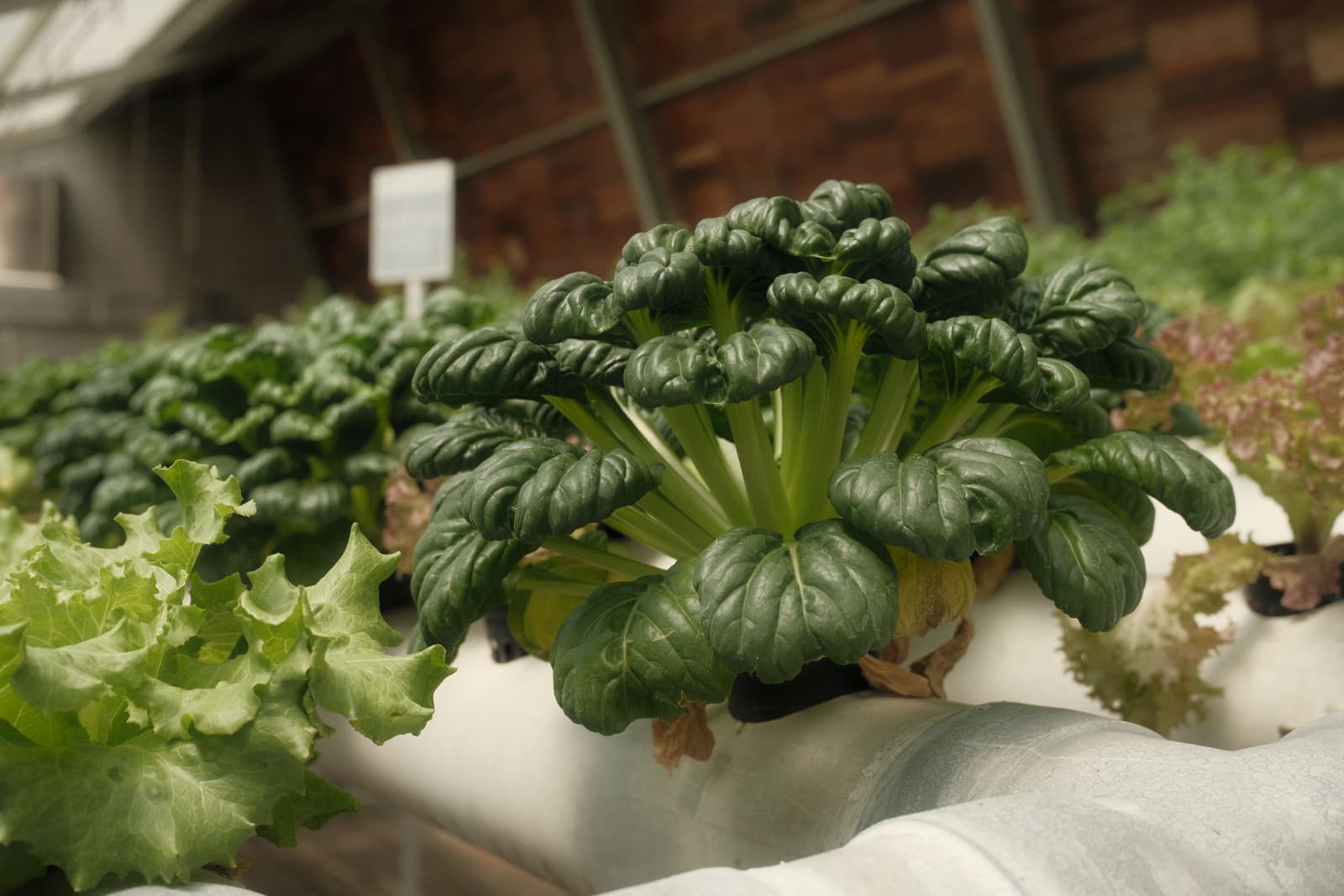
Photographs on this site are licensed stock and are illustrative of the fixture type. We do not own the units we write about.
How this page is funded: the buy links here are Amazon Associates links, and we earn a commission on qualifying purchases at no extra cost to you. We have not been paid to feature anything on this page, we accept no free product, and commission plays no part in the ranking. Full disclosure.
We have not tested these units. Everything below comes from the manufacturer’s own published specifications, or from arithmetic we have shown our working for. Where a figure is not published, we say so instead of estimating one. Read the method.
Quick picks
Efficacy is photons out per joule in. Where a manufacturer publishes it we quote theirs; where they publish photon output and wattage but not efficacy, we divide and label it as ours; where they publish neither, the cell says so rather than guessing. Tap a row for the full write-up.
| # | Product | Best for | Efficacy | Price |
|---|---|---|---|---|
| 1 | 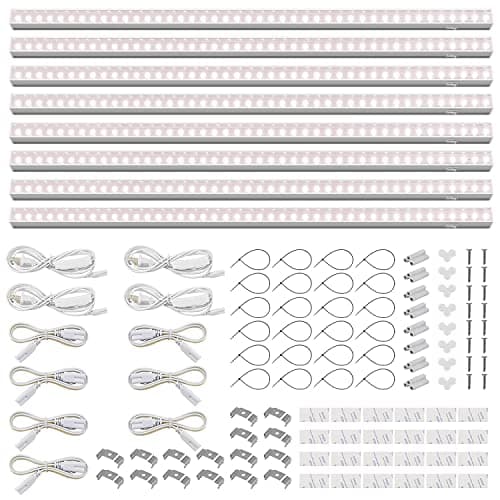 Barrina T5 4ft Grow Light Strips The default seed-starting bar for good reasons — 4 ft long, linkable in series, cheap per foot — and the reason we built a coverage calculator, because Barrina publishes no photon data whatsoever. | A full rack of trays | Not published | |
| 2 | 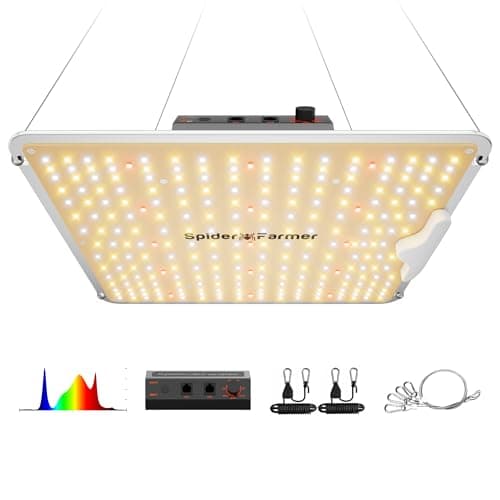 Spider Farmer SF1000 Publishes PPF to two decimal places and an efficacy figure that actually divides out of it. That internal consistency is rarer in this category than it should be. | One bench, verifiable | 2.5 umol/J | |
| 3 | 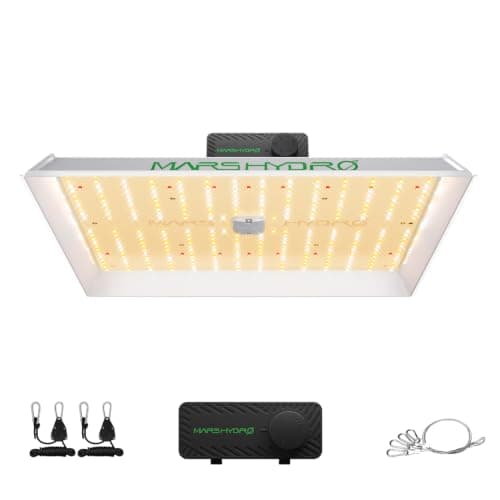 Mars Hydro TS 1000 The most photons of anything on this list, and one of only three fixtures here that publishes both PPF and efficacy so the claim can be checked against itself. | The biggest sowing | 2.3 umol/J |
The reasoning
There is a useful simplification available here that most vegetable seed-starting advice buries: at the seedling stage, brassicas, lettuce, squash, peppers and tomatoes all want about the same light. They diverge enormously later, in the garden. Under lights, in a tray, for six weeks, they do not.
University of New Hampshire Extension puts the seedling target at about 12 moles per square meter per day. That figure applies across the tray, which means you can light a mixed sowing with one fixture and one setting, and stop trying to zone your shelf by crop.
Daily light integral per University of New Hampshire Extension. The same number for brassicas, lettuce, cucurbits and nightshades at the seedling stage.
What actually differs between crops
Not the intensity — the timetable. Different vegetables reach transplant size at very different rates, and that is what determines how much shelf you need and for how long.
| Crop group | Time under lights | What that means for your setup |
|---|---|---|
| Peppers and eggplant | 8–10 weeks | First in, last out. These define the length of your season and should get the best-lit position |
| Tomatoes | 6–8 weeks | The classic. Stretch fast if under-lit — the most sensitive indicator on the shelf |
| Brassicas (broccoli, cabbage, kale) | 4–6 weeks | Quick turnaround; often a second wave into space the peppers have not vacated |
| Lettuce and greens | 3–5 weeks | Fast, and tolerant of being at the dimmer edge of the footprint |
| Cucurbits (squash, cucumber, melon) | 2–4 weeks | Sown late and moved out fast. Large seedlings quickly — they need headroom, not more light |
The practical consequence: your shelf is not one crop for eight weeks, it is a rolling succession. Size the light for a full tray, then plan which crop sits where as things come and go.
Sizing the fixture
Work backwards from the target. A daily light integral of 12 mol/m²/day at a given photoperiod implies a specific PPFD, and PPFD across your area implies a photon output.
Required PPF = PPFD × area (m²) ÷ uniformity
At 14 hours a day: PPFD = 12 × 1,000,000 ÷ (14 × 3600) = 238 µmol/m²/s.
At 16 hours: 12 × 1,000,000 ÷ (16 × 3600) = 208 µmol/m²/s — the longer photoperiod lowers the intensity you need.
A 4 × 1.5 ft shelf is 6 sq ft = 0.557 m². So at 14 hours: PPF = 238 × 0.557 ÷ 0.8 = 166 µmol/s.
That is a modest requirement — roughly two thirds of a single Spider Farmer SF1000, which publishes 249.21 µmol/s.
Bars, for the same reason as always
Seed trays are long rectangles and shelves are long rectangles. A square panel centered over a 4 ft shelf lights the middle well and the ends poorly, and the seedlings at the ends will tell you so within a week by leaning. Linear bars put emitters along the whole length.
The trade-off, stated plainly: Barrina publishes no photon output for any strip in its T5 range, so a bar-based shelf cannot be sized in advance the way a panel can. We still pick it first here, because the geometry advantage is large and seedlings give you feedback within days — the full argument is in bar versus panel coverage.
Photoperiod
University of Minnesota Extension recommends 16 to 18 hours a day for seedlings; Iowa State University Extension suggests 12 to 14 generally with 16 as a ceiling for home growers. For vegetables we would run 14 to 16 and put it on a timer, which lands inside both recommendations.
The reason to prefer the longer end is economic rather than botanical: hours are the cheapest way to raise daily light. Two extra hours a day on a 120 W rack costs about $6.60 across a ten-week season — far less than the fixture you would otherwise buy to raise intensity instead.
Distance, and the one crop that punishes you
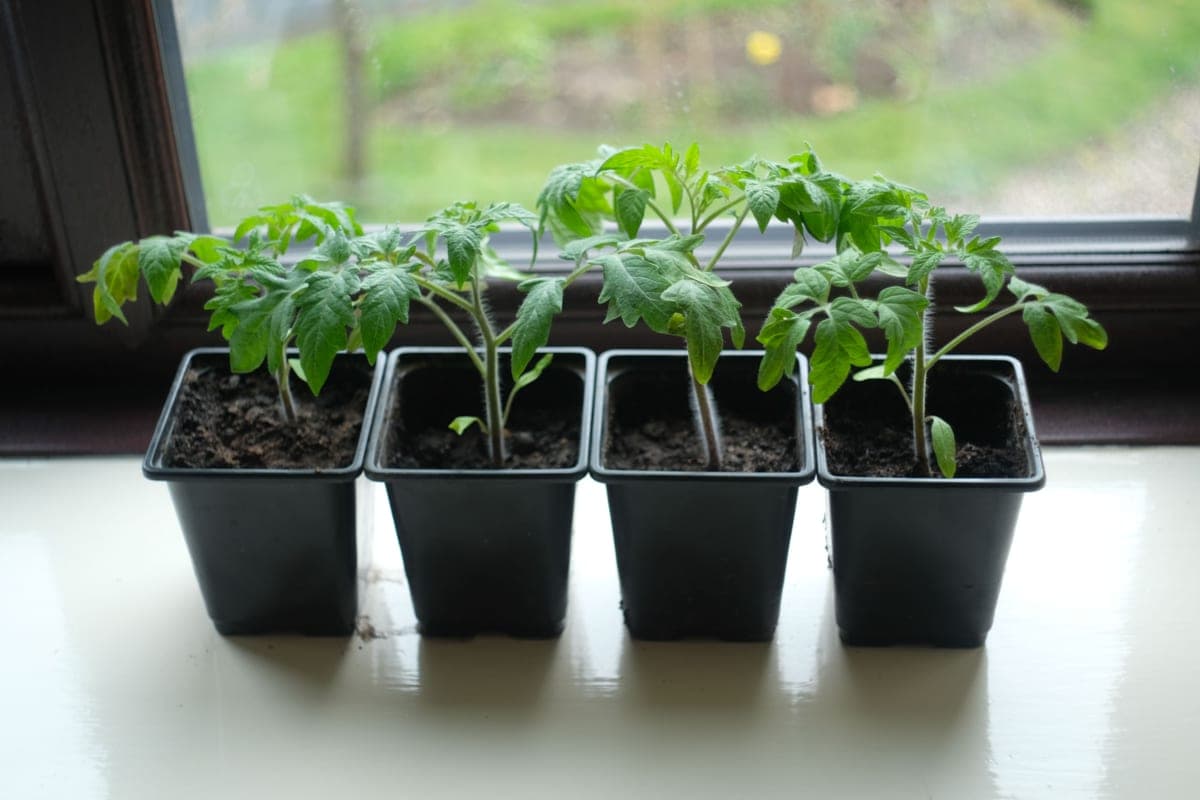
Keep bars 2 to 4 inches above the seedling tops and raise them as the plants grow. Tomatoes are the canary: they stretch within days of being under-lit and the stretched stem never shortens. If your tomatoes are leggy, every other crop on that shelf is also short of light — they are just hiding it better.
Crop-specific detail for the most common one is in grow lights for tomato seedlings, and the general distance arithmetic is in how far grow lights should be from seedlings.
What a vegetable season costs to light
Six linked 20 W strips = 120 W.
120 × 16 ÷ 1000 = 1.92 kWh a day.
Over 70 days: 134.4 kWh.
At 18.34 cents per kWh: $24.65 for the entire season — for every transplant you will put in the ground.
That figure is worth sitting with, because it is the strongest argument for starting your own vegetables at all. Price your own rack in the running-cost calculator.
Hardening off, which the light cannot do for you
A seedling grown under a fixture at 238 µmol/m²/s has never seen full sun, which on a clear day is several times that. Moving trays straight outdoors bleaches and scorches them regardless of how well they were lit indoors. Step them into outdoor conditions over a week to ten days — this is not a lighting problem and no fixture solves it.
The honest summary
One target, one fixture, one timer, for the whole mixed tray. Size for about 166 µmol/s over a standard shelf at 14 hours, use bars because your shelf is a rectangle, keep them close, and watch the tomatoes for the first sign that anything is wrong. The whole season costs less than a flat of nursery transplants.
Every pick in full
Barrina T5 4ft Grow Light Strips
LED barA full rack of trays
The default seed-starting bar for good reasons — 4 ft long, linkable in series, cheap per foot — and the reason we built a coverage calculator, because Barrina publishes no photon data whatsoever.
What Barrina publishes
- Power draw
- 20 W per fixture; an 8-pack draws 160 W (source)
- Spectrum
- 5000 K (source)
- Dimming
- No; on/off switch per fixture, linkable up to 8 in series (source)
- Dimensions
- 4 ft strip, 120-degree beam angle, 120 V AC (source)
What Barrina does not publish
- PPF in umol/s — for any strip in the range
- PPFD at any stated distance
- Photon efficacy in umol/J
- LED count per strip, and rated lifespan
Who should skip it
Skip it if you need to know what you are getting before it arrives. There is no published PPF, no PPFD and no efficacy figure, so nothing about its output can be verified in advance.
Spider Farmer SF1000
LED panelOne bench, verifiable
Publishes PPF to two decimal places and an efficacy figure that actually divides out of it. That internal consistency is rarer in this category than it should be.
What Spider Farmer publishes
- Power draw
- 100 W +/-5% at 100-277 V AC (source)
- PPF (photon output)
- 249.21 umol/s (source)
- Efficacy
- 2.5 umol/J (source)
- Stated coverage
- 2 x 2 ft core, 3 x 3 ft maximum (source)
- Spectrum
- 650-665 nm, 730-740 nm, 2800-3000 K, 4800-5000 K (source)
- Diodes
- Bridgelux (source)
- Dimming
- Yes, dimming knob (source)
- Dimensions
- 32.5 x 29.0 x 5.9 cm (source)
- Rated life
- 55,000 hours (source)
Our arithmetic
- Does the published efficacy check out against the published PPF?: Yes — 2.49 umol/J computed against 2.5 umol/J published
249.21 umol/s / 100 W = 2.4921 umol/J. The published 2.5 umol/J is that number rounded. Not every brand's two figures agree like this, which is exactly why we divide them. - Average PPFD across its 2 x 2 ft core footprint: about 536 umol/m2/s
2 ft x 2 ft = 4 sq ft = 0.372 m2. 249.21 / 0.372 = 670 umol/m2/s at perfect uniformity; at a 0.8 uniformity factor, about 536 umol/m2/s.
Who should skip it
Skip it if raw output is what you are buying — the TS 1000 delivers 38% more photons per second, at the cost of 50 W more draw.
Mars Hydro TS 1000
LED panelThe biggest sowing
The most photons of anything on this list, and one of only three fixtures here that publishes both PPF and efficacy so the claim can be checked against itself.
What Mars Hydro publishes
- Power draw
- 150 W +/-5% at 100-277 V AC (source)
- PPF (photon output)
- 343 umol/s (source)
- Efficacy
- 2.3 umol/J (source)
- Stated coverage
- 2.5 x 2.5 ft vegetative, 2.3 x 2.3 ft flowering (source)
- Spectrum
- 660-665 nm, 730-740 nm, 3000 K, 5000 K (source)
- Diodes
- Bridgelux (source)
- Dimming
- Yes, 0-100% dimmer knob (source)
- Dimensions
- 406 x 326 x 50 mm (source)
Our arithmetic
- Average PPFD across its stated 2.5 x 2.5 ft vegetative footprint: about 470 umol/m2/s
2.5 ft x 2.5 ft = 6.25 sq ft = 0.581 m2. 343 umol/s divided by 0.581 m2 = 590 umol/m2/s at perfect uniformity; applying a 0.8 uniformity factor gives about 472 umol/m2/s average. - Electricity used at 14 hours a day for 30 days: 63.0 kWh a month
150 W x 14 h x 30 d / 1000 = 63.0 kWh.
Who should skip it
Skip it if you are lighting a bookshelf. 343 umol/s concentrated into a 2.5 ft square is far more light than a monstera wants, and you pay 150 W to deliver it.
Questions people actually ask
+Do different vegetables need different grow light settings?
+What size grow light do I need for vegetable seedlings?
+How many hours a day for vegetable seedlings?
+Which vegetable seedling shows light problems first?
+Have you grown vegetables under these lights?
Sources
- University of New Hampshire Extension — Growing Seedlings Under Lights — consulted September 2, 2026
- University of Minnesota Extension — Lighting for indoor plants and starting seeds — consulted September 2, 2026
- Iowa State University Extension — Important Considerations for Providing Supplemental Light to Indoor Plants — consulted September 2, 2026
- Virginia Cooperative Extension — Calculating and Using Daily Light Integral (DLI), SPES-720 — consulted September 2, 2026
- Spider Farmer — SF1000 published specification table — consulted September 2, 2026
- Barrina — T5 ML20 4ft 20W product page — consulted September 2, 2026
- US Energy Information Administration — Electric Power Monthly, Table 5.3 (US residential average, June 2026) — consulted September 2, 2026
Read next
Seed Starting
Grow Lights for Pepper Seedlings
Sizing for the longest occupant of a seed shelf, and why peppers hide a light deficit until it is too late.
Top pick
Barrina T5 4ft Grow Light Strips
Seed Starting
The Best Grow Lights for Seed Starting
Sized against a 12 mol/m2/day seedling target using published photon output, not marketing claims.
Top pick
Barrina T5 4ft Grow Light Strips
Seed Starting
How Much Light Do Seedlings Actually Need?
The 12 mol/m2/day seedling target, converted into the PPFD and hours you can actually set.
Top pick
Spider Farmer SF1000
Seed Starting
Grow Lights for Tomato Seedlings
Tomato seedlings stretch faster than anything else on the shelf. The target, the hours, and what reaches them.
Top pick
Spider Farmer SF1000
Seed Starting
Grow Light Shelf Setup for Seed Trays
The build: rack, fixtures, chains, timer — with the measurements that make it work and the mistakes that waste a season.
Top pick
Barrina T5 4ft Grow Light Strips
Where this sits
This page belongs to Grow Lights for Seed Starting. Every figure on it is either quoted from a named published source or derived in view — the full method is on our methodology page, and how the site is funded is on the affiliate disclosure.