Grow Lights for Tomato Seedlings
Tomatoes are the crop that punishes a weak light fastest, and the one that most rewards getting the number right.
By Scooter M. — An enthusiast who's genuinely into this. I read the manuals, compile the published specs, and do the math. No lab coat.
Published · How we pick
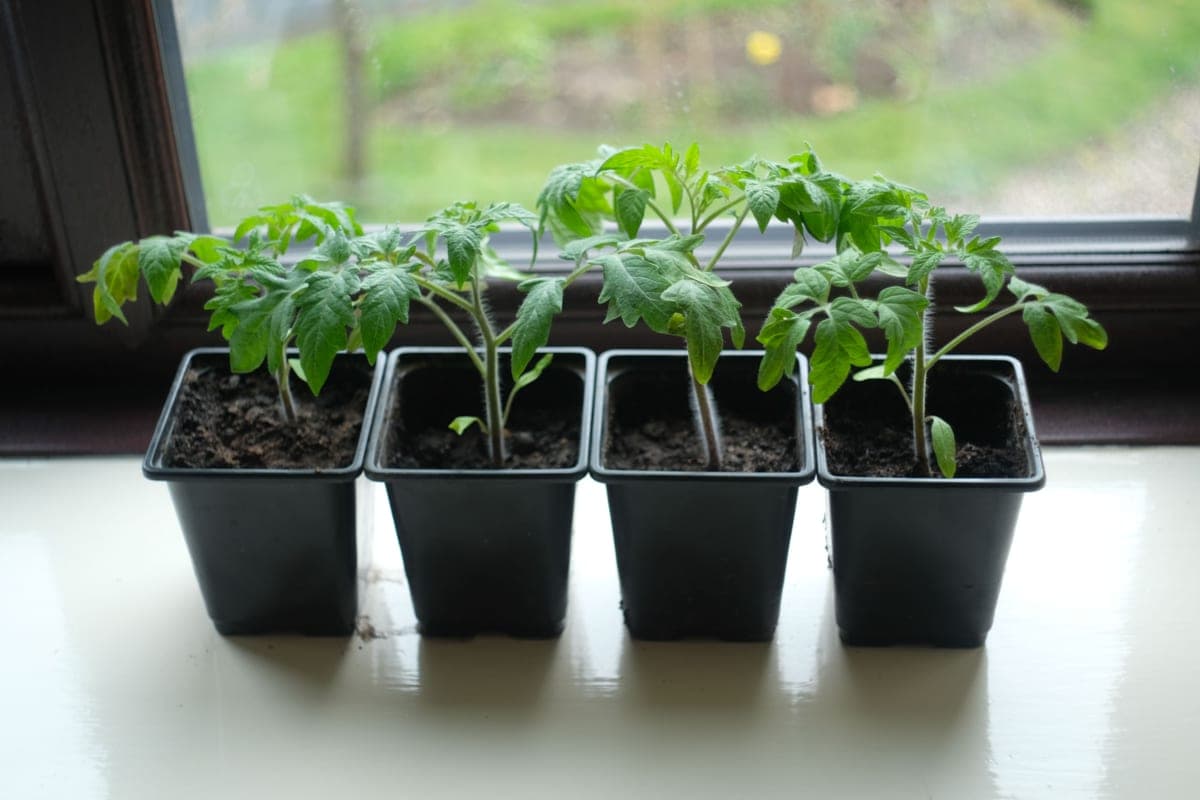
Photographs on this site are licensed stock and are illustrative of the fixture type. We do not own the units we write about.
How this page is funded: the buy links here are Amazon Associates links, and we earn a commission on qualifying purchases at no extra cost to you. We have not been paid to feature anything on this page, we accept no free product, and commission plays no part in the ranking. Full disclosure.
We have not tested these units. Everything below comes from the manufacturer’s own published specifications, or from arithmetic we have shown our working for. Where a figure is not published, we say so instead of estimating one. Read the method.
Quick picks
Efficacy is photons out per joule in. Where a manufacturer publishes it we quote theirs; where they publish photon output and wattage but not efficacy, we divide and label it as ours; where they publish neither, the cell says so rather than guessing. Tap a row for the full write-up.
| # | Product | Best for | Efficacy | Price |
|---|---|---|---|---|
| 1 | 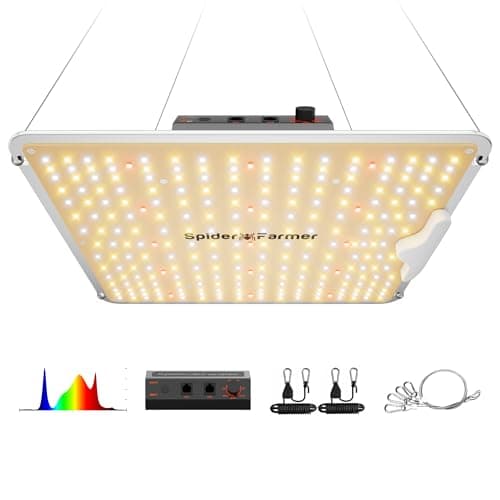 Spider Farmer SF1000 Publishes PPF to two decimal places and an efficacy figure that actually divides out of it. That internal consistency is rarer in this category than it should be. | One tray of tomatoes | 2.5 umol/J | |
| 2 | 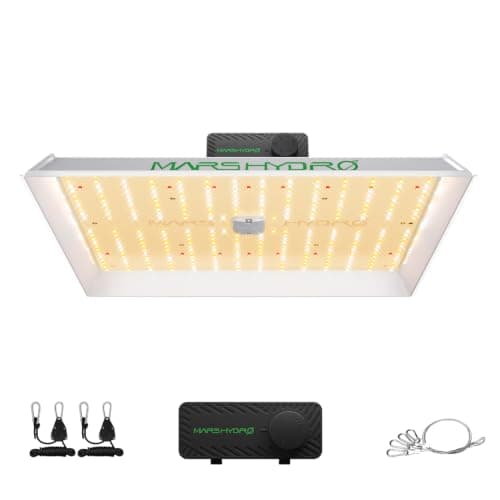 Mars Hydro TS 1000 The most photons of anything on this list, and one of only three fixtures here that publishes both PPF and efficacy so the claim can be checked against itself. | Growing on to transplant | 2.3 umol/J | |
| 3 | 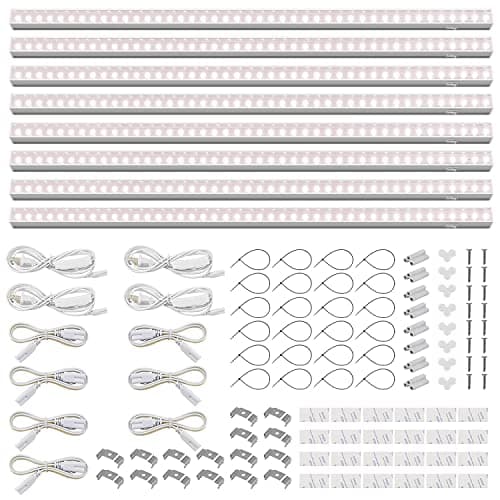 Barrina T5 4ft Grow Light Strips The default seed-starting bar for good reasons — 4 ft long, linkable in series, cheap per foot — and the reason we built a coverage calculator, because Barrina publishes no photon data whatsoever. | A whole shelf of them | Not published |
The reasoning
Tomato seedlings stretch faster and further than almost anything else you will start indoors. Give a pepper marginal light and it sits and sulks; give a tomato marginal light and within a week it is six inches tall, pencil-thin and leaning. That sensitivity makes tomatoes the best diagnostic on the shelf — and the crop where hitting the number actually pays.
Seedlings generally want about 12 mol/m²/day (UNH Extension). Iowa State University Extension's high-light band — 12 to 16 mol/m²/day — covers seedlings intended for fruiting crops. Mature fruiting tomatoes want 20 to 30 (Virginia Cooperative Extension), but that is a greenhouse problem, not a windowsill one.
What that means at the tray
| PPFD at the canopy | Hours per day | DLI delivered |
|---|---|---|
| 200 µmol/m²/s | 16 h | 11.5 mol/m²/day |
| 250 µmol/m²/s | 16 h | 14.4 mol/m²/day |
| 300 µmol/m²/s | 14 h | 15.1 mol/m²/day |
| 350 µmol/m²/s | 12 h | 15.1 mol/m²/day |
| 400 µmol/m²/s | 10 h | 14.4 mol/m²/day |
The practical sweet spot for tomatoes is 250 to 300 µmol/m²/s for 14 to 16 hours. That is comfortably inside what a single 100 W-class panel delivers over a couple of trays, and it is a stretch for a lone clip light over the same area.
Why tomatoes specifically stretch
Two things happen at once under low light. The plant elongates its internodes reaching for a brighter source — that is the visible stretch. And it does so at the expense of stem thickness, because the carbon it does capture is going into length rather than girth. The result is a tall seedling with a stem that cannot support it, which then needs staking, transplants badly, and is more vulnerable to wind and handling.
Tomatoes will root along a buried stem, so a stretched seedling can be planted deep and partly rescued at transplant. That is a genuine recovery route and worth knowing. It is not a reason to under-light them for eight weeks.
The setup that works
- Light on before they emerge. The stretch starts the hour the shoot breaks the surface. See whether seeds need light to germinate for the sequencing.
- 4 to 6 inches for strips, 12 to 18 for panels, raised weekly. Tomatoes grow fast enough that a fortnightly check is not enough.
- 14 to 16 hours. Longer does not help enough to be worth the electricity, and tomatoes do want a dark period.
- Pot up before they get leggy, not after. Tomatoes can be buried deeper each time they are potted on, which converts some of the stem into root.
- Brush the tops daily, or run a small fan. Mechanical movement thickens stems. It costs nothing and it visibly works.
Sizing a fixture for a tomato tray
Two 1020 trays side by side is about 3.2 sq ft, or 0.297 m². The Spider Farmer SF1000 publishes 249.21 µmol/s.
249.21 ÷ 0.297 × 0.8 uniformity = 671 µmol/m²/s. That is far more than tomatoes need at seedling stage — so raise it, or dim it, or spread it over four trays instead of two.
Over four trays (0.595 m²): 249.21 ÷ 0.595 × 0.8 = 335 µmol/m²/s. At 14 hours, DLI = 16.9 mol/m²/day. That is the right side of the target with margin at the edges.
Run your own numbers in the coverage calculator, and see PPFD targets by plant type for how tomatoes compare with everything else you might have on the same shelf.
Every pick in full
Spider Farmer SF1000
LED panelOne tray of tomatoes
Publishes PPF to two decimal places and an efficacy figure that actually divides out of it. That internal consistency is rarer in this category than it should be.
What Spider Farmer publishes
- Power draw
- 100 W +/-5% at 100-277 V AC (source)
- PPF (photon output)
- 249.21 umol/s (source)
- Efficacy
- 2.5 umol/J (source)
- Stated coverage
- 2 x 2 ft core, 3 x 3 ft maximum (source)
- Spectrum
- 650-665 nm, 730-740 nm, 2800-3000 K, 4800-5000 K (source)
- Diodes
- Bridgelux (source)
- Dimming
- Yes, dimming knob (source)
- Dimensions
- 32.5 x 29.0 x 5.9 cm (source)
- Rated life
- 55,000 hours (source)
Our arithmetic
- Does the published efficacy check out against the published PPF?: Yes — 2.49 umol/J computed against 2.5 umol/J published
249.21 umol/s / 100 W = 2.4921 umol/J. The published 2.5 umol/J is that number rounded. Not every brand's two figures agree like this, which is exactly why we divide them. - Average PPFD across its 2 x 2 ft core footprint: about 536 umol/m2/s
2 ft x 2 ft = 4 sq ft = 0.372 m2. 249.21 / 0.372 = 670 umol/m2/s at perfect uniformity; at a 0.8 uniformity factor, about 536 umol/m2/s.
Who should skip it
Skip it if raw output is what you are buying — the TS 1000 delivers 38% more photons per second, at the cost of 50 W more draw.
Mars Hydro TS 1000
LED panelGrowing on to transplant
The most photons of anything on this list, and one of only three fixtures here that publishes both PPF and efficacy so the claim can be checked against itself.
What Mars Hydro publishes
- Power draw
- 150 W +/-5% at 100-277 V AC (source)
- PPF (photon output)
- 343 umol/s (source)
- Efficacy
- 2.3 umol/J (source)
- Stated coverage
- 2.5 x 2.5 ft vegetative, 2.3 x 2.3 ft flowering (source)
- Spectrum
- 660-665 nm, 730-740 nm, 3000 K, 5000 K (source)
- Diodes
- Bridgelux (source)
- Dimming
- Yes, 0-100% dimmer knob (source)
- Dimensions
- 406 x 326 x 50 mm (source)
Our arithmetic
- Average PPFD across its stated 2.5 x 2.5 ft vegetative footprint: about 470 umol/m2/s
2.5 ft x 2.5 ft = 6.25 sq ft = 0.581 m2. 343 umol/s divided by 0.581 m2 = 590 umol/m2/s at perfect uniformity; applying a 0.8 uniformity factor gives about 472 umol/m2/s average. - Electricity used at 14 hours a day for 30 days: 63.0 kWh a month
150 W x 14 h x 30 d / 1000 = 63.0 kWh.
Who should skip it
Skip it if you are lighting a bookshelf. 343 umol/s concentrated into a 2.5 ft square is far more light than a monstera wants, and you pay 150 W to deliver it.
Barrina T5 4ft Grow Light Strips
LED barA whole shelf of them
The default seed-starting bar for good reasons — 4 ft long, linkable in series, cheap per foot — and the reason we built a coverage calculator, because Barrina publishes no photon data whatsoever.
What Barrina publishes
- Power draw
- 20 W per fixture; an 8-pack draws 160 W (source)
- Spectrum
- 5000 K (source)
- Dimming
- No; on/off switch per fixture, linkable up to 8 in series (source)
- Dimensions
- 4 ft strip, 120-degree beam angle, 120 V AC (source)
What Barrina does not publish
- PPF in umol/s — for any strip in the range
- PPFD at any stated distance
- Photon efficacy in umol/J
- LED count per strip, and rated lifespan
Who should skip it
Skip it if you need to know what you are getting before it arrives. There is no published PPF, no PPFD and no efficacy figure, so nothing about its output can be verified in advance.
Questions people actually ask
+How much light do tomato seedlings need?
+Why are my tomato seedlings so tall and thin?
+Can I fix leggy tomato seedlings?
+How many hours of light do tomato seedlings need?
Sources
- University of New Hampshire Extension — Growing Seedlings Under Lights — consulted September 2, 2026
- Iowa State University Extension — Important Considerations for Providing Supplemental Light to Indoor Plants — consulted September 2, 2026
- Virginia Cooperative Extension — Calculating and Using Daily Light Integral (DLI), SPES-720 — consulted September 2, 2026
- Spider Farmer — SF1000 published specification table — consulted September 2, 2026
- University of Minnesota Extension — Lighting for indoor plants and starting seeds — consulted September 2, 2026
Read next
Seed Starting
Grow Lights for Pepper Seedlings
Sizing for the longest occupant of a seed shelf, and why peppers hide a light deficit until it is too late.
Top pick
Barrina T5 4ft Grow Light Strips
Seed Starting
Grow Lights for Vegetable Seedlings
One light target across every vegetable crop, and how succession timing decides your shelf layout.
Top pick
Barrina T5 4ft Grow Light Strips
Seed Starting
How Much Light Do Seedlings Actually Need?
The 12 mol/m2/day seedling target, converted into the PPFD and hours you can actually set.
Top pick
Spider Farmer SF1000
Seed Starting
How Far Should Grow Lights Be From Seedlings?
Distance by fixture type, in a table, with the inverse-square arithmetic that explains why an inch matters so much.
Top pick
Barrina T5 4ft Grow Light Strips
Coverage & Sizing
PPFD Targets by Plant Type
Published light bands mapped to common indoor plants, with the DLI each implies.
Top pick
GooingTop Clip Grow Light
Seed Starting
The Best Grow Lights for Seed Starting
Sized against a 12 mol/m2/day seedling target using published photon output, not marketing claims.
Top pick
Barrina T5 4ft Grow Light Strips
Where this sits
This page belongs to Grow Lights for Seed Starting. Every figure on it is either quoted from a named published source or derived in view — the full method is on our methodology page, and how the site is funded is on the affiliate disclosure.