Grow Lights for Propagation and Cuttings
A cutting has no roots, so the light that suits a seedling will dry it out before it grows any. The target starts low and climbs in stages.
By Scooter M. — An enthusiast who's genuinely into this. I read the manuals, compile the published specs, and do the math. No lab coat.
Published · How we pick
Photographs on this site are licensed stock and are illustrative of the fixture type. We do not own the units we write about.
How this page is funded: the buy links here are Amazon Associates links, and we earn a commission on qualifying purchases at no extra cost to you. We have not been paid to feature anything on this page, we accept no free product, and commission plays no part in the ranking. Full disclosure.
We have not tested these units. Everything below comes from the manufacturer’s own published specifications, or from arithmetic we have shown our working for. Where a figure is not published, we say so instead of estimating one. Read the method.
Quick picks
Efficacy is photons out per joule in. Where a manufacturer publishes it we quote theirs; where they publish photon output and wattage but not efficacy, we divide and label it as ours; where they publish neither, the cell says so rather than guessing. Tap a row for the full write-up.
| # | Product | Best for | Efficacy | Price |
|---|---|---|---|---|
| 1 | 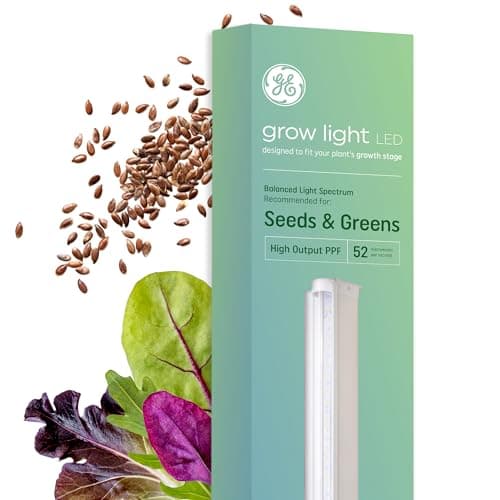 GE Grow Light 48in LED Fixture, Seeds and Greens A 4 ft shelf fixture that publishes its photon output, 52 umol/s from 30 W, so a shelf can be sized around it before it arrives rather than after. | A prop shelf you can stage by numbers | Not published | |
| 2 | 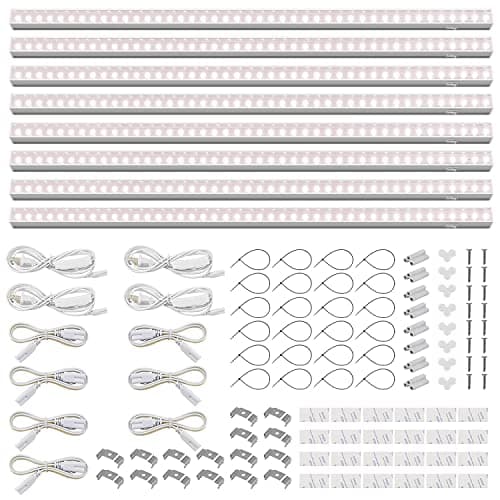 Barrina T5 4ft Grow Light Strips The default seed-starting bar for good reasons — 4 ft long, linkable in series, cheap per foot — and the reason we built a coverage calculator, because Barrina publishes no photon data whatsoever. | The cheapest linear foot | Not published | |
| 3 | 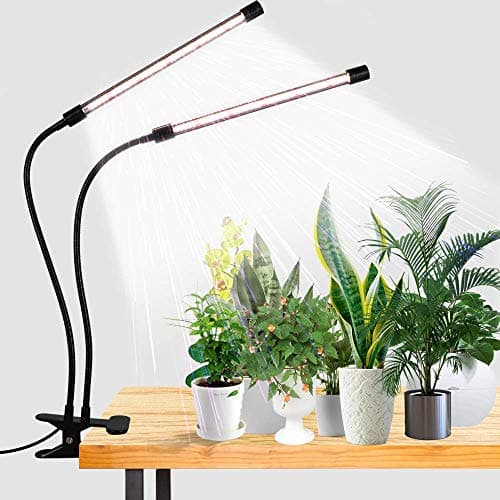 GooingTop Clip Grow Light The cheapest way to put real light on one plant on one desk, and honest about being exactly that — a 10 W clip lamp with a repeating timer. | A jar of cuttings on a desk | Not published |
The reasoning
We have not tested these fixtures. What follows is published specification, a named horticultural source for the light targets, and our arithmetic joining the two.
Almost everything written about propagation light says “bright, indirect” and stops. That is a shame, because propagation is one of the few areas of home growing with genuinely precise published targets — and because the intuition most people bring to it is backwards. A cutting is a leaf with no roots. Light drives photosynthesis, but it also drives water loss, and for the first week the cutting cannot replace what it loses. Too much light at that point does not speed rooting up; it wilts the cutting.
The staged target
Erik Runkle of Michigan State University, writing in Greenhouse Product News, sets out propagation light in three stages. These are commercial figures for unrooted cuttings, and they map cleanly onto a shelf at home.
| Stage | Roughly | Target DLI | Peak PPFD limit |
|---|---|---|---|
| 1. Sticking to callus | 5-7 days | 4 to 5 mol/m²/day | Not above 200 µmol/m²/s |
| 2. Initial rooting | 4-6 days | 6 to 8 mol/m²/day | Not above 400 µmol/m²/s |
| 3. Filling out | 6-8 days | 8 to 12 mol/m²/day | Higher levels tolerated |
Two things stand out. The first-stage target is lower than a houseplant’s — 4 to 5 mol/m²/day sits at the bottom of Iowa State University Extension’s 3-to-6 band for low-light foliage plants. The third-stage target is roughly what a seedling wants. So propagation is not one light level; it is a ramp, and the whole skill is in moving up it at the right speed.
Seedlings want about 12 mol/m²/day (University of New Hampshire Extension). Unrooted cuttings want 4 to 5 for the first week. Putting fresh cuttings straight under a seed-starting shelf is roughly triple the published stage-one target.
Running the ramp with one fixture
The elegant part is that you do not need three fixtures. With a bar that publishes its output, you can move through all three stages using height, hours and a second unit.
One GE 48in fixture, 52 µmol/s, over 4 sq ft = 0.3716 m²: 52 ÷ 0.3716 × 0.8 = 112 µmol/m²/s — comfortably under the stage-one cap of 200.
Stage 1 at 12 hours: 112 × 12 × 3600 ÷ 1,000,000 = 4.8 mol/m²/day. On target.
Stage 2, same fixture at 16 hours: 6.4 mol/m²/day. On target, without touching the intensity.
Stage 3, add a second fixture and go back to 12 hours: 224 µmol/m²/s → 9.7 mol/m²/day. On target, and still under the stage-two intensity cap.
That is a complete propagation lighting plan derived from two published numbers and a timer. It is the clearest example on this site of why a manufacturer publishing its PPF is worth paying for.
1. GE Grow 48in fixture — a prop shelf you can stage by numbers
52 µmol/s from 30 W, published, damp-rated, with a 5 ft cord and hanging chains. The damp rating earns its place here: propagation means humidity domes, misting and wet media directly under the fixture.
At 1.73 µmol/J it is the most efficient bar we cover, and the staged plan above is built on its published figure.
The downside: it does not dim, so stage transitions have to come from hours and from adding a second unit rather than a knob. And you will want that second unit, which doubles the cost of the setup at stage three.
2. Barrina T5 4ft — the cheapest linear foot
20 W per 4 ft strip, linkable up to eight in series, and the cheapest way to light a propagation shelf per foot. A three-shelf prop rack with two strips per shelf is one plug and one timer.
The downside: Barrina publishes no PPF, no PPFD and no efficacy for any strip in the range, so nothing on this page can be computed for it. On a page that is entirely about hitting specific DLI numbers in sequence, that is a real cost — you would be running the ramp by eye, using cutting behavior rather than arithmetic as the instrument. Detail in the Barrina T5 review.
3. GooingTop clip light — a jar of cuttings on a desk
Most propagation at home is not a shelf. It is three pothos cuttings in a jar on a windowsill in February. For that, a clip light with five brightness levels and a repeating 4/8/12-hour timer is the whole answer: start on a low setting for the first week, step it up as roots appear, and let the timer handle the hours.
The downside: no published photon data at all, so the staged targets above cannot be applied. For a jar of easy cuttings that is acceptable; for a tray of something slow and expensive it is not.
Why cuttings behave differently from seeds
A seed carries its own food and pushes roots down before it needs much light. A cutting is the reverse: it has leaves and no roots, so it can photosynthesize from day one but cannot drink. That asymmetry explains every piece of standard propagation advice.
- Why the light starts low: intensity drives transpiration. Under strong light a rootless cutting loses water it has no way to replace, and wilts before it calluses.
- Why it does not stay low: rooting needs energy, and once a callus forms and the first roots appear, more light produces a better-rooted plant faster. Runkle’s stage three doubles the stage one target for exactly that reason.
- Why a cover helps: a humidity dome or a bag reduces water loss, which is what buys the cutting time. It also means the fixture must be far enough away that the enclosed air does not heat up, the same problem covered in do LED grow lights get hot.
Reading the cuttings
- Too much light, too early: wilting within a day or two of sticking, leaf edges drying, cuttings collapsing while the medium is still wet. Raise the fixture or cut the hours before you blame the rooting hormone.
- Too little, for too long: cuttings staying green and alive but producing nothing for weeks, then yellowing from the bottom leaf. A cutting that is neither rooting nor dying is usually short of energy.
- On track: leaves holding firm and flat through the first week, a callus at the cut by the end of it, and new growth at the tip only after roots — tip growth before roots is a cutting spending reserves it cannot replace.
Running cost
One 30 W fixture, 12 hours: 10.8 kWh a month = $1.98.
Two, at 12 hours: 21.6 kWh = $3.96.
A full propagation cycle of about three weeks, running the staged plan above, comes to roughly $2 of electricity.
Which makes propagation the cheapest thing you can do with a grow light, and the one with the highest return: three weeks and two dollars turns one plant into five.
Not every cutting starts at stage one
The staged plan above is written for cuttings with leaves and no roots, which is the hardest case. Several common propagation methods start somewhere else on the ramp.
- Water propagation of pothos, philodendron and monstera. The cutting is sitting in its water supply, so the wilting risk that justifies the low stage-one target is much reduced. These can start nearer stage two, and they are the reason water propagation feels easier than it should.
- Leaf cuttings of succulents. A different problem entirely: succulent leaves store their own water and the risk is rot rather than desiccation. They want the bright, dry end of the range from the start, closer to the succulent target than to anything on this page.
- Division. A division already has roots, so it skips the ramp and resumes at whatever the parent plant wanted, usually after a fortnight of slightly reduced light while it settles.
- Woody and semi-ripe cuttings. Slow, often six weeks or more, and the stage-one period is correspondingly longer. Hold the low setting until you see a callus rather than counting days.
The staged numbers are a framework rather than a timetable. Runkle gives durations in days because commercial propagators run uniform batches; at home, watch the cutting and move up the ramp when it earns it.
Setting the shelf up physically
Propagation asks something of a shelf that seed starting does not: the fixture has to move, repeatedly, over three weeks.
Chains and S-hooks make that a ten-second job and are supplied with most bar fixtures. Fixed mounting screwed to the underside of a shelf does not, and it is the reason many propagation setups run the whole cycle at one intensity — not because the grower disagrees with the staged plan but because changing it is inconvenient.
The second physical consideration is the humidity cover. A dome or a bag is what buys an unrooted cutting time, and it sits between the fixture and the leaves. Clear domes pass most of the light; a cloudy, heavily condensed dome passes noticeably less, which means the cutting receives less than the arithmetic says. That is usually fine at stage one, where the target is low anyway, and it is worth remembering at stage three when you are trying to hit 8 to 12 mol/m²/day through a plastic lid.
What it costs against what it produces
Propagation is the best-value thing a grow light does, and the arithmetic is worth seeing beside the plant prices people pay.
Stage 1, one 30 W fixture at 12 hours for a week: 2.52 kWh = $0.46.
Stage 2, same fixture at 16 hours for a week: 3.36 kWh = $0.62.
Stage 3, two fixtures at 12 hours for a week: 5.04 kWh = $0.92.
Three weeks, one shelf: about $2.00 of electricity for as many rooted plants as the shelf holds.
A 4 ft shelf holds a lot of cuttings. Against the price of a single nursery plant, the fixture pays for itself in one cycle and the electricity never becomes the limiting factor — which is not something this site gets to say on many pages.
Heat, light and the two together
Propagation guidance almost always pairs light with bottom heat, and the two interact in a way worth understanding before you set a schedule.
Warmth at the base drives root initiation; light at the top drives photosynthesis and water loss. A cutting with a warm base and modest light puts its energy into roots, which is the outcome you want. A cutting with a cold base and strong light is being asked to run its leaves hard while its roots are inactive, which is the combination that produces wilting and rot.
The fixture contributes to this directly, because most of its wattage leaves as heat. A bar a few inches above a covered tray warms the air inside that tray, which is usually helpful in a cold room and unhelpful in a warm one. In a heated room in summer, the same setup that worked in February can cook a dome by mid-afternoon.
The practical rule is to treat the light and the heat as one system: in a cold room, run the fixture closer and lean on its warmth; in a warm room, raise it, vent the dome, and accept that the stage-one intensity is easier to hit from further away anyway. How much heat to expect from an LED fixture is covered in do LED grow lights get hot.
Every pick in full
GE Grow Light 48in LED Fixture, Seeds and Greens
LED barA prop shelf you can stage by numbers
A 4 ft shelf fixture that publishes its photon output, 52 umol/s from 30 W, so a shelf can be sized around it before it arrives rather than after.
What GE Lighting publishes
- Power draw
- 30 W at 120 V AC (source)
- PPF (photon output)
- 52 umol/s (source)
- Spectrum
- 2000 lumens, CRI 90; no color temperature or spectral distribution published (source)
- Dimming
- No; damp humidity rating, not rated for outdoor use (source)
- Dimensions
- 48.2 x 2.8 x 2.4 in; 5 ft cord, 8 in mounting chains (source)
Our arithmetic
- Photon efficacy, computed from the published figures: 1.73 umol/J
52 umol/s / 30 W = 1.73 umol/J. GE publishes no efficacy figure, so this one is ours. It sits mid-table on this site: above the Soltech Aspect at 1.39 umol/J, below the LED boards at 2.3 to 2.75. - Average PPFD from one fixture over a 4 x 1 ft run of shelf: about 112 umol/m2/s
4 sq ft / 10.7639 = 0.3716 m2. 52 umol/s / 0.3716 m2 = 139.9 umol/m2/s at perfect uniformity; a 0.8 uniformity factor gives about 112 umol/m2/s. That is the low band, 50 to 150 umol/m2/s, on the University of Minnesota Extension's scale. - Daily light integral from one fixture: 6.4 mol/m2/day at 16 hours; 7.3 at GE's recommended 18
112 umol/m2/s x 16 h x 3600 / 1,000,000 = 6.4 mol/m2/day. At 18 hours, 7.3. Both are short of the roughly 12 mol/m2/day the University of New Hampshire Extension gives for seedlings. - Two fixtures over the same 4 x 1 ft run: about 224 umol/m2/s, or 12.9 mol/m2/day at 16 hours
104 umol/s / 0.3716 m2 x 0.8 = 223.9 umol/m2/s. 223.9 x 16 h x 3600 / 1,000,000 = 12.9 mol/m2/day, which clears the seedling target without needing GE's 18 hours. - Electricity at 16 hours a day for 30 days: $2.64 a month
30 W x 16 h x 30 d / 1000 = 14.4 kWh. 14.4 x 18.34 cents = $2.64. At GE's 18 hours: 16.2 kWh = $2.97.
What GE Lighting does not publish
- PPFD at any stated distance
- Beam angle
- Color temperature and spectral distribution
- Photon efficacy in umol/J — PPF and wattage are given, so efficacy has to be derived
Who should skip it
Skip it if you want one fixture to carry a seed tray. A single unit averages about 112 umol/m2/s over a 4 x 1 ft run, which is the low band, and it does not dim.
Barrina T5 4ft Grow Light Strips
LED barThe cheapest linear foot
The default seed-starting bar for good reasons — 4 ft long, linkable in series, cheap per foot — and the reason we built a coverage calculator, because Barrina publishes no photon data whatsoever.
What Barrina publishes
- Power draw
- 20 W per fixture; an 8-pack draws 160 W (source)
- Spectrum
- 5000 K (source)
- Dimming
- No; on/off switch per fixture, linkable up to 8 in series (source)
- Dimensions
- 4 ft strip, 120-degree beam angle, 120 V AC (source)
What Barrina does not publish
- PPF in umol/s — for any strip in the range
- PPFD at any stated distance
- Photon efficacy in umol/J
- LED count per strip, and rated lifespan
Who should skip it
Skip it if you need to know what you are getting before it arrives. There is no published PPF, no PPFD and no efficacy figure, so nothing about its output can be verified in advance.
GooingTop Clip Grow Light
Clip lightA jar of cuttings on a desk
The cheapest way to put real light on one plant on one desk, and honest about being exactly that — a 10 W clip lamp with a repeating timer.
What GooingTop publishes
- Power draw
- About 10 W (source)
- Spectrum
- 6000 K, 74 white plus 10 red LEDs, CRI 95 (source)
- Dimming
- Five brightness levels; repeating 4 / 8 / 12 hour timer (source)
What GooingTop does not publish
- PPF in umol/s
- PPFD at any distance
- Photon efficacy in umol/J
- The manufacturer publishes no spec sheet at all; the figures above come from the retail listing
Who should skip it
Skip it if the plant is more than about a foot across, or if you want any number at all before you buy — nobody publishes photon data for this fixture.
Questions people actually ask
+How much light do cuttings need to root?
+Can you put cuttings under a seed-starting light?
+How do you increase light as cuttings root?
+Do cuttings in water need a grow light?
Sources
- Erik Runkle, Michigan State University — Technically Speaking: Managing light during cutting propagation, Greenhouse Product News — consulted September 20, 2026
- University of New Hampshire Extension — Growing Seedlings Under Lights — consulted September 2, 2026
- Iowa State University Extension — Important Considerations for Providing Supplemental Light to Indoor Plants — consulted September 2, 2026
- GE Lighting shop — 48in Seeds and Greens integrated fixture (PPF, dimensions, cord, humidity rating) — consulted September 17, 2026
- Barrina — T5 ML20 4ft 20W product page — consulted September 2, 2026
- GooingTop clip grow light — retail listing specifications (no manufacturer spec sheet published) — consulted September 2, 2026
- US Energy Information Administration — Electric Power Monthly, Table 5.3 (US residential average, June 2026) — consulted September 2, 2026
Read next
Seed Starting
Grow Light Shelf Setup for Seed Trays
The build: rack, fixtures, chains, timer — with the measurements that make it work and the mistakes that waste a season.
Top pick
Barrina T5 4ft Grow Light Strips
Seed Starting
The Best Grow Lights for Seed Starting
Sized against a 12 mol/m2/day seedling target using published photon output, not marketing claims.
Top pick
Barrina T5 4ft Grow Light Strips
Houseplants
Grow Lights for Herbs Indoors
Culinary herbs want 9-20 mol/m2/day. Why kitchen herbs fail, and what actually reaches the target.
Top pick
Barrina T5 4ft Grow Light Strips
Coverage & Sizing
How Far Should a Grow Light Be From Plants?
The inverse-square rule, published PPFD-at-distance figures, and a by-plant table.
Top pick
Soltech Aspect Gen 2
Where this sits
This page belongs to Grow Lights for Seed Starting. Every figure on it is either quoted from a named published source or derived in view — the full method is on our methodology page, and how the site is funded is on the affiliate disclosure.