Grow Lights for Succulents
Succulents want three to four times what a pothos wants, and they tell you immediately when they are not getting it.
By Scooter M. — An enthusiast who's genuinely into this. I read the manuals, compile the published specs, and do the math. No lab coat.
Published · How we pick
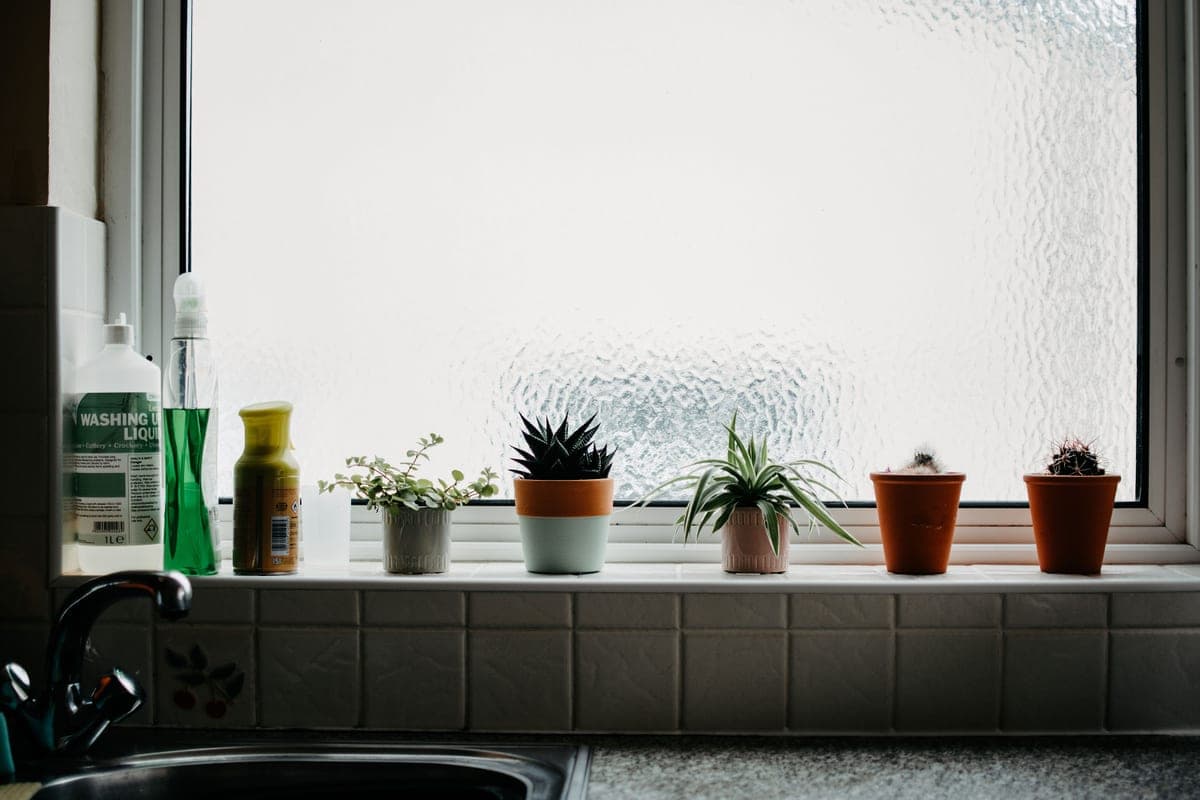
Photographs on this site are licensed stock and are illustrative of the fixture type. We do not own the units we write about.
How this page is funded: the buy links here are Amazon Associates links, and we earn a commission on qualifying purchases at no extra cost to you. We have not been paid to feature anything on this page, we accept no free product, and commission plays no part in the ranking. Full disclosure.
We have not tested these units. Everything below comes from the manufacturer’s own published specifications, or from arithmetic we have shown our working for. Where a figure is not published, we say so instead of estimating one. Read the method.
Quick picks
Efficacy is photons out per joule in. Where a manufacturer publishes it we quote theirs; where they publish photon output and wattage but not efficacy, we divide and label it as ours; where they publish neither, the cell says so rather than guessing. Tap a row for the full write-up.
| # | Product | Best for | Efficacy | Price |
|---|---|---|---|---|
| 1 | 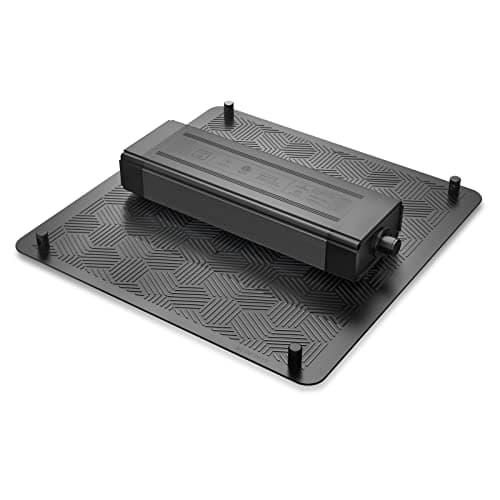 AC Infinity IONBOARD S22 The highest published efficacy of any fixture here at 2.7 umol/J, on Samsung LM301H diodes, with dimming in real 20% steps rather than a vague knob. | A succulent shelf | 2.7 umol/J | |
| 2 | 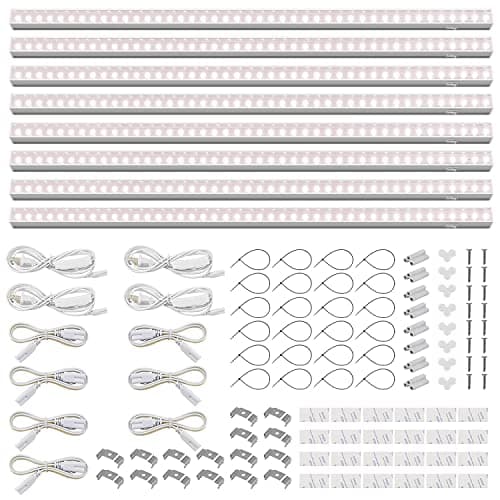 Barrina T5 4ft Grow Light Strips The default seed-starting bar for good reasons — 4 ft long, linkable in series, cheap per foot — and the reason we built a coverage calculator, because Barrina publishes no photon data whatsoever. | A long windowsill | Not published | |
| 3 | 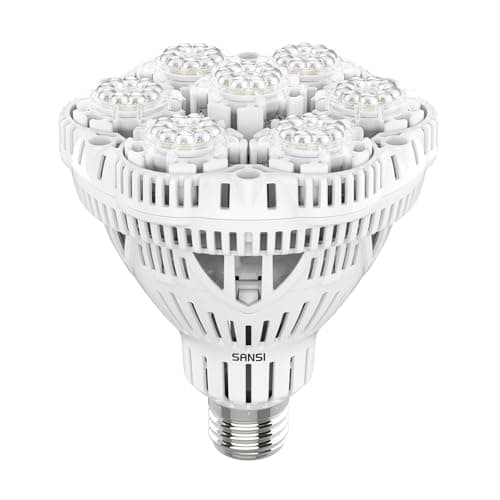 SANSI 36W BR30 Grow Light Bulb The rare grow bulb that publishes both PPF and a PPFD figure with the measurement distance attached, which is the only reason it can be sized honestly. | A few pots | 1.82 umol/J (ours) |
The reasoning
Succulents are the plants that most often disappoint indoors, and it is almost always the same cause: they are high-light plants being given houseplant light. Iowa State University Extension puts succulents in the 12 to 16 mol/m²/day band — three to four times what a pothos is happy with, and roughly what a seed tray wants.
Iowa State University Extension's high-light band, which groups succulents with flowering houseplants and leafy herbs. A low-light foliage plant wants 3 to 6.
The stretch, and why it is permanent
Under-lit succulents etiolate: the rosette opens out, the spacing between leaves increases, and the plant grows a pale elongated stem reaching for light. It is the same mechanism as a stretched tomato seedling, and it has the same property — it does not reverse. Adding light stops further stretching; it does not re-compact what already stretched.
This makes succulents the best diagnostic plant you can own. They report a light deficit visibly, within weeks, and the record is permanent. If your succulents are compact, your shelf is well lit.
What it takes to hit 14 mol
| PPFD at the plants | Hours per day | DLI delivered |
|---|---|---|
| 250 µmol/m²/s | 16 h | 14.4 mol/m²/day |
| 300 µmol/m²/s | 13 h | 14.0 mol/m²/day |
| 350 µmol/m²/s | 11 h | 13.9 mol/m²/day |
| 400 µmol/m²/s | 10 h | 14.4 mol/m²/day |
Note where that sits against University of Minnesota Extension’s bands: 250 to 450 µmol/m²/s is their high light category. A succulent shelf needs to be at the top of what indoor lighting delivers, which is why a clip light over a tray of them will not do.
A 2 × 2 ft shelf (0.372 m²), targeting 300 µmol/m²/s at 13 hours.
300 × 0.372 = 112 µmol/s landing on the plants; at 0.8 uniformity the fixture must produce about 140 µmol/s.
The IONBOARD S22 implies about 311 µmol/s (115 W × 2.7 µmol/J, our arithmetic), so it is comfortably sufficient — and dimming it to around 40-60% would land close to the target while cutting the running cost.
At 60% of 115 W for 13 hours a day: roughly 69 W × 13 × 30 ÷ 1000 = 26.9 kWh a month, about $4.93.
Practical points specific to succulents
- Acclimate gradually. A succulent moved from a dim shelf straight under a strong fixture can bleach or scorch. Step it up over a week or two, or start with the fixture dimmed.
- Long photoperiods are fine. Fourteen to sixteen hours suits them and is the cheapest way to hit a high daily total without a high-intensity fixture.
- More light means more water, not less. A well-lit succulent transpires and grows faster, so the watering interval shortens. Many people add light, keep the old watering schedule and conclude the light hurt the plant.
- Color is a light signal. The reds, purples and oranges people prize in succulents are stress pigments produced under high light. A green-only collection is usually an under-lit one, and this is one case where the aesthetic goal and the health goal point the same way.
The full target table is at PPFD targets by plant type, and photoperiod by plant is at grow light hours per day by plant.
Every pick in full
AC Infinity IONBOARD S22
LED panelA succulent shelf
The highest published efficacy of any fixture here at 2.7 umol/J, on Samsung LM301H diodes, with dimming in real 20% steps rather than a vague knob.
What AC Infinity publishes
- Power draw
- 115 W (source)
- Efficacy
- 2.7 umol/J (source)
- PPFD
- 1098 PPFD (no measurement distance published) (source)
- Stated coverage
- 2 x 2 ft (source)
- Spectrum
- Samsung LM301H, plus 660 nm, 730 nm, 3000 K, 6500 K (source)
- Diodes
- 272 diodes (source)
- Dimming
- Yes, 0-100% in 20% increments (source)
- Dimensions
- 30.0 x 30.0 cm board, 1.1 cm thick (source)
- Rated life
- 50,000 hours (source)
Our arithmetic
- Photon output implied by the published wattage and efficacy: about 311 umol/s
115 W x 2.7 umol/J = 310.5 umol/s. AC Infinity does not print PPF directly, so this is our arithmetic from two figures it does print.
What AC Infinity does not publish
- PPF in umol/s — only efficacy is given, so photon output has to be derived
- The measurement distance for the 1098 PPFD figure, without which the number cannot be compared to anything
Who should skip it
Skip it if you want to place it by the numbers. AC Infinity prints 1098 PPFD with no measurement distance attached, which makes that figure impossible to use or compare.
Barrina T5 4ft Grow Light Strips
LED barA long windowsill
The default seed-starting bar for good reasons — 4 ft long, linkable in series, cheap per foot — and the reason we built a coverage calculator, because Barrina publishes no photon data whatsoever.
What Barrina publishes
- Power draw
- 20 W per fixture; an 8-pack draws 160 W (source)
- Spectrum
- 5000 K (source)
- Dimming
- No; on/off switch per fixture, linkable up to 8 in series (source)
- Dimensions
- 4 ft strip, 120-degree beam angle, 120 V AC (source)
What Barrina does not publish
- PPF in umol/s — for any strip in the range
- PPFD at any stated distance
- Photon efficacy in umol/J
- LED count per strip, and rated lifespan
Who should skip it
Skip it if you need to know what you are getting before it arrives. There is no published PPF, no PPFD and no efficacy figure, so nothing about its output can be verified in advance.
SANSI 36W BR30 Grow Light Bulb
Grow bulbA few pots
The rare grow bulb that publishes both PPF and a PPFD figure with the measurement distance attached, which is the only reason it can be sized honestly.
What SANSI publishes
- Power draw
- 36 W (source)
- PPF (photon output)
- 65.6 umol/s (source)
- PPFD
- 265.58 umol/m2/s at 1 ft (source)
- Spectrum
- 4000 K, 400-780 nm, CRI close to 100 (source)
- Rated life
- 25,000 hours (source)
Our arithmetic
- Efficacy, computed from the published figures: 1.82 umol/J
65.6 umol/s / 36 W = 1.82 umol/J. That is roughly a third less efficient than the panels on this page — the price of a screw-in form factor. - Electricity used at 12 hours a day for 30 days: 12.96 kWh a month
36 W x 12 h x 30 d / 1000 = 12.96 kWh.
What SANSI does not publish
- Beam angle
- Fixture dimensions
Who should skip it
Skip it if you are lighting more than one plant. 65.6 umol/s is a small amount of light spread over a cone — it lights a single specimen, not a shelf.
Questions people actually ask
+How much light do succulents need indoors?
+Why are my succulents stretching under a grow light?
+Can succulents get too much light indoors?
+Do grow lights bring out succulent colors?
Sources
- Iowa State University Extension — Important Considerations for Providing Supplemental Light to Indoor Plants — consulted September 2, 2026
- University of Minnesota Extension — Lighting for indoor plants and starting seeds — consulted September 2, 2026
- AC Infinity — IONBOARD S22 published specifications — consulted September 2, 2026
- US Energy Information Administration — Electric Power Monthly, Table 5.3 (US residential average, June 2026) — consulted September 2, 2026
Read next
Houseplants
Grow Lights for Jade Plants
The high-light band jade wants, the distance that delivers it, and how to acclimate a stretched plant.
Top pick
Spider Farmer SF1000
Coverage & Sizing
PPFD Targets by Plant Type
Published light bands mapped to common indoor plants, with the DLI each implies.
Top pick
GooingTop Clip Grow Light
Houseplants
How Much Light Do Houseplants Need in Winter?
Published DLI bands by plant type, and how to work out what your winter window is short by.
Top pick
SANSI 36W BR30 Grow Light Bulb
Houseplants
The Best Grow Lights for Winter
Winter is a daily-total problem. Modest fixture, long photoperiod — sized against published targets and costed for the season.
Top pick
Barrina T5 4ft Grow Light Strips
Coverage & Sizing
Grow Light Hours Per Day, by Plant
Published photoperiod guidance by plant, plus the cost of each additional hour.
Top pick
GooingTop Clip Grow Light
Houseplants
Grow Lights for Carnivorous Plants
Full-sun bog plants. Why most houseplant lights fall short, and the three fixtures that do not.
Top pick
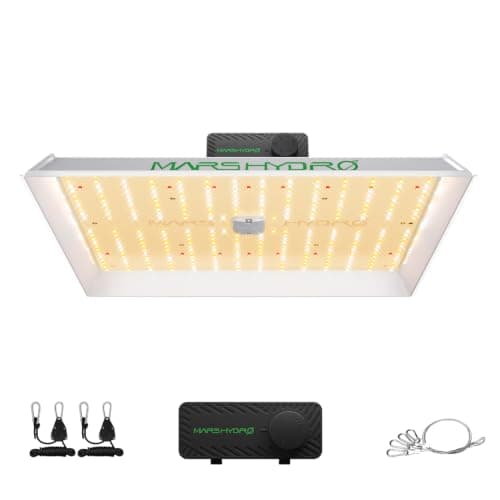
Mars Hydro TS 1000
Where this sits
This page belongs to Grow Lights for Houseplants and Winter. Every figure on it is either quoted from a named published source or derived in view — the full method is on our methodology page, and how the site is funded is on the affiliate disclosure.