Grow Lights for Jade Plants
Jade is a succulent, which puts it at the opposite end of the scale from every low-light houseplant. The stretching everyone blames on water is a light problem.
By Scooter M. — An enthusiast who's genuinely into this. I read the manuals, compile the published specs, and do the math. No lab coat.
Published · How we pick
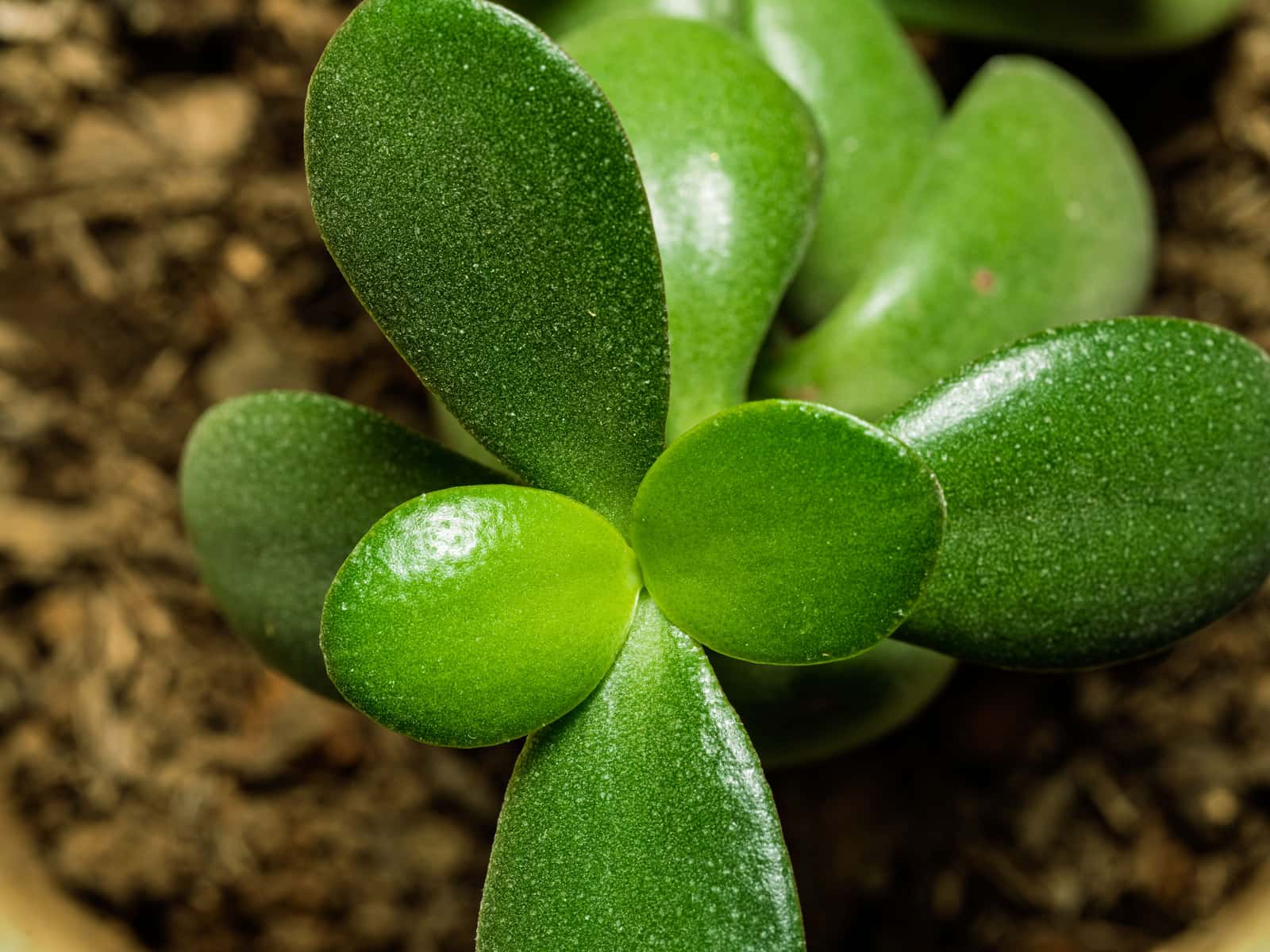
Photographs on this site are licensed stock and are illustrative of the fixture type. We do not own the units we write about.
How this page is funded: the buy links here are Amazon Associates links, and we earn a commission on qualifying purchases at no extra cost to you. We have not been paid to feature anything on this page, we accept no free product, and commission plays no part in the ranking. Full disclosure.
We have not tested these units. Everything below comes from the manufacturer’s own published specifications, or from arithmetic we have shown our working for. Where a figure is not published, we say so instead of estimating one. Read the method.
Quick picks
Efficacy is photons out per joule in. Where a manufacturer publishes it we quote theirs; where they publish photon output and wattage but not efficacy, we divide and label it as ours; where they publish neither, the cell says so rather than guessing. Tap a row for the full write-up.
| # | Product | Best for | Efficacy | Price |
|---|---|---|---|---|
| 1 | 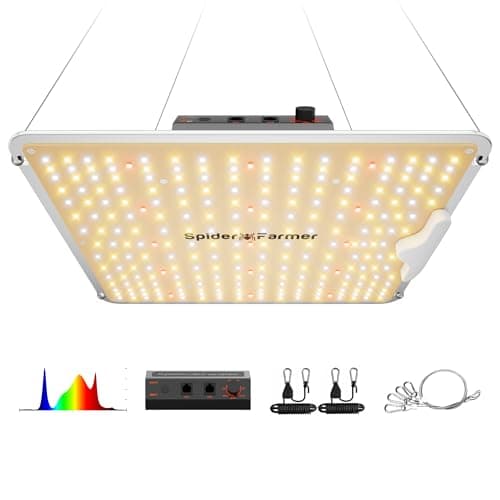 Spider Farmer SF1000 Publishes PPF to two decimal places and an efficacy figure that actually divides out of it. That internal consistency is rarer in this category than it should be. | A collection of succulents | 2.5 umol/J | |
| 2 | 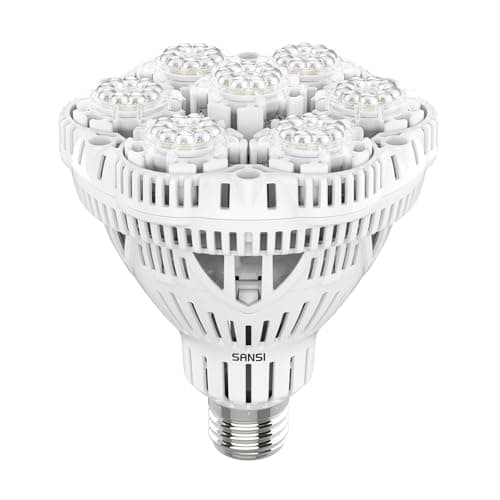 SANSI 36W BR30 Grow Light Bulb The rare grow bulb that publishes both PPF and a PPFD figure with the measurement distance attached, which is the only reason it can be sized honestly. | One jade, close up | 1.82 umol/J (ours) | |
| 3 | 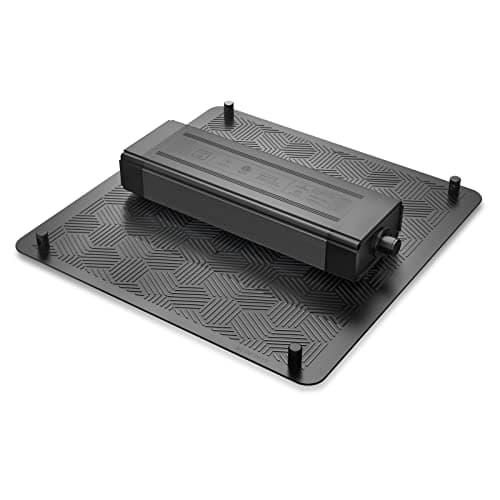 AC Infinity IONBOARD S22 The highest published efficacy of any fixture here at 2.7 umol/J, on Samsung LM301H diodes, with dimming in real 20% steps rather than a vague knob. | Dimming as it acclimates | 2.7 umol/J |
The reasoning
Almost every jade plant problem posted online is described as a watering question and answered as a watering question. A good share of them are light. Jade is a succulent from a high-light environment, and indoors it is routinely kept at a fraction of what it evolved for.
The tell is unmistakable once you know it: long bare stem between leaf pairs, leaves smaller than the older ones, the whole plant leaning. That is etiolation — the plant spending its resources reaching for light instead of thickening. No watering schedule fixes it, and the stretched sections never shorten back.
µmol/m²/s — the top of University of Minnesota Extension's high-light band. Roughly six times what a snake plant is asked for.
The gap between a jade and a windowsill
The number above is the whole story. Foliage houseplants sit in the 50–150 low band; jade wants 300–450. That is a factor of roughly six, and it is why a jade and a pothos in the same room have such different outcomes — the pothos is comfortable and the jade is quietly starving.
In summer a genuinely bright window covers it. In midwinter, in most of the country, it does not, which is why jade plants typically stretch between November and March and then partly recover in spring. The seasonal arithmetic is in how much light houseplants need in winter.
Sizing a fixture for the high band
One plant occupying roughly 1 × 1 ft = 0.093 m², targeting 350 µmol/m²/s:
350 × 0.093 ÷ 0.8 = 41 µmol/s — small enough that a single bulb covers it.
A collection over 2 × 2 ft = 0.372 m², same target: 350 × 0.372 ÷ 0.8 = 163 µmol/s — comfortably inside the Spider Farmer SF1000’s published 249.21 µmol/s.
The distance that hits the band
Same method as anywhere else on this site — take a published PPFD with a stated distance and scale it.
Published: 265.58 µmol/m²/s at 1 ft.
For 350 µmol/m²/s: 265.58 × (1 ÷ d)² = 350, so d² = 0.759 and d = about 10.5 inches.
At 1 ft you get the published 265.58, which is the bottom of the succulent range and still a perfectly good setting.
At 18 in you are down to 118 µmol/m²/s — fine for a pothos, and a jade kept there will stretch.
So for jade the bulb wants to be 10 to 12 inches away — roughly half the distance we would use for a snake plant with the identical fixture. Same lamp, same room, completely different setting.
Do not jump a stretched plant straight to full light
This is the one genuine risk. A jade that has spent a winter at 80 µmol/m²/s has grown leaves adapted to that level. Moving it directly under 400 can bleach them — pale or whitened patches on the upper surfaces that do not recover.
- Step it up over two to three weeks. Start at roughly double where it has been and raise from there.
- A dimmable fixture makes this trivial. AC Infinity’s board dims in 20% increments, which means you can repeat a setting exactly rather than guessing at a knob position.
- Or use distance as the dimmer. Start the bulb at 18 inches and move it to 12 over a fortnight.
What a fixture will and will not fix
| Symptom | Light problem? | What it actually is |
|---|---|---|
| Long bare stem between leaf pairs | Yes | Etiolation. The stretched section is permanent; new growth above it will be compact once the light is right |
| New leaves smaller than old ones | Yes | The plant is building on a smaller light budget than it used to have |
| Leaning steadily toward a window | Yes | Directional growth toward the only light source in the room |
| Red or bronze leaf margins | No — usually the opposite | Commonly a response to strong light. On a jade it is normal and not damage |
| Soft, translucent, mushy leaves | No | Overwatering. A grow light will not fix it and may mask it by drying the pot faster |
| Leaves dropping after a move | No | Transplant or relocation shock; give it a few weeks before changing anything else |
Hours and cost
Succulents want high intensity more than long hours — 12 to 14 hours is ample, and Iowa State University Extension’s general 12-to-14 guidance fits well here.
One bulb: 36 W × 12 h ÷ 1000 = 0.432 kWh a day = 12.96 kWh a month = $2.38 at 18.34 cents per kWh.
A panel over a succulent shelf: 100 W × 12 h ÷ 1000 = 1.2 kWh a day = 36 kWh a month = $6.60.
Across an October-to-March winter (182 days) the panel comes to about $40 — for a shelf, not one plant.
Price your own configuration in the running-cost calculator, and if you keep other succulents alongside the jade, the shared setup is covered in grow lights for succulents.
The honest summary
Jade is one of the few common houseplants where a grow light changes the plant rather than merely maintaining it. Target the high band, put the fixture closer than feels right, run it 12 hours, and step a stretched plant up gradually. The stem it already stretched will stay stretched — that part is not recoverable, and anyone telling you otherwise is selling something. Everything it grows from here on will be compact.
Every pick in full
Spider Farmer SF1000
LED panelA collection of succulents
Publishes PPF to two decimal places and an efficacy figure that actually divides out of it. That internal consistency is rarer in this category than it should be.
What Spider Farmer publishes
- Power draw
- 100 W +/-5% at 100-277 V AC (source)
- PPF (photon output)
- 249.21 umol/s (source)
- Efficacy
- 2.5 umol/J (source)
- Stated coverage
- 2 x 2 ft core, 3 x 3 ft maximum (source)
- Spectrum
- 650-665 nm, 730-740 nm, 2800-3000 K, 4800-5000 K (source)
- Diodes
- Bridgelux (source)
- Dimming
- Yes, dimming knob (source)
- Dimensions
- 32.5 x 29.0 x 5.9 cm (source)
- Rated life
- 55,000 hours (source)
Our arithmetic
- Does the published efficacy check out against the published PPF?: Yes — 2.49 umol/J computed against 2.5 umol/J published
249.21 umol/s / 100 W = 2.4921 umol/J. The published 2.5 umol/J is that number rounded. Not every brand's two figures agree like this, which is exactly why we divide them. - Average PPFD across its 2 x 2 ft core footprint: about 536 umol/m2/s
2 ft x 2 ft = 4 sq ft = 0.372 m2. 249.21 / 0.372 = 670 umol/m2/s at perfect uniformity; at a 0.8 uniformity factor, about 536 umol/m2/s.
Who should skip it
Skip it if raw output is what you are buying — the TS 1000 delivers 38% more photons per second, at the cost of 50 W more draw.
SANSI 36W BR30 Grow Light Bulb
Grow bulbOne jade, close up
The rare grow bulb that publishes both PPF and a PPFD figure with the measurement distance attached, which is the only reason it can be sized honestly.
What SANSI publishes
- Power draw
- 36 W (source)
- PPF (photon output)
- 65.6 umol/s (source)
- PPFD
- 265.58 umol/m2/s at 1 ft (source)
- Spectrum
- 4000 K, 400-780 nm, CRI close to 100 (source)
- Rated life
- 25,000 hours (source)
Our arithmetic
- Efficacy, computed from the published figures: 1.82 umol/J
65.6 umol/s / 36 W = 1.82 umol/J. That is roughly a third less efficient than the panels on this page — the price of a screw-in form factor. - Electricity used at 12 hours a day for 30 days: 12.96 kWh a month
36 W x 12 h x 30 d / 1000 = 12.96 kWh.
What SANSI does not publish
- Beam angle
- Fixture dimensions
Who should skip it
Skip it if you are lighting more than one plant. 65.6 umol/s is a small amount of light spread over a cone — it lights a single specimen, not a shelf.
AC Infinity IONBOARD S22
LED panelDimming as it acclimates
The highest published efficacy of any fixture here at 2.7 umol/J, on Samsung LM301H diodes, with dimming in real 20% steps rather than a vague knob.
What AC Infinity publishes
- Power draw
- 115 W (source)
- Efficacy
- 2.7 umol/J (source)
- PPFD
- 1098 PPFD (no measurement distance published) (source)
- Stated coverage
- 2 x 2 ft (source)
- Spectrum
- Samsung LM301H, plus 660 nm, 730 nm, 3000 K, 6500 K (source)
- Diodes
- 272 diodes (source)
- Dimming
- Yes, 0-100% in 20% increments (source)
- Dimensions
- 30.0 x 30.0 cm board, 1.1 cm thick (source)
- Rated life
- 50,000 hours (source)
Our arithmetic
- Photon output implied by the published wattage and efficacy: about 311 umol/s
115 W x 2.7 umol/J = 310.5 umol/s. AC Infinity does not print PPF directly, so this is our arithmetic from two figures it does print.
What AC Infinity does not publish
- PPF in umol/s — only efficacy is given, so photon output has to be derived
- The measurement distance for the 1098 PPFD figure, without which the number cannot be compared to anything
Who should skip it
Skip it if you want to place it by the numbers. AC Infinity prints 1098 PPFD with no measurement distance attached, which makes that figure impossible to use or compare.
Questions people actually ask
+Why is my jade plant stretching and leggy?
+How close should a grow light be to a jade plant?
+Can I put my jade straight under a strong grow light?
+Do jade plants need more light than other houseplants?
+Have you tested these lights on jade plants?
Sources
- University of Minnesota Extension — Lighting for indoor plants and starting seeds — consulted September 2, 2026
- Iowa State University Extension — Important Considerations for Providing Supplemental Light to Indoor Plants — consulted September 2, 2026
- SANSI — BR30 36W grow light bulb product page — consulted September 2, 2026
- Spider Farmer — SF1000 published specification table — consulted September 2, 2026
- AC Infinity — IONBOARD S22 published specifications — consulted September 2, 2026
- US Energy Information Administration — Electric Power Monthly, Table 5.3 (US residential average, June 2026) — consulted September 2, 2026
Read next
Houseplants
Grow Lights for Succulents
Succulents are high-light plants at 12-16 mol/m2/day. The target, the stretch, and what reaches it.
Top pick
AC Infinity IONBOARD S22
Coverage & Sizing
PPFD Targets by Plant Type
Published light bands mapped to common indoor plants, with the DLI each implies.
Top pick
GooingTop Clip Grow Light
Coverage & Sizing
How Far Should a Grow Light Be From Plants?
The inverse-square rule, published PPFD-at-distance figures, and a by-plant table.
Top pick
Soltech Aspect Gen 2
Houseplants
The Best Grow Lights for Winter
Winter is a daily-total problem. Modest fixture, long photoperiod — sized against published targets and costed for the season.
Top pick
Barrina T5 4ft Grow Light Strips
Houseplants
Grow Lights for Bonsai
Indoor bonsai sit in the 6-10 mol/m2/day band. The target, the distance, and why junipers indoors fail anyway.
Top pick
SANSI 36W BR30 Grow Light Bulb
Where this sits
This page belongs to Grow Lights for Houseplants and Winter. Every figure on it is either quoted from a named published source or derived in view — the full method is on our methodology page, and how the site is funded is on the affiliate disclosure.