Grow Lights for Herbs Indoors
The reason supermarket basil dies on your counter is not watering. It is that a kitchen counter delivers a fraction of what basil needs.
By Scooter M. — An enthusiast who's genuinely into this. I read the manuals, compile the published specs, and do the math. No lab coat.
Published · How we pick
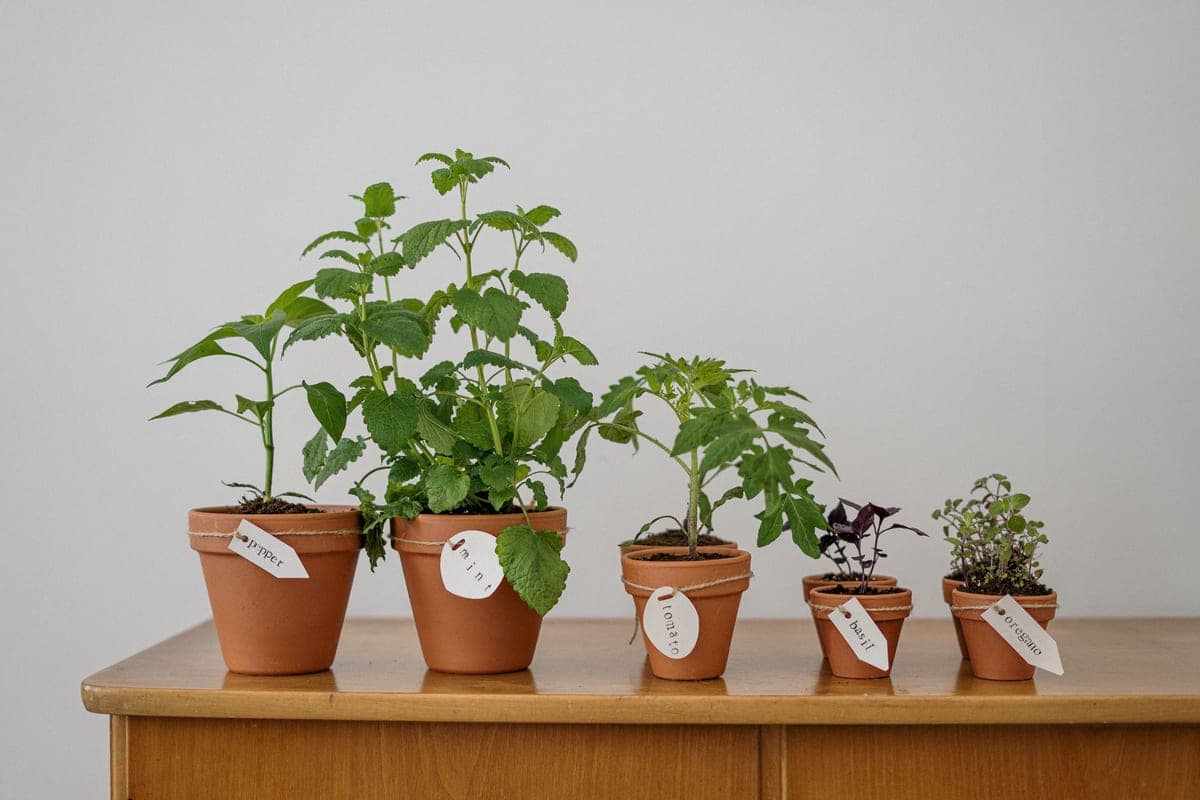
Photographs on this site are licensed stock and are illustrative of the fixture type. We do not own the units we write about.
How this page is funded: the buy links here are Amazon Associates links, and we earn a commission on qualifying purchases at no extra cost to you. We have not been paid to feature anything on this page, we accept no free product, and commission plays no part in the ranking. Full disclosure.
We have not tested these units. Everything below comes from the manufacturer’s own published specifications, or from arithmetic we have shown our working for. Where a figure is not published, we say so instead of estimating one. Read the method.
Quick picks
Efficacy is photons out per joule in. Where a manufacturer publishes it we quote theirs; where they publish photon output and wattage but not efficacy, we divide and label it as ours; where they publish neither, the cell says so rather than guessing. Tap a row for the full write-up.
| # | Product | Best for | Efficacy | Price |
|---|---|---|---|---|
| 1 | 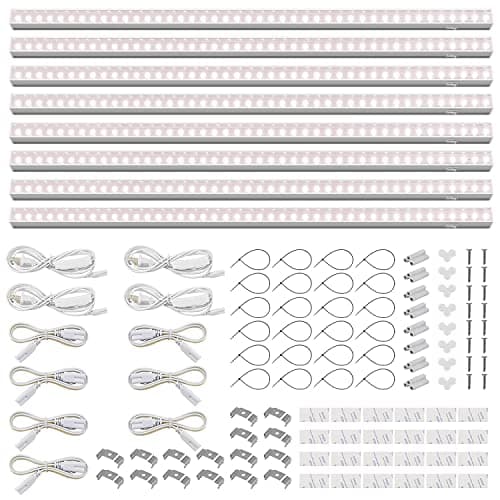 Barrina T5 4ft Grow Light Strips The default seed-starting bar for good reasons — 4 ft long, linkable in series, cheap per foot — and the reason we built a coverage calculator, because Barrina publishes no photon data whatsoever. | A herb shelf | Not published | |
| 2 | 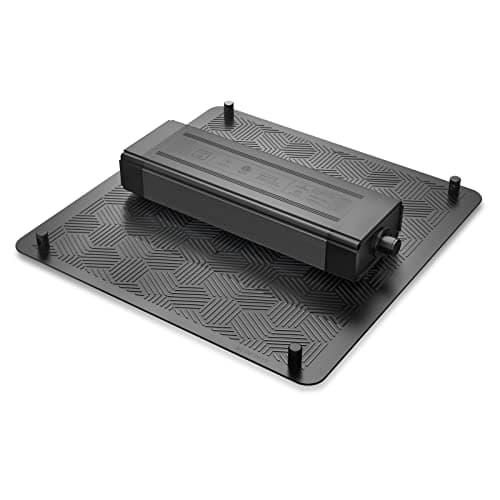 AC Infinity IONBOARD S22 The highest published efficacy of any fixture here at 2.7 umol/J, on Samsung LM301H diodes, with dimming in real 20% steps rather than a vague knob. | A dense herb block | 2.7 umol/J | |
| 3 | 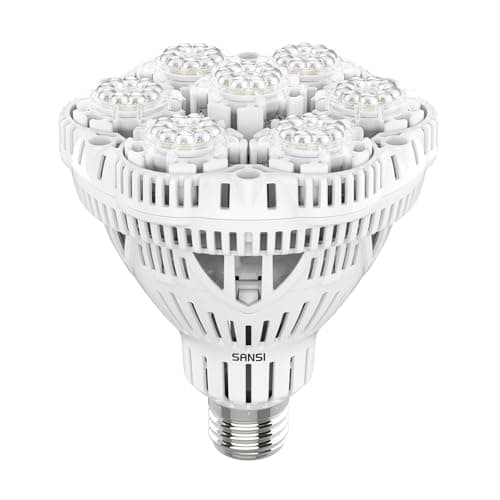 SANSI 36W BR30 Grow Light Bulb The rare grow bulb that publishes both PPF and a PPFD figure with the measurement distance attached, which is the only reason it can be sized honestly. | One or two pots | 1.82 umol/J (ours) |
The reasoning
Herbs are the most commonly attempted and most commonly failed indoor crop, and the reason is a number. Virginia Cooperative Extension puts leafy greens and herbs at 9 to 20 mol per square meter per day; Iowa State University Extension groups leafy herbs in its 12-to-16 high-light band. A kitchen counter three feet from a window in January is delivering a small fraction of that.
Virginia Cooperative Extension for leafy greens and herbs. Iowa State University Extension places leafy herbs in its 12-to-16 high-light band. Either way, herbs want two to four times what a foliage houseplant wants.
Why supermarket basil dies
It is not usually your fault, and it is usually not the watering. A supermarket herb pot is grown fast under high greenhouse light, typically with far more seedlings crammed into one pot than would ever be sown deliberately. Moved to a kitchen counter it faces three simultaneous problems: a large drop in light, severe root competition, and a plant that was never grown to last.
Light is the one you can fix. A basil plant receiving 15 mol/m²/day instead of 3 behaves like a different species.
Hitting the target
| PPFD at the canopy | Hours per day | DLI delivered |
|---|---|---|
| 200 µmol/m²/s | 16 h | 11.5 mol/m²/day |
| 250 µmol/m²/s | 16 h | 14.4 mol/m²/day |
| 300 µmol/m²/s | 14 h | 15.1 mol/m²/day |
| 350 µmol/m²/s | 12 h | 15.1 mol/m²/day |
A 36 × 10 in shelf is 2.5 sq ft, or 0.232 m². Targeting 250 µmol/m²/s.
250 × 0.232 = 58 µmol/s landing on the herbs; at 0.8 uniformity the fixture needs to produce about 73 µmol/s.
At 16 hours a day that is a DLI of 250 × 16 × 3600 ÷ 1,000,000 = 14.4 mol/m²/day, inside the target band.
Two linked 20 W bars along the shelf draw 40 W. Running cost: 40 × 16 × 30 ÷ 1000 = 19.2 kWh a month, about $3.52 at 18.34 cents per kWh.
Herb by herb
| Herb | Light appetite | Notes |
|---|---|---|
| Basil | Highest | The most light-hungry common herb and the fastest to sulk. Also the most rewarding when you get it right. |
| Rosemary, thyme, oregano, sage | High | Mediterranean plants adapted to full sun. They tolerate less, but they get leggy and lose flavor intensity. |
| Parsley, cilantro, chives | Medium to high | More tolerant of a shorter day than basil. Cilantro bolts under heat more than under light. |
| Mint | Medium | The most forgiving. Genuinely does fine at the lower end, which is why it is the herb that survives on windowsills. |
Practical points
- Split a supermarket pot. Twenty seedlings in one pot compete for everything. Divide into three or four pots and each gets a chance.
- Fourteen to sixteen hours. Long photoperiods suit herbs and are the cheap way to a high daily total.
- Harvest often, from the top. Pinching basil above a leaf pair forces branching and keeps it productive. Under good light it responds fast; under poor light, harvesting just weakens it.
- Expect more watering. Herbs under proper light transpire much faster. The pot that lasted a week will last three days.
For a faster and easier version of the same idea, see grow lights for microgreens.
Every pick in full
Barrina T5 4ft Grow Light Strips
LED barA herb shelf
The default seed-starting bar for good reasons — 4 ft long, linkable in series, cheap per foot — and the reason we built a coverage calculator, because Barrina publishes no photon data whatsoever.
What Barrina publishes
- Power draw
- 20 W per fixture; an 8-pack draws 160 W (source)
- Spectrum
- 5000 K (source)
- Dimming
- No; on/off switch per fixture, linkable up to 8 in series (source)
- Dimensions
- 4 ft strip, 120-degree beam angle, 120 V AC (source)
What Barrina does not publish
- PPF in umol/s — for any strip in the range
- PPFD at any stated distance
- Photon efficacy in umol/J
- LED count per strip, and rated lifespan
Who should skip it
Skip it if you need to know what you are getting before it arrives. There is no published PPF, no PPFD and no efficacy figure, so nothing about its output can be verified in advance.
AC Infinity IONBOARD S22
LED panelA dense herb block
The highest published efficacy of any fixture here at 2.7 umol/J, on Samsung LM301H diodes, with dimming in real 20% steps rather than a vague knob.
What AC Infinity publishes
- Power draw
- 115 W (source)
- Efficacy
- 2.7 umol/J (source)
- PPFD
- 1098 PPFD (no measurement distance published) (source)
- Stated coverage
- 2 x 2 ft (source)
- Spectrum
- Samsung LM301H, plus 660 nm, 730 nm, 3000 K, 6500 K (source)
- Diodes
- 272 diodes (source)
- Dimming
- Yes, 0-100% in 20% increments (source)
- Dimensions
- 30.0 x 30.0 cm board, 1.1 cm thick (source)
- Rated life
- 50,000 hours (source)
Our arithmetic
- Photon output implied by the published wattage and efficacy: about 311 umol/s
115 W x 2.7 umol/J = 310.5 umol/s. AC Infinity does not print PPF directly, so this is our arithmetic from two figures it does print.
What AC Infinity does not publish
- PPF in umol/s — only efficacy is given, so photon output has to be derived
- The measurement distance for the 1098 PPFD figure, without which the number cannot be compared to anything
Who should skip it
Skip it if you want to place it by the numbers. AC Infinity prints 1098 PPFD with no measurement distance attached, which makes that figure impossible to use or compare.
SANSI 36W BR30 Grow Light Bulb
Grow bulbOne or two pots
The rare grow bulb that publishes both PPF and a PPFD figure with the measurement distance attached, which is the only reason it can be sized honestly.
What SANSI publishes
- Power draw
- 36 W (source)
- PPF (photon output)
- 65.6 umol/s (source)
- PPFD
- 265.58 umol/m2/s at 1 ft (source)
- Spectrum
- 4000 K, 400-780 nm, CRI close to 100 (source)
- Rated life
- 25,000 hours (source)
Our arithmetic
- Efficacy, computed from the published figures: 1.82 umol/J
65.6 umol/s / 36 W = 1.82 umol/J. That is roughly a third less efficient than the panels on this page — the price of a screw-in form factor. - Electricity used at 12 hours a day for 30 days: 12.96 kWh a month
36 W x 12 h x 30 d / 1000 = 12.96 kWh.
What SANSI does not publish
- Beam angle
- Fixture dimensions
Who should skip it
Skip it if you are lighting more than one plant. 65.6 umol/s is a small amount of light spread over a cone — it lights a single specimen, not a shelf.
Questions people actually ask
+How much light do herbs need indoors?
+Why does supermarket basil always die?
+Which herbs need the most light?
+How many hours should a herb grow light be on?
Sources
- Virginia Cooperative Extension — Calculating and Using Daily Light Integral (DLI), SPES-720 — consulted September 2, 2026
- Iowa State University Extension — Important Considerations for Providing Supplemental Light to Indoor Plants — consulted September 2, 2026
- US Energy Information Administration — Electric Power Monthly, Table 5.3 (US residential average, June 2026) — consulted September 2, 2026
- Barrina — T5 ML20 4ft 20W product page — consulted September 2, 2026
Read next
Reviews
The Best Under-Cabinet Grow Lights
Fixtures that fit under a cabinet, and the honest gap between that space and what herbs want.
Top pick
Barrina T5 4ft Grow Light Strips
Houseplants
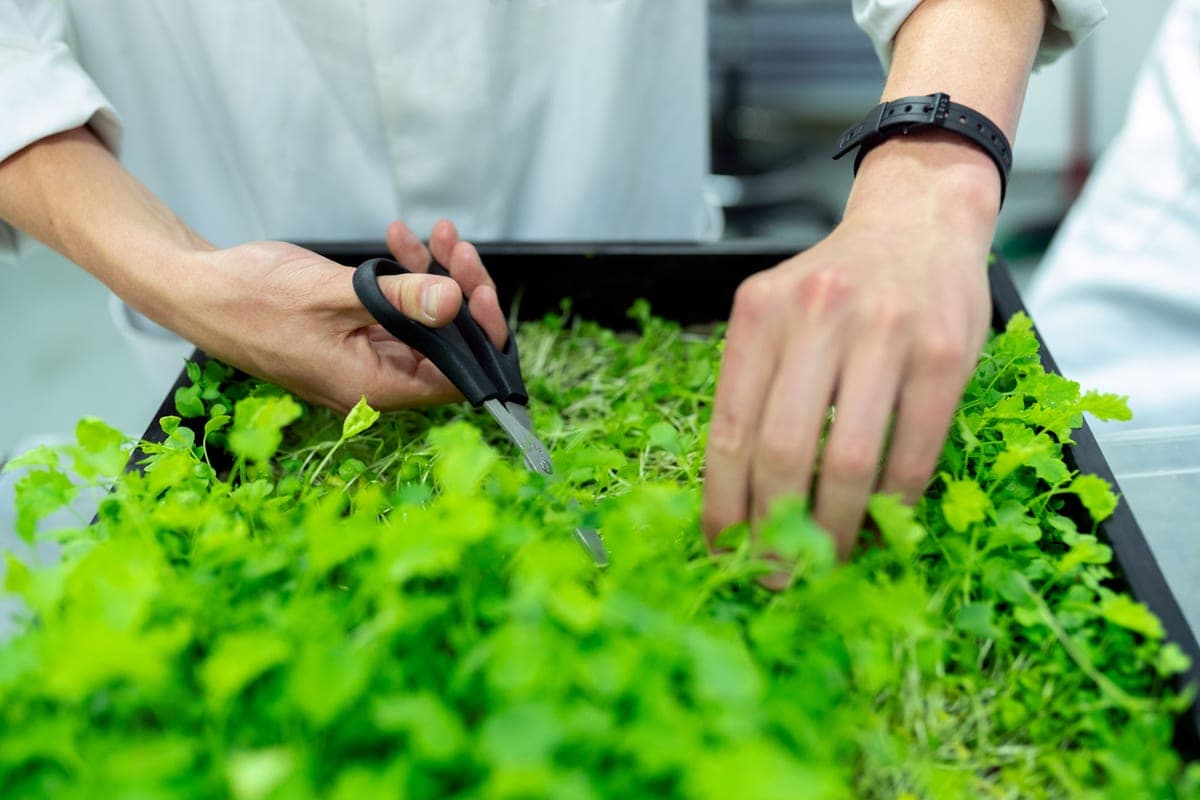
Grow Lights for Microgreens
Harvested at seedling stage, so a modest fixture really is enough. Target, timeline and running cost.
Top pick
Barrina T5 4ft Grow Light Strips
Coverage & Sizing
PPFD Targets by Plant Type
Published light bands mapped to common indoor plants, with the DLI each implies.
Top pick
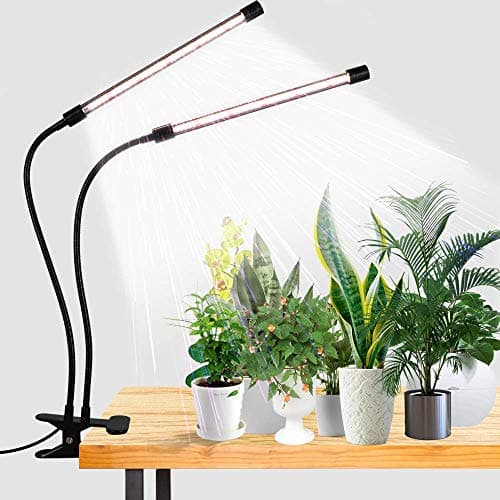
GooingTop Clip Grow Light
Coverage & Sizing
Grow Light Hours Per Day, by Plant
Published photoperiod guidance by plant, plus the cost of each additional hour.
Top pick
GooingTop Clip Grow Light
Houseplants
The Best Grow Lights for Indoor Plants
Sized to a 3-10 mol/m2/day houseplant target rather than a grow-tent target, with running cost for each.
Top pick
SANSI 36W BR30 Grow Light Bulb
Reviews
Best Grow Lights for Hydroponics
Leafy greens want 12-16 mol/m2/day. Four fixtures sized to that, and the damp ratings water changes.
Top pick
GE Grow Light 48in LED Fixture, Seeds and Greens
Seed Starting
Grow Lights for Propagation and Cuttings
Cuttings want 4-5 mol/m2/day at first, rising to 8-12 once rooted. The staged plan and the fixtures for it.
Top pick
GE Grow Light 48in LED Fixture, Seeds and Greens
Where this sits
This page belongs to Grow Lights for Houseplants and Winter. Every figure on it is either quoted from a named published source or derived in view — the full method is on our methodology page, and how the site is funded is on the affiliate disclosure.