Best Grow Lights for Hydroponics
Hydroponics removes every variable except light, which is why the fixture decision matters more here than in a pot of soil.
By Scooter M. — An enthusiast who's genuinely into this. I read the manuals, compile the published specs, and do the math. No lab coat.
Published · How we pick
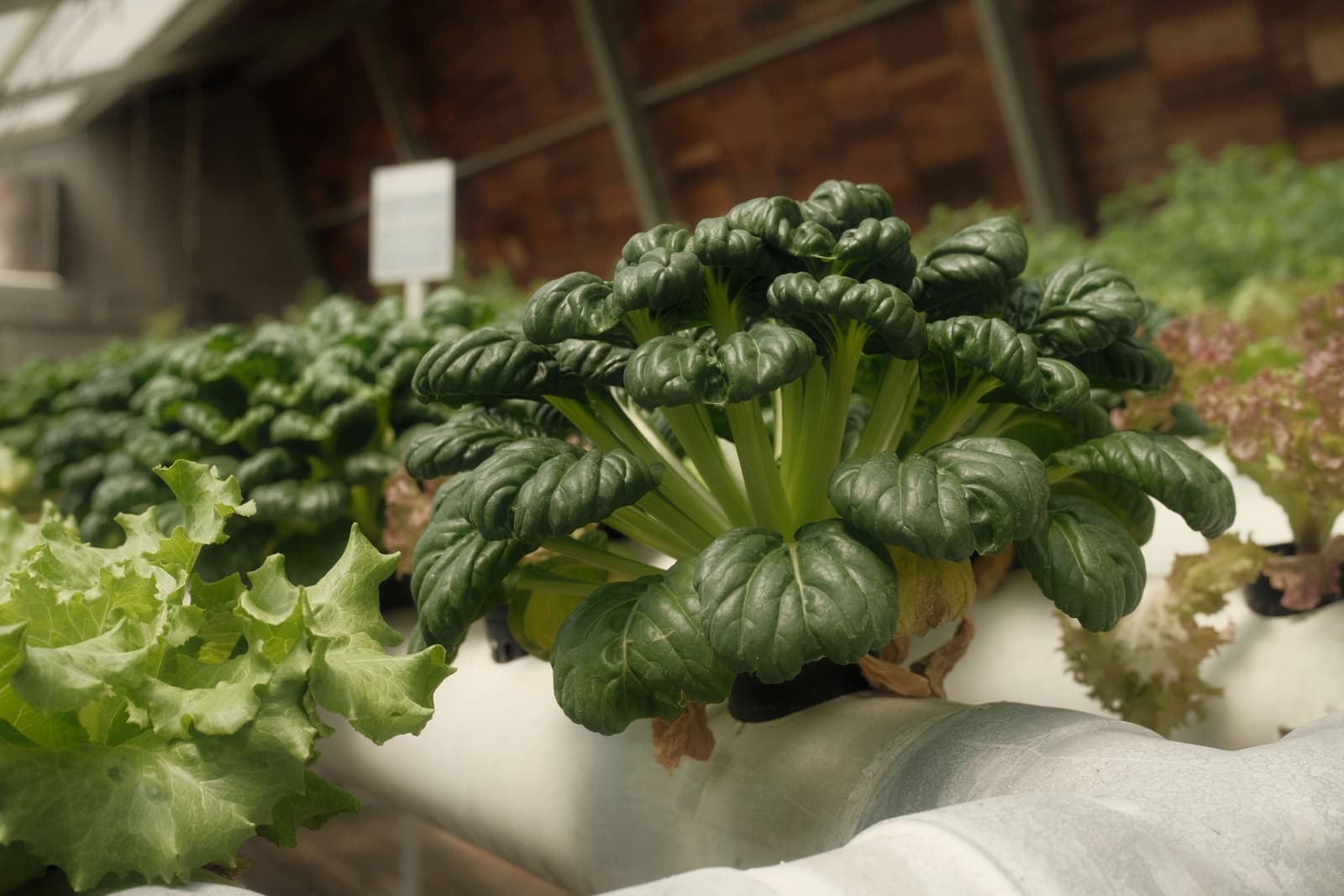
Photographs on this site are licensed stock and are illustrative of the fixture type. We do not own the units we write about.
How this page is funded: the buy links here are Amazon Associates links, and we earn a commission on qualifying purchases at no extra cost to you. We have not been paid to feature anything on this page, we accept no free product, and commission plays no part in the ranking. Full disclosure.
We have not tested these units. Everything below comes from the manufacturer’s own published specifications, or from arithmetic we have shown our working for. Where a figure is not published, we say so instead of estimating one. Read the method.
Quick picks
Efficacy is photons out per joule in. Where a manufacturer publishes it we quote theirs; where they publish photon output and wattage but not efficacy, we divide and label it as ours; where they publish neither, the cell says so rather than guessing. Tap a row for the full write-up.
| # | Product | Best for | Efficacy | Price |
|---|---|---|---|---|
| 1 | 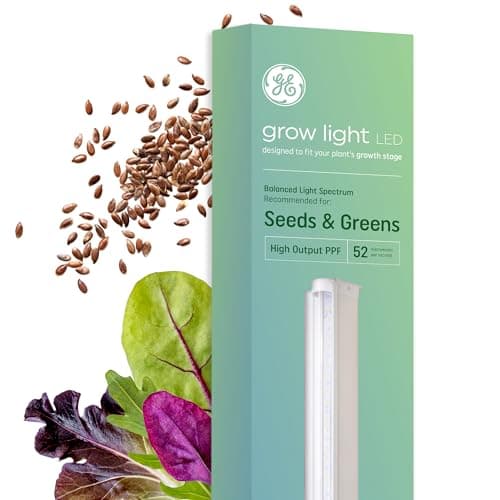 GE Grow Light 48in LED Fixture, Seeds and Greens A 4 ft shelf fixture that publishes its photon output, 52 umol/s from 30 W, so a shelf can be sized around it before it arrives rather than after. | A 4 ft channel, sized by its published PPF | Not published | |
| 2 | 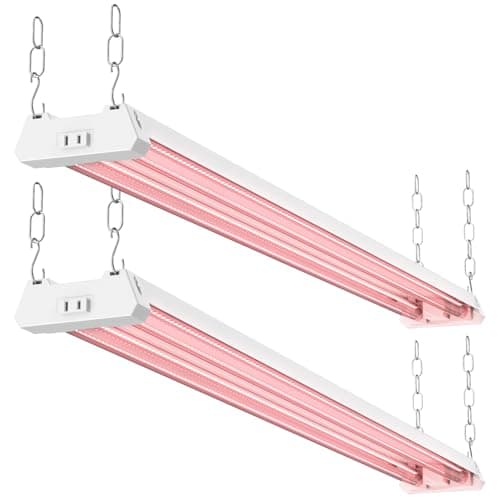 SuncoGrow 4ft 40W Grow Light The only cheap 4 ft strip we have found that publishes a PPF figure at all, which makes it the only one in its class you can size a shelf around before you buy it. | The same job, one number published | Not published | |
| 3 | 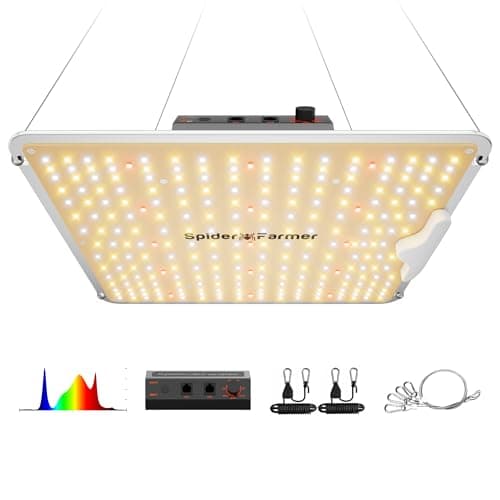 Spider Farmer SF1000 Publishes PPF to two decimal places and an efficacy figure that actually divides out of it. That internal consistency is rarer in this category than it should be. | A deep-water tote or fruiting crops | 2.5 umol/J | |
| 4 | 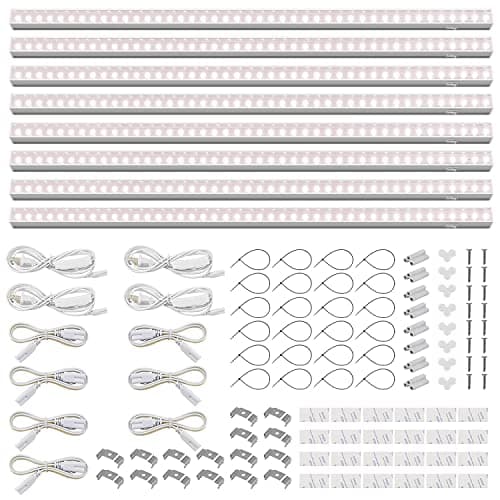 Barrina T5 4ft Grow Light Strips The default seed-starting bar for good reasons — 4 ft long, linkable in series, cheap per foot — and the reason we built a coverage calculator, because Barrina publishes no photon data whatsoever. | The cheapest linear foot | Not published |
The reasoning
We have not tested any of these fixtures or grown anything hydroponically to check them. What follows is published specification and arithmetic, shown step by step.
A hydroponic setup takes soil, watering habits and nutrient guesswork off the table. What remains is temperature and light, and light is the one you buy. That makes this a page where getting the number right matters more than usual: an underpowered fixture over a lettuce raft does not produce slow lettuce so much as pale, leggy, disappointing lettuce.
How we judged, before we ranked
- Does it publish a PPF? Hydroponic growers work in daily light integral, and you cannot compute DLI from lumens. A published µmol/s figure is the entry requirement.
- Does the shape match a channel or a tote? Most home hydroponics is linear — a length of NFT channel, a raft, a row of net pots — which suits a bar. Deep-water totes are square, which suits a panel.
- Is there a published location rating? This is the criterion hydroponics adds that soil growing does not. There is an open reservoir under the fixture, and pumps and top-ups splash.
- What does it cost to run? Leafy greens want long days, so these fixtures run 14 to 16 hours. Efficiency compounds.
The target: 12 to 16 mol/m²/day
Iowa State University Extension groups leafy herbs in its 12-to-16 mol/m²/day high-light band, and that band is the right target for hydroponic lettuce, basil, chard and pak choi as well. It is roughly three times what a pothos wants and about the same as a tray of seedlings.
14 mol/m²/day on a 16-hour schedule: 14,000,000 ÷ (16 × 3600) = 243 µmol/m²/s.
A 4 ft × 1 ft channel is 4 sq ft = 0.3716 m². Delivering 243 across it at 0.8 uniformity needs 243 × 0.3716 ÷ 0.8 = about 113 µmol/s of fixture output.
For 14 mol/m²/day at 16 hours a day, with a 0.8 uniformity factor. Derived by us from Iowa State University Extension's 12-16 mol/m²/day high-light band. No single sub-$70 bar on this site reaches it alone — two do.
1. GE Grow 48in fixture — a 4 ft channel, sized by its own number
52 µmol/s from 30 W, published, damp-rated, with a 5 ft cord and hanging chains. Two of them over a 4 ft channel is the configuration this page recommends, and the arithmetic is why.
104 µmol/s ÷ 0.3716 m² × 0.8 = about 224 µmol/m²/s.
At 16 hours: 224 × 16 × 3600 ÷ 1,000,000 = 12.9 mol/m²/day — inside the 12-16 band, at 60 W total.
At 1.73 µmol/J it is the most efficient bar on this site, and the damp rating is published rather than assumed, which over an open reservoir is the point.
The downside: one fixture is not enough — a single unit delivers about 6.4 mol/m²/day, half the target — so budget for two. It does not dim, so your only control over a crop that needs less light is the timer.
2. SuncoGrow 4ft 40W — the same job, one number published
48.42 µmol/s from 40 W, damp-rated, and the other bar on this site that publishes a photon figure. Two over the same channel give about 208 µmol/m²/s and 12.0 mol/m²/day at 16 hours, which clears the bottom of the band.
The downside: 1.21 µmol/J is the lowest efficacy of anything we cover. Two of them draw 80 W to do what two GE fixtures do with 60 W, and on a 16-hour hydroponic schedule that gap is real money across a year. The details are in the SuncoGrow review.
3. Spider Farmer SF1000 — a deep-water tote or fruiting crops
249.21 µmol/s published, 2.5 µmol/J, and a dimmer. If your hydroponics is a square tote of a few large plants rather than a linear channel of greens — or if you are trying to fruit a tomato or a pepper indoors — this is the shape and the output for it.
249.21 ÷ 0.3716 m² × 0.8 = about 536 µmol/m²/s.
At 16 hours that is 30.9 mol/m²/day, roughly double the leafy-greens target — which is why the dimmer matters, and why for lettuce you would run it lower or shorter.
The downside: it publishes no location rating, which on this page counts against it; keep it well clear of the reservoir and any splash. It is also several times the price of a bar, and for flat greens a square panel lights the middle well and the corners less well.
4. Barrina T5 4ft — the cheapest linear foot
20 W per 4 ft strip, linkable up to eight in series, and by a distance the cheapest way to put light along a channel. Four strips over a 4 ft run is 80 W and one plug.
The downside: Barrina publishes no PPF, no PPFD and no efficacy for any strip in the range, so none of the arithmetic on this page can be applied to it. In a hydroponic setup, where you are trying to hit a DLI number rather than just keep a plant alive, that is a sharper drawback than it is on a shelf of houseplants. There is no published location rating either. Full detail in the Barrina T5 review.
The four, against the target
| Fixture | Units | Total W | DLI delivered | Location rating |
|---|---|---|---|---|
| GE Grow 48in | 2 | 60 W | 12.9 mol/m²/day | Damp |
| SuncoGrow 4ft 40W | 2 | 80 W | 12.0 mol/m²/day | Damp |
| Spider Farmer SF1000 | 1 (over a 2×2 tote) | 100 W | 30.9 mol/m²/day | Not published |
| Barrina T5 4ft | 4 | 80 W | Cannot compute | Not published |
Water, electricity and the rating question
Hydroponics puts an open body of water directly beneath a mains-powered fixture, and the water level changes every few days as the plants drink it. That is a different situation from a shelf of pots, and it is worth two minutes of thought.
A damp-location rating covers humidity and condensation. It does not cover a fixture being splashed while you top up a reservoir. Neither rating is a substitute for hanging the light where water cannot reach it and where you are not reaching across it with a full jug. Where a manufacturer publishes no rating at all — which is most of this category — treat the absence as information rather than as permission.
Running cost over a real growing year
Two GE fixtures, 60 W: 28.8 kWh a month = $5.28, or about $63 a year.
Two SuncoGrow strips, 80 W: 38.4 kWh = $7.04 a month, about $84 a year.
One SF1000, 100 W: 48 kWh = $8.80 a month.
The 21-dollar-a-year gap between the first two is the efficiency difference, nothing else — same shape, same schedule, same job. Over the rated life of the fixtures it dwarfs the difference in purchase price, which is the argument the whole µmol/J ranking exists to make.
Photoperiod, and one thing hydroponics changes
Leafy greens tolerate long days well, and 16 hours is the schedule this page has costed. Iowa State University Extension gives 16 hours as the ceiling for home growing generally, so there is no case for pushing past it — extra hours beyond that buy very little and cost linearly.
The thing hydroponics changes is that light drives water uptake. A reservoir under a 16-hour schedule empties noticeably faster than the same reservoir under a 12-hour one, and a pump running dry is a worse outcome than a slightly lower DLI. If you increase the day length, check the level more often for the first week.
Kratky jars and countertop units
Not all home hydroponics is a channel. Two smaller formats are far commoner, and both need different arithmetic from the 4 ft run above.
A Kratky jar — a mason jar of nutrient solution with a net pot in the lid, no pump — holds one lettuce or one basil plant in a footprint of about half a square foot.
0.5 sq ft = 0.0465 m². For 14 mol/m²/day at 16 hours you need 243 µmol/m²/s, so 243 × 0.0465 ÷ 0.8 = about 14 µmol/s.
That is one 9 W grow bulb. A jar on a kitchen counter does not need a bar, and anyone selling you one for it is overselling.
Countertop units — the sealed appliances with their own built-in lights and pods — are a different case again, because the light is not a purchase you make. Where those units disappoint, it is usually because the fixture is fixed at a height suited to seedlings and the plants grow past it. There is no fixing that with a better bulb; the answer is to harvest earlier or to move the crop into an open setup where the light can be raised.
Two bars or one panel over a tote?
For a 2 ft by 2 ft deep-water tote the two shapes genuinely compete, and the published figures decide it.
| Option | Total W | PPFD | DLI at 16 h | Evenness |
|---|---|---|---|---|
| Two GE 48in bars | 60 W | about 224 µmol/m²/s | 12.9 mol | Even along the length |
| One Spider Farmer SF1000 | 100 W | about 536 µmol/m²/s | 30.9 mol | Strongest in the middle |
The bars use 40% less power and deliver a DLI that suits leafy greens almost exactly. The panel delivers more than twice as much, which is wasted on lettuce and welcome on a fruiting tomato — and being dimmable, it can be turned down to sit where the bars sit while retaining headroom for a crop that wants more later.
So the question is really about what you intend to grow next year, not this month. Greens only: bars. Anything you hope to fruit: the panel, dimmed.
Distance, and what changes as the crop grows
Hydroponic crops move toward the light faster than soil crops, because nothing else is limiting them. A lettuce raft that started six inches below the fixture can be two inches below it three weeks later, and the intensity at the leaf rises with the square of that change.
Halving the distance quadruples the intensity, which is how a setup that was correct at transplant becomes a bleached crop at harvest. Bars on adjustable hangers solve it in seconds; fixed shelf mounts do not. If the fixture cannot move, plan the starting height for the harvest-size plant rather than the seedling, and accept a slower first fortnight.
The inverse-square relationship and how to use it are set out in how far a grow light should be from plants.
Light that reaches the solution instead of the plant
Hydroponics has one problem soil growing does not: any light that misses the canopy and lands on the nutrient solution grows algae in it.
Algae are not immediately fatal, but they compete for the dissolved oxygen and nutrients the crop needs, they foul pumps and air stones, and in a warm reservoir under a 16-hour schedule they establish quickly. The fix is not a different fixture; it is covering the solution. Opaque lids, foam collars that fill the net pot opening, and wrapping clear reservoirs in something light-tight all work.
This changes how you should think about spill. On a shelf of pots, light that misses the plants is merely wasted. Over a hydroponic reservoir it is actively unhelpful, which is a further argument for bars running the length of a channel rather than a panel throwing a cone across an open tote. A bar mounted close and aimed down puts a higher proportion of its output on leaves and less on water.
It is also an argument for keeping the canopy full. A mature raft of lettuce shades its own solution; the same raft at transplant does not, and the first fortnight after transplant is when algae get established. Cover the gaps until the plants close the canopy themselves.
Every pick in full
GE Grow Light 48in LED Fixture, Seeds and Greens
LED barA 4 ft channel, sized by its published PPF
A 4 ft shelf fixture that publishes its photon output, 52 umol/s from 30 W, so a shelf can be sized around it before it arrives rather than after.
What GE Lighting publishes
- Power draw
- 30 W at 120 V AC (source)
- PPF (photon output)
- 52 umol/s (source)
- Spectrum
- 2000 lumens, CRI 90; no color temperature or spectral distribution published (source)
- Dimming
- No; damp humidity rating, not rated for outdoor use (source)
- Dimensions
- 48.2 x 2.8 x 2.4 in; 5 ft cord, 8 in mounting chains (source)
Our arithmetic
- Photon efficacy, computed from the published figures: 1.73 umol/J
52 umol/s / 30 W = 1.73 umol/J. GE publishes no efficacy figure, so this one is ours. It sits mid-table on this site: above the Soltech Aspect at 1.39 umol/J, below the LED boards at 2.3 to 2.75. - Average PPFD from one fixture over a 4 x 1 ft run of shelf: about 112 umol/m2/s
4 sq ft / 10.7639 = 0.3716 m2. 52 umol/s / 0.3716 m2 = 139.9 umol/m2/s at perfect uniformity; a 0.8 uniformity factor gives about 112 umol/m2/s. That is the low band, 50 to 150 umol/m2/s, on the University of Minnesota Extension's scale. - Daily light integral from one fixture: 6.4 mol/m2/day at 16 hours; 7.3 at GE's recommended 18
112 umol/m2/s x 16 h x 3600 / 1,000,000 = 6.4 mol/m2/day. At 18 hours, 7.3. Both are short of the roughly 12 mol/m2/day the University of New Hampshire Extension gives for seedlings. - Two fixtures over the same 4 x 1 ft run: about 224 umol/m2/s, or 12.9 mol/m2/day at 16 hours
104 umol/s / 0.3716 m2 x 0.8 = 223.9 umol/m2/s. 223.9 x 16 h x 3600 / 1,000,000 = 12.9 mol/m2/day, which clears the seedling target without needing GE's 18 hours. - Electricity at 16 hours a day for 30 days: $2.64 a month
30 W x 16 h x 30 d / 1000 = 14.4 kWh. 14.4 x 18.34 cents = $2.64. At GE's 18 hours: 16.2 kWh = $2.97.
What GE Lighting does not publish
- PPFD at any stated distance
- Beam angle
- Color temperature and spectral distribution
- Photon efficacy in umol/J — PPF and wattage are given, so efficacy has to be derived
Who should skip it
Skip it if you want one fixture to carry a seed tray. A single unit averages about 112 umol/m2/s over a 4 x 1 ft run, which is the low band, and it does not dim.
SuncoGrow 4ft 40W Grow Light
LED barThe same job, one number published
The only cheap 4 ft strip we have found that publishes a PPF figure at all, which makes it the only one in its class you can size a shelf around before you buy it.
What Sunco Lighting publishes
- Power draw
- 40 W at 120 V AC; marketed as a 260 W equivalent (source)
- PPF (photon output)
- 48.42 umol/s (source)
- Spectrum
- Full spectrum, 2000 lumens, CRI 80+, 120-degree beam angle (source)
- Dimming
- No; linkable up to 4 fixtures, damp rated, ETL, FCC and RoHS listed (source)
- Dimensions
- 4 ft strip; 5 ft plug-in cord, 12 in pull chain (source)
- Rated life
- 50,000 hours, 50,000 switching cycles, 3-year warranty (source)
Our arithmetic
- Photon efficacy, computed from the published figures: 1.21 umol/J
48.42 umol/s / 40 W = 1.2105 umol/J. Sunco publishes no efficacy figure, so this one is ours. It is the lowest of any fixture on this site: the next lowest is the Soltech Aspect at 1.39 umol/J, and the LED boards run 2.3 to 2.75 umol/J. - Average PPFD from one strip over a 4 x 1 ft run of shelf: about 104 umol/m2/s
4 sq ft / 10.7639 = 0.3716 m2. 48.42 umol/s / 0.3716 m2 = 130.3 umol/m2/s at perfect uniformity; applying a 0.8 uniformity factor gives about 104 umol/m2/s. That sits in the low band, 50 to 150 umol/m2/s, on the University of Minnesota Extension's scale. - Daily light integral from one strip run 16 hours: 6.0 mol/m2/day
104 umol/m2/s x 16 h x 3600 / 1,000,000 = 6.0 mol/m2/day. That is half the roughly 12 mol/m2/day the University of New Hampshire Extension gives for seedlings, which is the arithmetic reason one strip per shelf disappoints people. - Two strips over that same 4 x 1 ft run: about 208 umol/m2/s, or 12.0 mol/m2/day at 16 hours
2 x 48.42 = 96.84 umol/s / 0.3716 m2 x 0.8 = 208.5 umol/m2/s. 208.5 x 16 h x 3600 / 1,000,000 = 12.0 mol/m2/day. Two strips land on the seedling target almost exactly, which is the configuration we would actually buy. - Electricity at 16 hours a day for 30 days: $3.52 a month per strip
40 W x 16 h x 30 d / 1000 = 19.2 kWh. 19.2 x 18.34 cents = $3.52. Two strips, 80 W, come to $7.04 a month.
What Sunco Lighting does not publish
- PPFD at any stated distance
- Photon efficacy in umol/J — PPF and wattage are given, so efficacy has to be derived
- Coverage area
- Diode manufacturer and LED count
- Fixture dimensions beyond the 4 ft length
Who should skip it
Skip it if photons per watt decide the purchase. The figure Sunco publishes works out to 1.21 umol/J, the lowest of anything on this site, so you pay for that certainty on the meter every month.
Spider Farmer SF1000
LED panelA deep-water tote or fruiting crops
Publishes PPF to two decimal places and an efficacy figure that actually divides out of it. That internal consistency is rarer in this category than it should be.
What Spider Farmer publishes
- Power draw
- 100 W +/-5% at 100-277 V AC (source)
- PPF (photon output)
- 249.21 umol/s (source)
- Efficacy
- 2.5 umol/J (source)
- Stated coverage
- 2 x 2 ft core, 3 x 3 ft maximum (source)
- Spectrum
- 650-665 nm, 730-740 nm, 2800-3000 K, 4800-5000 K (source)
- Diodes
- Bridgelux (source)
- Dimming
- Yes, dimming knob (source)
- Dimensions
- 32.5 x 29.0 x 5.9 cm (source)
- Rated life
- 55,000 hours (source)
Our arithmetic
- Does the published efficacy check out against the published PPF?: Yes — 2.49 umol/J computed against 2.5 umol/J published
249.21 umol/s / 100 W = 2.4921 umol/J. The published 2.5 umol/J is that number rounded. Not every brand's two figures agree like this, which is exactly why we divide them. - Average PPFD across its 2 x 2 ft core footprint: about 536 umol/m2/s
2 ft x 2 ft = 4 sq ft = 0.372 m2. 249.21 / 0.372 = 670 umol/m2/s at perfect uniformity; at a 0.8 uniformity factor, about 536 umol/m2/s.
Who should skip it
Skip it if raw output is what you are buying — the TS 1000 delivers 38% more photons per second, at the cost of 50 W more draw.
Barrina T5 4ft Grow Light Strips
LED barThe cheapest linear foot
The default seed-starting bar for good reasons — 4 ft long, linkable in series, cheap per foot — and the reason we built a coverage calculator, because Barrina publishes no photon data whatsoever.
What Barrina publishes
- Power draw
- 20 W per fixture; an 8-pack draws 160 W (source)
- Spectrum
- 5000 K (source)
- Dimming
- No; on/off switch per fixture, linkable up to 8 in series (source)
- Dimensions
- 4 ft strip, 120-degree beam angle, 120 V AC (source)
What Barrina does not publish
- PPF in umol/s — for any strip in the range
- PPFD at any stated distance
- Photon efficacy in umol/J
- LED count per strip, and rated lifespan
Who should skip it
Skip it if you need to know what you are getting before it arrives. There is no published PPF, no PPFD and no efficacy figure, so nothing about its output can be verified in advance.
Questions people actually ask
+How much light do hydroponic lettuce and herbs need?
+Is one 4 ft bar enough for a hydroponic channel?
+Do grow lights for hydroponics need a damp rating?
+What does it cost to run a hydroponic grow light?
Sources
- Iowa State University Extension — Important Considerations for Providing Supplemental Light to Indoor Plants — consulted September 2, 2026
- University of Minnesota Extension — Lighting for indoor plants and starting seeds — consulted September 2, 2026
- GE Lighting shop — 48in Seeds and Greens integrated fixture (PPF, dimensions, cord, humidity rating) — consulted September 17, 2026
- Sunco Lighting — SuncoGrow LED Grow Light 4ft 40W product specifications — consulted September 14, 2026
- Spider Farmer — SF1000 published specification table — consulted September 2, 2026
- Barrina — T5 ML20 4ft 20W product page — consulted September 2, 2026
- US Energy Information Administration — Electric Power Monthly, Table 5.3 (US residential average, June 2026) — consulted September 2, 2026
Read next
Houseplants
Grow Lights for Microgreens
Harvested at seedling stage, so a modest fixture really is enough. Target, timeline and running cost.
Top pick
Barrina T5 4ft Grow Light Strips
Houseplants
Grow Lights for Herbs Indoors
Culinary herbs want 9-20 mol/m2/day. Why kitchen herbs fail, and what actually reaches the target.
Top pick
Barrina T5 4ft Grow Light Strips
Coverage & Sizing
The Best Grow Lights for a Shelf or Rack
Picks chosen on footprint match first, because a square panel over a long shelf wastes its edges.
Top pick
Barrina T5 4ft Grow Light Strips
Running Cost
The Most Efficient Grow Lights by µmol/J
Every fixture we cover ranked on published photon efficacy, with derivations shown.
Where this sits
This page belongs to Fixture Reviews and Roundups. Every figure on it is either quoted from a named published source or derived in view — the full method is on our methodology page, and how the site is funded is on the affiliate disclosure.