The Best Under-Cabinet Grow Lights
A kitchen counter is the hardest shape in this category: long, shallow, low clearance — and the plants people put there want more light than the space suggests.
By Scooter M. — An enthusiast who's genuinely into this. I read the manuals, compile the published specs, and do the math. No lab coat.
Published · How we pick
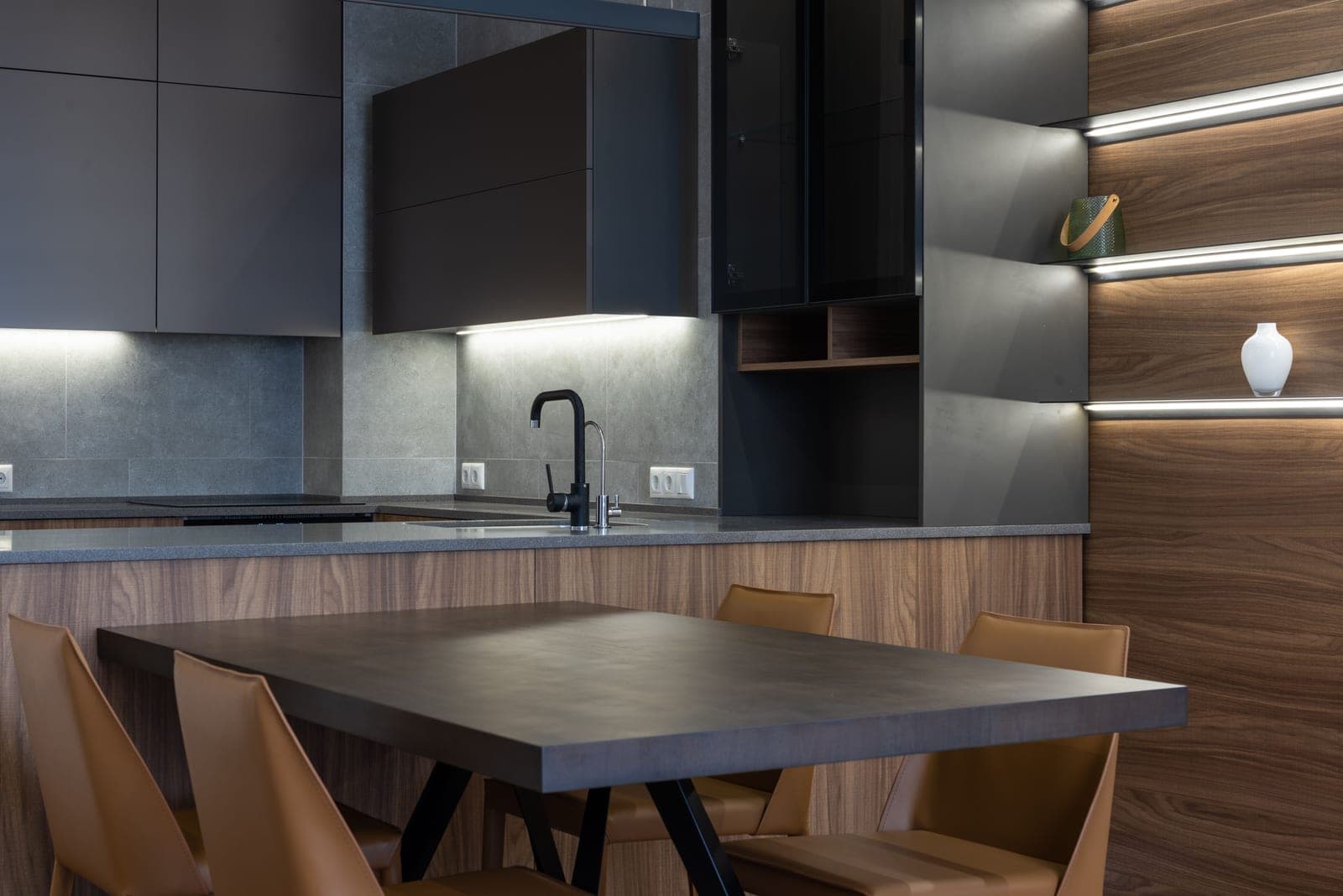
Photographs on this site are licensed stock and are illustrative of the fixture type. We do not own the units we write about.
How this page is funded: the buy links here are Amazon Associates links, and we earn a commission on qualifying purchases at no extra cost to you. We have not been paid to feature anything on this page, we accept no free product, and commission plays no part in the ranking. Full disclosure.
We have not tested these units. Everything below comes from the manufacturer’s own published specifications, or from arithmetic we have shown our working for. Where a figure is not published, we say so instead of estimating one. Read the method.
Quick picks
Efficacy is photons out per joule in. Where a manufacturer publishes it we quote theirs; where they publish photon output and wattage but not efficacy, we divide and label it as ours; where they publish neither, the cell says so rather than guessing. Tap a row for the full write-up.
| # | Product | Best for | Efficacy | Price |
|---|---|---|---|---|
| 1 | 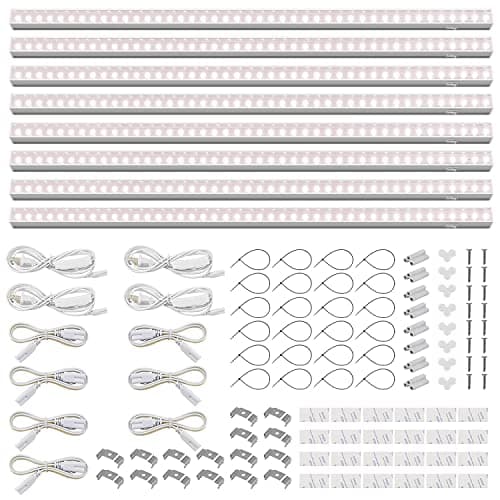 Barrina T5 4ft Grow Light Strips The default seed-starting bar for good reasons — 4 ft long, linkable in series, cheap per foot — and the reason we built a coverage calculator, because Barrina publishes no photon data whatsoever. | Matching the counter run | Not published | |
| 2 | 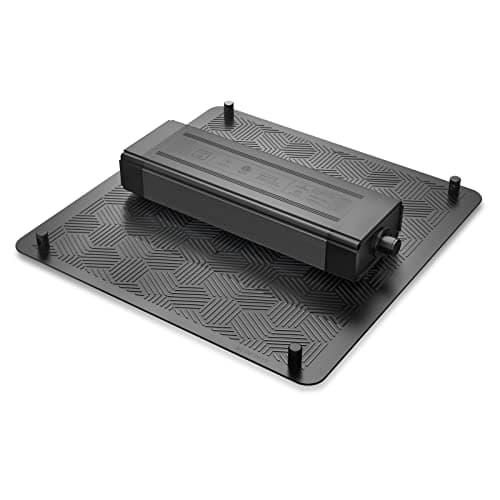 AC Infinity IONBOARD S22 The highest published efficacy of any fixture here at 2.7 umol/J, on Samsung LM301H diodes, with dimming in real 20% steps rather than a vague knob. | 11 mm of clearance | 2.7 umol/J | |
| 3 | 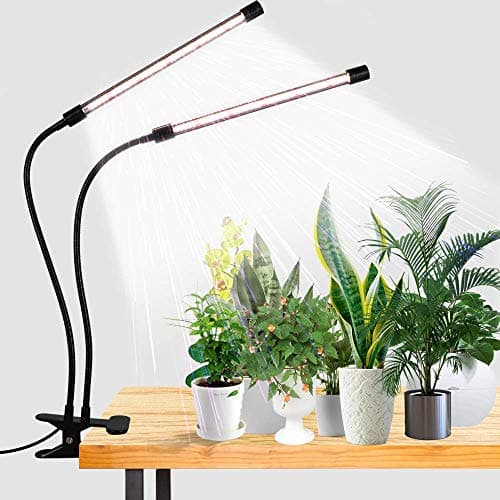 GooingTop Clip Grow Light The cheapest way to put real light on one plant on one desk, and honest about being exactly that — a 10 W clip lamp with a repeating timer. | Clamping to the cabinet edge | Not published | |
| 4 | 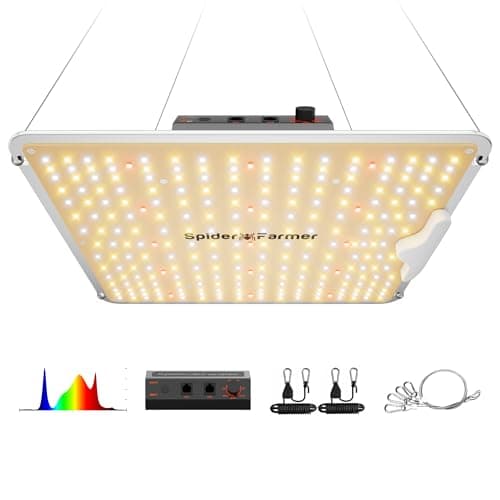 Spider Farmer SF1000 Publishes PPF to two decimal places and an efficacy figure that actually divides out of it. That internal consistency is rarer in this category than it should be. | An open shelf instead | 2.5 umol/J |
The reasoning
Under-cabinet growing is the most common request in this category that nobody sizes properly. The space is genuinely awkward: typically 15 to 20 inches of clearance to the counter, a run 2 to 4 feet long and about 12 inches deep, and — the part that catches people out — the plants most often put there are herbs, which want the high light band.
µmol/m²/s — the high band per University of Minnesota Extension. Roughly three times what a pothos on the same counter would need.
That is the tension this page is about. The space suits a low-profile linear fixture; the plants want a lot of light. Those two facts pull in opposite directions, and the honest answer involves saying which one gives.
How we ranked these
- Does it physically fit? Under-cabinet means a flat mount and shallow depth. A fixture that needs hanging is disqualified before anything else is considered.
- Does its shape match a counter? A counter run is a long shallow rectangle. Linear fixtures match it; square panels do not.
- Can it reach the herb band at that clearance? The criterion most under-cabinet advice skips.
- Is it tolerable in a kitchen? This is a room people eat in.
The clearance arithmetic
A 3 × 1 ft strip of counter = 3 sq ft ÷ 10.7639 = 0.279 m².
Targeting 300 µmol/m²/s: PPF = 300 × 0.279 ÷ 0.8 = 105 µmol/s.
That is a modest requirement in absolute terms — well under half a single SF1000. The difficulty is not total photons; it is getting them spread along a 3 ft line from a fixture 15 inches above it.
1. Barrina T5 4ft strips — the shape is the whole argument
A 4 ft strip over a 4 ft counter run puts emitters along the entire length of what you are lighting. Nothing else in this list does that. They mount flat with clips or ties, draw 20 W each, link up to 8 in series from one plug, and run cool enough to sit close under a cabinet.
Two strips side by side along the depth of the counter get you closer to the herb band than one, and because there is no dimming you control the level by how many strips you run — a coarse control that also saves the electricity of the ones you leave off.
The honest con, and it is the big one: Barrina publishes no PPF, no PPFD and no efficacy figure for any strip in the range. We checked the product page directly. So the arithmetic above tells you what the counter needs, and nothing tells you what these strips deliver. You are buying on form factor and price, and finding out afterwards. That is a legitimate purchase — it is our first pick here — but it should be a conscious one. Full detail in the Barrina T5 write-up.
2. AC Infinity IONBOARD S22 — the flat-mount alternative
A board 30 × 30 cm and 1.1 cm thick, passively cooled, designed to mount flat rather than hang. Under a cabinet that thickness is the specification that matters — it costs you almost none of your clearance.
It publishes 2.7 µmol/J on named Samsung LM301H diodes, dims in stated 20% increments, and has no fan, which in a kitchen means silence and nothing to clog with cooking grease.
The honest cons: it is square, so over a long counter run it lights a 30 cm section well and the rest poorly — the geometry problem in bar versus panel coverage. It publishes no PPF (its ~311 µmol/s is our arithmetic from wattage and efficacy), and its “1098 PPFD” figure carries no measurement distance, so it cannot be used. Being passively cooled, it also needs airflow behind it — do not press it flush against the underside of a solid cabinet.
3. GooingTop clip light — for one pot, not a run
Clamps to a cabinet edge or a shelf lip, which solves the mounting problem outright with no hardware. About 10 W, five brightness levels, a built-in repeating timer, and roughly $4.00 of electricity across an entire winter.
The honest con: at about 10 W it lights one pot, not a counter. And there is no manufacturer spec sheet at all for it, so nothing about its output can be computed or compared — the figures we report come from the retail listing. Pick it for a single basil plant by the sink, not for a herb garden.
4. Spider Farmer SF1000 — if you can use an open shelf instead
Included as the honest escape hatch. If your herbs can live on an open shelf rather than crammed under a cabinet, a panel that publishes 249.21 µmol/s and a 2.5 µmol/J efficacy that divides correctly out of its own 100 W rating is a better lighting solution than anything that fits under a cabinet.
Over a 2 × 2 ft area it computes to about 536 µmol/m²/s — well past the herb band, so you would raise or dim it.
The honest con: it does not fit under a cabinet. It needs to hang, and its depth alone eats clearance you probably do not have. This is the pick that says the constraint may be worth changing rather than working within.
The honest gap
Here is what most under-cabinet advice will not tell you. The fixtures that fit the space best — low-profile linear strips — are also the ones with no published photon data, so you cannot verify in advance that an under-cabinet setup reaches the herb band. The fixture that publishes the most does not fit.
Our reading: for basil, mint and other leafy herbs, run two strips rather than one, keep them as close to the plants as the cabinet allows, and give them 14 to 16 hours. Then watch the plants — leggy stems with long gaps between leaf pairs mean you are short, and the fix is another strip rather than more hours. The herb-specific detail is in grow lights for herbs.
Kitchen-specific practicalities
- Grease and steam. A kitchen coats everything. Fanless fixtures have no intake to clog, and a wipeable flat surface beats a finned heat sink here.
- Water. You will water plants directly under a powered fixture on a counter near a sink. Route cables so nothing runs through a wet zone.
- Glare at eye level. Under-cabinet fixtures sit at standing eye height. Choose one with a diffuser or mount it toward the back of the cabinet so you are not looking into the emitters.
- Warm white is easier to live with. A kitchen is a room you spend evenings in; 5000 K strips are effective and bright, which is not always what you want over dinner.
The verdict
Two linked Barrina strips for a counter run, accepting that you cannot size them in advance. The AC Infinity board if your growing spot is a 30 cm patch rather than a run, and you want figures you can partly compute. The clip light for one pot. And if the cabinet is negotiable, put the herbs on an open shelf under a panel instead — it is the better lighting answer, and the only reason not to is the cabinet itself.
Every pick in full
Barrina T5 4ft Grow Light Strips
LED barMatching the counter run
The default seed-starting bar for good reasons — 4 ft long, linkable in series, cheap per foot — and the reason we built a coverage calculator, because Barrina publishes no photon data whatsoever.
What Barrina publishes
- Power draw
- 20 W per fixture; an 8-pack draws 160 W (source)
- Spectrum
- 5000 K (source)
- Dimming
- No; on/off switch per fixture, linkable up to 8 in series (source)
- Dimensions
- 4 ft strip, 120-degree beam angle, 120 V AC (source)
What Barrina does not publish
- PPF in umol/s — for any strip in the range
- PPFD at any stated distance
- Photon efficacy in umol/J
- LED count per strip, and rated lifespan
Who should skip it
Skip it if you need to know what you are getting before it arrives. There is no published PPF, no PPFD and no efficacy figure, so nothing about its output can be verified in advance.
AC Infinity IONBOARD S22
LED panel11 mm of clearance
The highest published efficacy of any fixture here at 2.7 umol/J, on Samsung LM301H diodes, with dimming in real 20% steps rather than a vague knob.
What AC Infinity publishes
- Power draw
- 115 W (source)
- Efficacy
- 2.7 umol/J (source)
- PPFD
- 1098 PPFD (no measurement distance published) (source)
- Stated coverage
- 2 x 2 ft (source)
- Spectrum
- Samsung LM301H, plus 660 nm, 730 nm, 3000 K, 6500 K (source)
- Diodes
- 272 diodes (source)
- Dimming
- Yes, 0-100% in 20% increments (source)
- Dimensions
- 30.0 x 30.0 cm board, 1.1 cm thick (source)
- Rated life
- 50,000 hours (source)
Our arithmetic
- Photon output implied by the published wattage and efficacy: about 311 umol/s
115 W x 2.7 umol/J = 310.5 umol/s. AC Infinity does not print PPF directly, so this is our arithmetic from two figures it does print.
What AC Infinity does not publish
- PPF in umol/s — only efficacy is given, so photon output has to be derived
- The measurement distance for the 1098 PPFD figure, without which the number cannot be compared to anything
Who should skip it
Skip it if you want to place it by the numbers. AC Infinity prints 1098 PPFD with no measurement distance attached, which makes that figure impossible to use or compare.
GooingTop Clip Grow Light
Clip lightClamping to the cabinet edge
The cheapest way to put real light on one plant on one desk, and honest about being exactly that — a 10 W clip lamp with a repeating timer.
What GooingTop publishes
- Power draw
- About 10 W (source)
- Spectrum
- 6000 K, 74 white plus 10 red LEDs, CRI 95 (source)
- Dimming
- Five brightness levels; repeating 4 / 8 / 12 hour timer (source)
What GooingTop does not publish
- PPF in umol/s
- PPFD at any distance
- Photon efficacy in umol/J
- The manufacturer publishes no spec sheet at all; the figures above come from the retail listing
Who should skip it
Skip it if the plant is more than about a foot across, or if you want any number at all before you buy — nobody publishes photon data for this fixture.
Spider Farmer SF1000
LED panelAn open shelf instead
Publishes PPF to two decimal places and an efficacy figure that actually divides out of it. That internal consistency is rarer in this category than it should be.
What Spider Farmer publishes
- Power draw
- 100 W +/-5% at 100-277 V AC (source)
- PPF (photon output)
- 249.21 umol/s (source)
- Efficacy
- 2.5 umol/J (source)
- Stated coverage
- 2 x 2 ft core, 3 x 3 ft maximum (source)
- Spectrum
- 650-665 nm, 730-740 nm, 2800-3000 K, 4800-5000 K (source)
- Diodes
- Bridgelux (source)
- Dimming
- Yes, dimming knob (source)
- Dimensions
- 32.5 x 29.0 x 5.9 cm (source)
- Rated life
- 55,000 hours (source)
Our arithmetic
- Does the published efficacy check out against the published PPF?: Yes — 2.49 umol/J computed against 2.5 umol/J published
249.21 umol/s / 100 W = 2.4921 umol/J. The published 2.5 umol/J is that number rounded. Not every brand's two figures agree like this, which is exactly why we divide them. - Average PPFD across its 2 x 2 ft core footprint: about 536 umol/m2/s
2 ft x 2 ft = 4 sq ft = 0.372 m2. 249.21 / 0.372 = 670 umol/m2/s at perfect uniformity; at a 0.8 uniformity factor, about 536 umol/m2/s.
Who should skip it
Skip it if raw output is what you are buying — the TS 1000 delivers 38% more photons per second, at the cost of 50 W more draw.
Questions people actually ask
+Can you grow herbs under kitchen cabinets?
+What is the thinnest grow light for under a cabinet?
+How much light do I need for a 3 foot counter?
+Will a grow light under my cabinets be annoying to look at?
+Have you tested any of these under a cabinet?
Sources
- Barrina — T5 ML20 4ft 20W product page — consulted September 2, 2026
- AC Infinity — IONBOARD S22 published specifications — consulted September 2, 2026
- GooingTop clip grow light — retail listing specifications (no manufacturer spec sheet published) — consulted September 2, 2026
- Spider Farmer — SF1000 published specification table — consulted September 2, 2026
- University of Minnesota Extension — Lighting for indoor plants and starting seeds — consulted September 2, 2026
- Iowa State University Extension — Important Considerations for Providing Supplemental Light to Indoor Plants — consulted September 2, 2026
Read next
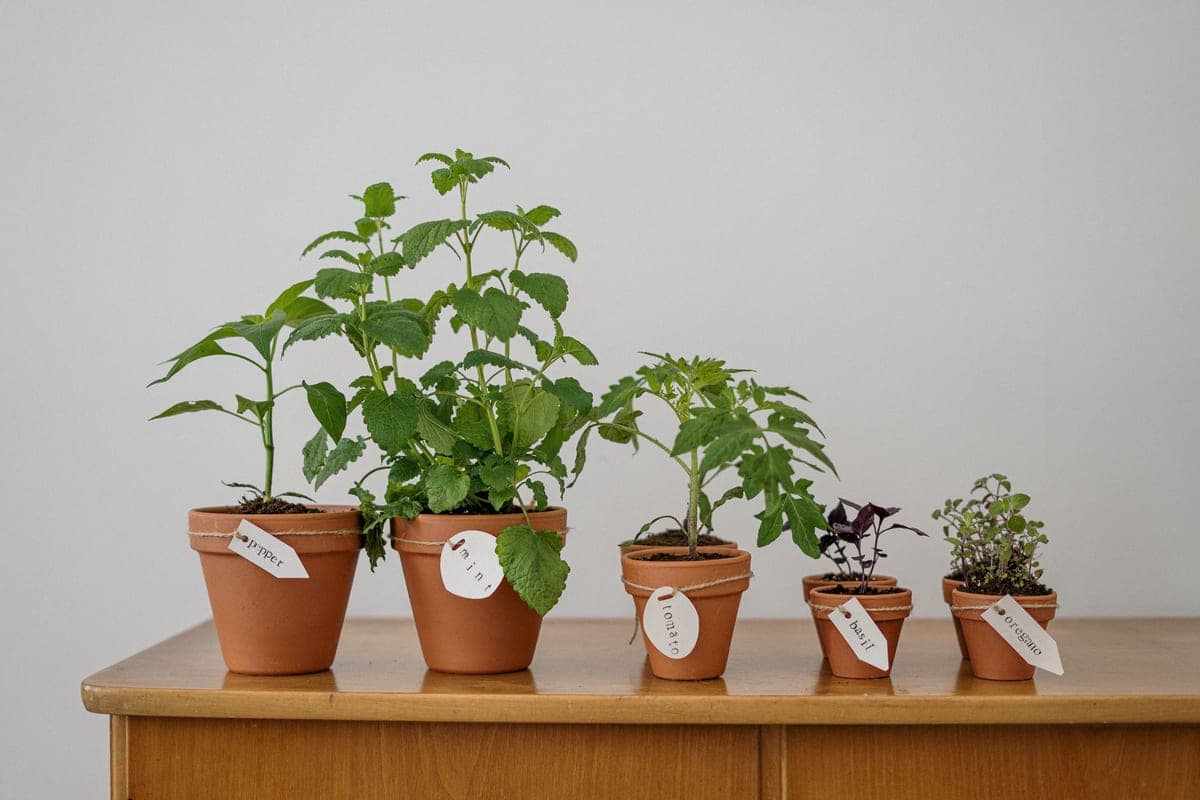
Houseplants
Grow Lights for Herbs Indoors
Culinary herbs want 9-20 mol/m2/day. Why kitchen herbs fail, and what actually reaches the target.
Top pick
Barrina T5 4ft Grow Light Strips
Coverage & Sizing
Bar vs Panel Coverage and Uniformity
How the two form factors distribute light, and which shapes each one suits.
Top pick
Barrina T5 4ft Grow Light Strips
Coverage & Sizing
The Best Grow Lights for a Shelf or Rack
Picks chosen on footprint match first, because a square panel over a long shelf wastes its edges.
Top pick
Barrina T5 4ft Grow Light Strips
Reviews
The Best Grow Light Bars
Linear fixtures for shelves and trays, and the disclosure gap running through the category.
Top pick
Barrina T5 4ft Grow Light Strips
Where this sits
This page belongs to Fixture Reviews and Roundups. Every figure on it is either quoted from a named published source or derived in view — the full method is on our methodology page, and how the site is funded is on the affiliate disclosure.