Do LED Grow Lights Get Hot?
Yes, but not where people expect. Every watt ends up as heat somewhere; what changes is whether it lands on your plants.
By Scooter M. — An enthusiast who's genuinely into this. I read the manuals, compile the published specs, and do the math. No lab coat.
Published · How we pick
The reasoning
No product picks on this page. It is partly a safety question, and a buy button next to a safety answer is a reason to distrust it.
The physics, stated plainly
Essentially all the electrical energy a light fixture consumes ends up as heat in the room. A 100 W LED panel is, in energy terms, a 100 W heater — the same as a 100 W incandescent bulb. What differs is not the total but the distribution: how much of it radiates directly onto your plants versus how much is conducted into a heat sink and convected into the air.
That distinction is the entire practical difference between LED and HID lighting. An HPS lamp radiates a large share of its heat straight down at the canopy. An LED panel puts most of its heat into an aluminum heat sink on its back, which is why the fixture itself is warm to the touch while the plants underneath are not being cooked.
The light itself is absorbed by surfaces and becomes heat too. A 100 W fixture is a 100 W heat source; what LED changes is where that heat goes, not how much there is.
What that means for your plants
- Leaf scorch from LED heat is uncommon at sensible distances, because the radiant component at the plant is small. What people often call “light burn” on an LED setup is usually photobleaching — too much light rather than too much heat.
- Faster drying is real. A fixture above a tray raises local temperature and air movement enough to increase evaporation, most noticeably in the center of the footprint. If the middle of your tray dries faster than the edges, that is the light.
- A warm room is a real effect at scale. Several hundred watts in a small closed room will raise the temperature measurably. Whether that is a problem depends on the room and the season — in a basement in February it is often a mild benefit.
Fans, and what they tell you
Some panels have fans and some do not, and it is a design trade-off rather than a quality signal. ViparSpectra advertises the P1000 as having no fan; AC Infinity’s IONBOARD S22 is a passively cooled board 1.1 cm thick. Passive designs rely on a large aluminum surface, which is why boards tend to be wide and flat.
What fanless designs buy you is silence and one fewer moving part to fail. What they require is airflow around the fixture, so mounting one flush against the underside of a wooden shelf with no gap works against the cooling it depends on.
Safety, briefly and specifically
The realistic hazards in a home grow-light setup are ordinary electrical and mechanical ones rather than exotic ones:
- Water and electricity. You are watering plants directly beneath a powered fixture. Route cables so they do not run under trays, and keep connections above the level of anything that can spill.
- Mounting. A panel that falls into a tray is the failure mode worth actually preventing. Use the hardware supplied and check it after any adjustment.
- Airflow. Do not sandwich a passively cooled fixture against a solid surface. It sheds heat through its back.
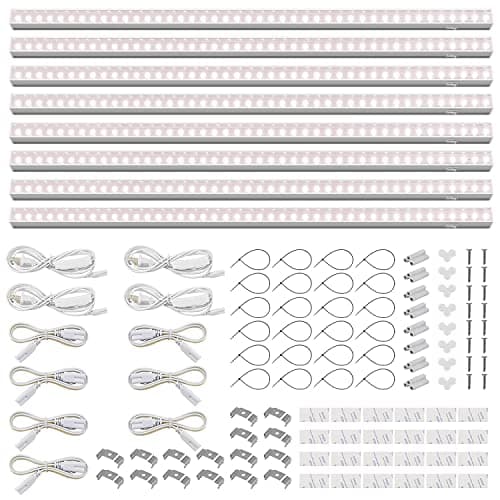
- Load. Linked strips are a single circuit — Barrina’s link up to 8 in series, which is 160 W on one plug. That is well within a normal outlet, but daisy-chaining several extension leads to reach a shelf is where people get into trouble.
The short version
An LED grow light gets warm, sheds most of its heat backwards through its heat sink rather than downward onto your plants, and adds its full wattage as heat to the room. At home scale none of that is a problem, and the drying effect on your growing medium is the consequence you will actually notice.
For the eye-exposure side of the safety question, see are grow lights safe for eyes and pets.
Questions people actually ask
+Do LED grow lights produce heat?
+Can an LED grow light burn my plants?
+Will grow lights heat up my room?
+Do grow lights without fans overheat?
Sources
- ViparSpectra — P1000 product page — consulted September 2, 2026
- AC Infinity — IONBOARD S22 published specifications — consulted September 2, 2026
- Barrina — T5 ML20 4ft 20W product page — consulted September 2, 2026
- ams OSRAM — Details on photobiological safety of LED light sources (IEC/EN 62471 risk groups) — consulted September 2, 2026
Read next
Running Cost
LED vs HPS Running Cost
What an LED panel actually saves against the HPS lamp it claims to replace.
Top pick
Mars Hydro TS 1000
Spectrum & PPFD
Are Grow Lights Safe for Eyes and Pets?
What IEC 62471 risk groups mean, the one real hazard, and sensible home precautions.
Coverage & Sizing
How Far Should a Grow Light Be From Plants?
The inverse-square rule, published PPFD-at-distance figures, and a by-plant table.
Top pick
Soltech Aspect Gen 2
Running Cost
How Much Electricity Do Grow Lights Use?
Monthly kWh and cost per fixture, and how that compares with household appliances.
Top pick
Barrina T5 4ft Grow Light Strips
Where this sits
This page belongs to Running Cost and Efficiency. Every figure on it is either quoted from a named published source or derived in view — the full method is on our methodology page, and how the site is funded is on the affiliate disclosure.