Feit Electric Grow Lights
Feit prints a photon number on most of its grow bulbs, which puts it ahead of most of this category. It also prints that number in a unit no bulb on earth could satisfy, so this review works out what it must actually mean.
By Scooter M. — An enthusiast who's genuinely into this. I read the manuals, compile the published specs, and do the math. No lab coat.
Published · How we pick
Photographs on this site are licensed stock and are illustrative of the fixture type. We do not own the units we write about.
How this page is funded: the buy links here are Amazon Associates links, and we earn a commission on qualifying purchases at no extra cost to you. We have not been paid to feature anything on this page, we accept no free product, and commission plays no part in the ranking. Full disclosure.
We have not tested these units. Everything below comes from the manufacturer’s own published specifications, or from arithmetic we have shown our working for. Where a figure is not published, we say so instead of estimating one. Read the method.
Quick picks
Efficacy is photons out per joule in. Where a manufacturer publishes it we quote theirs; where they publish photon output and wattage but not efficacy, we divide and label it as ours; where they publish neither, the cell says so rather than guessing. Tap a row for the full write-up.
| # | Product | Best for | Efficacy | Price |
|---|---|---|---|---|
| 1 | 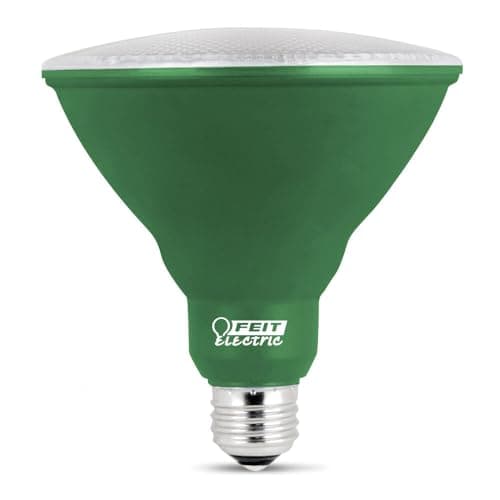 Feit Electric 16W PAR38 Grow Bulb The only bulb in Feit's grow range that publishes both a photon figure and a beam angle, which makes it the only one you can place over a plant by arithmetic instead of by guesswork. | Placing one plant by the numbers | Not published | |
| 2 | 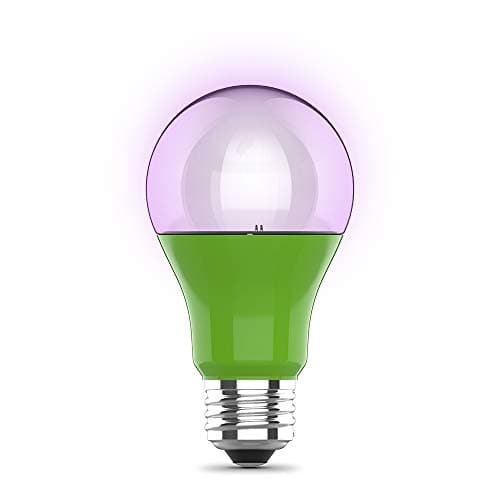 Feit Electric 9W A19 Grow Bulb A cheap household-shape grow bulb with a published photon figure, once you correct the unit Feit prints beside it. | A bare socket and a small plant | Not published | |
| 3 | 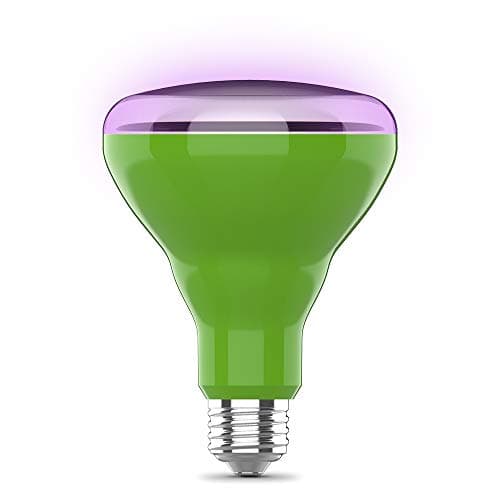 Feit Electric 9W BR30 Grow Bulb The right shape for pointing light at a plant — a reflector flood with a published 110-degree beam — and the one bulb in Feit's range whose own spec page carries no photon figure at all. | The right shape, no photon figure | Not published |
The reasoning
We have not tested these bulbs. We own none of them and have measured none of them. What follows is the specification Feit publishes, our own arithmetic on top of it, and an explicit account of where that specification goes wrong.
Feit Electric is a mainstream US lighting brand, sold in hardware stores and warehouse clubs, with a small grow line of screw-in bulbs and plug-in fixtures. Like GE, it belongs to the group of household brands that publish a photon figure at all, which is more than most of this category manages. Unlike GE, it does not appear to have had anyone check the units.
What Feit publishes
The A19 and the PAR38 state one. The BR30 page does not. Neither of the two figures is printed with a correct unit: one carries a unit that is wrong by a factor of a million, and the other carries no unit at all.
That sounds like nitpicking. It is not, and the arithmetic below shows why: the number Feit prints for its A19 bulb, read exactly as written, describes a bulb that would vaporize the room.
The unit problem, worked out
Feit's A19 page states: "Photo synthetically active radiation (PAR/PPF value): 14.2 mol/s". A mole of photons is a real unit of light, and horticultural fixtures are rated in micromoles per second — millionths of a mole. The difference matters more than a prefix usually does.
Feit says this bulb emits between 449 nm blue and 630 nm red. Photons in that range carry roughly 190 to 266 kilojoules per mole.
14.2 mol/s × 190,000 J/mol = about 2.7 million watts. At the blue end it is closer to 3.8 million. The bulb draws 9 watts.
Read instead as 14.2 µmol/s: 14.2 millionths of a mole × roughly 218,000 J/mol = about 3 watts of light from 9 watts of electricity. That is precisely what an LED of this kind should produce.
So the figure is usable and the unit beside it is not. Everywhere below we read Feit's photon numbers as micromoles per second, because that is the only physically possible reading, and we say so rather than quietly correcting a manufacturer's page.
The label has a second, smaller problem. "PAR/PPF" runs together two different things: PAR is a waveband, the 400 to 700 nm range plants use, while PPF is a rate, the photons a fixture emits each second. A bulb does not have "a PAR" any more than a faucet has "a water". The distinction is laid out in PAR, PPFD and DLI explained.
The range as published
| Feit product | Power | Photon figure as printed | Efficacy (µmol/J) | Beam angle |
|---|---|---|---|---|
| PAR38 grow bulb | 16 W | "20.0PAR/PPF", no unit | 1.25 | 40° |
| A19 grow bulb | 9 W | "14.2 mol/s" | 1.58 | Not published |
| BR30 grow bulb | 9 W | None on the spec page | Cannot compute | 110° |
| 2 ft plant fixture | Not in the spec table | "up to 90", no unit | Cannot compute | Not published |
The 2 ft fixture is the worst of it: a photon figure given as "up to 90" with no unit, and no wattage row at all on the specification table, so nothing about it can be computed or checked. We also could not match it to a current Amazon listing, so it appears here and nowhere else on this page.
The BR30 is the odd one in the other direction. Retail listings for it quote a photon figure, but Feit's own specification page for the bulb carries none, and a retailer's marketing copy is a weaker source than a manufacturer's sheet. We report the absence rather than borrow the number.
What the numbers say once the unit is fixed
The A19 works out to 1.58 µmol/J and the PAR38 to 1.25 µmol/J. On this site only the SuncoGrow 40 W strip, at 1.21, is lower than that PAR38, and the LED boards run from 2.3 to 2.75. Feit's grow bulbs are therefore inexpensive to buy and comparatively expensive to run per photon delivered — the full ranking is in most efficient grow lights by µmol/J.
The 16 W PAR38 emits more photons than the 9 W A19 in absolute terms, 20 against 14.2, which is what you would expect from nearly twice the power. It is simply less efficient about it.
The PAR38 is the only one you can place
Here is where Feit does something GE does not. It publishes a beam angle for the PAR38: 40 degrees. A photon figure plus a beam angle is enough to compute intensity at a distance, which no other bulb in this range allows.
A 40-degree beam spreads to a radius of distance × tan(20°) = distance × 0.364.
At 12 in: a circle of 0.416 sq ft = 0.0387 m². 20.0 µmol/s ÷ 0.0387 = 517, × 0.8 for uniformity = about 414 µmol/m²/s.
At 18 in: 0.0870 m² → about 184 µmol/m²/s. At 24 in: 0.1547 m² → about 103 µmol/m²/s.
Those figures assume every photon falls inside the stated cone, so treat each as the top of its range rather than a measurement. Even so they are genuinely useful. At 12 inches the bulb reaches the high band, 250 to 450 µmol/m²/s on the University of Minnesota Extension's scale. At 18 inches it is medium, and run 16 hours that works out to about 10.6 mol/m²/day, a little under the roughly 12 mol/m²/day the University of New Hampshire Extension gives for seedlings. At 24 inches it has fallen to the low band, which suits a foliage houseplant and not much else. The general case for distance is in how far a grow light should be from plants.
The A19 and the BR30
Without a beam angle, the A19 can only be bounded. If every photon it emits landed inside one square foot, the average would be 153 µmol/m²/s; a bare A19 throws light in every direction, so the real figure at the plant is well under that. It is a bulb for one small plant in a socket close by, and not a serious option for a tray.
The BR30 is the shape you actually want — a reflector flood that pushes light forward, with a published 110-degree spread — and it is the one Feit tells you least about. Buying it means accepting that its output cannot be checked in advance, the same trade the Barrina strips ask for.
The ratings that actually differ
Feit publishes a location rating on all three bulbs, and they are not the same one. The PAR38 is rated for wet locations and for enclosed fixtures; the A19 and the BR30 are damp-rated. For a bulb going into a humid propagation area, a covered porch or a closed fixture, that distinction decides whether it is being used inside its listing. This is the part household lighting brands are reliably good at, precisely because a safety listing is tested rather than marketed.
All three are rated at 25,000 hours and carry a two-year warranty, where GE claims the same hours with three years. Neither lifespan figure is something a buyer can verify, but the hours are worth taking seriously for a different reason.
9 W × 25,000 h = 225 kWh = about $41 at 18.34 cents per kWh.
16 W × 25,000 h = 400 kWh = about $73.
Either figure is several times what the bulb costs to buy. That is the practical case for caring about µmol/J on a cheap bulb at all: the sticker price is the small number in the transaction, and the efficacy figure decides the large one. Two bulbs of the same wattage cost the same to run, so the one emitting more photons is delivering them free.
Feit against GE, at the same wattage
Both brands sell a 9 W A19 grow bulb, which makes for an unusually clean comparison. Feit's emits 14.2 µmol/s and 680 lumens. GE's emits 16 µmol/s and 500 lumens.
The Feit bulb is noticeably brighter to your eye and delivers about 11% fewer photons to the plant. That is the whole argument against judging a grow light by how bright it looks, in two products from the same shelf at the same wattage. The GE range is covered in our GE grow lights review.
A19 or BR30, 9 W, 16 hours a day: 4.32 kWh a month = $0.79.
PAR38, 16 W, same schedule: 7.68 kWh a month = $1.41.
Who should buy which
- The PAR38 if you want one plant lit properly and want to know what it is getting. It is the only bulb here you can place by arithmetic, and at 12 to 18 inches the arithmetic is good. The cost is efficiency: 1.25 µmol/J is near the bottom of this site's table.
- The A19 only for a small plant in a socket that will not take a reflector bulb, accepting that its spread is unknown.
- The BR30 if you want the reflector shape at the lowest price and are comfortable buying without published output. If you want that shape with published output, the SANSI 36 W BR30 publishes both a PPF and a PPFD at a stated distance.
- None of them for a seed tray. These are single-plant bulbs; a tray wants a bar, and the options are in best grow light bars.
What Feit does not publish
No PPFD at any distance for any bulb. No efficacy figure. No spectral distribution — two peak wavelengths are named, which is not a curve. No beam angle for the A19. No photon figure at all for the BR30, and no wattage on the 2 ft fixture's specification table.
It would be easy to conclude from the unit error that Feit's numbers are worthless. We do not think that. A manufacturer that publishes 14.2 and 20.0 has measured something, and both figures land exactly where a bulb of that wattage should land once the prefix is corrected. What the error costs Feit is trust, and trust is the thing a shopper comparing spec sheets is actually spending.
Every pick in full
Feit Electric 16W PAR38 Grow Bulb
Grow bulbPlacing one plant by the numbers
The only bulb in Feit's grow range that publishes both a photon figure and a beam angle, which makes it the only one you can place over a plant by arithmetic instead of by guesswork.
What Feit Electric publishes
- Power draw
- 16 W at 120 V; medium E26 base (source)
- PPF (photon output)
- 20.0 umol/s, printed by Feit as "20.0PAR/PPF" with no unit (source)
- Stated coverage
- 40-degree beam angle; wet-location and enclosed-fixture rated (source)
- Spectrum
- 900 lumens, 3500 K, CRI 80; stated to emit between 454 nm blue and 630 nm red, with no distribution curve published (source)
- Dimming
- No (source)
- Rated life
- 25,000 hours; 2-year warranty (source)
Our arithmetic
- Photon efficacy, computed from the published figures: 1.25 umol/J
20.0 umol/s / 16 W = 1.25 umol/J. Feit publishes no efficacy figure, so this one is ours. Only the SuncoGrow 40 W at 1.21 umol/J is lower on this site; the LED boards run 2.3 to 2.75. - Average PPFD inside its 40-degree beam, by distance: about 414 at 12 in, 184 at 18 in, 103 at 24 in (umol/m2/s)
A 40-degree beam spreads to a radius of distance x tan(20 degrees) = distance x 0.364. At 12 in that is a 0.416 sq ft circle = 0.0387 m2, so 20.0 umol/s / 0.0387 m2 = 517 umol/m2/s, and a 0.8 uniformity factor gives about 414. At 18 in: 0.936 sq ft = 0.0870 m2, 230 before uniformity, about 184 after. At 24 in: 1.665 sq ft = 0.1547 m2, 129 before, about 103 after. This assumes every photon falls inside the stated cone, so treat each figure as the top of the range. - Daily light integral at 18 in, run 16 hours: about 10.6 mol/m2/day
184 umol/m2/s x 16 h x 3600 / 1,000,000 = 10.6 mol/m2/day, a little under the roughly 12 mol/m2/day the University of New Hampshire Extension gives for seedlings. Moving the bulb to 12 in clears it easily. - Electricity at 16 hours a day for 30 days: $1.41 a month
16 W x 16 h x 30 d / 1000 = 7.68 kWh. 7.68 x 18.34 cents = $1.41.
What Feit Electric does not publish
- PPFD at any stated distance
- Photon efficacy in umol/J
- A spectral distribution — two peak wavelengths are named, no curve
- The unit on its own photon figure
Who should skip it
Skip it if photons per watt matter. 20 umol/s from 16 W works out to 1.25 umol/J, the second-lowest figure on this site, so you are paying for the placement data on the meter.
Feit Electric 9W A19 Grow Bulb
Grow bulbA bare socket and a small plant
A cheap household-shape grow bulb with a published photon figure, once you correct the unit Feit prints beside it.
What Feit Electric publishes
- Power draw
- 9 W at 120 V; medium E26 base (source)
- PPF (photon output)
- 14.2 umol/s, printed by Feit as "14.2 mol/s" (source)
- Spectrum
- 680 lumens, 3300 K, CRI 80; stated to emit between 449 nm blue and 630 nm red, with no distribution curve published (source)
- Dimming
- No; damp-location rated (source)
- Rated life
- 25,000 hours; 2-year warranty (source)
Our arithmetic
- Which unit the published figure must actually be: micromoles per second, not moles
Feit's own page prints 14.2 mol/s. Photons between 449 and 630 nm carry roughly 190 to 266 kJ per mole, so 14.2 mol/s would be 2.7 to 3.8 megawatts of radiant power out of a 9 W bulb. Read as 14.2 umol/s it is about 3 W of light from 9 W of electricity, which is what an LED of this type should produce. The figure is usable; the unit beside it is not. - Photon efficacy, computed from the corrected figure: 1.58 umol/J
14.2 umol/s / 9 W = 1.58 umol/J. Below the GE Grow A19 at 1.78 umol/J, which draws the same 9 W. - The ceiling over one square foot: at most 153 umol/m2/s
1 sq ft = 0.0929 m2. 14.2 umol/s / 0.0929 m2 = 153 umol/m2/s, and only if every photon lands inside that square foot, which no bare bulb manages. With no published beam angle, the real spread cannot be computed. - Electricity at 16 hours a day for 30 days: $0.79 a month
9 W x 16 h x 30 d / 1000 = 4.32 kWh. 4.32 x 18.34 cents = $0.79.
What Feit Electric does not publish
- PPFD at any stated distance
- Beam angle
- Photon efficacy in umol/J
- A spectral distribution — two peak wavelengths are named, no curve
Who should skip it
Skip it if the lamp will take a reflector bulb. An A19 throws light in every direction, and Feit publishes no beam angle for this one, so where its 14.2 umol/s lands cannot be computed.
Feit Electric 9W BR30 Grow Bulb
Grow bulbThe right shape, no photon figure
The right shape for pointing light at a plant — a reflector flood with a published 110-degree beam — and the one bulb in Feit's range whose own spec page carries no photon figure at all.
What Feit Electric publishes
- Power draw
- 9 W at 120 V; medium E26 base (source)
- Stated coverage
- 110-degree beam angle; damp-location and enclosed-fixture rated (source)
- Spectrum
- 680 lumens, 3300 K, CRI 80; stated to emit more light at 449 nm blue and 630 nm red than a white LED, with no distribution curve published (source)
- Dimming
- No (source)
- Rated life
- 25,000 hours; 2-year warranty (source)
Our arithmetic
- Electricity at 16 hours a day for 30 days: $0.79 a month
9 W x 16 h x 30 d / 1000 = 4.32 kWh. 4.32 x 18.34 cents = $0.79. Wattage is the only published figure on this bulb that supports any arithmetic at all.
What Feit Electric does not publish
- PPF in umol/s — published for the A19 and the PAR38 in the same range, but absent from this bulb's specification page
- PPFD at any stated distance
- Photon efficacy in umol/J
- A spectral distribution — two peak wavelengths are named, no curve
Who should skip it
Skip it if you want to know the output before it arrives. Feit publishes a photon figure for its A19 and its PAR38 and none for this bulb, so nothing about its light can be verified in advance.
Questions people actually ask
+What is the PPF of a Feit Electric grow light bulb?
+Why does Feit print its grow light PPF as mol/s?
+How efficient are Feit Electric grow lights?
+How far should a Feit PAR38 grow bulb be from a plant?
+How much does a Feit grow light bulb cost to run?
Sources
- Feit Electric — 9 W LED Grow Light Bulb, A19/GROW/LEDG2/BX (specifications) — consulted September 19, 2026
- Feit Electric — BR30 LED Plant Grow Light Bulb, BR30/GROW/LEDG2/BX (specifications) — consulted September 19, 2026
- Feit Electric — 16W PAR38 E26 Base LED Plant Grow Light Bulb, PAR38/GROW/LED/BX (specifications) — consulted September 19, 2026
- Feit Electric — 2 ft. LED Plant Grow Light, GLP24H/V/60W/LED (specifications) — consulted September 19, 2026
- University of Minnesota Extension — Lighting for indoor plants and starting seeds — consulted September 2, 2026
- University of New Hampshire Extension — Growing Seedlings Under Lights — consulted September 2, 2026
- US Energy Information Administration — Electric Power Monthly, Table 5.3 (US residential average, June 2026) — consulted September 2, 2026
Read next
Reviews
GE Grow Lights
PPF published on all seven GE Grow products we checked, 1.56 to 1.80 µmol/J. No PPFD on any of them.
Top pick
GE Grow Light 48in LED Fixture, Seeds and Greens

Reviews
The Best Grow Light Bulbs
Screw-in fixtures for single plants, what the form factor costs, and how to place one.
Top pick
SANSI 36W BR30 Grow Light Bulb

Reviews
SANSI 36W BR30 Grow Light Bulb
65.6 µmol/s and a PPFD at a stated 1 ft — enough to place it by arithmetic.
Top pick
SANSI 36W BR30 Grow Light Bulb
Spectrum & PPFD
PAR, PPFD and DLI, Explained
The three photon units, what each measures, and the conversions between them, shown.
Top pick
Spider Farmer SF1000
Where this sits
This page belongs to Fixture Reviews and Roundups. Every figure on it is either quoted from a named published source or derived in view — the full method is on our methodology page, and how the site is funded is on the affiliate disclosure.