Grow Light vs Regular LED Bulb
Household bulbs emit photons plants can use. The catch is intensity, and the deeper catch is that nobody publishes the number you would need to check.
By Scooter M. — An enthusiast who's genuinely into this. I read the manuals, compile the published specs, and do the math. No lab coat.
Published · How we pick
Photographs on this site are licensed stock and are illustrative of the fixture type. We do not own the units we write about.
How this page is funded: the buy links here are Amazon Associates links, and we earn a commission on qualifying purchases at no extra cost to you. We have not been paid to feature anything on this page, we accept no free product, and commission plays no part in the ranking. Full disclosure.
We have not tested these units. Everything below comes from the manufacturer’s own published specifications, or from arithmetic we have shown our working for. Where a figure is not published, we say so instead of estimating one. Read the method.
Quick picks
Efficacy is photons out per joule in. Where a manufacturer publishes it we quote theirs; where they publish photon output and wattage but not efficacy, we divide and label it as ours; where they publish neither, the cell says so rather than guessing. Tap a row for the full write-up.
| # | Product | Best for | Efficacy | Price |
|---|---|---|---|---|
| 1 | 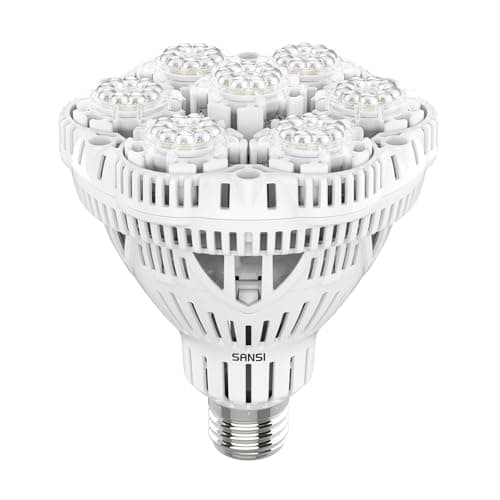 SANSI 36W BR30 Grow Light Bulb The rare grow bulb that publishes both PPF and a PPFD figure with the measurement distance attached, which is the only reason it can be sized honestly. | A socket you already have | 1.82 umol/J (ours) | |
| 2 | 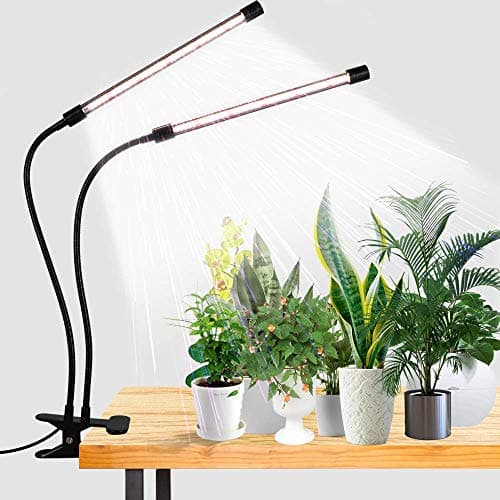 GooingTop Clip Grow Light The cheapest way to put real light on one plant on one desk, and honest about being exactly that — a 10 W clip lamp with a repeating timer. | No socket at all | Not published | |
| 3 | 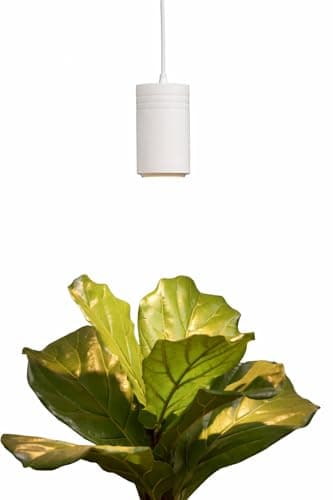 Soltech Aspect Gen 2 The only fixture here you would willingly hang in a living room, and the only one publishing PPFD at three separate distances so it can actually be placed by the numbers. | A fixture on show | 1.39 umol/J (ours) |
The reasoning
Ask whether a normal LED bulb can grow a plant and you will get two confident answers, both wrong. “No, plants need special light” is wrong, because a white LED bulb emits plenty of photons in the 400–700 nm band. “Yes, any bulb works” is wrong, because the typical household bulb is nowhere near bright enough at the distance you would actually hang it.
The real answer is arithmetic, and it turns on intensity rather than spectrum.
The spectrum objection is the weak one
A 4000 K or 5000 K white LED bulb produces broad output across the visible range. The peer-reviewed comparison of white light with blue-plus-red radiation found white performed comparably for growth, so a white household bulb is not emitting the wrong kind of light in any meaningful sense. It is emitting a small amount of the right kind.
The intensity objection is the real one
Here is the problem as a number. A SANSI 36 W BR30 grow bulb publishes 65.6 µmol/s of photon output. A common household LED bulb of the same shape draws around 9 to 11 W. Even assuming identical efficacy — generous, since a grow bulb is optimized for photon output rather than lumens — you are looking at roughly a quarter of the photons.
Take the SANSI figure as a ceiling: 65.6 µmol/s from 36 W is 1.82 µmol/J. A 10 W household bulb at the same efficacy would emit about 18 µmol/s.
Spread that over even a small 1 × 1 ft area (0.093 m²) at 0.8 uniformity: 18 ÷ 0.093 × 0.8 = about 155 µmol/m²/s directly beneath it.
That lands in Minnesota Extension’s medium band, and only for a one-square-foot patch immediately under the bulb, at close range. Move the plant to the far side of a shelf and it falls off a cliff.
Verdict: a bright household bulb, hung close, over one small plant, is genuinely doing something. Over a shelf, it is doing nearly nothing.
The deeper problem: you cannot check any of this
The calculation above starts with “assume the same efficacy as a grow bulb,” which is an assumption we made explicit because we had to make one. Household bulbs publish lumens. Lumens cannot be converted to photon flux without knowing the spectrum, so there is no way to do this sum properly for a bulb you own.
That is the real difference between a grow light and a regular bulb: not the light, the data. A grow bulb publishing 65.6 µmol/s and a PPFD of 265.58 µmol/m²/s at 1 ft can be placed deliberately. A household bulb rated at 800 lumens can only be tried.
| Situation | Household LED bulb | Grow bulb or fixture |
|---|---|---|
| One small plant on a desk, lamp within a foot | Workable, if the bulb is bright and close | Better, and you can predict the result |
| A shelf of several plants | No — the falloff across the shelf is severe | Yes; size it with the coverage calculator |
| Seedlings, where stretching is instant and permanent | No | Yes — the intensity target is specific and published |
| Supplementing a bright window in winter | Marginal | Yes; work out the shortfall first |
| You want to check what you are buying before you buy it | Impossible — lumens do not convert | Possible whenever PPF is published |
The honest middle ground
If you have one pothos on a desk and a bright lamp already pointed at it, you do not need to buy anything. Move it closer, run it longer, and watch it for a month. The plant will tell you.
If you are lighting more than one plant, or the plant is a seedling that will be ruined before you notice, buy a fixture that publishes its photon output and size it. That is a modest purchase that removes the guesswork completely, and it is the whole reason this site computes instead of estimating. Start from our houseplant picks or work the numbers yourself in the coverage calculator.
Every pick in full
SANSI 36W BR30 Grow Light Bulb
Grow bulbA socket you already have
The rare grow bulb that publishes both PPF and a PPFD figure with the measurement distance attached, which is the only reason it can be sized honestly.
What SANSI publishes
- Power draw
- 36 W (source)
- PPF (photon output)
- 65.6 umol/s (source)
- PPFD
- 265.58 umol/m2/s at 1 ft (source)
- Spectrum
- 4000 K, 400-780 nm, CRI close to 100 (source)
- Rated life
- 25,000 hours (source)
Our arithmetic
- Efficacy, computed from the published figures: 1.82 umol/J
65.6 umol/s / 36 W = 1.82 umol/J. That is roughly a third less efficient than the panels on this page — the price of a screw-in form factor. - Electricity used at 12 hours a day for 30 days: 12.96 kWh a month
36 W x 12 h x 30 d / 1000 = 12.96 kWh.
What SANSI does not publish
- Beam angle
- Fixture dimensions
Who should skip it
Skip it if you are lighting more than one plant. 65.6 umol/s is a small amount of light spread over a cone — it lights a single specimen, not a shelf.
GooingTop Clip Grow Light
Clip lightNo socket at all
The cheapest way to put real light on one plant on one desk, and honest about being exactly that — a 10 W clip lamp with a repeating timer.
What GooingTop publishes
- Power draw
- About 10 W (source)
- Spectrum
- 6000 K, 74 white plus 10 red LEDs, CRI 95 (source)
- Dimming
- Five brightness levels; repeating 4 / 8 / 12 hour timer (source)
What GooingTop does not publish
- PPF in umol/s
- PPFD at any distance
- Photon efficacy in umol/J
- The manufacturer publishes no spec sheet at all; the figures above come from the retail listing
Who should skip it
Skip it if the plant is more than about a foot across, or if you want any number at all before you buy — nobody publishes photon data for this fixture.
Soltech Aspect Gen 2
PendantA fixture on show
The only fixture here you would willingly hang in a living room, and the only one publishing PPFD at three separate distances so it can actually be placed by the numbers.
What Soltech publishes
- Power draw
- 36 W (source)
- PPF (photon output)
- 50 umol/s (source)
- PPFD
- about 50 umol/m2/s at 1 m, 34.9 at 4 ft, 15.5 at 6 ft (source)
- Spectrum
- 3000 K warm white, CRI 98 (source)
- Dimming
- Yes, in-line dimmer 10-100% (source)
- Dimensions
- 3.5 x 3.5 x 6.2 inches (source)
- Rated life
- 50,000 hours (source)
Our arithmetic
- Efficacy, computed from the published figures: 1.39 umol/J
50 umol/s / 36 W = 1.39 umol/J. Roughly half the efficacy of a 2.7 umol/J board — the design premium is paid twice, once at purchase and again every month on the meter.
Who should skip it
Skip it if photons per watt is the metric that matters. At 50 umol/s from 36 W it is the least efficient fixture on this page, and much of the price is industrial design.
Questions people actually ask
+Can a normal LED bulb grow plants?
+What makes a grow bulb different from a household bulb?
+How many lumens do plants need?
+Is a daylight 5000K bulb better for plants than a warm one?
Sources
- SANSI — BR30 36W grow light bulb product page — consulted September 2, 2026
- Zhen & van Iersel et al., PLOS ONE — Spectral effects of LEDs on plant growth, visual color quality and photosynthetic photon efficacy: white versus blue plus red radiation — consulted September 2, 2026
- University of Minnesota Extension — Lighting for indoor plants and starting seeds — consulted September 2, 2026
- Iowa State University Extension — Important Considerations for Providing Supplemental Light to Indoor Plants — consulted September 2, 2026
Read next
Spectrum & PPFD
What “Full Spectrum” Actually Means
The phrase is unregulated and carries no threshold. These are the numbers that replace it.
Top pick
Spider Farmer SF1000
Spectrum & PPFD
PAR, PPFD and DLI, Explained
The three photon units, what each measures, and the conversions between them, shown.
Top pick
Spider Farmer SF1000
Seed Starting
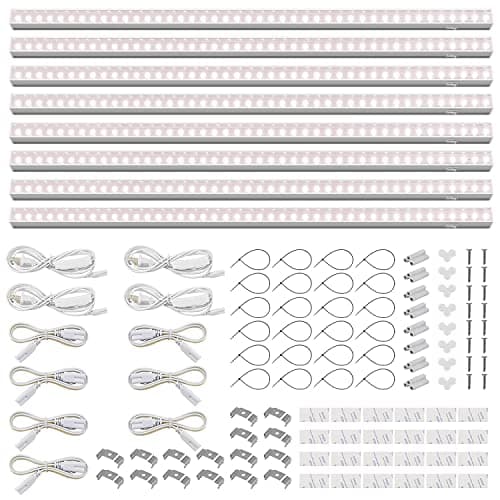
Shop Light vs Grow Light for Seedlings
Shop lights grow fine seedlings. They just publish the wrong unit, so you cannot size one in advance.
Top pick
Barrina T5 4ft Grow Light Strips
Houseplants
The Best Grow Lights for Indoor Plants
Sized to a 3-10 mol/m2/day houseplant target rather than a grow-tent target, with running cost for each.
Top pick
SANSI 36W BR30 Grow Light Bulb
Where this sits
This page belongs to Spectrum and PPFD, Honestly. Every figure on it is either quoted from a named published source or derived in view — the full method is on our methodology page, and how the site is funded is on the affiliate disclosure.