Shop Light vs Grow Light for Seedlings
The shop light usually works. The problem is that you cannot find out whether it will before you buy it.
By Scooter M. — An enthusiast who's genuinely into this. I read the manuals, compile the published specs, and do the math. No lab coat.
Published · How we pick
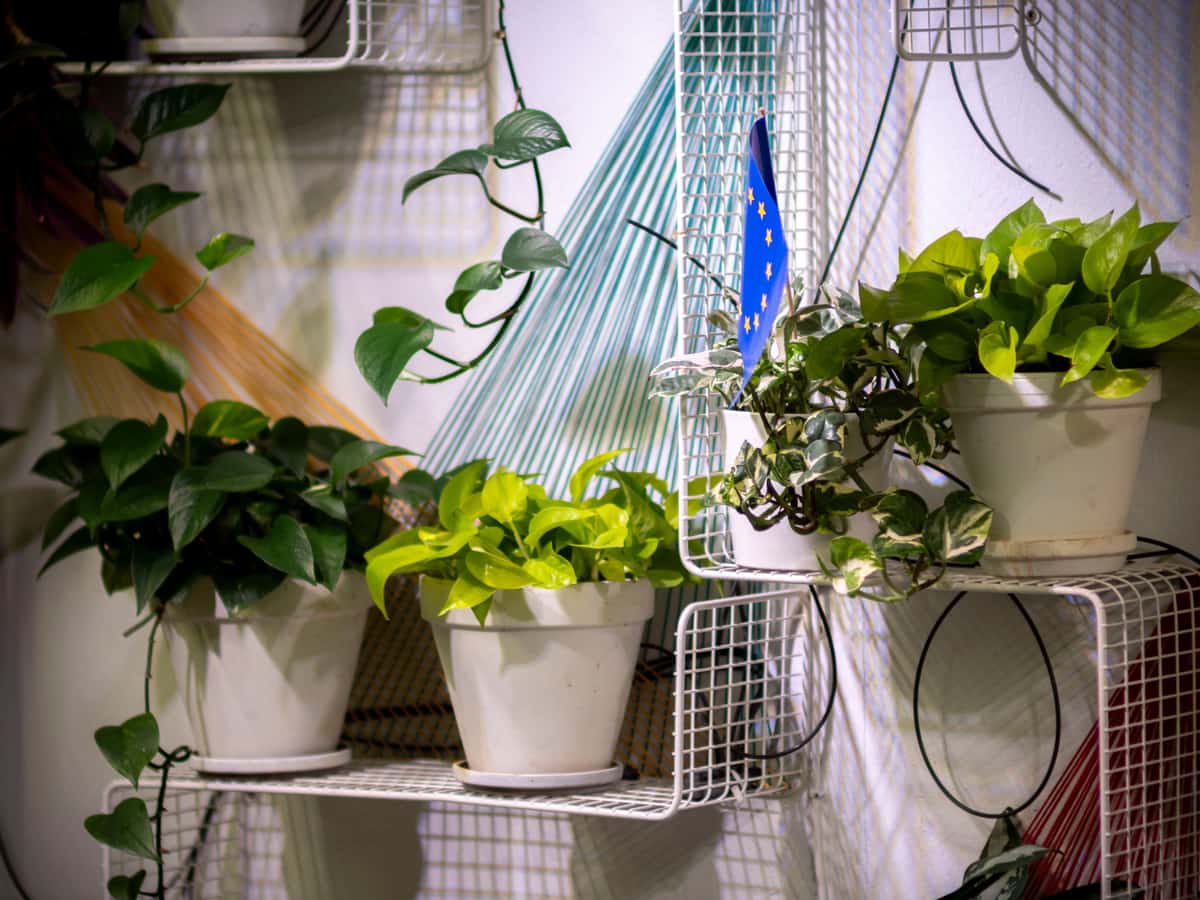
Photographs on this site are licensed stock and are illustrative of the fixture type. We do not own the units we write about.
How this page is funded: the buy links here are Amazon Associates links, and we earn a commission on qualifying purchases at no extra cost to you. We have not been paid to feature anything on this page, we accept no free product, and commission plays no part in the ranking. Full disclosure.
We have not tested these units. Everything below comes from the manufacturer’s own published specifications, or from arithmetic we have shown our working for. Where a figure is not published, we say so instead of estimating one. Read the method.
Quick picks
Efficacy is photons out per joule in. Where a manufacturer publishes it we quote theirs; where they publish photon output and wattage but not efficacy, we divide and label it as ours; where they publish neither, the cell says so rather than guessing. Tap a row for the full write-up.
| # | Product | Best for | Efficacy | Price |
|---|---|---|---|---|
| 1 | 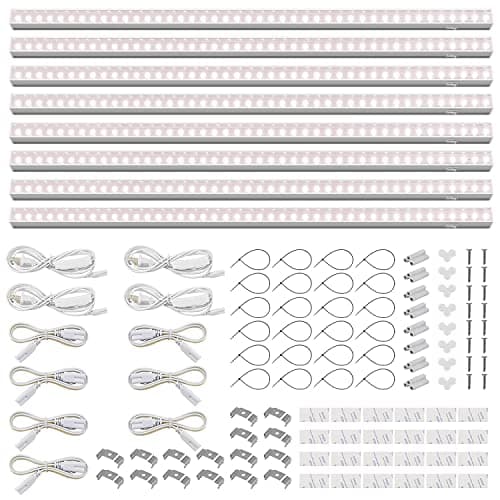 Barrina T5 4ft Grow Light Strips The default seed-starting bar for good reasons — 4 ft long, linkable in series, cheap per foot — and the reason we built a coverage calculator, because Barrina publishes no photon data whatsoever. | Shop-light shape | Not published | |
| 2 | 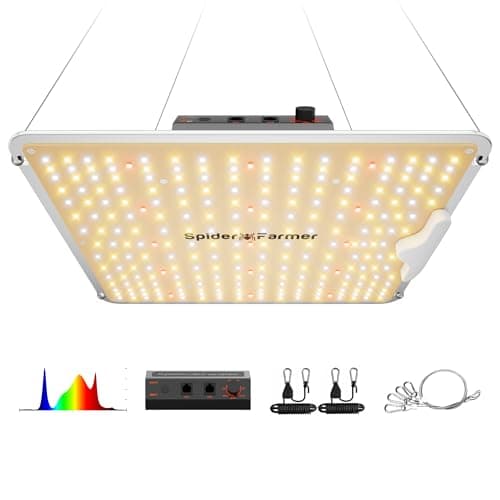 Spider Farmer SF1000 Publishes PPF to two decimal places and an efficacy figure that actually divides out of it. That internal consistency is rarer in this category than it should be. | Actual photon specs | 2.5 umol/J |
The reasoning
Gardeners have raised excellent seedlings under plain white shop lights for decades, and the internet’s insistence that you need a purpose-built horticultural fixture is mostly wrong. Seedlings are driven by intensity far more than by exotic spectrum, and a modern white LED shop light produces plenty of usable photons.
There is one real difference, and it is not about the light. It is about the specification.
The unit problem
A shop light is sold in lumens. A grow light — a good one — is sold in PPF, in µmol/s. These measure different things and are not interconvertible without knowing the fixture’s exact spectrum.
- Lumens weight light by the sensitivity of the human eye, which peaks in the green around 555 nm — the region plants reflect most, which is why leaves look green.
- PPF counts every photon between 400 and 700 nm equally, because that is the range that drives photosynthesis.
A fixture heavy in green light scores well in lumens and poorly for plants. A fixture heavy in deep red scores poorly in lumens and well for plants. So a lumen figure cannot be converted into a PPFD figure, and any published conversion factor has silently assumed a spectrum. We do not publish one, and you should distrust anyone who does.
| White LED shop light | Horticultural LED | |
|---|---|---|
| Will it grow seedlings? | Yes, if it is bright enough and close enough | Yes |
| Published in | Lumens, and sometimes watts | PPF (µmol/s) and often efficacy (µmol/J) |
| Can you size it before buying? | No — no photon figure exists to divide | Yes, if the manufacturer publishes PPF |
| Spectrum | Usually 4000–5000 K white; fine for seedlings | White plus supplemental deep red and far red |
| Cost per foot of coverage | Usually lower | Usually higher |
| Mounting for a shelf | Excellent — designed for it | Depends on form factor |
| Dimming | Rarely | Common on panels; useful over young seedlings |
What to do with a shop light you already own
Use it, and compensate for the missing specification with distance and hours rather than arithmetic:
- Get it close — 4 to 6 inches above the seedlings for an LED strip fixture, and raise it weekly.
- Run 14 to 16 hours a day. If a fixture is dimmer than ideal, hours are the lever you have.
- Read the plants rather than a spec sheet. Stocky green seedlings mean it is working; pale stretched ones mean lower it, lengthen the photoperiod, or add a second fixture.
- Prefer 4000 K or 5000 K over warm 2700 K if you are choosing. It is a small effect for seedlings, but a free one.
The verdict
If you already own a bright white LED shop light, use it — it will almost certainly do the job. If you are buying new and want to know in advance that the fixture will hit your target, buy something that publishes PPF. Paying a premium for a “grow” label on a fixture that still only publishes lumens gets you the worst of both: the price of a horticultural product and the unverifiability of a shop light.
That test — does the manufacturer publish a photon figure — is a more reliable buying filter than any brand name, and it is how our seed-starting picks are ordered.
Every pick in full
Barrina T5 4ft Grow Light Strips
LED barShop-light shape
The default seed-starting bar for good reasons — 4 ft long, linkable in series, cheap per foot — and the reason we built a coverage calculator, because Barrina publishes no photon data whatsoever.
What Barrina publishes
- Power draw
- 20 W per fixture; an 8-pack draws 160 W (source)
- Spectrum
- 5000 K (source)
- Dimming
- No; on/off switch per fixture, linkable up to 8 in series (source)
- Dimensions
- 4 ft strip, 120-degree beam angle, 120 V AC (source)
What Barrina does not publish
- PPF in umol/s — for any strip in the range
- PPFD at any stated distance
- Photon efficacy in umol/J
- LED count per strip, and rated lifespan
Who should skip it
Skip it if you need to know what you are getting before it arrives. There is no published PPF, no PPFD and no efficacy figure, so nothing about its output can be verified in advance.
Spider Farmer SF1000
LED panelActual photon specs
Publishes PPF to two decimal places and an efficacy figure that actually divides out of it. That internal consistency is rarer in this category than it should be.
What Spider Farmer publishes
- Power draw
- 100 W +/-5% at 100-277 V AC (source)
- PPF (photon output)
- 249.21 umol/s (source)
- Efficacy
- 2.5 umol/J (source)
- Stated coverage
- 2 x 2 ft core, 3 x 3 ft maximum (source)
- Spectrum
- 650-665 nm, 730-740 nm, 2800-3000 K, 4800-5000 K (source)
- Diodes
- Bridgelux (source)
- Dimming
- Yes, dimming knob (source)
- Dimensions
- 32.5 x 29.0 x 5.9 cm (source)
- Rated life
- 55,000 hours (source)
Our arithmetic
- Does the published efficacy check out against the published PPF?: Yes — 2.49 umol/J computed against 2.5 umol/J published
249.21 umol/s / 100 W = 2.4921 umol/J. The published 2.5 umol/J is that number rounded. Not every brand's two figures agree like this, which is exactly why we divide them. - Average PPFD across its 2 x 2 ft core footprint: about 536 umol/m2/s
2 ft x 2 ft = 4 sq ft = 0.372 m2. 249.21 / 0.372 = 670 umol/m2/s at perfect uniformity; at a 0.8 uniformity factor, about 536 umol/m2/s.
Who should skip it
Skip it if raw output is what you are buying — the TS 1000 delivers 38% more photons per second, at the cost of 50 W more draw.
Questions people actually ask
+Can I use a regular LED shop light to start seeds?
+What is the difference between a shop light and a grow light?
+How many lumens do seedlings need?
Sources
- University of Minnesota Extension — Lighting for indoor plants and starting seeds — consulted September 2, 2026
- University of New Hampshire Extension — Growing Seedlings Under Lights — consulted September 2, 2026
- Zhen & van Iersel et al., PLOS ONE — Spectral effects of LEDs on plant growth, visual color quality and photosynthetic photon efficacy: white versus blue plus red radiation — consulted September 2, 2026
Read next
Seed Starting
T5 Fluorescent vs LED for Seed Starting
LED wins on hours, cost and lifespan. The one remaining case for fluorescent, stated honestly.
Top pick
Barrina T5 4ft Grow Light Strips
Spectrum & PPFD
Grow Light vs Regular LED Bulb
Household bulbs emit usable light but cannot be sized. Where the line actually falls.
Top pick
SANSI 36W BR30 Grow Light Bulb
Seed Starting
The Best Grow Lights for Seed Starting
Sized against a 12 mol/m2/day seedling target using published photon output, not marketing claims.
Top pick
Barrina T5 4ft Grow Light Strips
Coverage & Sizing
What Size Grow Light Do I Need?
Size from area and target, not from watts. The sum, plus a lookup table by area.
Top pick
SANSI 36W BR30 Grow Light Bulb
Where this sits
This page belongs to Grow Lights for Seed Starting. Every figure on it is either quoted from a named published source or derived in view — the full method is on our methodology page, and how the site is funded is on the affiliate disclosure.