T5 Fluorescent vs LED for Seed Starting
LED, in almost every case — and the extension data showing a fluorescent setup needing 22 hours to match an LED's 10 is the clearest evidence there is.
By Scooter M. — An enthusiast who's genuinely into this. I read the manuals, compile the published specs, and do the math. No lab coat.
Published · How we pick
Photographs on this site are licensed stock and are illustrative of the fixture type. We do not own the units we write about.
How this page is funded: the buy links here are Amazon Associates links, and we earn a commission on qualifying purchases at no extra cost to you. We have not been paid to feature anything on this page, we accept no free product, and commission plays no part in the ranking. Full disclosure.
We have not tested these units. Everything below comes from the manufacturer’s own published specifications, or from arithmetic we have shown our working for. Where a figure is not published, we say so instead of estimating one. Read the method.
Quick picks
Efficacy is photons out per joule in. Where a manufacturer publishes it we quote theirs; where they publish photon output and wattage but not efficacy, we divide and label it as ours; where they publish neither, the cell says so rather than guessing. Tap a row for the full write-up.
| # | Product | Best for | Efficacy | Price |
|---|---|---|---|---|
| 1 | 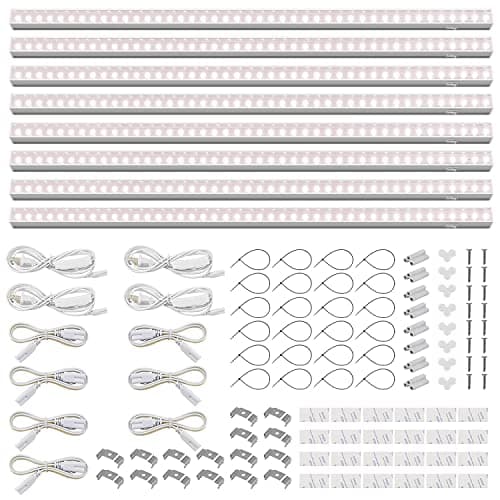 Barrina T5 4ft Grow Light Strips The default seed-starting bar for good reasons — 4 ft long, linkable in series, cheap per foot — and the reason we built a coverage calculator, because Barrina publishes no photon data whatsoever. | LED in a T5 shape | Not published | |
| 2 | 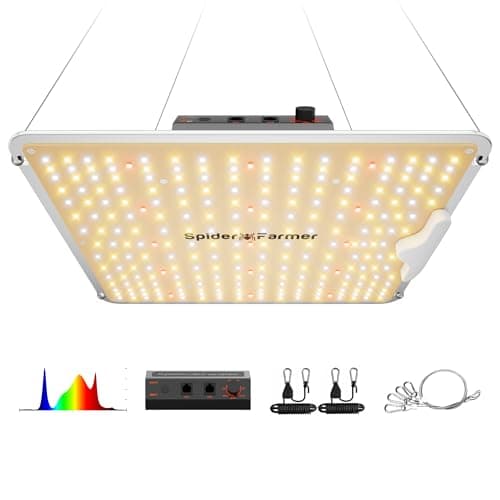 Spider Farmer SF1000 Publishes PPF to two decimal places and an efficacy figure that actually divides out of it. That internal consistency is rarer in this category than it should be. | LED with real specs | 2.5 umol/J |
The reasoning
A word of clarification first, because it causes real confusion: “T5” describes a tube diameter, not a technology. It means a tube five-eighths of an inch across. Most fixtures sold today as “T5 grow lights” — including the linked strips that dominate seed starting — are LEDs in a T5-shaped housing. The real comparison is between fluorescent tubes and LED emitters, whatever shape the housing is.
The decision table
| Fluorescent T5 | LED | |
|---|---|---|
| Hours needed for the same daily light | 22 h for tomato seedlings, per UNH Extension | 10 h for a high-output horticultural LED, same target |
| Energy use | Higher — Minnesota Extension notes fluorescents use more energy than LEDs | Lower for the same photon delivery |
| Up-front cost | Cheaper per fixture | Higher per fixture, falling every year |
| Lifespan | Shorter — Minnesota Extension notes they do not last as long as LEDs | Typically 25,000–55,000 hours where published |
| Output over time | Falls noticeably; tubes need periodic replacement | Falls slowly over tens of thousands of hours |
| Distance from seedlings | 1–3 inches — must sit very close | 4–6 inches for strips, 12–18 for panels |
| Cold tolerance | Output drops in a cold basement or garage | Largely unaffected; some LEDs run better cold |
| Disposal | Contains mercury; needs proper disposal | Ordinary electronics disposal |
The number that decides it
UNH Extension’s comparison is the most concrete evidence in this debate, because it holds the plant and the outcome constant and varies only the fixture: tomato seedlings needed 22 hours a day under fluorescent to reach the same growth that a high-output horticultural LED achieved in 10 hours a day.
Two fixtures, both nominally 40 W, run over an eight-week season at 18.34 cents per kWh.
Fluorescent at 22 h: 40 × 22 × 56 ÷ 1000 = 49.3 kWh → $9.04.
LED at 10 h: 40 × 10 × 56 ÷ 1000 = 22.4 kWh → $4.11.
About $5 a season on one fixture. Small. On a three-shelf rack with eight fixtures, roughly $40 a season — and that is before the tube replacements.
The honest reading: for a single shelf the running-cost difference is real but not large. It is the combination — fewer hours, longer life, no tube replacement, no mercury — that makes LED the default rather than any one figure. Our full running-cost comparison works this through for longer photoperiods, where the gap widens considerably.
Where fluorescent still wins
Two cases, and they are genuine:
- You already own the fixture and the tubes. Nothing here justifies replacing working fluorescent hardware. Run it until the tubes fade, then replace with LED.
- Very low up-front budget and a short season. If you start seeds for six weeks a year and a shop-light fixture is a fraction of an LED bar’s price, the payback period is longer than most people are honestly planning for.
The verdict, and when it flips
Buy LED. Fewer hours for the same result, longer service life, no tube replacement cycle, no mercury, and it works in a cold basement. The verdict flips only if you already own fluorescent hardware that works, in which case the right move is to use it up.
If you want the T5 form factor with LED inside — which is what most seed starters actually want — that is the linked-strip category, and our grow light bar roundup covers it. Just note the caveat that runs through this whole site: the most popular strips in that category publish no photon data at all.
Every pick in full
Barrina T5 4ft Grow Light Strips
LED barLED in a T5 shape
The default seed-starting bar for good reasons — 4 ft long, linkable in series, cheap per foot — and the reason we built a coverage calculator, because Barrina publishes no photon data whatsoever.
What Barrina publishes
- Power draw
- 20 W per fixture; an 8-pack draws 160 W (source)
- Spectrum
- 5000 K (source)
- Dimming
- No; on/off switch per fixture, linkable up to 8 in series (source)
- Dimensions
- 4 ft strip, 120-degree beam angle, 120 V AC (source)
What Barrina does not publish
- PPF in umol/s — for any strip in the range
- PPFD at any stated distance
- Photon efficacy in umol/J
- LED count per strip, and rated lifespan
Who should skip it
Skip it if you need to know what you are getting before it arrives. There is no published PPF, no PPFD and no efficacy figure, so nothing about its output can be verified in advance.
Spider Farmer SF1000
LED panelLED with real specs
Publishes PPF to two decimal places and an efficacy figure that actually divides out of it. That internal consistency is rarer in this category than it should be.
What Spider Farmer publishes
- Power draw
- 100 W +/-5% at 100-277 V AC (source)
- PPF (photon output)
- 249.21 umol/s (source)
- Efficacy
- 2.5 umol/J (source)
- Stated coverage
- 2 x 2 ft core, 3 x 3 ft maximum (source)
- Spectrum
- 650-665 nm, 730-740 nm, 2800-3000 K, 4800-5000 K (source)
- Diodes
- Bridgelux (source)
- Dimming
- Yes, dimming knob (source)
- Dimensions
- 32.5 x 29.0 x 5.9 cm (source)
- Rated life
- 55,000 hours (source)
Our arithmetic
- Does the published efficacy check out against the published PPF?: Yes — 2.49 umol/J computed against 2.5 umol/J published
249.21 umol/s / 100 W = 2.4921 umol/J. The published 2.5 umol/J is that number rounded. Not every brand's two figures agree like this, which is exactly why we divide them. - Average PPFD across its 2 x 2 ft core footprint: about 536 umol/m2/s
2 ft x 2 ft = 4 sq ft = 0.372 m2. 249.21 / 0.372 = 670 umol/m2/s at perfect uniformity; at a 0.8 uniformity factor, about 536 umol/m2/s.
Who should skip it
Skip it if raw output is what you are buying — the TS 1000 delivers 38% more photons per second, at the cost of 50 W more draw.
Questions people actually ask
+Is a T5 grow light fluorescent or LED?
+Are LED grow lights better than fluorescent for seedlings?
+Do I need to replace my fluorescent tubes for seed starting?
Sources
- University of New Hampshire Extension — Growing Seedlings Under Lights — consulted September 2, 2026
- University of Minnesota Extension — Lighting for indoor plants and starting seeds — consulted September 2, 2026
- US Energy Information Administration — Electric Power Monthly, Table 5.3 (US residential average, June 2026) — consulted September 2, 2026
- Barrina — T5 ML20 4ft 20W product page — consulted September 2, 2026
Read next
Reviews
T5 vs T8 Grow Lights
What T5 and T8 actually mean, why most are now LED, and how to tell what you are buying.
Top pick
Barrina T5 4ft Grow Light Strips
Running Cost
LED vs Fluorescent Running Cost
The draw difference between T5 fluorescent and LED replacements, priced over a season.
Top pick
Barrina T5 4ft Grow Light Strips
Seed Starting
The Best Grow Lights for Seed Starting
Sized against a 12 mol/m2/day seedling target using published photon output, not marketing claims.
Top pick
Barrina T5 4ft Grow Light Strips
Seed Starting
How Much Light Do Seedlings Actually Need?
The 12 mol/m2/day seedling target, converted into the PPFD and hours you can actually set.
Top pick
Spider Farmer SF1000
Reviews
The Best Grow Light Bars
Linear fixtures for shelves and trays, and the disclosure gap running through the category.
Top pick
Barrina T5 4ft Grow Light Strips
Where this sits
This page belongs to Grow Lights for Seed Starting. Every figure on it is either quoted from a named published source or derived in view — the full method is on our methodology page, and how the site is funded is on the affiliate disclosure.