SANSI vs GE Grow Light Bulbs
These two are the rare grow bulbs that publish what they emit. Their efficiency is nearly identical, so the decision comes down to something simpler.
By Scooter M. — An enthusiast who's genuinely into this. I read the manuals, compile the published specs, and do the math. No lab coat.
Published · How we pick
Photographs on this site are licensed stock and are illustrative of the fixture type. We do not own the units we write about.
How this page is funded: the buy links here are Amazon Associates links, and we earn a commission on qualifying purchases at no extra cost to you. We have not been paid to feature anything on this page, we accept no free product, and commission plays no part in the ranking. Full disclosure.
We have not tested these units. Everything below comes from the manufacturer’s own published specifications, or from arithmetic we have shown our working for. Where a figure is not published, we say so instead of estimating one. Read the method.
Quick picks
Efficacy is photons out per joule in. Where a manufacturer publishes it we quote theirs; where they publish photon output and wattage but not efficacy, we divide and label it as ours; where they publish neither, the cell says so rather than guessing. Tap a row for the full write-up.
| # | Product | Best for | Efficacy | Price |
|---|---|---|---|---|
| 1 | 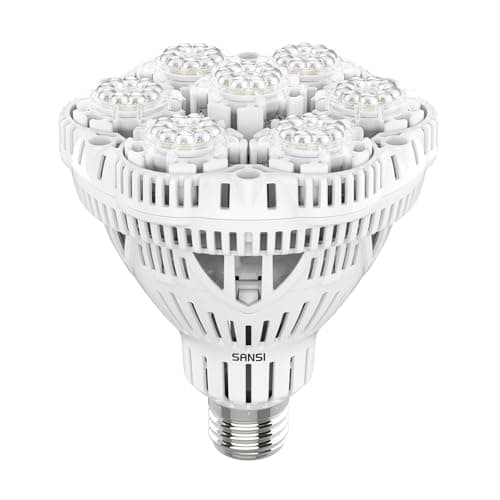 SANSI 36W BR30 Grow Light Bulb The rare grow bulb that publishes both PPF and a PPFD figure with the measurement distance attached, which is the only reason it can be sized honestly. | One plant that needs real light | 1.82 umol/J (ours) | |
| 2 | 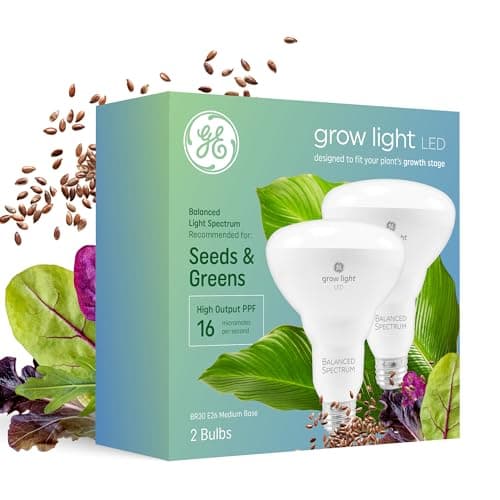 GE Grow Light BR30 Bulb, Seeds and Greens (2-pack) A mainstream-brand grow bulb that prints its photon output on the box: 16 umol/s from 9 W, which is enough for one low- or medium-light plant under a lamp you already own, and not much more. | Two plants that need a little | Not published |
The reasoning
We have not tested either bulb. What follows is the manufacturers’ published specifications, our own arithmetic on those figures, and the one number each brand leaves out.
This comparison is unusual on this site because both sides publish a photon figure. Most grow bulbs give you lumens and a color temperature and leave you guessing. SANSI and GE both state output in micromoles per second, which means the comparison can be arithmetic rather than opinion.
The published figures
| SANSI 36W BR30 | GE Grow BR30 | |
|---|---|---|
| Power | 36 W | 9 W per bulb |
| PPF published | 65.6 µmol/s | 16 µmol/s |
| Efficacy (derived) | 1.82 µmol/J | 1.78 µmol/J |
| PPFD published | 265.58 µmol/m²/s at a stated 1 ft | None |
| Spectrum | 4000 K, 400-780 nm, CRI close to 100 | 500 lumens, CRI 90 |
| Rated life | 25,000 hours | Up to 25,000 hours, 3-year warranty |
| Sold as | Single bulb | Two-pack |
The surprise: efficiency is a tie
The instinct with a 36 W bulb against a 9 W bulb is that the big one must be the serious product and the small one a compromise. The arithmetic says otherwise.
SANSI: 65.6 µmol/s ÷ 36 W = 1.82 µmol/J.
GE: 16 µmol/s ÷ 9 W = 1.78 µmol/J.
A 2% difference, which is inside the rounding on either published figure. These two bulbs convert electricity into plant light at effectively the same rate.
That matters because it removes the usual reason to prefer one fixture over another. Neither bulb is cheaper to run per photon delivered. Buy four GE bulbs and you have spent 36 W to produce 64 µmol/s — almost exactly the SANSI’s 65.6 µmol/s from the same 36 W.
So the question is not efficiency. It is where you need the light to arrive.
One socket, or several
A bulb concentrates its output into a cone beneath it. Four times the photons from one socket is a genuinely different tool from the same photons split across four sockets in four places.
- SANSI puts 65.6 µmol/s over one plant. At its published one-foot distance that is 265.58 µmol/m²/s, which is the high band on the University of Minnesota Extension’s scale — enough for a herb pot, a monstera, a bonsai, a flytrap.
- GE puts 16 µmol/s over one plant, twice, because it comes in a two-pack. Even if every photon landed inside one square foot — which no bulb manages — the ceiling is 172 µmol/m²/s. That is the right size for a pothos, a calathea, a peace lily being kept rather than bloomed.
Put plainly: the SANSI is one bright light, the GE is two dim ones. Neither is better in the abstract, and the mistake is buying the wrong shape of answer for the plants you own.
The disclosure difference, which decides close calls
When the efficiency is a tie, the tiebreaker is what you can know in advance.
SANSI publishes a PPFD with the measurement distance attached: 265.58 µmol/m²/s at one foot. A PPFD without a distance is meaningless, and attaching one is rarer than it should be. Because that figure exists, the bulb can be placed by arithmetic — light falls with the square of distance, so 15 inches gives about 170 µmol/m²/s and 20 inches about 96.
GE publishes no beam angle and no PPFD at any distance. The best that can be said about the GE is a ceiling: 16 µmol/s over one square foot is at most 172 µmol/m²/s, and in reality less, by an amount nobody has published. You can buy the GE and find out, or you can buy the SANSI and calculate.
SANSI publishes PPFD at a stated one foot, so the intensity at any other height follows from the inverse-square relationship. GE publishes no beam angle and no PPFD, so only an upper bound can be computed.
Color, and the room the plant lives in
Both are white-light bulbs rather than the purple-pink kind, which is the right choice for a plant in a room you occupy. GE publishes CRI 90; SANSI publishes a CRI close to 100 with a stated 400-780 nm range.
Those are both high enough that foliage looks like itself. The SANSI figure is the better one on paper, and in practice the difference between CRI 90 and CRI 98 on a green leaf is small next to the difference between either of them and a purple fixture. The research on white against blue-plus-red is summarized in full spectrum versus red and blue.
Running cost
SANSI, 36 W: 12.96 kWh a month = $2.38.
One GE bulb, 9 W: 3.24 kWh = $0.59. Both bulbs from the two-pack: $1.18.
Four GE bulbs, matching the SANSI’s 36 W and its output: $2.36 — the same bill, as the efficiency tie predicts.
Where each one wins
| Situation | Pick | Why |
|---|---|---|
| One medium- or high-light plant | SANSI | 65.6 µmol/s in one cone, placeable by its published 1 ft figure |
| Two low-light plants in two rooms | GE | Two bulbs in the box; light delivered where each plant actually is |
| A plant you want to flower | SANSI | Flowering wants the band above survival, and 16 µmol/s does not reach it over a 2 sq ft plant |
| A dark corner you want kept alive cheaply | GE | $0.59 a month, and the low band is the correct target |
| You want to calculate before you buy | SANSI | The only one of the two with a PPFD at a stated distance |
| A seed tray | Neither | A tray wants a bar; both of these are single-plant bulbs |
The honest downside of each
SANSI: it lights one plant and no more, it is four times the wattage on the meter, and at 25,000 rated hours it is rated for less life than several fixtures on this site. If your problem is three plants in three rooms, buying three of these is an expensive way to solve it.
GE: it publishes no beam angle, so what actually reaches the plant cannot be computed, only bounded. And it is genuinely not enough light for anything in the medium or high bands — we say so on the GE review and it is worth repeating here, because the two-pack makes it look like more light than it is.
The short answer
If you have one plant that wants real light, buy the SANSI: same efficiency, four times the output in one place, and the only published PPFD-at-a-distance of the two. If you have two undemanding plants in two spots, buy the GE two-pack and put the light where the plants are. The brands are not really competing — they are selling different amounts of the same thing at the same efficiency.
GE sells the same output in two shapes
One wrinkle before you decide. GE publishes identical photometrics for its BR30 and its A19 grow bulbs: 9 W, 16 µmol/s, 500 lumens, CRI 90. The difference is the glass.
A BR30 is a reflector flood — the bulged shape with a mirrored interior that pushes light forward. An A19 is the ordinary household bulb shape that emits in every direction. Same photons, different destinations: in an open socket a good share of the A19’s output lights the ceiling, while the BR30 sends most of its cone downward.
For a plant, that makes the BR30 the default and the A19 the fallback for fixtures a BR30 will not physically fit — a table lamp with a narrow harp, a pendant designed around a standard bulb. It is worth knowing because the A19 two-pack is often the cheaper listing, and the saving is real only if your lamp cannot take the better shape.
The lamp problem, which the price tags hide
Neither of these is a complete fixture. Both are bulbs, and a bulb needs a lamp that points down at a plant and looks acceptable where it sits. That is a cost and a constraint the listing price does not show.
The SANSI concentrates a lot of light into one socket, which means the lamp has to be somewhere useful — directly above the plant, at a workable height, aimed down. A clamp lamp on a shelf edge does this well and looks like a workshop. The GE pair asks less of each lamp, because 16 µmol/s does not need precise placement to do its modest job, and two ordinary lamps in two rooms is an easier thing to arrange than one perfectly positioned one.
If the fixture itself is the obstacle — a plant in a room where a clamp lamp is unacceptable — then neither of these is really the answer, and the comparison worth reading instead is SANSI against the Soltech, where the whole argument is about what a fixture looks like.
What neither of them publishes
Both brands are unusually forthcoming for grow bulbs, which makes the remaining gaps worth naming.
- Neither publishes a beam angle for its BR30. SANSI gets around this by publishing a PPFD at a stated distance, which is the more useful disclosure. GE publishes neither, so its output can only be bounded rather than placed.
- Neither publishes a spectral distribution. SANSI states a 400-780 nm range and a CRI close to 100; GE describes “blue and red” and publishes CRI 90. Those are descriptions, not curves, so the actual balance of wavelengths is unknown for both.
- Neither publishes a location rating on these bulbs. If the plant lives in a kitchen or bathroom, that absence matters — it is the subject of grow lights for bathrooms, where the only rated bulbs come from a third brand.
None of that changes the recommendation. It does mean that the honest basis for choosing between these two is the two figures they both publish — output and wattage — and the one SANSI publishes alone.
What changes once you have three plants
Both answers on this page assume one or two plants. Past that the arithmetic turns against bulbs of either brand.
Three plants on one shelf is not three cones of light; it is a strip of shelf that needs lighting evenly. Three GE bulbs deliver 48 µmol/s from 27 W in three overlapping circles with dark gaps between them, and three SANSI bulbs deliver 196.8 µmol/s from 108 W with the same geometry problem and a much larger bill. A single 4 ft bar publishing 52 µmol/s from 30 W covers the whole run evenly instead, which is why this site keeps pointing shelf owners at grow light bars rather than at more bulbs.
The switch-over point is roughly two plants. One or two, buy bulbs and put them where the plants are. Three or more in a row, stop buying bulbs and buy the right shape.
Every pick in full
SANSI 36W BR30 Grow Light Bulb
Grow bulbOne plant that needs real light
The rare grow bulb that publishes both PPF and a PPFD figure with the measurement distance attached, which is the only reason it can be sized honestly.
What SANSI publishes
- Power draw
- 36 W (source)
- PPF (photon output)
- 65.6 umol/s (source)
- PPFD
- 265.58 umol/m2/s at 1 ft (source)
- Spectrum
- 4000 K, 400-780 nm, CRI close to 100 (source)
- Rated life
- 25,000 hours (source)
Our arithmetic
- Efficacy, computed from the published figures: 1.82 umol/J
65.6 umol/s / 36 W = 1.82 umol/J. That is roughly a third less efficient than the panels on this page — the price of a screw-in form factor. - Electricity used at 12 hours a day for 30 days: 12.96 kWh a month
36 W x 12 h x 30 d / 1000 = 12.96 kWh.
What SANSI does not publish
- Beam angle
- Fixture dimensions
Who should skip it
Skip it if you are lighting more than one plant. 65.6 umol/s is a small amount of light spread over a cone — it lights a single specimen, not a shelf.
GE Grow Light BR30 Bulb, Seeds and Greens (2-pack)
Grow bulbTwo plants that need a little
A mainstream-brand grow bulb that prints its photon output on the box: 16 umol/s from 9 W, which is enough for one low- or medium-light plant under a lamp you already own, and not much more.
What GE Lighting publishes
- Power draw
- 9 W per bulb at 120 V; medium E26 base (source)
- PPF (photon output)
- 16 umol/s per bulb (source)
- Spectrum
- 500 lumens, CRI 90; described as full spectrum with blue and red, no spectral distribution published (source)
- Dimming
- No (source)
- Rated life
- Up to 25,000 hours; 3-year warranty (source)
Our arithmetic
- Photon efficacy, computed from the published figures: 1.78 umol/J
16 umol/s / 9 W = 1.78 umol/J. Ours, not GE's. Just below the SANSI 36W BR30 at 1.82 umol/J, which puts it with the better grow bulbs on this site. - The ceiling over one square foot: at most 172 umol/m2/s
1 sq ft = 0.0929 m2. 16 umol/s / 0.0929 m2 = 172 umol/m2/s. That average holds only if every photon the bulb emits lands inside that square foot, so the real figure is lower. GE publishes no beam angle, so the actual spread cannot be computed. - The daily light ceiling at GE's recommended 18 hours: at most 11.2 mol/m2/day
172 umol/m2/s x 18 h x 3600 / 1,000,000 = 11.2 mol/m2/day. Under an assumption that flatters the bulb, that is still short of the roughly 12 mol/m2/day the University of New Hampshire Extension gives for seedlings. - Electricity at 16 hours a day for 30 days: $0.79 a month per bulb
9 W x 16 h x 30 d / 1000 = 4.32 kWh. 4.32 x 18.34 cents = $0.79. At GE's 18 hours: 4.86 kWh = $0.89.
What GE Lighting does not publish
- PPFD at any stated distance
- Beam angle
- Color temperature and spectral distribution
- Photon efficacy in umol/J
Who should skip it
Skip it for a seed tray or a plant that wants bright light. Even if every photon it emits landed inside one square foot, which no bulb manages, the average would top out around 172 umol/m2/s.
Questions people actually ask
+Is SANSI or GE better for grow lights?
+How many GE grow bulbs equal one SANSI?
+Which one can you position by the numbers?
+Are SANSI and GE grow lights white or purple?
Sources
- SANSI — BR30 36W grow light bulb product page — consulted September 2, 2026
- GE Lighting — GE Grow Light BR30 LED bulb for Seeds and Greens, 16 PPF (specifications) — consulted September 17, 2026
- University of Minnesota Extension — Lighting for indoor plants and starting seeds — consulted September 2, 2026
- Iowa State University Extension — Important Considerations for Providing Supplemental Light to Indoor Plants — consulted September 2, 2026
- US Energy Information Administration — Electric Power Monthly, Table 5.3 (US residential average, June 2026) — consulted September 2, 2026
Read next
Reviews
Barrina T5 vs SANSI Grow Bulb
A 4 ft strip against a screw-in bulb: different shapes, different data, different jobs.
Top pick
Barrina T5 4ft Grow Light Strips
Reviews
SANSI 36W BR30 Grow Light Bulb
65.6 µmol/s and a PPFD at a stated 1 ft — enough to place it by arithmetic.
Top pick
SANSI 36W BR30 Grow Light Bulb
Reviews
GE Grow Lights
PPF published on all seven GE Grow products we checked, 1.56 to 1.80 µmol/J. No PPFD on any of them.
Top pick
GE Grow Light 48in LED Fixture, Seeds and Greens
Reviews
The Best Grow Light Bulbs
Screw-in fixtures for single plants, what the form factor costs, and how to place one.
Top pick
SANSI 36W BR30 Grow Light Bulb
Where this sits
This page belongs to Fixture Reviews and Roundups. Every figure on it is either quoted from a named published source or derived in view — the full method is on our methodology page, and how the site is funded is on the affiliate disclosure.