Grow Lights for Bathrooms
Bathrooms are the room people most want to put a plant in and the room with the one specification almost no grow light publishes.
By Scooter M. — An enthusiast who's genuinely into this. I read the manuals, compile the published specs, and do the math. No lab coat.
Published · How we pick
Photographs on this site are licensed stock and are illustrative of the fixture type. We do not own the units we write about.
How this page is funded: the buy links here are Amazon Associates links, and we earn a commission on qualifying purchases at no extra cost to you. We have not been paid to feature anything on this page, we accept no free product, and commission plays no part in the ranking. Full disclosure.
We have not tested these units. Everything below comes from the manufacturer’s own published specifications, or from arithmetic we have shown our working for. Where a figure is not published, we say so instead of estimating one. Read the method.
Quick picks
Efficacy is photons out per joule in. Where a manufacturer publishes it we quote theirs; where they publish photon output and wattage but not efficacy, we divide and label it as ours; where they publish neither, the cell says so rather than guessing. Tap a row for the full write-up.
| # | Product | Best for | Efficacy | Price |
|---|---|---|---|---|
| 1 | 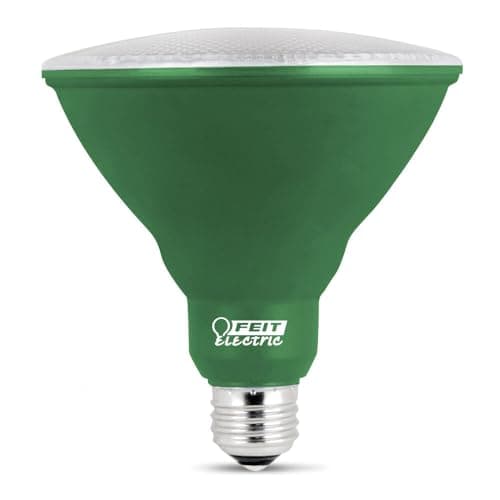 Feit Electric 16W PAR38 Grow Bulb The only bulb in Feit's grow range that publishes both a photon figure and a beam angle, which makes it the only one you can place over a plant by arithmetic instead of by guesswork. | The only wet-rated pick | Not published | |
| 2 | 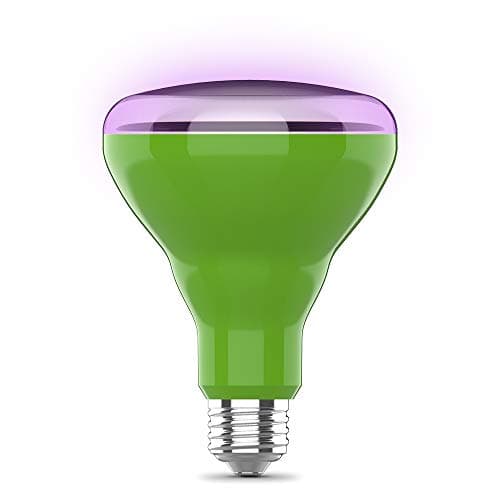 Feit Electric 9W BR30 Grow Bulb The right shape for pointing light at a plant — a reflector flood with a published 110-degree beam — and the one bulb in Feit's range whose own spec page carries no photon figure at all. | A damp-rated flood for one plant | Not published | |
| 3 | 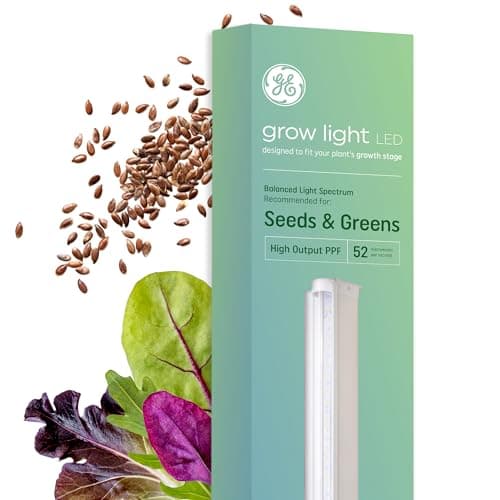 GE Grow Light 48in LED Fixture, Seeds and Greens A 4 ft shelf fixture that publishes its photon output, 52 umol/s from 30 W, so a shelf can be sized around it before it arrives rather than after. | A damp-rated shelf run | Not published |
The reasoning
We have not tested any of these fixtures. What follows is the manufacturers’ published specifications, our own arithmetic, and one specification that matters more in this room than anywhere else in the house.
A windowless bathroom is where a lot of houseplants go to die slowly, and it is also where people most want one. The humidity genuinely suits tropical foliage. The light almost never does. The fix is a grow light — but a bathroom is a damp location in the electrical sense, and that narrows the field far more sharply than any photon figure.
The specification that decides this page
Lighting products carry a location rating: dry for ordinary interior use, damp for places with humidity and condensation but no direct water, and wet for places where water may contact the fixture directly. A bathroom is at minimum a damp location, and the area in or near a shower is treated as wet.
Here is the uncomfortable finding. Of the seventeen fixtures this site covers, most never publish a location rating at all.
| Fixture | Published location rating |
|---|---|
| Feit Electric 16W PAR38 | Wet |
| Feit Electric 9W BR30 | Damp |
| Feit Electric 9W A19 | Damp |
| GE Grow 48in fixture | Damp |
| SuncoGrow 4ft fixtures | Damp |
| GE Grow BR30 and A19 bulbs | Not published |
| SANSI, Barrina, GooingTop, Soltech, the LED panels | Not published |
That is not a claim that the unrated products are unsafe. It is a statement about what the manufacturers documented. In a dry living room the distinction rarely matters. In a room that fogs up twice a day it is the first thing to check, and “the manufacturer did not say” is a reason to choose something else rather than to assume.
How much light a bathroom plant actually needs
The plants that suit a bathroom — pothos, philodendron, ferns, calathea, a ZZ plant — are low-light foliage species. Iowa State University Extension puts that group at 3 to 6 mol/m²/day, which is the lowest target on this site.
4.5 mol/m²/day over 12 hours = 4,500,000 ÷ (12 × 3600) = 104 µmol/m²/s.
Over one square foot of shelf (0.0929 m²) that needs 104 × 0.0929 ÷ 0.8 = about 12 µmol/s.
Twelve micromoles per second is one small bulb. You are not buying a panel for a bathroom, and you should be suspicious of any recommendation that sends you toward one: a high-output fixture in a small tiled room is glare, heat and wasted electricity, aimed at plants that evolved on a forest floor.
1. Feit Electric 16W PAR38 — the only wet-rated pick
Rated for wet locations and for enclosed fixtures, which is the combination you want if the plant lives near the shower or the light goes into a closed ceiling fitting. It publishes 20.0 µmol/s and a 40-degree beam angle, so unlike almost everything else here you can compute what arrives.
At 12 in it delivers about 414 µmol/m²/s — four times too much. At 24 in, about 103 µmol/m²/s, which is the target almost exactly.
So: mount it two feet above the plant, not one. That is a ceiling fitting or a high shelf, which in a bathroom is usually where the socket is anyway.
The downside: it is the least efficient bulb we cover at 1.25 µmol/J, and you are deliberately using a fraction of its output. You are paying for the rating and the optics. Feit also prints its photon figures with broken units, which we unpick in the Feit Electric review.
2. Feit Electric 9W BR30 — a damp-rated flood for one plant
Damp-rated, enclosed-fixture rated, and a reflector flood with a published 110-degree spread, which is a good match for a single plant on a shelf or a vanity a foot or two below. At 9 W it is the cheapest thing here to run, at about $0.59 a month on a 12-hour schedule.
The downside: Feit publishes no photon figure at all for this bulb — it publishes one for its A19 and its PAR38 and nothing for this one — so none of the arithmetic above can be applied to it. You are buying the rating and the shape and finding out the rest after it arrives.
3. GE Grow 48in fixture — a damp-rated shelf run
If the bathroom has a run of shelf or a windowsill ledge with several plants rather than one specimen, the bulb answer stops working and a bar starts. This one is damp-rated, publishes 52 µmol/s from 30 W, and comes with a 5 ft cord and hanging chains.
52 µmol/s ÷ 0.3716 m² × 0.8 = about 112 µmol/m²/s, or 4.8 mol/m²/day at 12 hours.
That lands inside the 3-6 band across the whole shelf, which is exactly right for this plant group — one fixture, not two.
The downside: it is a 4 ft fixture, so it only makes sense if you genuinely have a 4 ft run. In a small bathroom it will dominate the room visually, and it does not dim.
Glare, mirrors and eye level
One thing is specific to this room. Bathrooms have mirrors, and they have people standing close to fixtures at eye height, often first thing in the morning.
Photobiological safety for lamps is handled by IEC/EN 62471, which sorts sources into risk groups by exposure time and distance. The practical instruction that follows is the same as everywhere else on this site — do not look into the emitters — but a mirror makes that harder to obey by accident. Mount the fixture so the emitter is not in the mirror’s line, or behind the plant rather than in front of it. The fuller treatment is in are grow lights safe for eyes and pets.
Which plants this actually works for
A bathroom grow light does not turn the room into a greenhouse. It moves a dark corner from “nothing survives” to the low band, and that is enough for a specific group.
- Comfortable: pothos, heartleaf philodendron, ZZ plant, snake plant, ferns, calathea. All sit in the 3-6 mol/m²/day band this page targets.
- Possible with the light close: a small monstera, at the top of the band and with slower growth than it would manage in a bright room.
- Not worth attempting: succulents, cacti, herbs, citrus, anything that wants 12 mol/m²/day or more. Delivering that in a bathroom means a fixture far too bright for the room, run long enough to notice on the bill.
The pothos case is the commonest by a distance, and it has its own page with the same arithmetic worked through at plant level: grow lights for pothos.
Running cost, which is the easy part
9 W bulb: 3.24 kWh a month = $0.59.
16 W PAR38: 5.76 kWh = $1.06. 30 W fixture: 10.8 kWh = $1.98.
Under two dollars a month at the top end. Whatever makes this decision for you, it is not the electricity — it is the rating on the box.
Where the fixture goes
A bathroom gives you fewer mounting options than any other room, and the rating you just checked constrains them further.
- An existing ceiling fitting. The cleanest answer if the plant sits below it: a PAR38 in a ceiling can, two feet or more above the leaves, which the distance table above shows lands in the right band. This is also the arrangement furthest from splash.
- A shelf or vanity lamp. A small reflector bulb in a desk lamp beside the plant, aimed down. Keep the cable and the base off the counter surface that gets wet, and out of reach of the sink.
- A bar above a windowsill or a run of shelf. Only worth it for several plants, and only with a damp-rated fixture.
Two habits matter more than the choice: keep the fixture where a shower spray or a splash cannot reach it, and never position it where you would have to reach across it with wet hands. Those are not substitutes for a location rating, and a location rating is not a substitute for them.
Condensation, heat and the fixture itself
A bathroom fogs, and the fog lands on everything including the light. Two consequences are worth planning for.
The first is optical. A film of condensation on a bulb or a lens scatters light, and a fixture that has been rained on by shower steam twice a day accumulates mineral deposits as that water dries. Neither is dangerous in a damp-rated fixture, but both reduce what reaches the plant, gradually and invisibly. Wiping the lens when you clean the room is worth more than it sounds.
The second is thermal. Most of a bulb’s wattage leaves as heat — a 9 W LED emits roughly 3 W as light and the rest warms its surroundings. In a small, closed, already-humid room that is a modest but real addition, and it is one more reason not to mount a fixture tight against a plant or inside an enclosed fitting that is not rated for it. The general case is in do LED grow lights get hot.
The cheaper answer: move the plant
This site sells nothing by telling you not to buy, so it is worth saying plainly. A great many bathroom plant problems are solved by moving the plant to a bright room for a month and rotating it back, which costs nothing.
That works because the low-light species that suit a bathroom are tolerant of variation rather than dependent on constancy. A pothos that spends alternate months on a bright landing and in a windowless shower room does noticeably better than one that spends every month in the dark, and no fixture, rating or cable is involved.
A grow light earns its place when rotation is impractical — there is nowhere bright to rotate to, the plant is large or mounted, or you want the room to look furnished rather than to serve as a plant hospital. Those are good reasons. “The plant is struggling and a light seems like the fix” is a weaker one, and worth testing with a fortnight somewhere brighter before spending anything.
If the bathroom has a window
A bathroom with even a small frosted window is a different problem from a windowless one, and it is worth working out which you have before buying anything.
Frosted or reeded glass diffuses light rather than blocking it, so a frosted bathroom window still delivers usable light to a plant on the sill — often enough for a pothos or a ZZ plant on its own for most of the year. What it does not do is deliver it in winter, at northern latitudes, on a north-facing wall, which is where the fixture earns its place.
For a windowed bathroom, that argues for treating the light as seasonal: run it from October to March, on the same short-day schedule the rest of this site uses for winter supplementing, and switch it off in spring. A plug-in timer makes that a twice-yearly decision rather than a daily one, and the running cost halves.
It also argues for the cheapest pick rather than the best one. A supplement closing a seasonal gap has an easier job than a sole light source, and the 9 W bulb that would be marginal year-round is comfortable for six months alongside a window.
Every pick in full
Feit Electric 16W PAR38 Grow Bulb
Grow bulbThe only wet-rated pick
The only bulb in Feit's grow range that publishes both a photon figure and a beam angle, which makes it the only one you can place over a plant by arithmetic instead of by guesswork.
What Feit Electric publishes
- Power draw
- 16 W at 120 V; medium E26 base (source)
- PPF (photon output)
- 20.0 umol/s, printed by Feit as "20.0PAR/PPF" with no unit (source)
- Stated coverage
- 40-degree beam angle; wet-location and enclosed-fixture rated (source)
- Spectrum
- 900 lumens, 3500 K, CRI 80; stated to emit between 454 nm blue and 630 nm red, with no distribution curve published (source)
- Dimming
- No (source)
- Rated life
- 25,000 hours; 2-year warranty (source)
Our arithmetic
- Photon efficacy, computed from the published figures: 1.25 umol/J
20.0 umol/s / 16 W = 1.25 umol/J. Feit publishes no efficacy figure, so this one is ours. Only the SuncoGrow 40 W at 1.21 umol/J is lower on this site; the LED boards run 2.3 to 2.75. - Average PPFD inside its 40-degree beam, by distance: about 414 at 12 in, 184 at 18 in, 103 at 24 in (umol/m2/s)
A 40-degree beam spreads to a radius of distance x tan(20 degrees) = distance x 0.364. At 12 in that is a 0.416 sq ft circle = 0.0387 m2, so 20.0 umol/s / 0.0387 m2 = 517 umol/m2/s, and a 0.8 uniformity factor gives about 414. At 18 in: 0.936 sq ft = 0.0870 m2, 230 before uniformity, about 184 after. At 24 in: 1.665 sq ft = 0.1547 m2, 129 before, about 103 after. This assumes every photon falls inside the stated cone, so treat each figure as the top of the range. - Daily light integral at 18 in, run 16 hours: about 10.6 mol/m2/day
184 umol/m2/s x 16 h x 3600 / 1,000,000 = 10.6 mol/m2/day, a little under the roughly 12 mol/m2/day the University of New Hampshire Extension gives for seedlings. Moving the bulb to 12 in clears it easily. - Electricity at 16 hours a day for 30 days: $1.41 a month
16 W x 16 h x 30 d / 1000 = 7.68 kWh. 7.68 x 18.34 cents = $1.41.
What Feit Electric does not publish
- PPFD at any stated distance
- Photon efficacy in umol/J
- A spectral distribution — two peak wavelengths are named, no curve
- The unit on its own photon figure
Who should skip it
Skip it if photons per watt matter. 20 umol/s from 16 W works out to 1.25 umol/J, the second-lowest figure on this site, so you are paying for the placement data on the meter.
Feit Electric 9W BR30 Grow Bulb
Grow bulbA damp-rated flood for one plant
The right shape for pointing light at a plant — a reflector flood with a published 110-degree beam — and the one bulb in Feit's range whose own spec page carries no photon figure at all.
What Feit Electric publishes
- Power draw
- 9 W at 120 V; medium E26 base (source)
- Stated coverage
- 110-degree beam angle; damp-location and enclosed-fixture rated (source)
- Spectrum
- 680 lumens, 3300 K, CRI 80; stated to emit more light at 449 nm blue and 630 nm red than a white LED, with no distribution curve published (source)
- Dimming
- No (source)
- Rated life
- 25,000 hours; 2-year warranty (source)
Our arithmetic
- Electricity at 16 hours a day for 30 days: $0.79 a month
9 W x 16 h x 30 d / 1000 = 4.32 kWh. 4.32 x 18.34 cents = $0.79. Wattage is the only published figure on this bulb that supports any arithmetic at all.
What Feit Electric does not publish
- PPF in umol/s — published for the A19 and the PAR38 in the same range, but absent from this bulb's specification page
- PPFD at any stated distance
- Photon efficacy in umol/J
- A spectral distribution — two peak wavelengths are named, no curve
Who should skip it
Skip it if you want to know the output before it arrives. Feit publishes a photon figure for its A19 and its PAR38 and none for this bulb, so nothing about its light can be verified in advance.
GE Grow Light 48in LED Fixture, Seeds and Greens
LED barA damp-rated shelf run
A 4 ft shelf fixture that publishes its photon output, 52 umol/s from 30 W, so a shelf can be sized around it before it arrives rather than after.
What GE Lighting publishes
- Power draw
- 30 W at 120 V AC (source)
- PPF (photon output)
- 52 umol/s (source)
- Spectrum
- 2000 lumens, CRI 90; no color temperature or spectral distribution published (source)
- Dimming
- No; damp humidity rating, not rated for outdoor use (source)
- Dimensions
- 48.2 x 2.8 x 2.4 in; 5 ft cord, 8 in mounting chains (source)
Our arithmetic
- Photon efficacy, computed from the published figures: 1.73 umol/J
52 umol/s / 30 W = 1.73 umol/J. GE publishes no efficacy figure, so this one is ours. It sits mid-table on this site: above the Soltech Aspect at 1.39 umol/J, below the LED boards at 2.3 to 2.75. - Average PPFD from one fixture over a 4 x 1 ft run of shelf: about 112 umol/m2/s
4 sq ft / 10.7639 = 0.3716 m2. 52 umol/s / 0.3716 m2 = 139.9 umol/m2/s at perfect uniformity; a 0.8 uniformity factor gives about 112 umol/m2/s. That is the low band, 50 to 150 umol/m2/s, on the University of Minnesota Extension's scale. - Daily light integral from one fixture: 6.4 mol/m2/day at 16 hours; 7.3 at GE's recommended 18
112 umol/m2/s x 16 h x 3600 / 1,000,000 = 6.4 mol/m2/day. At 18 hours, 7.3. Both are short of the roughly 12 mol/m2/day the University of New Hampshire Extension gives for seedlings. - Two fixtures over the same 4 x 1 ft run: about 224 umol/m2/s, or 12.9 mol/m2/day at 16 hours
104 umol/s / 0.3716 m2 x 0.8 = 223.9 umol/m2/s. 223.9 x 16 h x 3600 / 1,000,000 = 12.9 mol/m2/day, which clears the seedling target without needing GE's 18 hours. - Electricity at 16 hours a day for 30 days: $2.64 a month
30 W x 16 h x 30 d / 1000 = 14.4 kWh. 14.4 x 18.34 cents = $2.64. At GE's 18 hours: 16.2 kWh = $2.97.
What GE Lighting does not publish
- PPFD at any stated distance
- Beam angle
- Color temperature and spectral distribution
- Photon efficacy in umol/J — PPF and wattage are given, so efficacy has to be derived
Who should skip it
Skip it if you want one fixture to carry a seed tray. A single unit averages about 112 umol/m2/s over a 4 x 1 ft run, which is the low band, and it does not dim.
Questions people actually ask
+Can you use a grow light in a bathroom?
+How much light does a bathroom plant need?
+Is a damp rating the same as a wet rating?
+Will a grow light let me keep any plant in a windowless bathroom?
Sources
- Iowa State University Extension — Important Considerations for Providing Supplemental Light to Indoor Plants — consulted September 2, 2026
- University of Minnesota Extension — Lighting for indoor plants and starting seeds — consulted September 2, 2026
- Feit Electric — 16W PAR38 E26 Base LED Plant Grow Light Bulb, PAR38/GROW/LED/BX (specifications) — consulted September 19, 2026
- Feit Electric — BR30 LED Plant Grow Light Bulb, BR30/GROW/LEDG2/BX (specifications) — consulted September 19, 2026
- GE Lighting shop — 48in Seeds and Greens integrated fixture (PPF, dimensions, cord, humidity rating) — consulted September 17, 2026
- ams OSRAM — Details on photobiological safety of LED light sources (IEC/EN 62471 risk groups) — consulted September 2, 2026
- US Energy Information Administration — Electric Power Monthly, Table 5.3 (US residential average, June 2026) — consulted September 2, 2026
Read next

Houseplants
Grow Lights for Pothos
When a pothos needs a fixture, the lamp distance that hits the low band, and the variegation exception.
Top pick
SANSI 36W BR30 Grow Light Bulb
Reviews
The Best Grow Light Bulbs
Screw-in fixtures for single plants, what the form factor costs, and how to place one.
Top pick
SANSI 36W BR30 Grow Light Bulb
Houseplants
What Plants Benefit From Grow Lights?
Plants ranked by how much a fixture actually changes the outcome, not by their light band.
Top pick
Barrina T5 4ft Grow Light Strips

Spectrum & PPFD
Are Grow Lights Safe for Eyes and Pets?
What IEC 62471 risk groups mean, the one real hazard, and sensible home precautions.
Where this sits
This page belongs to Fixture Reviews and Roundups. Every figure on it is either quoted from a named published source or derived in view — the full method is on our methodology page, and how the site is funded is on the affiliate disclosure.