Best Grow Lights Under $50
Fifty dollars is a real budget in this category, and it buys a specific thing: one or two plants lit properly, not a shelf. Here is how far the money actually goes.
By Scooter M. — An enthusiast who's genuinely into this. I read the manuals, compile the published specs, and do the math. No lab coat.
Published · How we pick
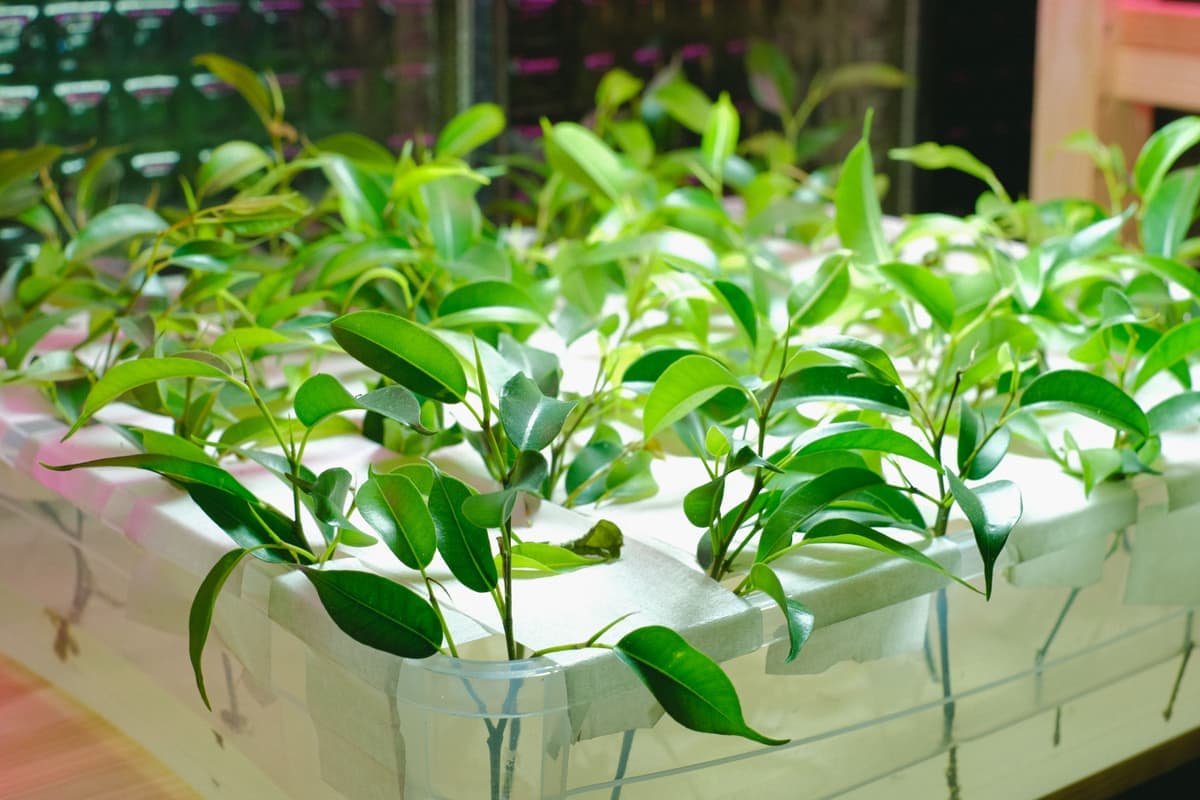
Photographs on this site are licensed stock and are illustrative of the fixture type. We do not own the units we write about.
How this page is funded: the buy links here are Amazon Associates links, and we earn a commission on qualifying purchases at no extra cost to you. We have not been paid to feature anything on this page, we accept no free product, and commission plays no part in the ranking. Full disclosure.
We have not tested these units. Everything below comes from the manufacturer’s own published specifications, or from arithmetic we have shown our working for. Where a figure is not published, we say so instead of estimating one. Read the method.
Quick picks
Efficacy is photons out per joule in. Where a manufacturer publishes it we quote theirs; where they publish photon output and wattage but not efficacy, we divide and label it as ours; where they publish neither, the cell says so rather than guessing. Tap a row for the full write-up.
| # | Product | Best for | Efficacy | Price |
|---|---|---|---|---|
| 1 | 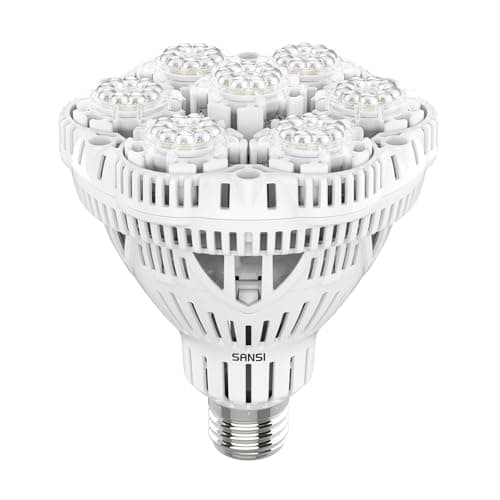 SANSI 36W BR30 Grow Light Bulb The rare grow bulb that publishes both PPF and a PPFD figure with the measurement distance attached, which is the only reason it can be sized honestly. | The most photons in the bracket | 1.82 umol/J (ours) | |
| 2 | 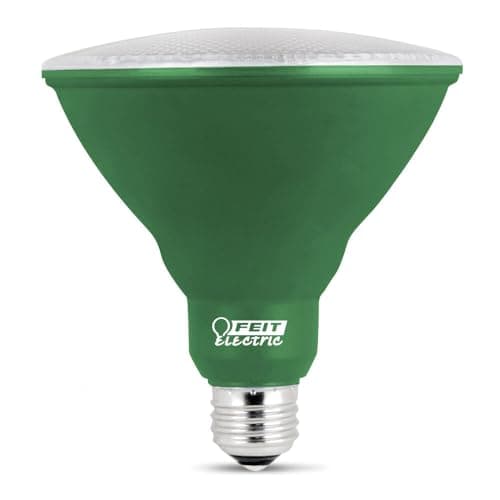 Feit Electric 16W PAR38 Grow Bulb The only bulb in Feit's grow range that publishes both a photon figure and a beam angle, which makes it the only one you can place over a plant by arithmetic instead of by guesswork. | The one you can aim | Not published | |
| 3 | 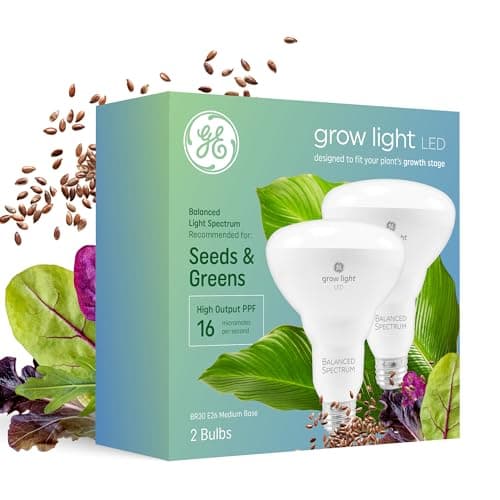 GE Grow Light BR30 Bulb, Seeds and Greens (2-pack) A mainstream-brand grow bulb that prints its photon output on the box: 16 umol/s from 9 W, which is enough for one low- or medium-light plant under a lamp you already own, and not much more. | Two plants at once | Not published | |
| 4 | 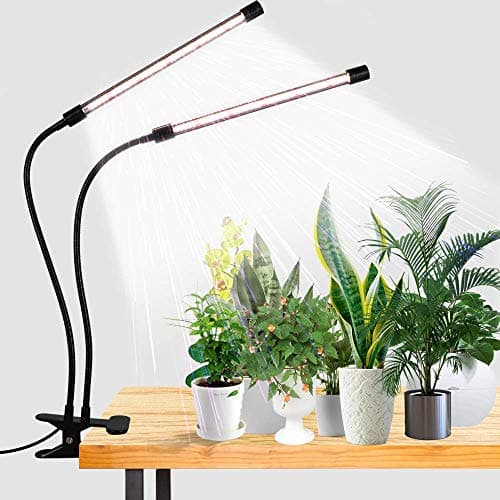 GooingTop Clip Grow Light The cheapest way to put real light on one plant on one desk, and honest about being exactly that — a 10 W clip lamp with a repeating timer. | A desk, with a timer built in | Not published | |
| 5 | 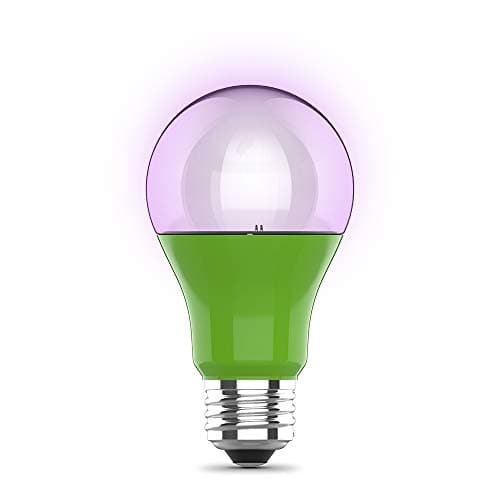 Feit Electric 9W A19 Grow Bulb A cheap household-shape grow bulb with a published photon figure, once you correct the unit Feit prints beside it. | The lowest price with a real number | Not published |
The reasoning
We have not tested any of these. We own none of them and have measured none of them. Everything below is the manufacturer’s published specification with our own arithmetic on top, and the arithmetic is shown so you can check it.
Prices move, so this page does not argue from a number in the prose. The buy rows carry live prices pulled from Amazon with the date attached. Every pick was comfortably inside the bracket when this page was written; if one has drifted above it, the live price will say so before you click.
How we judged, before we ranked
Four things decide this bracket, and only one of them is price.
- Does it publish a photon figure? PPF in µmol/s is the only number that tells you how much light a fixture makes. Most cheap grow lights publish lumens instead, which are weighted for human eyes and cannot be converted. Under $50 a published PPF is the exception, so it is the first filter.
- Does the shape match the job? A reflector bulb pushes light down at one plant. A bare bulb sprays it everywhere. A clip lamp reaches over a desk. Shape decides how much of the output lands on leaves, and at this budget you cannot afford to waste much.
- What does it cost to run? A cheap, inefficient bulb can spend its own purchase price on electricity inside a year. We price every pick at the US residential average.
- Can you buy it now? Everything here was in stock and price-checked against Amazon’s live catalog when this page was written.
The honest ceiling on $50
Before the picks, the limit. Under $50 you are buying bulbs. You are not buying a bar or a panel: the cheapest 4 ft fixtures we cover sit above this bracket, and LED boards are several times it. That matters because a bulb lights one plant well and a tray badly.
A standard 10 × 20 in tray is 1.39 sq ft = 0.129 m². Seedlings want about 12 mol/m²/day (University of New Hampshire Extension). At 16 hours that is 12,000,000 ÷ (16 × 3600) = 208 µmol/m²/s.
Delivering that over the tray needs 208 × 0.129 ÷ 0.8 = about 34 µmol/s landing on the tray — and a bulb sprays a cone, so most of what it emits misses. The best bulb here emits 65.6 µmol/s in every direction at once.
So: one plant, or two small ones, is what this money lights properly. If a tray of seedlings is the job, the honest advice is to save for a 4 ft bar rather than buy three bulbs — the argument is laid out in best grow light bars, and the cheapest sensible seed-starting setups are in best budget grow lights for seed starting.
1. SANSI 36W BR30 — the most photons in the bracket
65.6 µmol/s published, and a PPFD of 265.58 µmol/m²/s at a stated one foot. That second figure is rarer than it sounds: a PPFD without a measurement distance is meaningless, and SANSI is one of the few brands at any price that attaches one. It means you can place this bulb by arithmetic instead of guesswork.
At 36 W it works out to 1.82 µmol/J, which is the best efficiency in this bracket and mid-table across the whole site. 265 µmol/m²/s at a foot is the high band on the University of Minnesota Extension’s scale — enough for a herb pot, a young tomato plant or a monstera.
The downside: it is the most expensive pick here and it draws four times the wattage of the 9 W bulbs, so it is also the most expensive to run. It lights one plant. Buying two of them takes you out of the bracket entirely.
2. Feit Electric 16W PAR38 — the one you can aim
20.0 µmol/s and, unusually, a published 40-degree beam angle. A photon figure plus a beam angle is enough to compute intensity at a distance, which almost nothing else at this price allows.
A 40° beam spreads to a radius of distance × tan(20°) = distance × 0.364.
At 12 in: about 414 µmol/m²/s. At 18 in: about 184. At 24 in: about 103.
That is a genuinely useful ladder: 12 inches for a herb or a seedling, 18 for a monstera, 24 for a low-light foliage plant. It is also rated for wet locations, which no other pick here publishes — relevant if the plant lives in a kitchen or a bathroom.
The downside: efficiency. 20 µmol/s from 16 W is 1.25 µmol/J, second-lowest of anything on this site. You are paying for the optics and the rating, not for photons per watt. Feit also prints that photon figure with no unit at all, and prints its A19’s as “mol/s” — a factor-of-a-million error we unpick in the Feit Electric review.
3. GE Grow BR30, two-pack — two plants at once
16 µmol/s per bulb from 9 W, CRI 90, and two bulbs in the box. That is 1.78 µmol/J, better than every other pick here except the SANSI, and the reflector shape sends the output forward instead of at the ceiling.
Two plants lit for the price of one bulb elsewhere is the argument, and for low- and medium-light foliage — pothos, philodendron, a small calathea — 16 µmol/s aimed down from a foot is the right order of magnitude rather than overkill.
The downside: GE publishes no beam angle, so unlike the Feit PAR38 you cannot compute what lands where; the best you get is a ceiling of 172 µmol/m²/s if every photon hit one square foot, which no bulb manages. GE also publishes no location rating for its bulbs. Details in the GE grow lights review.
4. GooingTop clip light — a desk, with a timer built in
The cheapest way to put real light on one plant on one desk. It clips to a shelf edge, bends where you point it, has five brightness levels and a repeating 4/8/12-hour timer built into the cable — which means no separate plug-in timer, and no forgetting.
For a single plant that has to live somewhere dark, the combination of a gooseneck and a built-in schedule is worth more in practice than a slightly better spec sheet you then have to remember to switch on.
The downside: nobody publishes photon data for this fixture — no PPF, no PPFD, no efficacy. You are buying on form factor and price, and you will find out what you got after it arrives. It also lights about a foot of bench and no more.
5. Feit Electric 9W A19 — the lowest price with a real number
The cheapest pick here that publishes any photon figure at all: 14.2 µmol/s from 9 W, or 1.58 µmol/J once the unit is corrected. For a single small plant in a lamp you already own, it does the job for the price of a sandwich.
The downside: the A19 is the ordinary household bulb shape, so it throws light in every direction and Feit publishes no beam angle. In an open socket a good share of those 14.2 µmol/s lights the ceiling. If your lamp takes a reflector bulb, pick 3 puts more of its output on the plant.
The five, side by side
| Pick | Power | PPF (µmol/s) | Efficacy (µmol/J) | Placeable? |
|---|---|---|---|---|
| SANSI 36W BR30 | 36 W | 65.6 | 1.82 | Yes — PPFD at a stated 1 ft |
| Feit PAR38 16W | 16 W | 20.0 | 1.25 | Yes — 40° beam published |
| GE Grow BR30 | 9 W each | 16 | 1.78 | No beam angle |
| GooingTop clip | About 10 W | Not published | Cannot compute | No |
| Feit A19 9W | 9 W | 14.2 | 1.58 | No beam angle |
What they cost to run
9 W bulb: 9 × 12 × 30 ÷ 1000 = 3.24 kWh = $0.59 a month.
16 W PAR38: 5.76 kWh = $1.06. 36 W SANSI: 12.96 kWh = $2.38.
Over a 25,000-hour rated life the 9 W bulb burns 225 kWh, or about $41 — several times its purchase price.
That last line is the real argument for caring about efficiency on a cheap bulb. The sticker is the small number in the transaction; the meter is the large one. Two bulbs of equal wattage cost the same to run, so the one emitting more photons is giving them to you free. The whole field is ranked in most efficient grow lights by µmol/J.
Which one to buy
- One plant that wants real light — a herb pot, a fiddle leaf fig, a young tomato: the SANSI, placed by its published one-foot figure.
- One plant you need to place precisely, or a plant in a damp room: the Feit PAR38, using the distance ladder above.
- Two ordinary houseplants: the GE two-pack.
- A desk plant and no patience for timers: the GooingTop.
- The lowest possible spend: the Feit A19.
- A tray of seedlings: none of these. Save for a bar.
Two cheap bulbs, or one better one?
This is the question the bracket actually poses, and the arithmetic answers it cleanly. Two 9 W bulbs publishing 16 µmol/s each give you 32 µmol/s for roughly the price of one 36 W bulb publishing 65.6 µmol/s.
Two GE BR30: 32 µmol/s total, 18 W, 1.78 µmol/J.
One SANSI 36W: 65.6 µmol/s, 36 W, 1.82 µmol/J — more than twice the photons for twice the power, at fractionally better efficiency.
So the pair is not cheaper per photon; it is simply divisible. Buy two bulbs when you have two plants in two places, because light delivered to the wrong room is worth nothing. Buy the single larger bulb when one plant needs real intensity, because concentrating 65.6 µmol/s on one canopy beats splitting 32 across two.
What does not work is buying two cheap bulbs to light one plant better. Two bulbs a foot apart over a single canopy produce overlapping cones, uneven intensity and twice the clutter for less light than one properly sized bulb directly above.
What the next $50 buys, and when to wait for it
It is worth knowing exactly what you are giving up by staying inside this bracket, because for some jobs the honest advice is to wait two weeks and double the budget.
| Fixture class | Typical output | Efficacy | What it lights |
|---|---|---|---|
| Grow bulb, under $50 | 14 to 65.6 µmol/s | 1.25 to 1.82 µmol/J | One plant |
| 4 ft bar, just above $50 | 48 to 52 µmol/s | 1.21 to 1.73 µmol/J | A 4 ft shelf, evenly |
| LED board or panel | 249 to 343 µmol/s | 2.3 to 2.75 µmol/J | A 2 ft square, intensely |
Notice that a 4 ft bar does not emit dramatically more than a good bulb. What it does is spread a similar number of photons along four feet instead of concentrating them in a cone, which is exactly what a shelf or a tray needs and exactly what a bulb cannot do. And the panels are a different category again: two to three times the photons and roughly 50% better efficiency, which is where the money goes when a budget stops being a constraint.
The practical rule: if the job is one plant, this bracket is not a compromise and spending more buys you very little. If the job is a shelf, a tray or a rack, everything in this bracket is the wrong shape at any price, and the shelf and rack guide is the page you want instead.
How to check you got it right
None of these fixtures comes with a way to verify what is landing on the plant, and a PAR meter costs more than every pick on this page combined. Two things are worth knowing.
A phone light meter app reports lux, not PPFD, and the conversion between them depends entirely on the spectrum of the source — which is why this site never publishes a lux-to-PPFD factor. What a phone app is good for is relative measurement: hold it at the leaf, note the number, move the fixture, note it again. Doubling the reading means roughly doubling the light, whatever the absolute value is.
The more reliable instrument is the plant, which reports within a couple of weeks: new growth closer-spaced than old growth means the light is working, and new leaves smaller than old ones means it is not. The full method is in how to measure PPFD without a meter.
Every pick in full
SANSI 36W BR30 Grow Light Bulb
Grow bulbThe most photons in the bracket
The rare grow bulb that publishes both PPF and a PPFD figure with the measurement distance attached, which is the only reason it can be sized honestly.
What SANSI publishes
- Power draw
- 36 W (source)
- PPF (photon output)
- 65.6 umol/s (source)
- PPFD
- 265.58 umol/m2/s at 1 ft (source)
- Spectrum
- 4000 K, 400-780 nm, CRI close to 100 (source)
- Rated life
- 25,000 hours (source)
Our arithmetic
- Efficacy, computed from the published figures: 1.82 umol/J
65.6 umol/s / 36 W = 1.82 umol/J. That is roughly a third less efficient than the panels on this page — the price of a screw-in form factor. - Electricity used at 12 hours a day for 30 days: 12.96 kWh a month
36 W x 12 h x 30 d / 1000 = 12.96 kWh.
What SANSI does not publish
- Beam angle
- Fixture dimensions
Who should skip it
Skip it if you are lighting more than one plant. 65.6 umol/s is a small amount of light spread over a cone — it lights a single specimen, not a shelf.
Feit Electric 16W PAR38 Grow Bulb
Grow bulbThe one you can aim
The only bulb in Feit's grow range that publishes both a photon figure and a beam angle, which makes it the only one you can place over a plant by arithmetic instead of by guesswork.
What Feit Electric publishes
- Power draw
- 16 W at 120 V; medium E26 base (source)
- PPF (photon output)
- 20.0 umol/s, printed by Feit as "20.0PAR/PPF" with no unit (source)
- Stated coverage
- 40-degree beam angle; wet-location and enclosed-fixture rated (source)
- Spectrum
- 900 lumens, 3500 K, CRI 80; stated to emit between 454 nm blue and 630 nm red, with no distribution curve published (source)
- Dimming
- No (source)
- Rated life
- 25,000 hours; 2-year warranty (source)
Our arithmetic
- Photon efficacy, computed from the published figures: 1.25 umol/J
20.0 umol/s / 16 W = 1.25 umol/J. Feit publishes no efficacy figure, so this one is ours. Only the SuncoGrow 40 W at 1.21 umol/J is lower on this site; the LED boards run 2.3 to 2.75. - Average PPFD inside its 40-degree beam, by distance: about 414 at 12 in, 184 at 18 in, 103 at 24 in (umol/m2/s)
A 40-degree beam spreads to a radius of distance x tan(20 degrees) = distance x 0.364. At 12 in that is a 0.416 sq ft circle = 0.0387 m2, so 20.0 umol/s / 0.0387 m2 = 517 umol/m2/s, and a 0.8 uniformity factor gives about 414. At 18 in: 0.936 sq ft = 0.0870 m2, 230 before uniformity, about 184 after. At 24 in: 1.665 sq ft = 0.1547 m2, 129 before, about 103 after. This assumes every photon falls inside the stated cone, so treat each figure as the top of the range. - Daily light integral at 18 in, run 16 hours: about 10.6 mol/m2/day
184 umol/m2/s x 16 h x 3600 / 1,000,000 = 10.6 mol/m2/day, a little under the roughly 12 mol/m2/day the University of New Hampshire Extension gives for seedlings. Moving the bulb to 12 in clears it easily. - Electricity at 16 hours a day for 30 days: $1.41 a month
16 W x 16 h x 30 d / 1000 = 7.68 kWh. 7.68 x 18.34 cents = $1.41.
What Feit Electric does not publish
- PPFD at any stated distance
- Photon efficacy in umol/J
- A spectral distribution — two peak wavelengths are named, no curve
- The unit on its own photon figure
Who should skip it
Skip it if photons per watt matter. 20 umol/s from 16 W works out to 1.25 umol/J, the second-lowest figure on this site, so you are paying for the placement data on the meter.
GE Grow Light BR30 Bulb, Seeds and Greens (2-pack)
Grow bulbTwo plants at once
A mainstream-brand grow bulb that prints its photon output on the box: 16 umol/s from 9 W, which is enough for one low- or medium-light plant under a lamp you already own, and not much more.
What GE Lighting publishes
- Power draw
- 9 W per bulb at 120 V; medium E26 base (source)
- PPF (photon output)
- 16 umol/s per bulb (source)
- Spectrum
- 500 lumens, CRI 90; described as full spectrum with blue and red, no spectral distribution published (source)
- Dimming
- No (source)
- Rated life
- Up to 25,000 hours; 3-year warranty (source)
Our arithmetic
- Photon efficacy, computed from the published figures: 1.78 umol/J
16 umol/s / 9 W = 1.78 umol/J. Ours, not GE's. Just below the SANSI 36W BR30 at 1.82 umol/J, which puts it with the better grow bulbs on this site. - The ceiling over one square foot: at most 172 umol/m2/s
1 sq ft = 0.0929 m2. 16 umol/s / 0.0929 m2 = 172 umol/m2/s. That average holds only if every photon the bulb emits lands inside that square foot, so the real figure is lower. GE publishes no beam angle, so the actual spread cannot be computed. - The daily light ceiling at GE's recommended 18 hours: at most 11.2 mol/m2/day
172 umol/m2/s x 18 h x 3600 / 1,000,000 = 11.2 mol/m2/day. Under an assumption that flatters the bulb, that is still short of the roughly 12 mol/m2/day the University of New Hampshire Extension gives for seedlings. - Electricity at 16 hours a day for 30 days: $0.79 a month per bulb
9 W x 16 h x 30 d / 1000 = 4.32 kWh. 4.32 x 18.34 cents = $0.79. At GE's 18 hours: 4.86 kWh = $0.89.
What GE Lighting does not publish
- PPFD at any stated distance
- Beam angle
- Color temperature and spectral distribution
- Photon efficacy in umol/J
Who should skip it
Skip it for a seed tray or a plant that wants bright light. Even if every photon it emits landed inside one square foot, which no bulb manages, the average would top out around 172 umol/m2/s.
GooingTop Clip Grow Light
Clip lightA desk, with a timer built in
The cheapest way to put real light on one plant on one desk, and honest about being exactly that — a 10 W clip lamp with a repeating timer.
What GooingTop publishes
- Power draw
- About 10 W (source)
- Spectrum
- 6000 K, 74 white plus 10 red LEDs, CRI 95 (source)
- Dimming
- Five brightness levels; repeating 4 / 8 / 12 hour timer (source)
What GooingTop does not publish
- PPF in umol/s
- PPFD at any distance
- Photon efficacy in umol/J
- The manufacturer publishes no spec sheet at all; the figures above come from the retail listing
Who should skip it
Skip it if the plant is more than about a foot across, or if you want any number at all before you buy — nobody publishes photon data for this fixture.
Feit Electric 9W A19 Grow Bulb
Grow bulbThe lowest price with a real number
A cheap household-shape grow bulb with a published photon figure, once you correct the unit Feit prints beside it.
What Feit Electric publishes
- Power draw
- 9 W at 120 V; medium E26 base (source)
- PPF (photon output)
- 14.2 umol/s, printed by Feit as "14.2 mol/s" (source)
- Spectrum
- 680 lumens, 3300 K, CRI 80; stated to emit between 449 nm blue and 630 nm red, with no distribution curve published (source)
- Dimming
- No; damp-location rated (source)
- Rated life
- 25,000 hours; 2-year warranty (source)
Our arithmetic
- Which unit the published figure must actually be: micromoles per second, not moles
Feit's own page prints 14.2 mol/s. Photons between 449 and 630 nm carry roughly 190 to 266 kJ per mole, so 14.2 mol/s would be 2.7 to 3.8 megawatts of radiant power out of a 9 W bulb. Read as 14.2 umol/s it is about 3 W of light from 9 W of electricity, which is what an LED of this type should produce. The figure is usable; the unit beside it is not. - Photon efficacy, computed from the corrected figure: 1.58 umol/J
14.2 umol/s / 9 W = 1.58 umol/J. Below the GE Grow A19 at 1.78 umol/J, which draws the same 9 W. - The ceiling over one square foot: at most 153 umol/m2/s
1 sq ft = 0.0929 m2. 14.2 umol/s / 0.0929 m2 = 153 umol/m2/s, and only if every photon lands inside that square foot, which no bare bulb manages. With no published beam angle, the real spread cannot be computed. - Electricity at 16 hours a day for 30 days: $0.79 a month
9 W x 16 h x 30 d / 1000 = 4.32 kWh. 4.32 x 18.34 cents = $0.79.
What Feit Electric does not publish
- PPFD at any stated distance
- Beam angle
- Photon efficacy in umol/J
- A spectral distribution — two peak wavelengths are named, no curve
Who should skip it
Skip it if the lamp will take a reflector bulb. An A19 throws light in every direction, and Feit publishes no beam angle for this one, so where its 14.2 umol/s lands cannot be computed.
Questions people actually ask
+Can you get a decent grow light for under $50?
+What is the best cheap grow light bulb?
+Are cheap grow lights worth it?
+How much does a cheap grow light cost to run?
Sources
- SANSI — BR30 36W grow light bulb product page — consulted September 2, 2026
- Feit Electric — 16W PAR38 E26 Base LED Plant Grow Light Bulb, PAR38/GROW/LED/BX (specifications) — consulted September 19, 2026
- Feit Electric — 9 W LED Grow Light Bulb, A19/GROW/LEDG2/BX (specifications) — consulted September 19, 2026
- GE Lighting — GE Grow Light BR30 LED bulb for Seeds and Greens, 16 PPF (specifications) — consulted September 17, 2026
- GooingTop clip grow light — retail listing specifications (no manufacturer spec sheet published) — consulted September 2, 2026
- University of Minnesota Extension — Lighting for indoor plants and starting seeds — consulted September 2, 2026
- University of New Hampshire Extension — Growing Seedlings Under Lights — consulted September 2, 2026
- US Energy Information Administration — Electric Power Monthly, Table 5.3 (US residential average, June 2026) — consulted September 2, 2026
Read next
Reviews
The Best Grow Light Bulbs
Screw-in fixtures for single plants, what the form factor costs, and how to place one.
Top pick
SANSI 36W BR30 Grow Light Bulb
Seed Starting
Best Budget Grow Lights for Seed Starting
Cheap to buy and cheap to run are different things. We separate them with efficacy figures and an eight-week cost.
Top pick
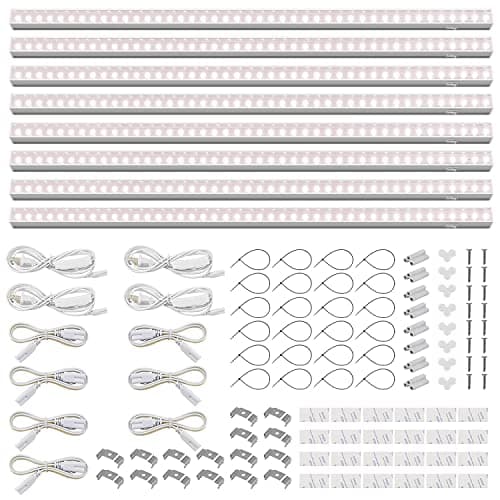
Barrina T5 4ft Grow Light Strips
Reviews
The Best Grow Lights
The main ranking: nine fixtures sorted on published data, with every gap named.
Top pick
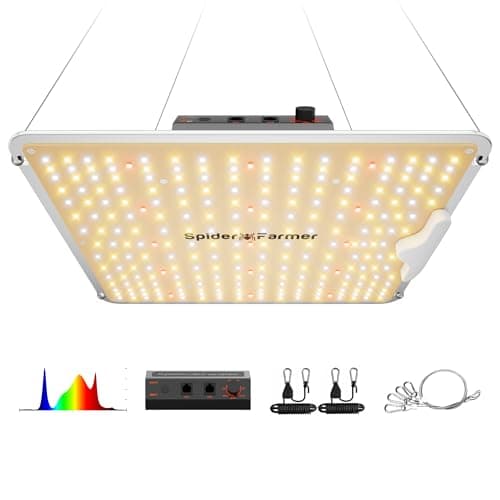
Spider Farmer SF1000
Running Cost
The Most Efficient Grow Lights by µmol/J
Every fixture we cover ranked on published photon efficacy, with derivations shown.
Where this sits
This page belongs to Fixture Reviews and Roundups. Every figure on it is either quoted from a named published source or derived in view — the full method is on our methodology page, and how the site is funded is on the affiliate disclosure.