How to Measure PPFD Without a Meter
You mostly cannot, and the apps that claim otherwise are measuring something else. Here is what actually works instead.
By Scooter M. — An enthusiast who's genuinely into this. I read the manuals, compile the published specs, and do the math. No lab coat.
Published · How we pick
The reasoning
This page has no product picks on it. It is a methodology page, and the honest conclusion is partly “you cannot do this properly without buying an instrument” — which is not a conclusion that should come with a buy button attached to something else.
Why the phone app answer is wrong
A phone’s ambient light sensor measures illuminance in lux. Lux is weighted by the photopic response curve — the sensitivity of human vision — which peaks in green around 555 nm. Plants are least responsive in green and most responsive in blue and red, so the weighting is close to the inverse of what you want.
Converting lux to PPFD requires a factor that depends on the spectrum of the specific light you are measuring. There is no universal constant. An app that offers a single conversion is applying a factor derived from some other light source to yours, with an error it cannot report because it does not know your spectrum.
The ratio depends on the spectral power distribution of the source being measured. Any single multiplier is an approximation to an unknown light, with unstated error.
Phone sensors carry a second problem on top of that: they are not calibrated instruments, they vary between handsets, and they sit behind cover glass and are subject to whatever automatic processing the manufacturer applies. Even the lux figure should be treated as indicative.
What actually works: compute it
If your fixture publishes PPF, you do not need to measure anything. Divide by your area and apply a uniformity factor, and you have a defensible estimate of the average — which is the same number a single-point meter reading would fail to give you anyway, since one reading is one point.
The coverage calculator does this and shows every step. It is the approach this entire site is built on, precisely because it needs no instrument and can be checked by anyone.
What works second: extrapolate published PPFD figures
If a manufacturer publishes PPFD at a stated distance, you can move it to another distance with the inverse-square relationship. Soltech publishes 34.9 µmol/m²/s at 4 ft and 15.5 at 6 ft for the Aspect Gen 2, and those two figures agree with the rule to within rounding — which gives reasonable confidence in extrapolating to a height they did not publish.
SANSI publishes 265.58 µmol/m²/s at 1 ft for the BR30.
At 2 ft: 265.58 × (1 ÷ 2)² = 66.4.
At 18 in (1.5 ft): 265.58 × (1 ÷ 1.5)² = 118.
Both results are estimates from a published measurement, which is a considerably stronger footing than a lux reading multiplied by a constant somebody guessed.
What works third: read the plants
Not a measurement, but genuinely diagnostic, and free. Extension guidance on indoor plant lighting uses shadow sharpness as a rough proxy for light level, and plants themselves report on their own conditions with a lag of days to weeks:
- Stretching, long internodes, leaning: not enough light. Reliable and fast on seedlings.
- Small, pale new leaves: not enough light, on an established plant.
- Compact growth, good color, steady new leaves: adequate.
- Bleached patches directly under the fixture: too much, or too close.
- Soil drying much faster in the center than at the edges: a strong uniformity signal, and easy to miss.
If you want to actually measure it
You need a quantum sensor — an instrument with a detector shaped to the 400 to 700 nm PAR band rather than to human vision. They are real scientific instruments and they are priced accordingly, which for most home growers puts them well past the cost of the light they would be measuring.
Our position is that for a home shelf, the arithmetic is enough. We have built this whole site on computed figures and published specifications for exactly that reason — and we say plainly on every page that we have measured nothing ourselves.
Questions people actually ask
+Can I use a phone app to measure PPFD?
+How do I convert lux to PPFD?
+Do I need a PAR meter to grow plants indoors?
+How can I tell if my plants have enough light without measuring?
Sources
- University of Minnesota Extension — Lighting for indoor plants and starting seeds — consulted September 2, 2026
- Soltech — Aspect Gen 2 published specifications — consulted September 2, 2026
- SANSI — BR30 36W grow light bulb product page — consulted September 2, 2026
- Virginia Cooperative Extension — Calculating and Using Daily Light Integral (DLI), SPES-720 — consulted September 2, 2026
- Iowa State University Extension — Important Considerations for Providing Supplemental Light to Indoor Plants — consulted September 2, 2026
Read next
Coverage & Sizing
Grow Light Coverage Calculator
Put in PPF, area and hours; get PPFD and DLI scored against published extension bands.
Top pick
Mars Hydro TS 1000
Spectrum & PPFD
PAR, PPFD and DLI, Explained
The three photon units, what each measures, and the conversions between them, shown.
Top pick
Spider Farmer SF1000
Coverage & Sizing
PPFD Targets by Plant Type
Published light bands mapped to common indoor plants, with the DLI each implies.
Top pick
GooingTop Clip Grow Light
Coverage & Sizing
How Far Should a Grow Light Be From Plants?
The inverse-square rule, published PPFD-at-distance figures, and a by-plant table.
Top pick
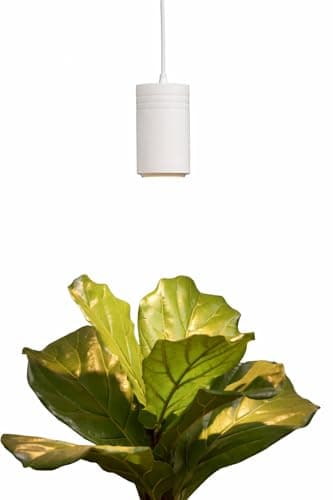
Soltech Aspect Gen 2
Where this sits
This page belongs to Coverage and Sizing Math. Every figure on it is either quoted from a named published source or derived in view — the full method is on our methodology page, and how the site is funded is on the affiliate disclosure.