Best Budget Grow Lights for Seed Starting
A cheap fixture that is inefficient stops being cheap in about two seasons. Here is where the line actually falls.
By Scooter M. — An enthusiast who's genuinely into this. I read the manuals, compile the published specs, and do the math. No lab coat.
Published · How we pick
Photographs on this site are licensed stock and are illustrative of the fixture type. We do not own the units we write about.
How this page is funded: the buy links here are Amazon Associates links, and we earn a commission on qualifying purchases at no extra cost to you. We have not been paid to feature anything on this page, we accept no free product, and commission plays no part in the ranking. Full disclosure.
We have not tested these units. Everything below comes from the manufacturer’s own published specifications, or from arithmetic we have shown our working for. Where a figure is not published, we say so instead of estimating one. Read the method.
Quick picks
Efficacy is photons out per joule in. Where a manufacturer publishes it we quote theirs; where they publish photon output and wattage but not efficacy, we divide and label it as ours; where they publish neither, the cell says so rather than guessing. Tap a row for the full write-up.
| # | Product | Best for | Efficacy | Price |
|---|---|---|---|---|
| 1 | 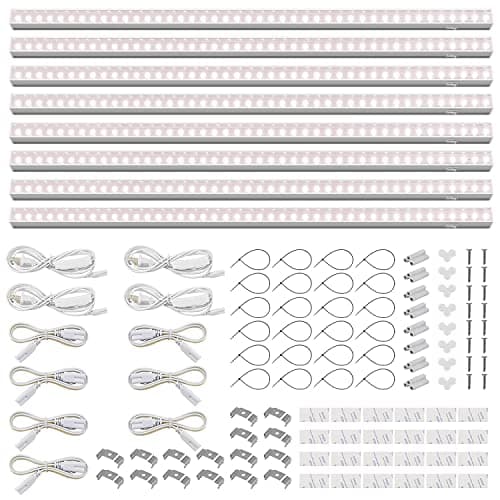 Barrina T5 4ft Grow Light Strips The default seed-starting bar for good reasons — 4 ft long, linkable in series, cheap per foot — and the reason we built a coverage calculator, because Barrina publishes no photon data whatsoever. | Lowest cost per foot | Not published | |
| 2 | 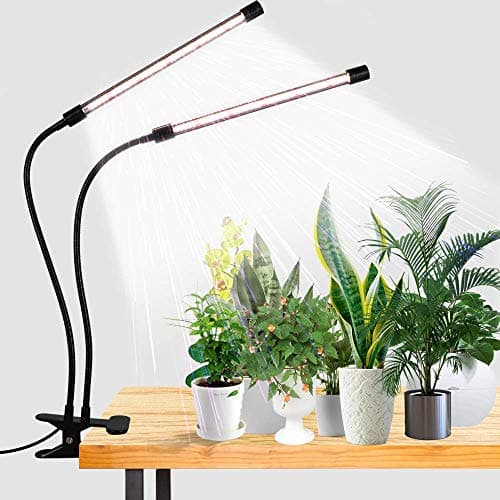 GooingTop Clip Grow Light The cheapest way to put real light on one plant on one desk, and honest about being exactly that — a 10 W clip lamp with a repeating timer. | One plant, minimum spend | Not published | |
| 3 | 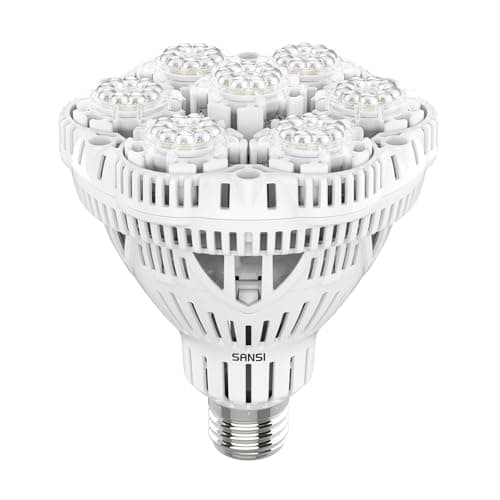 SANSI 36W BR30 Grow Light Bulb The rare grow bulb that publishes both PPF and a PPFD figure with the measurement distance attached, which is the only reason it can be sized honestly. | No fixture required | 1.82 umol/J (ours) | |
| 4 | 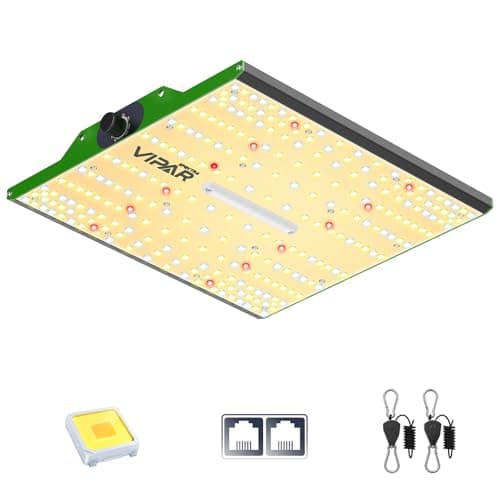 ViparSpectra P1000 Genuinely useful hardware — dimmer, daisy chain to 20 units, no fan — wrapped in a product page that publishes no photon data at all. | Cheapest full panel | Not published |
The reasoning
“Budget” hides two different questions. One is what the fixture costs today. The other is what it costs to run for the eight to twelve weeks a year you actually use it, every year, for the life of the unit. Those two answers do not rank the same way, and the gap between them is wide enough to matter.
The efficiency spread is nearly two to one
Photon efficacy — µmol/J, photons out per joule in — is the number that decides your running cost. Across the fixtures we have specs for, it ranges from 1.39 to 2.7. Two fixtures delivering the same light to the same tray can differ by nearly half on the electricity bill.
| Fixture | Efficacy | Source of the figure |
|---|---|---|
| AC Infinity IONBOARD S22 | 2.7 µmol/J | Published by AC Infinity |
| VIVOSUN VS1000 | 2.75 µmol/J | Published by VIVOSUN |
| Spider Farmer SF1000 | 2.5 µmol/J | Published, and it divides out of their PPF |
| Mars Hydro TS 1000 | 2.3 µmol/J | Published by Mars Hydro |
| SANSI 36W BR30 bulb | 1.82 µmol/J (ours) | 65.6 µmol/s ÷ 36 W |
| Soltech Aspect Gen 2 | 1.39 µmol/J (ours) | 50 µmol/s ÷ 36 W |
| Barrina T5, GooingTop clip | Not published | Neither brand publishes photon data |
What the efficiency gap is worth in dollars
Take two fixtures delivering roughly the same photons to the same tray. One runs at 2.7 µmol/J, the other at 1.4. To deliver 250 µmol/s the first draws about 93 W; the second draws about 179 W.
Efficient: 93 W × 16 h × 56 days ÷ 1000 = 83.3 kWh → $15.28.
Inefficient: 179 W × 16 h × 56 days ÷ 1000 = 160.4 kWh → $29.42.
A $14 difference over an eight-week season, at 18.34 cents per kWh. Over five seasons that is $70 — real, but smaller than most people assume, which is the honest finding here.
The conclusion cuts against the usual advice: for seed starting specifically, where the season is short, buying the cheaper fixture usually wins on total cost. Efficiency matters far more when you run a light all winter for houseplants, where the hours pile up.
Where cheap genuinely goes wrong
- Fixtures specified only in “equivalent” watts. “1000 W equivalent” on a 160 W product is a comparison to an obsolete technology, not a specification. It tells you nothing you can size with.
- Anything specified only in lumens. Lumens weight light by human eye sensitivity, which peaks in the green a plant uses least. There is no valid lumen-to-PPFD conversion without knowing the spectrum, and we will not publish one.
- Too small for the area. The commonest expensive mistake is buying one clip light for a whole tray. It will light about a quarter of it, and the rest will stretch.
If you want the reasoning behind the individual picks in more depth, the full seed-starting roundup sizes each one against the 12 mol/m²/day target, and what size grow light do I need walks the sizing procedure end to end.
Every pick in full
Barrina T5 4ft Grow Light Strips
LED barLowest cost per foot
The default seed-starting bar for good reasons — 4 ft long, linkable in series, cheap per foot — and the reason we built a coverage calculator, because Barrina publishes no photon data whatsoever.
What Barrina publishes
- Power draw
- 20 W per fixture; an 8-pack draws 160 W (source)
- Spectrum
- 5000 K (source)
- Dimming
- No; on/off switch per fixture, linkable up to 8 in series (source)
- Dimensions
- 4 ft strip, 120-degree beam angle, 120 V AC (source)
What Barrina does not publish
- PPF in umol/s — for any strip in the range
- PPFD at any stated distance
- Photon efficacy in umol/J
- LED count per strip, and rated lifespan
Who should skip it
Skip it if you need to know what you are getting before it arrives. There is no published PPF, no PPFD and no efficacy figure, so nothing about its output can be verified in advance.
GooingTop Clip Grow Light
Clip lightOne plant, minimum spend
The cheapest way to put real light on one plant on one desk, and honest about being exactly that — a 10 W clip lamp with a repeating timer.
What GooingTop publishes
- Power draw
- About 10 W (source)
- Spectrum
- 6000 K, 74 white plus 10 red LEDs, CRI 95 (source)
- Dimming
- Five brightness levels; repeating 4 / 8 / 12 hour timer (source)
What GooingTop does not publish
- PPF in umol/s
- PPFD at any distance
- Photon efficacy in umol/J
- The manufacturer publishes no spec sheet at all; the figures above come from the retail listing
Who should skip it
Skip it if the plant is more than about a foot across, or if you want any number at all before you buy — nobody publishes photon data for this fixture.
SANSI 36W BR30 Grow Light Bulb
Grow bulbNo fixture required
The rare grow bulb that publishes both PPF and a PPFD figure with the measurement distance attached, which is the only reason it can be sized honestly.
What SANSI publishes
- Power draw
- 36 W (source)
- PPF (photon output)
- 65.6 umol/s (source)
- PPFD
- 265.58 umol/m2/s at 1 ft (source)
- Spectrum
- 4000 K, 400-780 nm, CRI close to 100 (source)
- Rated life
- 25,000 hours (source)
Our arithmetic
- Efficacy, computed from the published figures: 1.82 umol/J
65.6 umol/s / 36 W = 1.82 umol/J. That is roughly a third less efficient than the panels on this page — the price of a screw-in form factor. - Electricity used at 12 hours a day for 30 days: 12.96 kWh a month
36 W x 12 h x 30 d / 1000 = 12.96 kWh.
What SANSI does not publish
- Beam angle
- Fixture dimensions
Who should skip it
Skip it if you are lighting more than one plant. 65.6 umol/s is a small amount of light spread over a cone — it lights a single specimen, not a shelf.
ViparSpectra P1000
LED panelCheapest full panel
Genuinely useful hardware — dimmer, daisy chain to 20 units, no fan — wrapped in a product page that publishes no photon data at all.
What ViparSpectra publishes
- Power draw
- 100 W (described as comparable to a 250 W HPS) (source)
- Stated coverage
- 2.5 x 2.5 ft vegetative at 16 inches, 2 x 2 ft flowering at 10 inches (source)
- Spectrum
- 660 nm red, 3000 K and 5000 K white, 730 nm far red (source)
- Dimming
- Yes, plus daisy chain up to 20 fixtures (source)
What ViparSpectra does not publish
- PPF in umol/s
- Photon efficacy in umol/J
- PPFD at any stated distance
- Fixture dimensions and rated lifespan
Who should skip it
Skip it if you want to compute coverage before you buy. With no published PPF and no published efficacy there is nothing to compute with, and we will not invent a figure to fill the gap.
Questions people actually ask
+Is a cheap grow light actually worth it for seed starting?
+What does "1000W equivalent" mean on a grow light?
+Can I use lumens to compare grow lights?
Sources
- AC Infinity — IONBOARD S22 published specifications — consulted September 2, 2026
- VIVOSUN — VS1000 product page — consulted September 2, 2026
- Spider Farmer — SF1000 published specification table — consulted September 2, 2026
- Mars Hydro — TS 1000 published specification table — consulted September 2, 2026
- SANSI — BR30 36W grow light bulb product page — consulted September 2, 2026
- Soltech — Aspect Gen 2 published specifications — consulted September 2, 2026
- Barrina — T5 ML20 4ft 20W product page — consulted September 2, 2026
- US Energy Information Administration — Electric Power Monthly, Table 5.3 (US residential average, June 2026) — consulted September 2, 2026
Read next
Seed Starting
The Best Grow Lights for Seed Starting
Sized against a 12 mol/m2/day seedling target using published photon output, not marketing claims.
Top pick
Barrina T5 4ft Grow Light Strips
Running Cost
The Most Efficient Grow Lights by µmol/J
Every fixture we cover ranked on published photon efficacy, with derivations shown.
Seed Starting
T5 Fluorescent vs LED for Seed Starting
LED wins on hours, cost and lifespan. The one remaining case for fluorescent, stated honestly.
Top pick
Barrina T5 4ft Grow Light Strips
Running Cost
How Much Electricity Do Grow Lights Use?
Monthly kWh and cost per fixture, and how that compares with household appliances.
Top pick
Barrina T5 4ft Grow Light Strips
Reviews
Best Grow Lights Under $50
What $50 buys: bulbs, not bars. Five picks ranked on published output, and the honest ceiling.
Top pick
SANSI 36W BR30 Grow Light Bulb
Where this sits
This page belongs to Grow Lights for Seed Starting. Every figure on it is either quoted from a named published source or derived in view — the full method is on our methodology page, and how the site is funded is on the affiliate disclosure.