The Cost to Run a Grow Light All Winter
Five real setups, October to March, priced to the dollar. The largest is smaller than most people guess for the smallest.
By Scooter M. — An enthusiast who's genuinely into this. I read the manuals, compile the published specs, and do the math. No lab coat.
Published · How we pick
Photographs on this site are licensed stock and are illustrative of the fixture type. We do not own the units we write about.
How this page is funded: the buy links here are Amazon Associates links, and we earn a commission on qualifying purchases at no extra cost to you. We have not been paid to feature anything on this page, we accept no free product, and commission plays no part in the ranking. Full disclosure.
We have not tested these units. Everything below comes from the manufacturer’s own published specifications, or from arithmetic we have shown our working for. Where a figure is not published, we say so instead of estimating one. Read the method.
Quick picks
Efficacy is photons out per joule in. Where a manufacturer publishes it we quote theirs; where they publish photon output and wattage but not efficacy, we divide and label it as ours; where they publish neither, the cell says so rather than guessing. Tap a row for the full write-up.
| # | Product | Best for | Efficacy | Price |
|---|---|---|---|---|
| 1 | 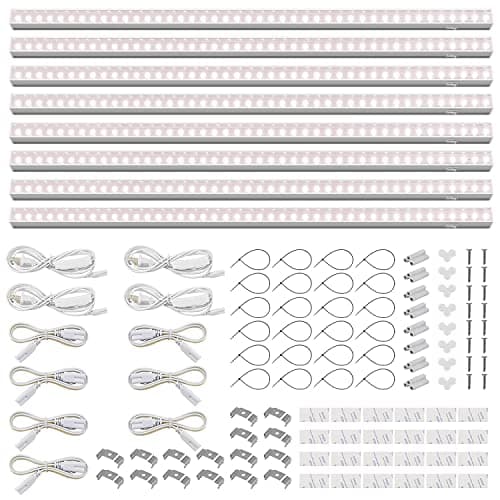 Barrina T5 4ft Grow Light Strips The default seed-starting bar for good reasons — 4 ft long, linkable in series, cheap per foot — and the reason we built a coverage calculator, because Barrina publishes no photon data whatsoever. | Cheapest per shelf-foot | Not published | |
| 2 | 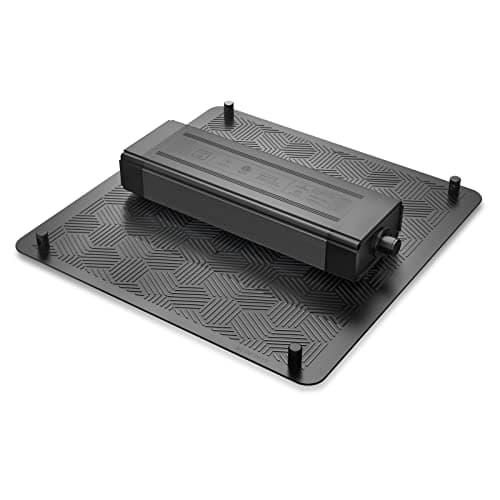 AC Infinity IONBOARD S22 The highest published efficacy of any fixture here at 2.7 umol/J, on Samsung LM301H diodes, with dimming in real 20% steps rather than a vague knob. | Lowest cost per photon | 2.7 umol/J | |
| 3 | 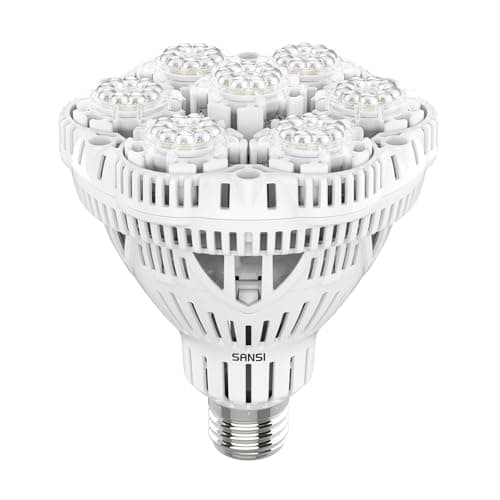 SANSI 36W BR30 Grow Light Bulb The rare grow bulb that publishes both PPF and a PPFD figure with the measurement distance attached, which is the only reason it can be sized honestly. | One plant, all winter | 1.82 umol/J (ours) | |
| 4 | 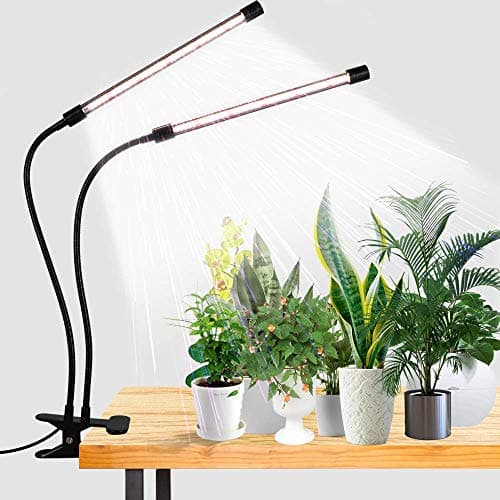 GooingTop Clip Grow Light The cheapest way to put real light on one plant on one desk, and honest about being exactly that — a 10 W clip lamp with a repeating timer. | Under a dollar a month | Not published |
The reasoning
“All winter” needs a definition before it can be priced. We use October 1 to March 31 — 182 days, six months — which matches when supplemental light is genuinely useful across most of the continental US. Every figure below uses the US residential average of 18.34 cents per kWh; substitute your own rate and everything scales directly.
October 1 to March 31. Every scenario below is computed across that span at the US residential average electricity rate.
Scenario 1: one clip light on a desk plant
About 10 W × 12 h ÷ 1000 = 0.12 kWh a day.
0.12 × 182 = 21.8 kWh for the season.
21.8 × $0.1834 = $4.00 for the whole winter.
Scenario 2: a grow bulb over one specimen plant
36 W × 12 h ÷ 1000 = 0.432 kWh a day.
0.432 × 182 = 78.6 kWh.
78.6 × $0.1834 = $14.42 for the winter, or about $2.40 a month.
Scenario 3: one panel over a shelf of houseplants
100 × 12 ÷ 1000 = 1.2 kWh a day.
1.2 × 182 = 218.4 kWh.
218.4 × $0.1834 = $40.05 for the winter, about $6.68 a month.
Run at 50% dim — appropriate if the coverage calculation says you are over target — that halves to about $20.
Scenario 4: a three-shelf rack of houseplants
6 × 20 W = 120 W. 120 × 12 ÷ 1000 = 1.44 kWh a day.
1.44 × 182 = 262.1 kWh.
262.1 × $0.1834 = $48.06 for the winter, about $8 a month.
Scenario 5: a serious seed-starting rack in late winter
Seed starting is a shorter, more intense season than houseplant supplementation — typically ten weeks from February, at longer hours.
120 W × 16 h ÷ 1000 = 1.92 kWh a day.
1.92 × 70 = 134.4 kWh.
134.4 × $0.1834 = $24.65 for the whole seed season.
All five, side by side
| Setup | Power | Hours/day | Season kWh | Season cost |
|---|---|---|---|---|
| Clip light, one plant | 10 W | 12 | 21.8 | $4.00 |
| Grow bulb, one specimen | 36 W | 12 | 78.6 | $14.42 |
| One panel, one shelf | 100 W | 12 | 218.4 | $40.05 |
| Three-shelf rack | 120 W | 12 | 262.1 | $48.06 |
| Seed rack, 10 weeks | 120 W | 16 | 134.4 | $24.65 |
What this should change about how you shop
At these numbers, running cost should not be the primary criterion for a home buyer. The gap between the cheapest and most expensive scenario here is about $44 across an entire winter — less than the price difference between two fixtures you are probably choosing between.
What should drive the decision instead: does the fixture match the shape of what you are lighting, does it deliver the light level your plants actually want, and does the manufacturer publish enough for you to know either of those things in advance. Those are the questions in what size grow light do I need and what full spectrum actually means.
Efficacy still matters at larger scale, and it compounds over years — the efficiency ranking is there if you want it. For your own season, put your own tariff into the running-cost calculator.
Every pick in full
Barrina T5 4ft Grow Light Strips
LED barCheapest per shelf-foot
The default seed-starting bar for good reasons — 4 ft long, linkable in series, cheap per foot — and the reason we built a coverage calculator, because Barrina publishes no photon data whatsoever.
What Barrina publishes
- Power draw
- 20 W per fixture; an 8-pack draws 160 W (source)
- Spectrum
- 5000 K (source)
- Dimming
- No; on/off switch per fixture, linkable up to 8 in series (source)
- Dimensions
- 4 ft strip, 120-degree beam angle, 120 V AC (source)
What Barrina does not publish
- PPF in umol/s — for any strip in the range
- PPFD at any stated distance
- Photon efficacy in umol/J
- LED count per strip, and rated lifespan
Who should skip it
Skip it if you need to know what you are getting before it arrives. There is no published PPF, no PPFD and no efficacy figure, so nothing about its output can be verified in advance.
AC Infinity IONBOARD S22
LED panelLowest cost per photon
The highest published efficacy of any fixture here at 2.7 umol/J, on Samsung LM301H diodes, with dimming in real 20% steps rather than a vague knob.
What AC Infinity publishes
- Power draw
- 115 W (source)
- Efficacy
- 2.7 umol/J (source)
- PPFD
- 1098 PPFD (no measurement distance published) (source)
- Stated coverage
- 2 x 2 ft (source)
- Spectrum
- Samsung LM301H, plus 660 nm, 730 nm, 3000 K, 6500 K (source)
- Diodes
- 272 diodes (source)
- Dimming
- Yes, 0-100% in 20% increments (source)
- Dimensions
- 30.0 x 30.0 cm board, 1.1 cm thick (source)
- Rated life
- 50,000 hours (source)
Our arithmetic
- Photon output implied by the published wattage and efficacy: about 311 umol/s
115 W x 2.7 umol/J = 310.5 umol/s. AC Infinity does not print PPF directly, so this is our arithmetic from two figures it does print.
What AC Infinity does not publish
- PPF in umol/s — only efficacy is given, so photon output has to be derived
- The measurement distance for the 1098 PPFD figure, without which the number cannot be compared to anything
Who should skip it
Skip it if you want to place it by the numbers. AC Infinity prints 1098 PPFD with no measurement distance attached, which makes that figure impossible to use or compare.
SANSI 36W BR30 Grow Light Bulb
Grow bulbOne plant, all winter
The rare grow bulb that publishes both PPF and a PPFD figure with the measurement distance attached, which is the only reason it can be sized honestly.
What SANSI publishes
- Power draw
- 36 W (source)
- PPF (photon output)
- 65.6 umol/s (source)
- PPFD
- 265.58 umol/m2/s at 1 ft (source)
- Spectrum
- 4000 K, 400-780 nm, CRI close to 100 (source)
- Rated life
- 25,000 hours (source)
Our arithmetic
- Efficacy, computed from the published figures: 1.82 umol/J
65.6 umol/s / 36 W = 1.82 umol/J. That is roughly a third less efficient than the panels on this page — the price of a screw-in form factor. - Electricity used at 12 hours a day for 30 days: 12.96 kWh a month
36 W x 12 h x 30 d / 1000 = 12.96 kWh.
What SANSI does not publish
- Beam angle
- Fixture dimensions
Who should skip it
Skip it if you are lighting more than one plant. 65.6 umol/s is a small amount of light spread over a cone — it lights a single specimen, not a shelf.
GooingTop Clip Grow Light
Clip lightUnder a dollar a month
The cheapest way to put real light on one plant on one desk, and honest about being exactly that — a 10 W clip lamp with a repeating timer.
What GooingTop publishes
- Power draw
- About 10 W (source)
- Spectrum
- 6000 K, 74 white plus 10 red LEDs, CRI 95 (source)
- Dimming
- Five brightness levels; repeating 4 / 8 / 12 hour timer (source)
What GooingTop does not publish
- PPF in umol/s
- PPFD at any distance
- Photon efficacy in umol/J
- The manufacturer publishes no spec sheet at all; the figures above come from the retail listing
Who should skip it
Skip it if the plant is more than about a foot across, or if you want any number at all before you buy — nobody publishes photon data for this fixture.
Questions people actually ask
+How much does it cost to run a grow light all winter?
+Is it cheaper to run one big light or several small ones?
+Should I turn grow lights off on sunny winter days?
+Do grow lights help with heating?
Sources
- US Energy Information Administration — Electric Power Monthly, Table 5.3 (US residential average, June 2026) — consulted September 2, 2026
- Barrina — T5 ML20 4ft 20W product page — consulted September 2, 2026
- Spider Farmer — SF1000 published specification table — consulted September 2, 2026
- SANSI — BR30 36W grow light bulb product page — consulted September 2, 2026
- GooingTop clip grow light — retail listing specifications (no manufacturer spec sheet published) — consulted September 2, 2026
- University of Minnesota Extension — Lighting for indoor plants and starting seeds — consulted September 2, 2026
Read next
Houseplants
The Best Grow Lights for Overwintering Plants
Active versus dormant overwintering, which plants want light and which do not, and the fixtures for the ones that do.
Top pick
Barrina T5 4ft Grow Light Strips

Houseplants
Grow Lights for Lemon Trees
What indoor citrus actually demands, what one fixture delivers, and the honest shortfall.
Top pick
Mars Hydro TS 1000
Houseplants
The Best Grow Lights for Winter
Winter is a daily-total problem. Modest fixture, long photoperiod — sized against published targets and costed for the season.
Top pick
Barrina T5 4ft Grow Light Strips
Running Cost
How Much Electricity Do Grow Lights Use?
Monthly kWh and cost per fixture, and how that compares with household appliances.
Top pick
Barrina T5 4ft Grow Light Strips
Running Cost
Grow Light Electricity Cost Calculator
Watts, hours and your own electricity rate, turned into monthly and seasonal cost.
Top pick
AC Infinity IONBOARD S22
Houseplants
Winter Daylight Loss, and What to Add Back
Why the winter deficit compounds, and how to size the supplement that closes it.
Top pick
Barrina T5 4ft Grow Light Strips
Where this sits
This page belongs to Running Cost and Efficiency. Every figure on it is either quoted from a named published source or derived in view — the full method is on our methodology page, and how the site is funded is on the affiliate disclosure.