Grow Lights for a Greenhouse
A greenhouse is not a light problem for nine months of the year and is a real one for the other three. Here is the shortfall in numbers, and the fixtures that close it.
By Scooter M. — An enthusiast who's genuinely into this. I read the manuals, compile the published specs, and do the math. No lab coat.
Published · How we pick
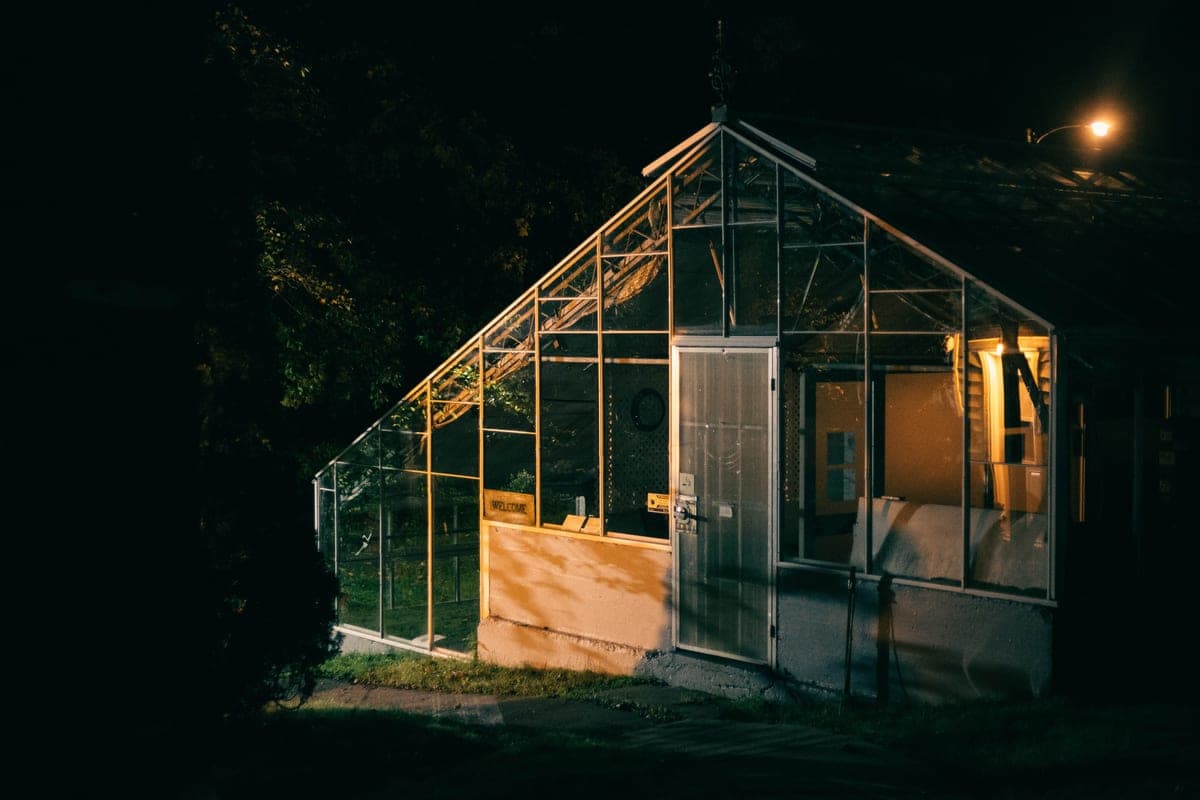
Photographs on this site are licensed stock and are illustrative of the fixture type. We do not own the units we write about.
How this page is funded: the buy links here are Amazon Associates links, and we earn a commission on qualifying purchases at no extra cost to you. We have not been paid to feature anything on this page, we accept no free product, and commission plays no part in the ranking. Full disclosure.
We have not tested these units. Everything below comes from the manufacturer’s own published specifications, or from arithmetic we have shown our working for. Where a figure is not published, we say so instead of estimating one. Read the method.
Quick picks
Efficacy is photons out per joule in. Where a manufacturer publishes it we quote theirs; where they publish photon output and wattage but not efficacy, we divide and label it as ours; where they publish neither, the cell says so rather than guessing. Tap a row for the full write-up.
| # | Product | Best for | Efficacy | Price |
|---|---|---|---|---|
| 1 | 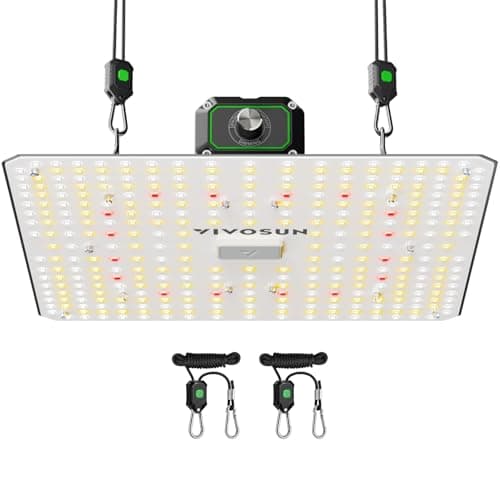 VIVOSUN LumaLight 100W Publishes a PPFD with the measurement distance attached, which most panels do not, and then publishes neither a PPF nor an efficacy figure, which most panels do. | The only IP65-rated board we cover | Not published | |
| 2 | 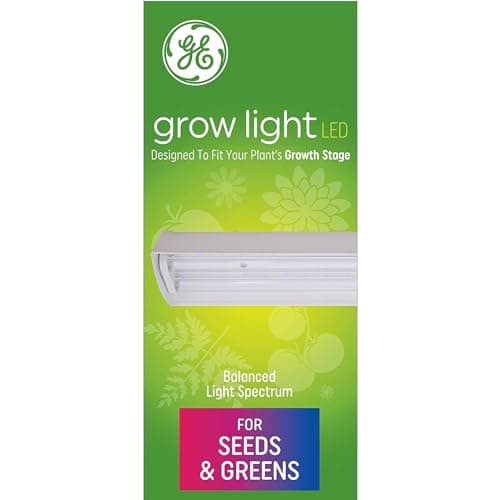 GE Grow Light 24in LED Fixture, Seeds and Greens A 2 ft shelf fixture that publishes its photon output, 72 umol/s from 40 W, so a shelf can be sized around it before it arrives rather than after. That works out to 1.8 umol/J, the most photons per watt of any linear fixture on this site. | A damp-rated run along a bench | Not published | |
| 3 | 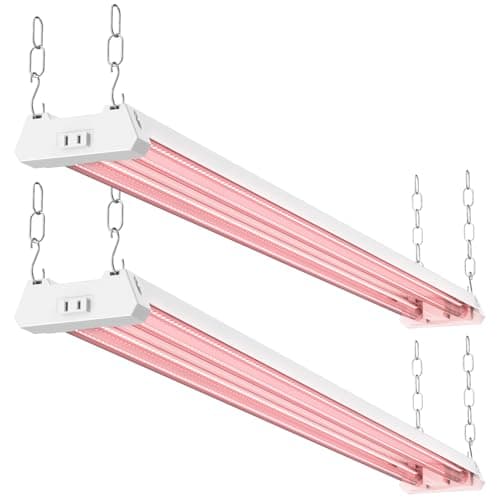 SuncoGrow 4ft 40W Grow Light The only cheap 4 ft strip we have found that publishes a PPF figure at all, which makes it the only one in its class you can size a shelf around before you buy it. | Damp-rated, by the linear foot | Not published | |
| 4 | 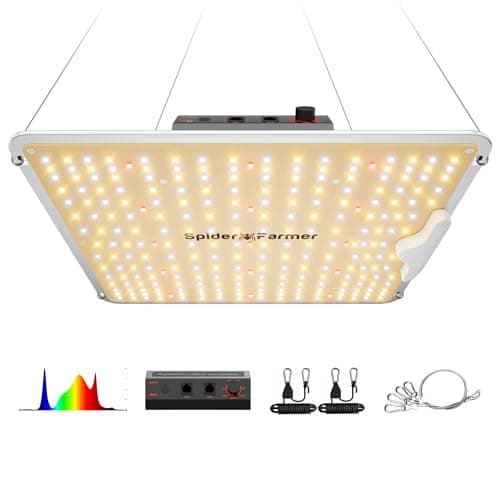 Spider Farmer SF1000 Publishes PPF to two decimal places and an efficacy figure that actually divides out of it. That internal consistency is rarer in this category than it should be. | The most photons per watt, under cover | 2.5 umol/J |
The reasoning
For about three months a year a greenhouse sits below the light level its crops want, and for the other nine it does not. If you are closing that gap over a bench of roughly two feet square, the VIVOSUN LumaLight 100W is the fixture we would buy, because it is the only board we cover that publishes an ingress rating for a damp structure. For a long bench, two GE Grow 24in fixtures end to end are the damp-rated answer.
We have not tested any of these fixtures. What follows is published specification, extension guidance quoted and named, and the subtraction that tells you whether you need a light at all.
The finding that surprises people: the glazing
A greenhouse is darker inside than the garden outside, and by far more than most owners assume. Writing in Vegetable Growers News, Erik Runkle of Michigan State University puts it plainly: a greenhouse’s “structure and glazing materials commonly reduce light transmission by 35 to 50 percent”, before you count hanging baskets, heat pipes or a winter’s worth of dust on the panels.
That loss is constant all year. It is invisible in June, when there is light to spare, and decisive in December, when there is not.
Erik Runkle, Supplemental lighting guidelines for greenhouses, Vegetable Growers News, March 2011. Before shading from structure, baskets or dirt.
How much light a greenhouse is actually short by
Runkle gives the three figures that make this a subtraction rather than a guess. On a dark winter day outdoor DLI “could be less than 5 mol·m-2·d-1”. A common target minimum inside a greenhouse “is 10 to 12 mol·m-2·d-1”. And in the northern half of the US, greenhouse DLI stays below 12 for about three months of the year.
5 mol/m²/day outside, with the mid-range 42% glazing loss applied: 5 × 0.58 = 2.9 mol/m²/day reaching the bench.
Against a 10 to 12 target, that is a shortfall of 7 to 9 mol/m²/day.
Supplying 8 mol over a 16-hour day: 8,000,000 ÷ (16 × 3600) = 139 µmol/m²/s of added light.
Now turn that into a fixture. A 2 × 2 ft bench is 0.3716 m², and we assume 80% of a fixture’s photons land inside its footprint — the same convention used across this site.
139 × 0.3716 ÷ 0.8 = about 65 µmol/s.
For a 4 × 2 ft bench (0.743 m²): 139 × 0.743 ÷ 0.8 = about 129 µmol/s.
Sixty-five micromoles per second is a small fixture — one 4 ft strip, or a single grow bulb at close range. That is the genuinely useful result on this page, and it runs against the instinct to buy the biggest panel available: a greenhouse light is a top-up, not a sun replacement, and it is sized accordingly. Compare a room with no window at all, where the same bench needs the whole daily total and the fixture roughly doubles — that arithmetic is here.
Do you need grow lights in a greenhouse at all?
For most of the year, no, and Runkle is explicit about the season: ornamentals at northern latitudes typically receive no supplemental light from April through September, because natural DLI is usually at least 12 by then.
So the honest answer is seasonal. A greenhouse grow light earns its place roughly from late November to mid-February in the northern half of the US, and is switched off the rest of the year. If you are buying one in May to improve growth, the fixture is not your constraint.
Two further cases where the answer is still no. If the crop is cold-hardy and slow by design — overwintering greens, garlic, hardy herbs under a cloche — the low winter DLI is part of the plan rather than a problem to fix. And if the greenhouse is unheated and sitting near freezing, light is not the limiting factor; temperature is.
Heat: the thing a grow light will not fix
This is the single most common misconception about greenhouse lighting, and it is worth stating bluntly. A grow light does not warm a greenhouse to any useful degree.
The arithmetic is unkind. A 100 W LED fixture dissipates at most 100 W of heat — about 341 BTU per hour — into a structure that loses heat through its entire glazed surface on a cold night. A small 6 × 8 ft greenhouse needs a heater rated in thousands of BTU to hold frost off. Four grow lights would not substitute for one small heater, and they would cost more to run. The general case is in do LED grow lights get hot.
The corollary matters for the opposite reason: because LED fixtures add so little heat, you can hang them close to a crop in a greenhouse without the scorch risk the old high-pressure sodium lamps carried.
The rating that decides this page
A greenhouse is a damp location in the electrical sense at minimum — condensation forms on every surface overnight, including the fixture — and in a structure you hose or mist, parts of it are a wet one. That narrows the field more sharply than any photon figure.
| Fixture | Published rating | Suitable for a greenhouse bench |
|---|---|---|
| VIVOSUN LumaLight 100W | IP65 | Yes — dust-tight, protected against water jets |
| GE Grow 24in fixture | Damp | Yes, away from direct spray |
| SuncoGrow 4ft 40W and 80W | Damp, ETL listed | Yes, away from direct spray |
| Feit Electric 16W PAR38 | Wet | Yes, including spray |
| Feit Electric 9W A19 and BR30 | Damp | Yes, away from direct spray |
| Mars Hydro, Spider Farmer, AC Infinity, ViparSpectra boards | Not published | At your own judgment |
| SANSI, Barrina, GooingTop, Soltech | Not published | At your own judgment |
IP65 means dust-tight and protected against water jets, which is a meaningful claim over a misted bench and is published by exactly one board we cover. “Not published” is not a claim that a fixture is unsafe; it is a statement about what the manufacturer documented. In a dry living room the distinction barely matters. In a structure that condenses every night it is the first thing to check.
Two things no rating covers. The first is the connection at the other end of the cord: a damp-rated fixture plugged into an unprotected indoor extension lead on a wet floor is still a hazard, and a greenhouse circuit should be GFCI protected with outdoor-rated cable. The second is cold. No manufacturer on this page publishes an operating temperature range, so an unheated greenhouse in a hard frost is outside every published specification here. That is a real gap in the available data and we are not going to fill it with an estimate.
When to run them, which is not all day
Supplemental light in a greenhouse is worth most when natural light is worth least, and Runkle’s guidance is specific: operate lamps during a portion of the night and on cloudy winter days, and in the early morning and late afternoon on sunny winter days.
In practice that is a timer with two blocks — a few hours before dawn and a few after dusk — rather than a fixture running through the middle of a bright day, when you are paying to add photons to a bench that already has enough. A cheap plug-in timer does this better than a built-in one, for the reasons in grow lights with timers.
A 40 W strip for 8 hours a day: 40 × 8 × 30 ÷ 1000 = 9.6 kWh a month, $1.76 at the US residential average of 18.34 cents per kWh.
A 100 W board on the same schedule: 24 kWh, $4.40 a month — about $13 for a three-month season.
The glass cabinet case, which is a different problem
A good share of people searching for a greenhouse grow light mean a glazed cabinet indoors — the converted display cabinet that houses a humidity-loving collection. That is not this page’s arithmetic. A cabinet in a room gets whatever the room gets, which in winter is often nothing usable, so the fixture supplies the entire daily total rather than a top-up, and the enclosure makes heat and airflow the design problem instead of rain. The sizing for that case is in grow lights for a room with no windows, and the small-fixture shortlist is in grow lights for terrariums.
1. VIVOSUN LumaLight 100W — the only IP65-rated board
Publishes an IP65 rating, a 2 × 2 ft coverage area and 521 µmol/m²/s at 12 inches — a PPFD figure with the distance attached, which most boards omit. For a bench that gets misted or condenses heavily, it is the only board here whose maker has said anything about water at all.
Best for: a 2 ft square bench in a structure that gets damp, where you want a rating rather than an assumption.
The downside: VIVOSUN publishes no PPF in µmol/s and no efficacy in µmol/J, so this board cannot be ranked against the others on photons per watt, and we will not derive a PPF from the PPFD because that calculation is not valid. It is also far more light than the 65 µmol/s a 2 ft square bench needs as a top-up, so expect to run it on a low dimmer step.
2. GE Grow 24in fixture — a damp-rated run along a bench
72 µmol/s from 40 W, damp-rated, and designed to be linked end to end — which is exactly the shape of a greenhouse bench. One fixture is slightly more than our 2 ft square top-up figure; two in line cover a 4 ft bench with 144 µmol/s against the 129 the arithmetic asked for.
Best for: the standard case — a 4 ft bench, a damp structure, a three-month season.
The downside: 1.80 µmol/J, which is well under the 2.5 µmol/J commercial efficacy minimum, and GE states explicitly that it is not rated for outdoor use — a greenhouse counts as indoors for this purpose only if it is a proper enclosed structure. Non-dimmable, so your only intensity control is height.
3. SuncoGrow 4ft 40W — damp-rated, by the linear foot
The only cheap 4 ft strip we have found that publishes a PPF at all (48.42 µmol/s), damp-rated and ETL listed, linkable up to four fixtures from one plug. For a bench run, that combination of a real number and a real rating is rare.
Best for: a long bench on a budget, where you want to add strips as the shortfall demands.
The downside: 1.21 µmol/J is the lowest efficacy of anything on this site, so you pay for that certainty every month on the meter. One strip over a 4 × 1 ft run averages about 104 µmol/m²/s, which is a genuine top-up but not a replacement; two strips is the configuration we would actually buy.
4. Spider Farmer SF1000 — the most photons per watt, under cover
249.21 µmol/s from 100 W at a published 2.5 µmol/J, which meets the commercial efficacy minimum exactly and is roughly twice the photons per watt of the damp-rated options above. Dimmable, which matters when your required top-up is a fifth of what the board can deliver.
Best for: a dry, heated greenhouse or a conservatory, where running cost over a long season matters more than an ingress rating.
The downside: Spider Farmer publishes no location or ingress rating of any kind, so on the one specification that decides this page it is silent. In a structure that condenses nightly, that is a judgment you are making rather than one the manufacturer has supported.
The honest summary
Check the season first: if it is not December, January or February and you are not in the northern half of the country, the shortfall may not exist. If it does, measure the bench, take 8 mol/m²/day as the gap, and the fixture you need is smaller than the category wants to sell you — about 65 µmol/s over a 2 ft square. Then choose on the rating rather than the photon figure, because in a greenhouse that is the specification doing the real work.
Every pick in full
VIVOSUN LumaLight 100W
LED panelThe only IP65-rated board we cover
Publishes a PPFD with the measurement distance attached, which most panels do not, and then publishes neither a PPF nor an efficacy figure, which most panels do.
What VIVOSUN publishes
- Power draw
- 100 W at 120-240 V AC (source)
- PPFD
- 521 umol/m2/s at 12 in (source)
- Stated coverage
- 2 x 2 ft (source)
- Spectrum
- White, blue, red and far-red: 3000 K, 5000 K, 660 nm, 750 nm (source)
- Dimming
- Yes, four steps: 25 / 50 / 75 / 100%, plus app control with the GrowHub sold separately (source)
- Dimensions
- 12 x 12 x 4 in (30 x 30 x 6.1 cm), 4.4 lb; IP65 rated (source)
- Rated life
- 36,000 hours to Q90; up to 5-year after-sale service (source)
Our arithmetic
- Daily light integral directly under the board at 12 in: 22.5 mol/m2/day at 12 hours
521 umol/m2/s x 12 h x 3600 / 1,000,000 = 22.5 mol/m2/day. That is the figure at the single point VIVOSUN measured, not an average across the footprint, so treat it as the ceiling directly beneath the board rather than what the whole 2 x 2 ft receives. - Electricity at 12 hours a day for 30 days: $6.60 a month
100 W x 12 h x 30 d / 1000 = 36.0 kWh. 36.0 x 18.34 cents = $6.60.
What VIVOSUN does not publish
- PPF in umol/s
- Photon efficacy in umol/J
- Diode manufacturer
- PPFD anywhere other than the single 12 in figure, so the falloff across the footprint is unknown
Who should skip it
Skip it if you rank fixtures by photons per watt. Without a published PPF there is no efficacy figure to compute, so this board cannot be placed in this site's umol/J table at all.
GE Grow Light 24in LED Fixture, Seeds and Greens
LED barA damp-rated run along a bench
A 2 ft shelf fixture that publishes its photon output, 72 umol/s from 40 W, so a shelf can be sized around it before it arrives rather than after. That works out to 1.8 umol/J, the most photons per watt of any linear fixture on this site.
What GE Lighting publishes
- Power draw
- 40 W at 120 V AC (source)
- PPF (photon output)
- 72 umol/s (source)
- Spectrum
- 2000 lumens, CRI 90; no color temperature or spectral distribution published (source)
- Dimming
- No; damp humidity rating, not rated for outdoor use (source)
- Dimensions
- 24.21 in long; GE publishes no width or height. Links up to 8 fixtures on integrated cords (source)
Our arithmetic
- Photon efficacy, computed from the published figures: 1.80 umol/J
72 umol/s / 40 W = 1.80 umol/J. GE publishes no efficacy figure, so this one is ours. It is the most efficient linear fixture on this site — above the Sunco 4 ft strip at 1.21 umol/J and the Soltech Aspect at 1.39 — and still below the LED boards at 2.3 to 2.75. - Average PPFD over its own 2 x 1 ft footprint: about 310 umol/m2/s
2 sq ft / 10.7639 = 0.1858 m2. 72 umol/s / 0.1858 m2 = 387.5 umol/m2/s at perfect uniformity; a 0.8 uniformity factor gives about 310 umol/m2/s. That is the high band on the University of Minnesota Extension's scale. - Daily light integral over that 2 x 1 ft footprint: 17.9 mol/m2/day at 16 hours; 20.1 at GE's recommended 18
310 umol/m2/s x 16 h x 3600 / 1,000,000 = 17.9 mol/m2/day. At 18 hours, 20.1. Both clear the roughly 12 mol/m2/day the University of New Hampshire Extension gives for seedlings. - One fixture stretched over a 4 x 1 ft run instead: about 155 umol/m2/s, or 8.9 mol/m2/day at 16 hours
4 sq ft / 10.7639 = 0.3716 m2. 72 umol/s / 0.3716 m2 x 0.8 = 155.0 umol/m2/s. 155 x 16 h x 3600 / 1,000,000 = 8.9 mol/m2/day, short of the seedling target — which is why a 4 ft shelf wants two of these rather than one. - Electricity at 16 hours a day for 30 days: $3.52 a month
40 W x 16 h x 30 d / 1000 = 19.2 kWh. 19.2 x 18.34 cents = $3.52. At GE's 18 hours: 21.6 kWh = $3.96.
What GE Lighting does not publish
- PPFD at any stated distance
- Beam angle
- Color temperature and spectral distribution
- Fixture width and height, and the cord length
- Photon efficacy in umol/J — PPF and wattage are given, so efficacy has to be derived
Who should skip it
Skip it if the shelf is 4 ft wide. One unit stretched over a 4 x 1 ft run averages about 155 umol/m2/s, barely clear of the low band, so a 4 ft shelf wants two of them. It does not dim either.
SuncoGrow 4ft 40W Grow Light
LED barDamp-rated, by the linear foot
The only cheap 4 ft strip we have found that publishes a PPF figure at all, which makes it the only one in its class you can size a shelf around before you buy it.
What Sunco Lighting publishes
- Power draw
- 40 W at 120 V AC; marketed as a 260 W equivalent (source)
- PPF (photon output)
- 48.42 umol/s (source)
- Spectrum
- Full spectrum, 2000 lumens, CRI 80+, 120-degree beam angle (source)
- Dimming
- No; linkable up to 4 fixtures, damp rated, ETL, FCC and RoHS listed (source)
- Dimensions
- 4 ft strip; 5 ft plug-in cord, 12 in pull chain (source)
- Rated life
- 50,000 hours, 50,000 switching cycles, 3-year warranty (source)
Our arithmetic
- Photon efficacy, computed from the published figures: 1.21 umol/J
48.42 umol/s / 40 W = 1.2105 umol/J. Sunco publishes no efficacy figure, so this one is ours. It is the lowest of any fixture on this site: the next lowest is the Soltech Aspect at 1.39 umol/J, and the LED boards run 2.3 to 2.75 umol/J. - Average PPFD from one strip over a 4 x 1 ft run of shelf: about 104 umol/m2/s
4 sq ft / 10.7639 = 0.3716 m2. 48.42 umol/s / 0.3716 m2 = 130.3 umol/m2/s at perfect uniformity; applying a 0.8 uniformity factor gives about 104 umol/m2/s. That sits in the low band, 50 to 150 umol/m2/s, on the University of Minnesota Extension's scale. - Daily light integral from one strip run 16 hours: 6.0 mol/m2/day
104 umol/m2/s x 16 h x 3600 / 1,000,000 = 6.0 mol/m2/day. That is half the roughly 12 mol/m2/day the University of New Hampshire Extension gives for seedlings, which is the arithmetic reason one strip per shelf disappoints people. - Two strips over that same 4 x 1 ft run: about 208 umol/m2/s, or 12.0 mol/m2/day at 16 hours
2 x 48.42 = 96.84 umol/s / 0.3716 m2 x 0.8 = 208.5 umol/m2/s. 208.5 x 16 h x 3600 / 1,000,000 = 12.0 mol/m2/day. Two strips land on the seedling target almost exactly, which is the configuration we would actually buy. - Electricity at 16 hours a day for 30 days: $3.52 a month per strip
40 W x 16 h x 30 d / 1000 = 19.2 kWh. 19.2 x 18.34 cents = $3.52. Two strips, 80 W, come to $7.04 a month.
What Sunco Lighting does not publish
- PPFD at any stated distance
- Photon efficacy in umol/J — PPF and wattage are given, so efficacy has to be derived
- Coverage area
- Diode manufacturer and LED count
- Fixture dimensions beyond the 4 ft length
Who should skip it
Skip it if photons per watt decide the purchase. The figure Sunco publishes works out to 1.21 umol/J, the lowest of anything on this site, so you pay for that certainty on the meter every month.
Spider Farmer SF1000
LED panelThe most photons per watt, under cover
Publishes PPF to two decimal places and an efficacy figure that actually divides out of it. That internal consistency is rarer in this category than it should be.
What Spider Farmer publishes
- Power draw
- 100 W +/-5% at 100-277 V AC (source)
- PPF (photon output)
- 249.21 umol/s (source)
- Efficacy
- 2.5 umol/J (source)
- Stated coverage
- 2 x 2 ft core, 3 x 3 ft maximum (source)
- Spectrum
- 650-665 nm, 730-740 nm, 2800-3000 K, 4800-5000 K (source)
- Diodes
- Bridgelux (source)
- Dimming
- Yes, dimming knob (source)
- Dimensions
- 32.5 x 29.0 x 5.9 cm (source)
- Rated life
- 55,000 hours (source)
Our arithmetic
- Does the published efficacy check out against the published PPF?: Yes — 2.49 umol/J computed against 2.5 umol/J published
249.21 umol/s / 100 W = 2.4921 umol/J. The published 2.5 umol/J is that number rounded. Not every brand's two figures agree like this, which is exactly why we divide them. - Average PPFD across its 2 x 2 ft core footprint: about 536 umol/m2/s
2 ft x 2 ft = 4 sq ft = 0.372 m2. 249.21 / 0.372 = 670 umol/m2/s at perfect uniformity; at a 0.8 uniformity factor, about 536 umol/m2/s.
Who should skip it
Skip it if raw output is what you are buying — the TS 1000 delivers 38% more photons per second, at the cost of 50 W more draw.
Questions people actually ask
+Do I need grow lights in a greenhouse?
+How much light does a greenhouse lose through the glazing?
+Can you use a grow light in an unheated greenhouse?
+What rating does a greenhouse grow light need?
+Will a grow light keep my greenhouse warm?
Sources
- Erik S. Runkle — Supplemental lighting guidelines for greenhouses, Vegetable Growers News, March 2011 — consulted October 30, 2026
- VIVOSUN — LumaLight 100W LED Grow Light product specifications — consulted September 27, 2026
- GE Lighting — GE Grow Light LED plant light fixture for Seeds and Greens, 72 PPF, 24in (specifications) — consulted September 17, 2026
- GE Lighting shop — 24in Seeds and Greens integrated fixture (wattage, PPF, lumens, humidity rating, dimming) — consulted October 23, 2026
- Sunco Lighting — SuncoGrow LED Grow Light 4ft 40W product specifications — consulted September 14, 2026
- Spider Farmer — SF1000 published specification table — consulted September 2, 2026
- Feit Electric — 16W PAR38 E26 Base LED Plant Grow Light Bulb, PAR38/GROW/LED/BX (specifications) — consulted September 19, 2026
- Virginia Cooperative Extension — Calculating and Using Daily Light Integral (DLI), SPES-720 — consulted September 2, 2026
- Iowa State University Extension — Important Considerations for Providing Supplemental Light to Indoor Plants — consulted September 2, 2026
- US Energy Information Administration — Electric Power Monthly, Table 5.3 (US residential average, June 2026) — consulted September 2, 2026
Read next
Houseplants
The Best Grow Lights for Winter
Winter is a daily-total problem. Modest fixture, long photoperiod — sized against published targets and costed for the season.
Top pick
Barrina T5 4ft Grow Light Strips
Reviews
Grow Lights for a Room With No Windows
Zero daylight means supplying 100% of the DLI, not a supplement. The sizing, the hours, and which plants will accept it.
Top pick
AC Infinity IONBOARD S22
Running Cost
Do LED Grow Lights Get Hot?
Where the heat actually goes, what it means for plants and rooms, and the safety basics.
Coverage & Sizing
Grow Lights With Timers
Built-in versus external timers, the failure mode nobody mentions, and what to set.
Top pick
GooingTop Clip Grow Light
Seed Starting
The Best Grow Lights for Seed Starting
Sized against a 12 mol/m2/day seedling target using published photon output, not marketing claims.
Top pick
Barrina T5 4ft Grow Light Strips
Where this sits
This page belongs to Fixture Reviews and Roundups. Every figure on it is either quoted from a named published source or derived in view — the full method is on our methodology page, and how the site is funded is on the affiliate disclosure.