Grow Lights for Terrariums
Most terrarium plants are forest-floor species, so the usual advice to buy the brightest light you can afford is exactly wrong here.
By Scooter M. — An enthusiast who's genuinely into this. I read the manuals, compile the published specs, and do the math. No lab coat.
Published · How we pick
Photographs on this site are licensed stock and are illustrative of the fixture type. We do not own the units we write about.
How this page is funded: the buy links here are Amazon Associates links, and we earn a commission on qualifying purchases at no extra cost to you. We have not been paid to feature anything on this page, we accept no free product, and commission plays no part in the ranking. Full disclosure.
We have not tested these units. Everything below comes from the manufacturer’s own published specifications, or from arithmetic we have shown our working for. Where a figure is not published, we say so instead of estimating one. Read the method.
Quick picks
Efficacy is photons out per joule in. Where a manufacturer publishes it we quote theirs; where they publish photon output and wattage but not efficacy, we divide and label it as ours; where they publish neither, the cell says so rather than guessing. Tap a row for the full write-up.
| # | Product | Best for | Efficacy | Price |
|---|---|---|---|---|
| 1 | 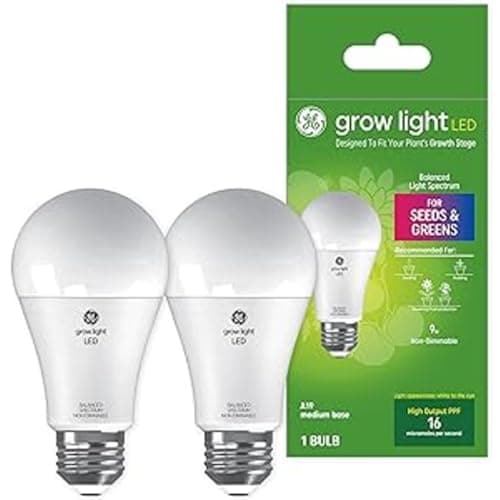 GE Grow A19 Bulb, Seeds and Greens (2-pack) The same published output as GE's BR30, 16 umol/s from 9 W, in the ordinary household bulb shape, for lamps and pendants that will not take a reflector flood. | A jar or a small closed build | Not published | |
| 2 | 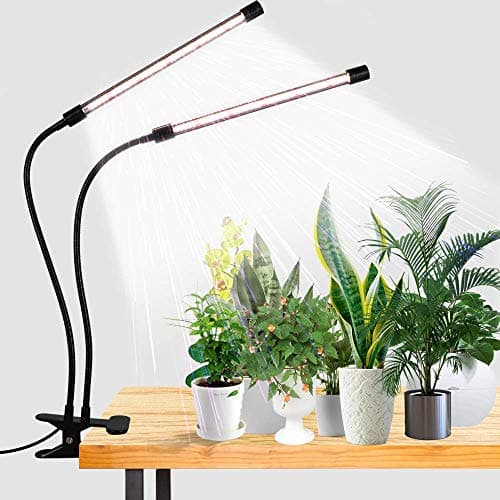 GooingTop Clip Grow Light The cheapest way to put real light on one plant on one desk, and honest about being exactly that — a 10 W clip lamp with a repeating timer. | An open bowl you can clip to | Not published | |
| 3 | 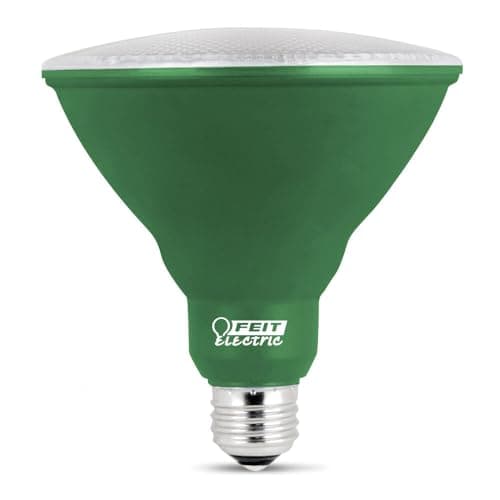 Feit Electric 16W PAR38 Grow Bulb The only bulb in Feit's grow range that publishes both a photon figure and a beam angle, which makes it the only one you can place over a plant by arithmetic instead of by guesswork. | A large or misted setup | Not published |
The reasoning
We have not tested these fixtures in a terrarium or anywhere else. What follows is published specification, our arithmetic, and the physics of putting a light above a sealed glass box.
Terrariums break the usual rule of this site. Most pages here are about getting enough light onto a plant. A terrarium is the opposite problem: the plants people put in them — fittonia, pilea, mosses, small ferns, creeping figs — are forest-floor species, and the glass adds a heat trap. Overshooting is the common failure, not undershooting.
The target, and where it comes from
Iowa State University Extension puts low-light foliage plants at 3 to 6 mol/m²/day. That is the band nearly every classic terrarium plant belongs to, and it is a quarter to a third of what a herb pot wants.
Take the middle of the band, 4.5 mol/m²/day, on a 12-hour schedule: 4,500,000 ÷ (12 × 3600) = 104 µmol/m²/s.
A 12 × 12 in terrarium footprint is 1 sq ft = 0.0929 m². Delivering 104 µmol/m²/s across it needs 104 × 0.0929 ÷ 0.8 = about 12 µmol/s reaching the plants.
Twelve micromoles per second is a remarkably small number. A 9 W grow bulb publishes 14 to 16 µmol/s. The 36 W bulb we recommend elsewhere on this site publishes 65.6 — five times too much. This is the one page here where the cheapest, weakest fixture is the correct answer and the upgrade is a mistake.
Derived from Iowa State University Extension's 3-6 mol/m²/day band for low-light foliage plants, at 12 hours a day with a 0.8 uniformity factor. Glass reflects and absorbs some of what you aim at it, so treat this as the floor, not a ceiling to aim past.
The heat problem nobody mentions
A sealed glass container has no airflow. Whatever heat arrives stays until it conducts out through the glass, and the plants inside are species adapted to stable, cool, humid forest floors.
LEDs are often described as running cool, which is only true in comparison to the incandescent and HPS fixtures they replaced. A 9 W bulb turns most of its 9 W into heat — a little over 3 W leaves as light, and the rest warms whatever is near it. Put that directly against glass and the inside climbs. The rule that follows is simple and it is the most important one on this page:
Keep the fixture outside the glass, and keep an air gap. Never seal a light inside a closed container, never rest a bulb on the lid, and if the glass is warm to the touch after an hour, raise the light. The general case is in do LED grow lights get hot.
1. GE Grow A19 — a jar or a small closed build
16 µmol/s from 9 W, published, with CRI 90 so the moss actually looks green rather than gray. Against the 12 µmol/s target computed above, one bulb in a lamp a foot above the glass is the right size — close to the number rather than five times past it.
The A19 shape, which is a drawback on most pages of this site because it sprays light in all directions, matters less here: a terrarium is a small target directly underneath, and the glass walls bounce some of the spill back in.
The downside: GE publishes no beam angle, so you cannot compute what fraction lands inside the glass — only the ceiling of 172 µmol/m²/s that would apply if every photon did. And it does not dim, so your only intensity control is distance.
2. GooingTop clip light — an open bowl you can clip to
Five brightness levels and a repeating 4/8/12-hour timer built into the cable, on a gooseneck that clips to the rim of an open bowl or the edge of the shelf it sits on. For terrariums the dimming is the feature: this is a plant group where you want to start low and watch, and this is the only pick here that lets you turn the light down rather than move it.
The downside: nobody publishes photon data for it — no PPF, no PPFD, no efficacy — so none of the arithmetic above can be applied to it. You are dialing by eye and by how the plants respond, which for low-light species is workable but is not the same as knowing.
3. Feit Electric 16W PAR38 — a large or misted setup
The only pick here rated for wet locations, which matters if you mist heavily or run an open paludarium where water and fixture share a space. It also publishes a 40-degree beam angle, so it can be placed by arithmetic.
At 12 in it delivers about 414 µmol/m²/s. At 18 in, about 184. At 24 in, about 103 µmol/m²/s.
Only the 24-inch figure is anywhere near the 104 µmol/m²/s this page is targeting. At a foot it is four times too much for a fittonia.
The downside: that is a fixture you have to deliberately under-use, and at 1.25 µmol/J it is the least efficient bulb we cover. Buy it for the wet rating and the beam angle, not for the output, and hang it high.
Sizing it for your actual box
| Terrarium footprint | Area | PPFD target | PPF needed |
|---|---|---|---|
| 8 × 8 in (a large jar) | 0.44 sq ft | 104 µmol/m²/s | about 5 µmol/s |
| 12 × 12 in | 1.0 sq ft | 104 µmol/m²/s | about 12 µmol/s |
| 18 × 12 in | 1.5 sq ft | 104 µmol/m²/s | about 18 µmol/s |
| 24 × 18 in (a tank) | 3.0 sq ft | 104 µmol/m²/s | about 36 µmol/s |
Only the largest of those approaches what a single 36 W grow bulb emits. Everything smaller is bulb-sized, and most of it is 9 W bulb-sized. If you are lighting a wall of small builds rather than one box, the shape changes and a bar makes sense — see best grow lights for a shelf or rack.
Hours, not intensity
When a terrarium is short of light the instinct is to go brighter. With low-band plants it is usually better to go longer. Iowa State University Extension gives 12 to 14 hours as the general range for indoor plants, with 10 as a floor and 16 as a ceiling. Running 14 hours at 104 µmol/m²/s delivers 5.2 mol/m²/day — the top of the low-light band — without raising the peak intensity the leaves see, and without adding heat all at once.
A timer is not optional for this. The GooingTop has one built in; everything else needs a plug-in timer, covered in grow lights with timers.
What tells you it is wrong
- Too much: bleached or reddening patches on the leaves nearest the glass top, crisping at the tips, moss going pale and dry. Raise the light or dim it.
- Too little: long weak stems reaching upward, new leaves smaller than old ones, variegation fading to plain green.
- Too hot: condensation vanishing from the glass during the day and heavy fogging at night, plants wilting in the afternoon in a sealed container. That is a heat problem, not a light problem, and the fix is distance and airflow rather than a different bulb.
Where to mount it, given you cannot put it inside
The fixture has to sit outside the glass, which leaves three arrangements, and they suit different builds.
- A bulb in a lamp above the lid. The simplest, and the one the arithmetic on this page assumes. A desk or clamp lamp with the bulb 10 to 14 inches above the glass puts the right intensity inside and leaves an air gap so the lid does not warm.
- A clip light on the rim. For open bowls and unlidded builds, where the gooseneck lets you aim into the planting rather than through the glass. This wastes the least light, because nothing has to pass through a curved surface first.
- A bar above a shelf of several builds. Once you have three or four jars, individual lamps stop making sense. A 4 ft fixture over a shelf lights them all, and the per-jar intensity is whatever the bar delivers at that height.
Glass matters more than people expect in the first two cases. A curved jar wall refracts and reflects some of what you aim at it, and a condensation film scatters more. None of that is computable from a spec sheet, which is another reason to treat the 12 µmol/s target as a floor and to judge by the plants.
Matching plants to the light you can actually give
A terrarium is a fixed volume, so it is often easier to choose plants to suit the light than to force the light to suit the plants.
| Plant | Band | Works in a closed build? |
|---|---|---|
| Mosses (sheet, cushion) | Low, 3-6 mol/m²/day | Yes — the classic case, and easy to overdo |
| Fittonia (nerve plant) | Low, 3-6 | Yes, the default terrarium plant |
| Small ferns (button, maidenhair) | Low, 3-6 | Yes, and they want the humidity |
| Pilea, peperomia | Low to medium | Yes, near the top of this page's target |
| Small philodendron, pothos cuttings | Low to medium | Yes, but they outgrow the box |
| Succulents, cacti | High, 12-16 | No — wrong humidity and four times this light |
| Carnivorous plants | Above the top band | No, not on this intensity |
The last two rows matter because open-topped “succulent terrariums” are sold everywhere and are a bad idea twice over: the light level this page targets is a quarter of what a succulent wants, and the humidity that suits moss rots them. If that is the build you have in mind, the fixtures and targets are in grow lights for succulents instead, and the container should be open and dry.
Checking the result without a meter
A PAR meter costs many times what a terrarium light costs, so nobody buys one for this. Two substitutes work.
A phone light meter app reads lux rather than PPFD, and the two cannot be converted without knowing the source spectrum — which is why this site never publishes a conversion factor. It is still useful as a relative instrument: take a reading at the moss surface, change the height, take another. The ratio is meaningful even though the absolute number is not.
The better instrument for a low-light planting is time. Mosses pale within a fortnight if they are getting too much and stretch within a month if they are getting too little, and fittonia reports faster than that. Set the light at the arithmetic above, leave it two weeks, and adjust once. The general method is in how to measure PPFD without a meter.
Spectrum, and the fact that you have to look at it
A terrarium is an object in a room, usually on a desk or a shelf at eye level, and it is the only growing setup on this site that is also furniture. That makes color rendering a real criterion rather than a vanity one.
The pink-purple fixtures that dominate cheap grow lighting concentrate output in blue and red because that is where chlorophyll absorbs most strongly. Plants do well under them. Mosses and fittonia viewed under them look gray-brown and faintly diseased, and the patterning that made you buy the plant disappears.
The measure to look for is CRI, the color rendering index, which describes how faithfully a source shows colors against a reference. Of the picks here, GE publishes CRI 90 and the GooingTop retail listing states CRI 95 — both high, both white-light sources, and both leaving a planting looking like itself. Feit publishes CRI 80 for the PAR38, which is acceptable rather than excellent.
None of that affects growth. White LEDs and blue-plus-red LEDs both grow plants, and the research comparing them is summarized in full spectrum versus red and blue. It affects whether you enjoy the thing you built, which for a terrarium is most of the point.
Open builds change the numbers
Everything above assumes a lidded container. An open bowl or a half-covered dish behaves differently in two ways that matter.
It loses humidity, so the plants that suit it are the tougher end of the list — pilea, peperomia, small pothos cuttings rather than maidenhair ferns and sheet moss. And it loses the heat trap, which removes the main reason to keep the fixture at a distance. An open bowl can take a light closer than a sealed jar can, and that is where the clip light comes into its own: aimed into the planting rather than through a pane of glass, with nothing in the way to scatter or absorb.
Every pick in full
GE Grow A19 Bulb, Seeds and Greens (2-pack)
Grow bulbA jar or a small closed build
The same published output as GE's BR30, 16 umol/s from 9 W, in the ordinary household bulb shape, for lamps and pendants that will not take a reflector flood.
What GE Lighting publishes
- Power draw
- 9 W per bulb at 120 V; medium base (source)
- PPF (photon output)
- 16 umol/s per bulb (source)
- Spectrum
- 500 lumens, CRI 90; no spectral distribution published (source)
- Dimming
- No (source)
Our arithmetic
- Photon efficacy, computed from the published figures: 1.78 umol/J
16 umol/s / 9 W = 1.78 umol/J, identical to the BR30. The difference between the two is where the light goes, not how much of it there is. - Electricity at 16 hours a day for 30 days: $0.79 a month per bulb
9 W x 16 h x 30 d / 1000 = 4.32 kWh. 4.32 x 18.34 cents = $0.79. At GE's 18 hours: $0.89.
What GE Lighting does not publish
- PPFD at any stated distance
- Beam angle
- Color temperature and spectral distribution
- Photon efficacy in umol/J
Who should skip it
Skip it if your fixture takes a BR30. An A19 sends its light out in every direction rather than forward, so in an open socket more of those 16 umol/s miss the plant.
GooingTop Clip Grow Light
Clip lightAn open bowl you can clip to
The cheapest way to put real light on one plant on one desk, and honest about being exactly that — a 10 W clip lamp with a repeating timer.
What GooingTop publishes
- Power draw
- About 10 W (source)
- Spectrum
- 6000 K, 74 white plus 10 red LEDs, CRI 95 (source)
- Dimming
- Five brightness levels; repeating 4 / 8 / 12 hour timer (source)
What GooingTop does not publish
- PPF in umol/s
- PPFD at any distance
- Photon efficacy in umol/J
- The manufacturer publishes no spec sheet at all; the figures above come from the retail listing
Who should skip it
Skip it if the plant is more than about a foot across, or if you want any number at all before you buy — nobody publishes photon data for this fixture.
Feit Electric 16W PAR38 Grow Bulb
Grow bulbA large or misted setup
The only bulb in Feit's grow range that publishes both a photon figure and a beam angle, which makes it the only one you can place over a plant by arithmetic instead of by guesswork.
What Feit Electric publishes
- Power draw
- 16 W at 120 V; medium E26 base (source)
- PPF (photon output)
- 20.0 umol/s, printed by Feit as "20.0PAR/PPF" with no unit (source)
- Stated coverage
- 40-degree beam angle; wet-location and enclosed-fixture rated (source)
- Spectrum
- 900 lumens, 3500 K, CRI 80; stated to emit between 454 nm blue and 630 nm red, with no distribution curve published (source)
- Dimming
- No (source)
- Rated life
- 25,000 hours; 2-year warranty (source)
Our arithmetic
- Photon efficacy, computed from the published figures: 1.25 umol/J
20.0 umol/s / 16 W = 1.25 umol/J. Feit publishes no efficacy figure, so this one is ours. Only the SuncoGrow 40 W at 1.21 umol/J is lower on this site; the LED boards run 2.3 to 2.75. - Average PPFD inside its 40-degree beam, by distance: about 414 at 12 in, 184 at 18 in, 103 at 24 in (umol/m2/s)
A 40-degree beam spreads to a radius of distance x tan(20 degrees) = distance x 0.364. At 12 in that is a 0.416 sq ft circle = 0.0387 m2, so 20.0 umol/s / 0.0387 m2 = 517 umol/m2/s, and a 0.8 uniformity factor gives about 414. At 18 in: 0.936 sq ft = 0.0870 m2, 230 before uniformity, about 184 after. At 24 in: 1.665 sq ft = 0.1547 m2, 129 before, about 103 after. This assumes every photon falls inside the stated cone, so treat each figure as the top of the range. - Daily light integral at 18 in, run 16 hours: about 10.6 mol/m2/day
184 umol/m2/s x 16 h x 3600 / 1,000,000 = 10.6 mol/m2/day, a little under the roughly 12 mol/m2/day the University of New Hampshire Extension gives for seedlings. Moving the bulb to 12 in clears it easily. - Electricity at 16 hours a day for 30 days: $1.41 a month
16 W x 16 h x 30 d / 1000 = 7.68 kWh. 7.68 x 18.34 cents = $1.41.
What Feit Electric does not publish
- PPFD at any stated distance
- Photon efficacy in umol/J
- A spectral distribution — two peak wavelengths are named, no curve
- The unit on its own photon figure
Who should skip it
Skip it if photons per watt matter. 20 umol/s from 16 W works out to 1.25 umol/J, the second-lowest figure on this site, so you are paying for the placement data on the meter.
Questions people actually ask
+How much light does a terrarium need?
+Can you put a grow light inside a closed terrarium?
+Is a 36W grow bulb too strong for a terrarium?
+How many hours a day should a terrarium light run?
Sources
- Iowa State University Extension — Important Considerations for Providing Supplemental Light to Indoor Plants — consulted September 2, 2026
- University of Minnesota Extension — Lighting for indoor plants and starting seeds — consulted September 2, 2026
- GE Lighting — GE Grow LED A19 bulb for Seeds and Greens, 16 PPF (specifications) — consulted September 17, 2026
- Feit Electric — 16W PAR38 E26 Base LED Plant Grow Light Bulb, PAR38/GROW/LED/BX (specifications) — consulted September 19, 2026
- GooingTop clip grow light — retail listing specifications (no manufacturer spec sheet published) — consulted September 2, 2026
- US Energy Information Administration — Electric Power Monthly, Table 5.3 (US residential average, June 2026) — consulted September 2, 2026
Read next
Reviews
The Best Desktop Grow Lights
Four fixtures for a single desk plant, and why a panel is the wrong tool for one square foot.
Top pick
GooingTop Clip Grow Light
Houseplants
Clip Light vs Panel vs Bar
Form factor decides more than brand. Which shape suits which setup, and where each stops working.
Top pick
Barrina T5 4ft Grow Light Strips
Coverage & Sizing
PPFD Targets by Plant Type
Published light bands mapped to common indoor plants, with the DLI each implies.
Top pick
GooingTop Clip Grow Light
Running Cost
Do LED Grow Lights Get Hot?
Where the heat actually goes, what it means for plants and rooms, and the safety basics.
Where this sits
This page belongs to Fixture Reviews and Roundups. Every figure on it is either quoted from a named published source or derived in view — the full method is on our methodology page, and how the site is funded is on the affiliate disclosure.