The Best Desktop Grow Lights
One plant, one square foot, and a room where someone is sitting. That last constraint eliminates most of this category before you compare a single spec.
By Scooter M. — An enthusiast who's genuinely into this. I read the manuals, compile the published specs, and do the math. No lab coat.
Published · How we pick
Photographs on this site are licensed stock and are illustrative of the fixture type. We do not own the units we write about.
How this page is funded: the buy links here are Amazon Associates links, and we earn a commission on qualifying purchases at no extra cost to you. We have not been paid to feature anything on this page, we accept no free product, and commission plays no part in the ranking. Full disclosure.
We have not tested these units. Everything below comes from the manufacturer’s own published specifications, or from arithmetic we have shown our working for. Where a figure is not published, we say so instead of estimating one. Read the method.
Quick picks
Efficacy is photons out per joule in. Where a manufacturer publishes it we quote theirs; where they publish photon output and wattage but not efficacy, we divide and label it as ours; where they publish neither, the cell says so rather than guessing. Tap a row for the full write-up.
| # | Product | Best for | Efficacy | Price |
|---|---|---|---|---|
| 1 | 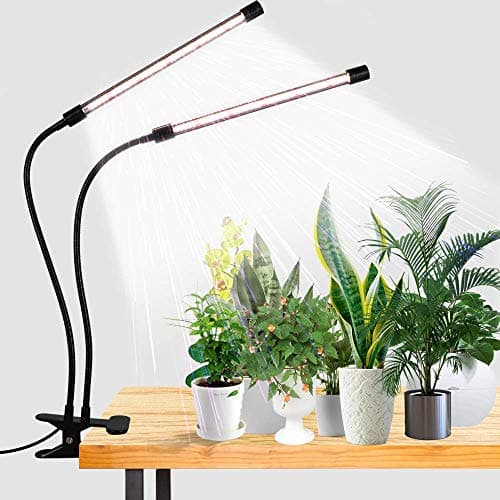 GooingTop Clip Grow Light The cheapest way to put real light on one plant on one desk, and honest about being exactly that — a 10 W clip lamp with a repeating timer. | Clamps to anything | Not published | |
| 2 | 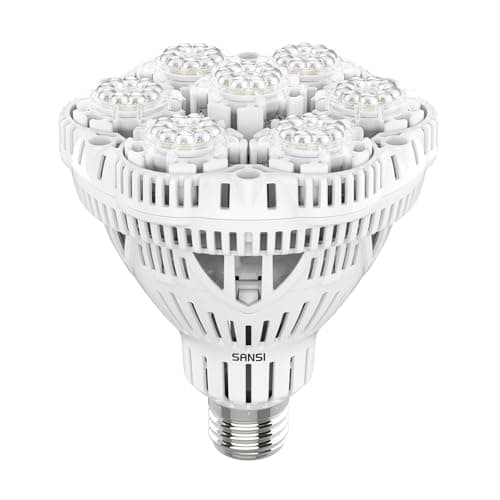 SANSI 36W BR30 Grow Light Bulb The rare grow bulb that publishes both PPF and a PPFD figure with the measurement distance attached, which is the only reason it can be sized honestly. | Placeable by arithmetic | 1.82 umol/J (ours) | |
| 3 | 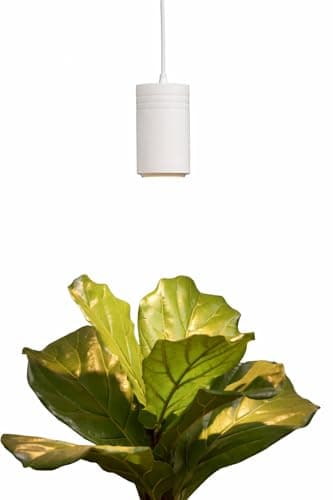 Soltech Aspect Gen 2 The only fixture here you would willingly hang in a living room, and the only one publishing PPFD at three separate distances so it can actually be placed by the numbers. | A desk on show | 1.39 umol/J (ours) | |
| 4 | 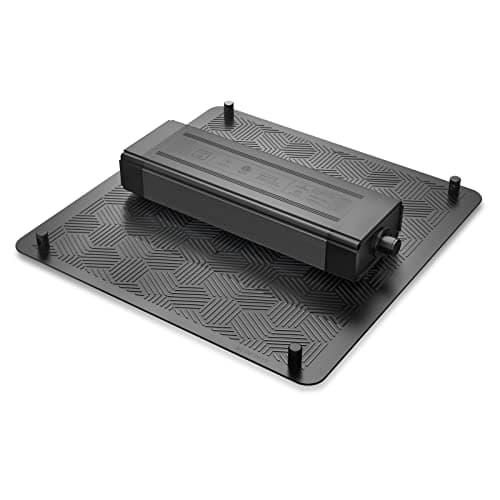 AC Infinity IONBOARD S22 The highest published efficacy of any fixture here at 2.7 umol/J, on Samsung LM301H diodes, with dimming in real 20% steps rather than a vague knob. | A shelf above the desk | 2.7 umol/J |
The reasoning
A desktop grow light is a genuinely different problem from every other page in this section, and the difference is not size. It is that you are sitting next to it. That single constraint rules out most of what this category sells.
Three things follow from it: the fixture has to look acceptable in a room you use, it must not put emitters at eye level, and its output needs to suit about one square foot rather than a shelf. Get those right and the shortlist is short.
200 µmol/m²/s over 1 × 1 ft (0.093 m²) at 0.8 uniformity. A 100 W panel publishes ten times that — which is the whole argument of this page.
The sizing, which explains the shortlist
1 × 1 ft = 0.093 m².
At a medium 200 µmol/m²/s: 200 × 0.093 ÷ 0.8 = 23 µmol/s.
At a high 350 µmol/m²/s, for a succulent or a herb: 350 × 0.093 ÷ 0.8 = 41 µmol/s.
The SANSI BR30 publishes 65.6 µmol/s. A Spider Farmer SF1000 publishes 249.21 — roughly six times what the desk needs, in a fixture you would have to hang.
So the honest headline: a panel on a desk is not a better desktop light, it is a worse one. You pay for output that lands on your keyboard, and you hang a fixture in a room where you work.
How we ranked these
- Does it mount without construction? A desk rarely has anywhere to hang from. Clamps and sockets beat hanging kits.
- Can you live with it on? Color rendering and glare matter more here than anywhere else on this site.
- Is the output right for a square foot? Not maximum — right.
- Can you place it by numbers? Where a manufacturer publishes PPFD with a distance, you can work out the height before you buy.
1. GooingTop clip light — the one that fits any desk
About 10 W, a gooseneck, a clamp, five brightness levels and a built-in repeating 4, 8 or 12-hour timer. For a desk with no free socket and nothing to hang from, it is the only fixture here that needs no other decision — and at roughly $4.00 of electricity across an entire October-to-March winter, the running cost rounds to nothing.
The built-in timer deserves credit on a desk specifically: nothing else to buy, nothing to remember. Its limitation is that a repeating cycle counts from when you switch it on rather than tracking a clock, so a power cut shifts the schedule — a real issue on a rack, a non-issue for one plant.
The honest con, and it is a significant one: nobody publishes any photon figure for it. There is no manufacturer spec sheet at all — the figures we can report come from the retail listing, which is a materially weaker source. You cannot size it, cannot place it by arithmetic, and cannot compare it to anything. Full detail in the clip light write-up.
2. SANSI 36W BR30 — the one you can actually place
The only fixture in this shortlist that publishes PPFD with the distance it was measured at: 265.58 µmol/m²/s at 1 ft, alongside 65.6 µmol/s of output. That means the lamp height is a calculation rather than a guess.
| Distance | PPFD (µmol/m²/s) | Suits |
|---|---|---|
| 10–12 in | 265–350 | Succulents, jade, herbs — the high band |
| 15 in | ~170 | Most foliage plants, comfortably |
| 18 in | ~118 | Pothos, snake plant, ZZ — the low band |
| 24 in | ~66 | Low-light plants, near the band floor |
It also renders color well — 4000 K at a CRI close to 100 — so it reads as an ordinary desk lamp rather than a grow light, and it goes in a socket you already own.
The honest con: 65.6 µmol/s from 36 W works out to 1.82 µmol/J, roughly a third less efficient than the panels we cover. That is the price of the screw-in form factor. At 36 W and about $2.38 a month it costs pennies, but it is a real inefficiency.
3. Soltech Aspect Gen 2 — if the desk is on show
The only fixture on this site you would specify for its appearance. A 3.5 × 3.5 × 6.2 inch pendant at 3000 K with a CRI of 98, publishing PPFD at three distances — about 50 µmol/m²/s at 1 m, 34.9 at 4 ft, 15.5 at 6 ft — and those figures obey the inverse-square relationship almost exactly, so you can extrapolate to a height they did not publish.
The honest con: two of them. At 50 µmol/s from 36 W it is 1.39 µmol/J, the least efficient fixture we cover. And the published numbers make its modesty plain — 50 µmol/m²/s at 1 m is exactly the floor of the low-light band, so this suits a low-light foliage plant and will not serve a herb or a succulent. It is also a pendant, so a desk needs something above it to hang from.
4. AC Infinity IONBOARD S22 — if there is a shelf above the desk
Included for one specific desk arrangement: a shelf or hutch above the work surface. At 30 × 30 cm and 1.1 cm thick, passively cooled, it mounts flat underneath rather than hanging — and it dims in stated 20% increments, which matters when the light is a foot from your face.
The honest con: at a derived ~311 µmol/s it is far more light than one plant needs, so you are buying capacity you will dim away. It also publishes a PPFD figure with no measurement distance, which makes that number unusable. Only pick this if the desk area is really more like a small shelf.
What to avoid on a desk
- Purple blue-and-red arrays. You cannot judge plant health under magenta light, and in a room you occupy the glow carries through the whole house. The evidence on white performing comparably for growth is in full spectrum versus red and blue.
- Anything at eye level. Mount above the plant and angle it down. The exposure question is covered in are grow lights safe for eyes and pets.
- A 100 W panel. Ten times the output for one square foot, in a fixture that needs hanging.
The verdict
For most desks, the clip light — it fits, it costs nothing to run, and it has a timer built in. Take the SANSI bulb instead if you have a lamp already and want to know what you are delivering before you buy, which is the only option here that lets you calculate it. The Soltech is for a desk people see, and the AC Infinity board only if there is a shelf above to mount it under.
Every pick in full
GooingTop Clip Grow Light
Clip lightClamps to anything
The cheapest way to put real light on one plant on one desk, and honest about being exactly that — a 10 W clip lamp with a repeating timer.
What GooingTop publishes
- Power draw
- About 10 W (source)
- Spectrum
- 6000 K, 74 white plus 10 red LEDs, CRI 95 (source)
- Dimming
- Five brightness levels; repeating 4 / 8 / 12 hour timer (source)
What GooingTop does not publish
- PPF in umol/s
- PPFD at any distance
- Photon efficacy in umol/J
- The manufacturer publishes no spec sheet at all; the figures above come from the retail listing
Who should skip it
Skip it if the plant is more than about a foot across, or if you want any number at all before you buy — nobody publishes photon data for this fixture.
SANSI 36W BR30 Grow Light Bulb
Grow bulbPlaceable by arithmetic
The rare grow bulb that publishes both PPF and a PPFD figure with the measurement distance attached, which is the only reason it can be sized honestly.
What SANSI publishes
- Power draw
- 36 W (source)
- PPF (photon output)
- 65.6 umol/s (source)
- PPFD
- 265.58 umol/m2/s at 1 ft (source)
- Spectrum
- 4000 K, 400-780 nm, CRI close to 100 (source)
- Rated life
- 25,000 hours (source)
Our arithmetic
- Efficacy, computed from the published figures: 1.82 umol/J
65.6 umol/s / 36 W = 1.82 umol/J. That is roughly a third less efficient than the panels on this page — the price of a screw-in form factor. - Electricity used at 12 hours a day for 30 days: 12.96 kWh a month
36 W x 12 h x 30 d / 1000 = 12.96 kWh.
What SANSI does not publish
- Beam angle
- Fixture dimensions
Who should skip it
Skip it if you are lighting more than one plant. 65.6 umol/s is a small amount of light spread over a cone — it lights a single specimen, not a shelf.
Soltech Aspect Gen 2
PendantA desk on show
The only fixture here you would willingly hang in a living room, and the only one publishing PPFD at three separate distances so it can actually be placed by the numbers.
What Soltech publishes
- Power draw
- 36 W (source)
- PPF (photon output)
- 50 umol/s (source)
- PPFD
- about 50 umol/m2/s at 1 m, 34.9 at 4 ft, 15.5 at 6 ft (source)
- Spectrum
- 3000 K warm white, CRI 98 (source)
- Dimming
- Yes, in-line dimmer 10-100% (source)
- Dimensions
- 3.5 x 3.5 x 6.2 inches (source)
- Rated life
- 50,000 hours (source)
Our arithmetic
- Efficacy, computed from the published figures: 1.39 umol/J
50 umol/s / 36 W = 1.39 umol/J. Roughly half the efficacy of a 2.7 umol/J board — the design premium is paid twice, once at purchase and again every month on the meter.
Who should skip it
Skip it if photons per watt is the metric that matters. At 50 umol/s from 36 W it is the least efficient fixture on this page, and much of the price is industrial design.
AC Infinity IONBOARD S22
LED panelA shelf above the desk
The highest published efficacy of any fixture here at 2.7 umol/J, on Samsung LM301H diodes, with dimming in real 20% steps rather than a vague knob.
What AC Infinity publishes
- Power draw
- 115 W (source)
- Efficacy
- 2.7 umol/J (source)
- PPFD
- 1098 PPFD (no measurement distance published) (source)
- Stated coverage
- 2 x 2 ft (source)
- Spectrum
- Samsung LM301H, plus 660 nm, 730 nm, 3000 K, 6500 K (source)
- Diodes
- 272 diodes (source)
- Dimming
- Yes, 0-100% in 20% increments (source)
- Dimensions
- 30.0 x 30.0 cm board, 1.1 cm thick (source)
- Rated life
- 50,000 hours (source)
Our arithmetic
- Photon output implied by the published wattage and efficacy: about 311 umol/s
115 W x 2.7 umol/J = 310.5 umol/s. AC Infinity does not print PPF directly, so this is our arithmetic from two figures it does print.
What AC Infinity does not publish
- PPF in umol/s — only efficacy is given, so photon output has to be derived
- The measurement distance for the 1098 PPFD figure, without which the number cannot be compared to anything
Who should skip it
Skip it if you want to place it by the numbers. AC Infinity prints 1098 PPFD with no measurement distance attached, which makes that figure impossible to use or compare.
Questions people actually ask
+What size grow light do I need for one plant on a desk?
+Can I use a normal desk lamp with a grow bulb?
+How far should a desktop grow light be from the plant?
+Are desktop grow lights bright enough to bother a person?
+Have you tested these on a desk?
Sources
- SANSI — BR30 36W grow light bulb product page — consulted September 2, 2026
- GooingTop clip grow light — retail listing specifications (no manufacturer spec sheet published) — consulted September 2, 2026
- Soltech — Aspect Gen 2 published specifications — consulted September 2, 2026
- AC Infinity — IONBOARD S22 published specifications — consulted September 2, 2026
- Spider Farmer — SF1000 published specification table — consulted September 2, 2026
- University of Minnesota Extension — Lighting for indoor plants and starting seeds — consulted September 2, 2026
- Zhen & van Iersel et al., PLOS ONE — Spectral effects of LEDs on plant growth, visual color quality and photosynthetic photon efficacy: white versus blue plus red radiation — consulted September 2, 2026
- US Energy Information Administration — Electric Power Monthly, Table 5.3 (US residential average, June 2026) — consulted September 2, 2026
Read next
Reviews
The Best Grow Lights for Small Apartments
Four fixtures judged on the apartment constraints: no mounting, no footprint, tolerable in a living space, silent.
Top pick
Soltech Aspect Gen 2
Reviews
The Best Grow Light Bulbs
Screw-in fixtures for single plants, what the form factor costs, and how to place one.
Top pick
SANSI 36W BR30 Grow Light Bulb
Houseplants
Clip Light vs Panel vs Bar
Form factor decides more than brand. Which shape suits which setup, and where each stops working.
Top pick
Barrina T5 4ft Grow Light Strips
Spectrum & PPFD
Grow Light vs Regular LED Bulb
Household bulbs emit usable light but cannot be sized. Where the line actually falls.
Top pick
SANSI 36W BR30 Grow Light Bulb
Houseplants
Grow Lights for Snake Plants
The low-light band, the exact lamp height that hits it, and why tolerating is not the same as thriving.
Top pick
SANSI 36W BR30 Grow Light Bulb
Reviews
Grow Lights for Terrariums
Terrarium plants sit in the 3-6 mol/m2/day band. The target, the heat trap, and three fixtures sized for glass.
Top pick
GE Grow A19 Bulb, Seeds and Greens (2-pack)
Where this sits
This page belongs to Fixture Reviews and Roundups. Every figure on it is either quoted from a named published source or derived in view — the full method is on our methodology page, and how the site is funded is on the affiliate disclosure.