The Best Grow Lights for Small Apartments
Renting adds constraints a garage never has — nothing mounted, no floor to spare, plants in the room you live in. The shortlist that survives all of them is short.
By Scooter M. — An enthusiast who's genuinely into this. I read the manuals, compile the published specs, and do the math. No lab coat.
Published · How we pick
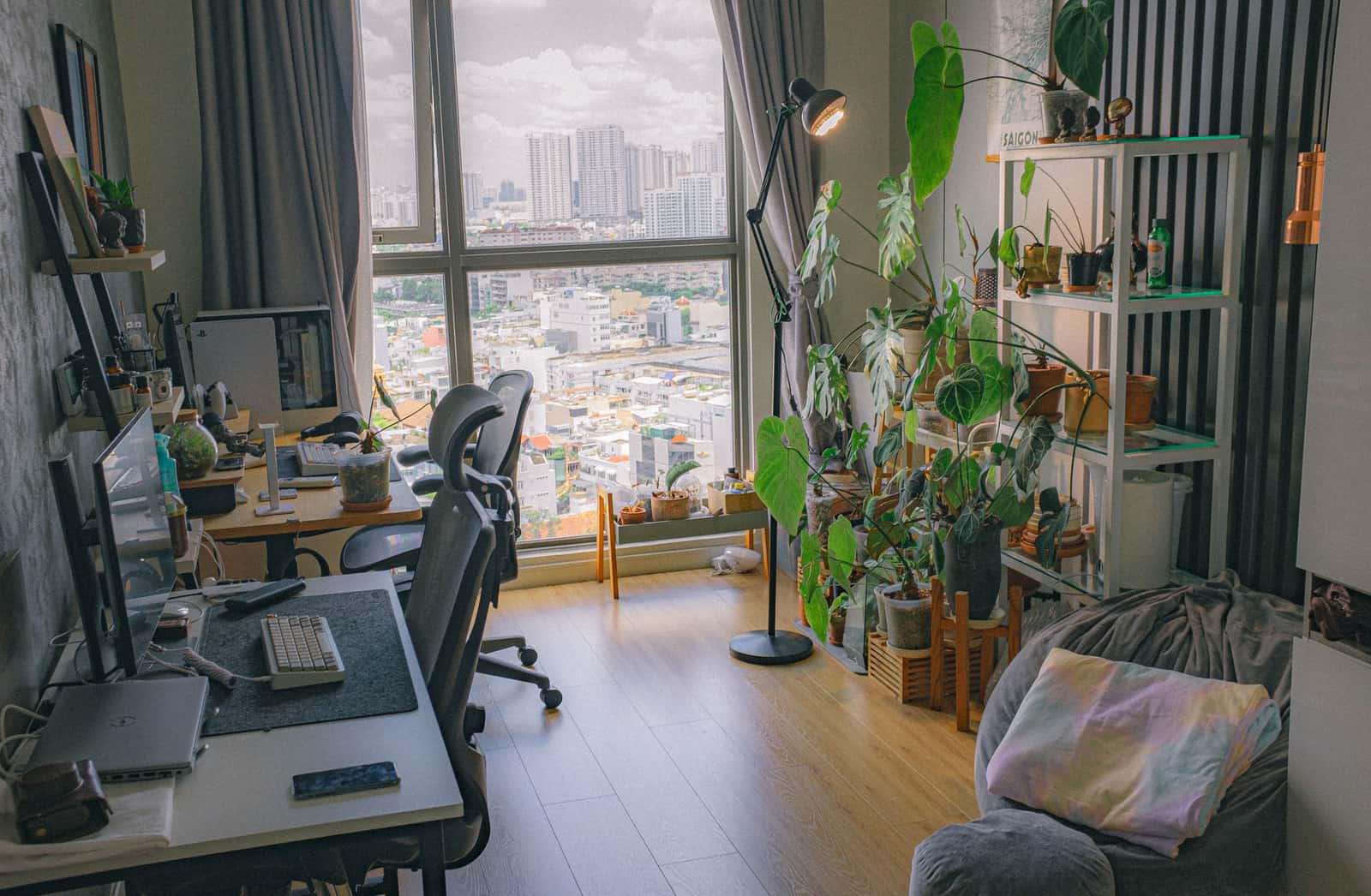
Photographs on this site are licensed stock and are illustrative of the fixture type. We do not own the units we write about.
How this page is funded: the buy links here are Amazon Associates links, and we earn a commission on qualifying purchases at no extra cost to you. We have not been paid to feature anything on this page, we accept no free product, and commission plays no part in the ranking. Full disclosure.
We have not tested these units. Everything below comes from the manufacturer’s own published specifications, or from arithmetic we have shown our working for. Where a figure is not published, we say so instead of estimating one. Read the method.
Quick picks
Efficacy is photons out per joule in. Where a manufacturer publishes it we quote theirs; where they publish photon output and wattage but not efficacy, we divide and label it as ours; where they publish neither, the cell says so rather than guessing. Tap a row for the full write-up.
| # | Product | Best for | Efficacy | Price |
|---|---|---|---|---|
| 1 | 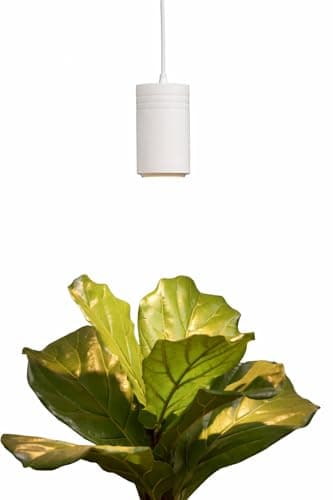 Soltech Aspect Gen 2 The only fixture here you would willingly hang in a living room, and the only one publishing PPFD at three separate distances so it can actually be placed by the numbers. | Looks like a light fitting | 1.39 umol/J (ours) | |
| 2 | 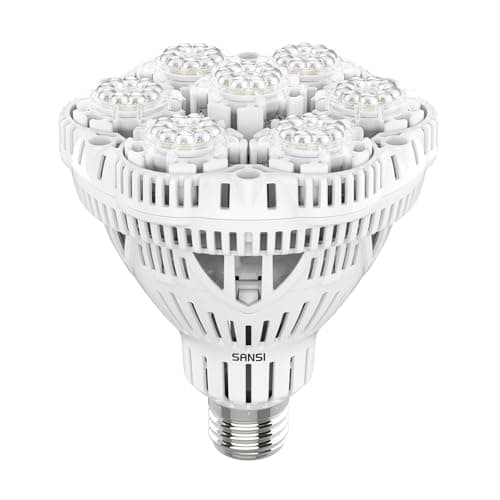 SANSI 36W BR30 Grow Light Bulb The rare grow bulb that publishes both PPF and a PPFD figure with the measurement distance attached, which is the only reason it can be sized honestly. | A lamp you already own | 1.82 umol/J (ours) | |
| 3 | 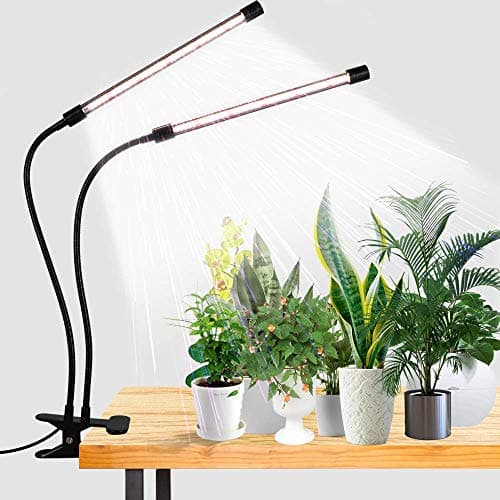 GooingTop Clip Grow Light The cheapest way to put real light on one plant on one desk, and honest about being exactly that — a 10 W clip lamp with a repeating timer. | Clamps, no holes | Not published | |
| 4 | 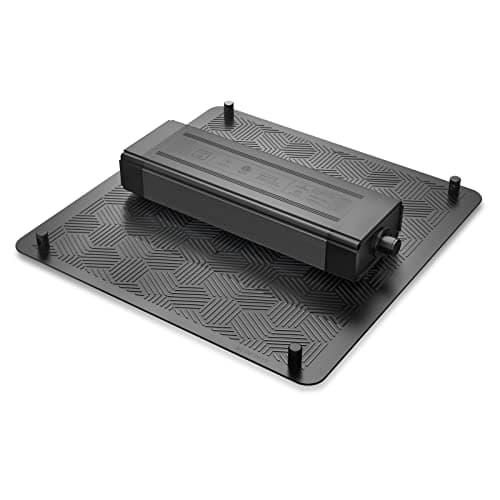 AC Infinity IONBOARD S22 The highest published efficacy of any fixture here at 2.7 umol/J, on Samsung LM301H diodes, with dimming in real 20% steps rather than a vague knob. | Under a bookshelf, silent | 2.7 umol/J |
The reasoning
Most grow-light advice is written for a garage, a basement or a tent — somewhere you can drill, hang, and leave a magenta fixture glowing at full output with nobody sitting under it. An apartment is none of those things. It adds four constraints at once, and a fixture that fails any one of them fails the apartment.
How we judged these
- Does it mount without a hole? A renter cannot drill a ceiling hook. Sockets, clamps and flat mounts under a bookshelf are in; hanging kits are out.
- Does it take floor space? A dedicated rack is a luxury a studio does not have. Fixtures that use a lamp, a shelf or a windowsill you already own beat ones that need their own real estate.
- Can you live in the room with it on? Color, glare and the way it looks switched off — this is a living room, not a grow room.
- Is it silent, and does it hold at night? A fan through a shared wall at 5 am is a problem a shed never has.
Every pick on this page goes in a socket, a clamp or flat under a shelf. That single constraint eliminated every hanging panel in the registry before output was considered.
What an apartment usually needs, in numbers
Apartment plants are typically a handful of foliage plants — pothos, monstera, a snake plant, maybe a fiddle leaf fig — and one or two things on a sill. That is the low-to-medium band, not the high one.
Three foliage plants in roughly a 2 × 2 ft corner (0.372 m²), targeting 150 µmol/m²/s: 150 × 0.372 ÷ 0.8 = 70 µmol/s.
One plant on a sill (0.093 m²) at the same level: 150 × 0.093 ÷ 0.8 = 17 µmol/s.
Both are small numbers. A 100 W panel publishing ~250 µmol/s is several times what either needs — which is why the picks here skew to bulbs, pendants and boards, not panels.
1. Soltech Aspect Gen 2 — the one that looks like a light fitting
The only fixture on this site designed to be seen. A 3.5 × 3.5 × 6.2 inch pendant at 3000 K warm white with a CRI of 98 — it reads as a lamp, not equipment — and it publishes light density at three distances: about 50 µmol/m²/s at 1 m, 34.9 at 4 ft, 15.5 at 6 ft. Those figures obey the inverse-square relationship to within rounding, so you can extrapolate to a height Soltech did not publish. In-line dimmer, 10 to 100%.
It is also the fixture we would put over a plant in the corner of a living room, because it is the only one that improves the room.
The cons: at 50 µmol/s from 36 W it is 1.39 µmol/J, the least efficient fixture we cover. And its own numbers show how modest it is — 50 µmol/m²/s at a meter is the floor of the low band, so it suits a low-light foliage plant hung within about 3 ft and will not serve herbs or a succulent. It also needs a hook or a plug-in pendant cord routed to somewhere it can hang — no ceiling hole, but somewhere.
2. SANSI 36W BR30 — in a lamp you already own
Zero mounting, zero footprint: it screws into the floor lamp or table lamp that is already in the room. It publishes 65.6 µmol/s and — the useful part — 265.58 µmol/m²/s at a stated 1 ft, so the lamp height is a calculation: 18 inches for a pothos, 12 for a succulent, 14 for a violet.
At 4000 K with a CRI close to 100 it looks like ordinary light, and at 36 W it costs about $2.38 a month.
The cons: 1.82 µmol/J is a third less efficient than a panel — the screw-in tax. It lights one plant, so an apartment with six plants needs six lamps, at which point a board under a shelf is the better answer.
3. GooingTop clip light — clamps to anything
A gooseneck on a clamp: bookshelf edge, windowsill, desk, headboard. About 10 W, five brightness levels, a built-in repeating timer, and roughly $4.00 of electricity across an entire winter. For a renter it solves mounting outright.
The cons: no manufacturer spec sheet exists — the figures we can report come from the retail listing, and nothing about its output can be computed or compared. It lights one small plant. And its repeating timer counts from power-on rather than tracking a clock, so a power interruption shifts the schedule.
4. AC Infinity IONBOARD S22 — flat under a bookshelf, silent
The apartment-friendly panel, because it is not a panel: a board 30 × 30 cm and 1.1 cm thick, passively cooled, designed to mount flat under a shelf rather than hang. No fan — which matters through a shared wall — and dimming in stated 20% steps, so you can run it at 40% in the evening and know that is what you set.
It publishes 2.7 µmol/J on named Samsung LM301H diodes, the highest efficacy we can attribute to a component.
The cons: its published “1098 PPFD” carries no measurement distance and cannot be used; it publishes no photon flux directly (~311 µmol/s is our arithmetic); and at full output it is far more than a corner of foliage plants needs, so you are buying capacity to dim away. Its 6500 K channel is also cooler-looking than most living rooms want — dim it and mount it out of the eyeline.
What we left off, and why
- Every hanging panel. The Mars Hydro TS 1000, Spider Farmer SF1000, ViparSpectra P1000 and VIVOSUN VS1000 all need a hook, and all publish several times the output a typical apartment corner uses. Good fixtures; wrong constraints.
- Linked strips. Barrina strips are the right tool for a wire rack of seedlings — and a wire rack is exactly the furniture an apartment does not have room for. If you do have a shelf to mount them under, they work; see the shelf and rack picks.
Living with it
- Mount above eye level, aim down. That handles the exposure question — covered in are grow lights safe for eyes and pets — and the glare one.
- Run it during the day. A timer that switches off before the evening means the light is on while you are out and off while you are on the sofa.
- Prefer warm white where you sit. The Soltech at 3000 K and the SANSI at 4000 K read as lamps; a 6500 K board reads as an office.
- Watch the cable. A clip light on a bookshelf with a cable to the floor is the thing that gets pulled down.
Running cost
| Fixture | Power | kWh/month | Cost |
|---|---|---|---|
| GooingTop clip light | about 10 W | 3.6 | $0.66 |
| SANSI 36W BR30 | 36 W | 12.96 | $2.38 |
| Soltech Aspect Gen 2 | 36 W | 12.96 | $2.38 |
| AC Infinity IONBOARD S22, at ~40% | about 46 W | 16.6 | $3.04 |
The honest verdict
For a plant in the corner of a room people sit in, the Soltech — it is modest light, but it is the only fixture here that makes the room better rather than worse. For one plant and a lamp you own, the SANSI. For a windowsill or a bookshelf edge with nowhere to mount anything, the clip light. And if the apartment has a bookshelf with a few plants on the shelf below, the AC Infinity board flat underneath it is the one genuinely capable fixture that fits the constraints. The single-desk version of this question is in the best desktop grow lights.
Every pick in full
Soltech Aspect Gen 2
PendantLooks like a light fitting
The only fixture here you would willingly hang in a living room, and the only one publishing PPFD at three separate distances so it can actually be placed by the numbers.
What Soltech publishes
- Power draw
- 36 W (source)
- PPF (photon output)
- 50 umol/s (source)
- PPFD
- about 50 umol/m2/s at 1 m, 34.9 at 4 ft, 15.5 at 6 ft (source)
- Spectrum
- 3000 K warm white, CRI 98 (source)
- Dimming
- Yes, in-line dimmer 10-100% (source)
- Dimensions
- 3.5 x 3.5 x 6.2 inches (source)
- Rated life
- 50,000 hours (source)
Our arithmetic
- Efficacy, computed from the published figures: 1.39 umol/J
50 umol/s / 36 W = 1.39 umol/J. Roughly half the efficacy of a 2.7 umol/J board — the design premium is paid twice, once at purchase and again every month on the meter.
Who should skip it
Skip it if photons per watt is the metric that matters. At 50 umol/s from 36 W it is the least efficient fixture on this page, and much of the price is industrial design.
SANSI 36W BR30 Grow Light Bulb
Grow bulbA lamp you already own
The rare grow bulb that publishes both PPF and a PPFD figure with the measurement distance attached, which is the only reason it can be sized honestly.
What SANSI publishes
- Power draw
- 36 W (source)
- PPF (photon output)
- 65.6 umol/s (source)
- PPFD
- 265.58 umol/m2/s at 1 ft (source)
- Spectrum
- 4000 K, 400-780 nm, CRI close to 100 (source)
- Rated life
- 25,000 hours (source)
Our arithmetic
- Efficacy, computed from the published figures: 1.82 umol/J
65.6 umol/s / 36 W = 1.82 umol/J. That is roughly a third less efficient than the panels on this page — the price of a screw-in form factor. - Electricity used at 12 hours a day for 30 days: 12.96 kWh a month
36 W x 12 h x 30 d / 1000 = 12.96 kWh.
What SANSI does not publish
- Beam angle
- Fixture dimensions
Who should skip it
Skip it if you are lighting more than one plant. 65.6 umol/s is a small amount of light spread over a cone — it lights a single specimen, not a shelf.
GooingTop Clip Grow Light
Clip lightClamps, no holes
The cheapest way to put real light on one plant on one desk, and honest about being exactly that — a 10 W clip lamp with a repeating timer.
What GooingTop publishes
- Power draw
- About 10 W (source)
- Spectrum
- 6000 K, 74 white plus 10 red LEDs, CRI 95 (source)
- Dimming
- Five brightness levels; repeating 4 / 8 / 12 hour timer (source)
What GooingTop does not publish
- PPF in umol/s
- PPFD at any distance
- Photon efficacy in umol/J
- The manufacturer publishes no spec sheet at all; the figures above come from the retail listing
Who should skip it
Skip it if the plant is more than about a foot across, or if you want any number at all before you buy — nobody publishes photon data for this fixture.
AC Infinity IONBOARD S22
LED panelUnder a bookshelf, silent
The highest published efficacy of any fixture here at 2.7 umol/J, on Samsung LM301H diodes, with dimming in real 20% steps rather than a vague knob.
What AC Infinity publishes
- Power draw
- 115 W (source)
- Efficacy
- 2.7 umol/J (source)
- PPFD
- 1098 PPFD (no measurement distance published) (source)
- Stated coverage
- 2 x 2 ft (source)
- Spectrum
- Samsung LM301H, plus 660 nm, 730 nm, 3000 K, 6500 K (source)
- Diodes
- 272 diodes (source)
- Dimming
- Yes, 0-100% in 20% increments (source)
- Dimensions
- 30.0 x 30.0 cm board, 1.1 cm thick (source)
- Rated life
- 50,000 hours (source)
Our arithmetic
- Photon output implied by the published wattage and efficacy: about 311 umol/s
115 W x 2.7 umol/J = 310.5 umol/s. AC Infinity does not print PPF directly, so this is our arithmetic from two figures it does print.
What AC Infinity does not publish
- PPF in umol/s — only efficacy is given, so photon output has to be derived
- The measurement distance for the 1098 PPFD figure, without which the number cannot be compared to anything
Who should skip it
Skip it if you want to place it by the numbers. AC Infinity prints 1098 PPFD with no measurement distance attached, which makes that figure impossible to use or compare.
Questions people actually ask
+What is the best grow light for an apartment?
+Can I use a grow light in an apartment without drilling?
+Will a grow light bother my neighbors or roommates?
+How much light do apartment plants actually need?
+Have you tested these in an apartment?
Sources
- Soltech — Aspect Gen 2 published specifications — consulted September 2, 2026
- SANSI — BR30 36W grow light bulb product page — consulted September 2, 2026
- GooingTop clip grow light — retail listing specifications (no manufacturer spec sheet published) — consulted September 2, 2026
- AC Infinity — IONBOARD S22 published specifications — consulted September 2, 2026
- University of Minnesota Extension — Lighting for indoor plants and starting seeds — consulted September 2, 2026
- US Energy Information Administration — Electric Power Monthly, Table 5.3 (US residential average, June 2026) — consulted September 2, 2026
- ams OSRAM — Details on photobiological safety of LED light sources (IEC/EN 62471 risk groups) — consulted September 2, 2026
Read next
Reviews
The Best Desktop Grow Lights
Four fixtures for a single desk plant, and why a panel is the wrong tool for one square foot.
Top pick
GooingTop Clip Grow Light
Houseplants
The Best Grow Lights for Indoor Plants
Sized to a 3-10 mol/m2/day houseplant target rather than a grow-tent target, with running cost for each.
Top pick
SANSI 36W BR30 Grow Light Bulb
Spectrum & PPFD
Are Grow Lights Safe for Eyes and Pets?
What IEC 62471 risk groups mean, the one real hazard, and sensible home precautions.
Reviews
The Best Grow Light Bulbs
Screw-in fixtures for single plants, what the form factor costs, and how to place one.
Top pick
SANSI 36W BR30 Grow Light Bulb
Where this sits
This page belongs to Fixture Reviews and Roundups. Every figure on it is either quoted from a named published source or derived in view — the full method is on our methodology page, and how the site is funded is on the affiliate disclosure.