Grow Lights for Snake Plants
The plant everyone calls indestructible is also the one most often kept barely alive. Here is the number it actually wants, and where to hang a lamp to deliver it.
By Scooter M. — An enthusiast who's genuinely into this. I read the manuals, compile the published specs, and do the math. No lab coat.
Published · How we pick
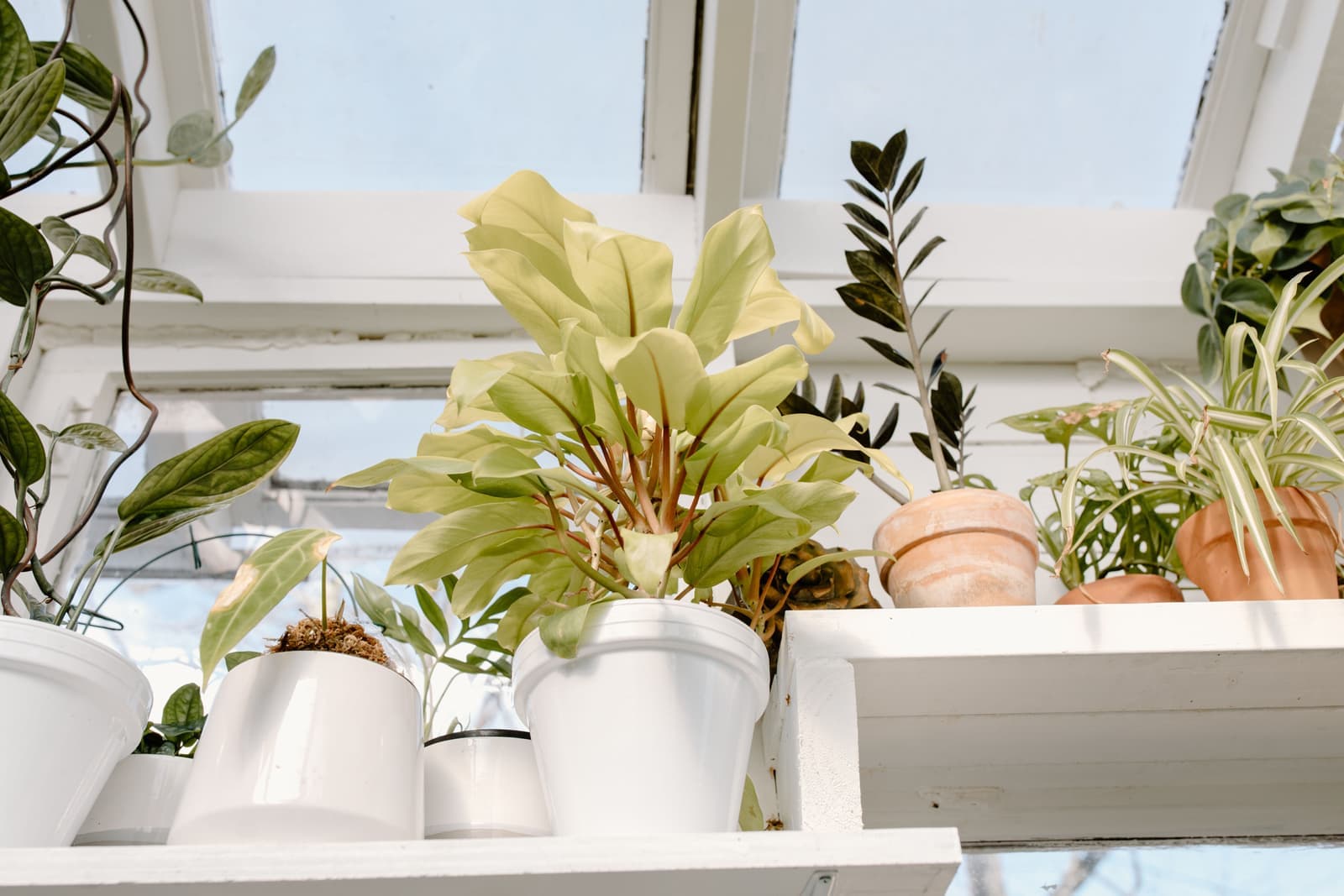
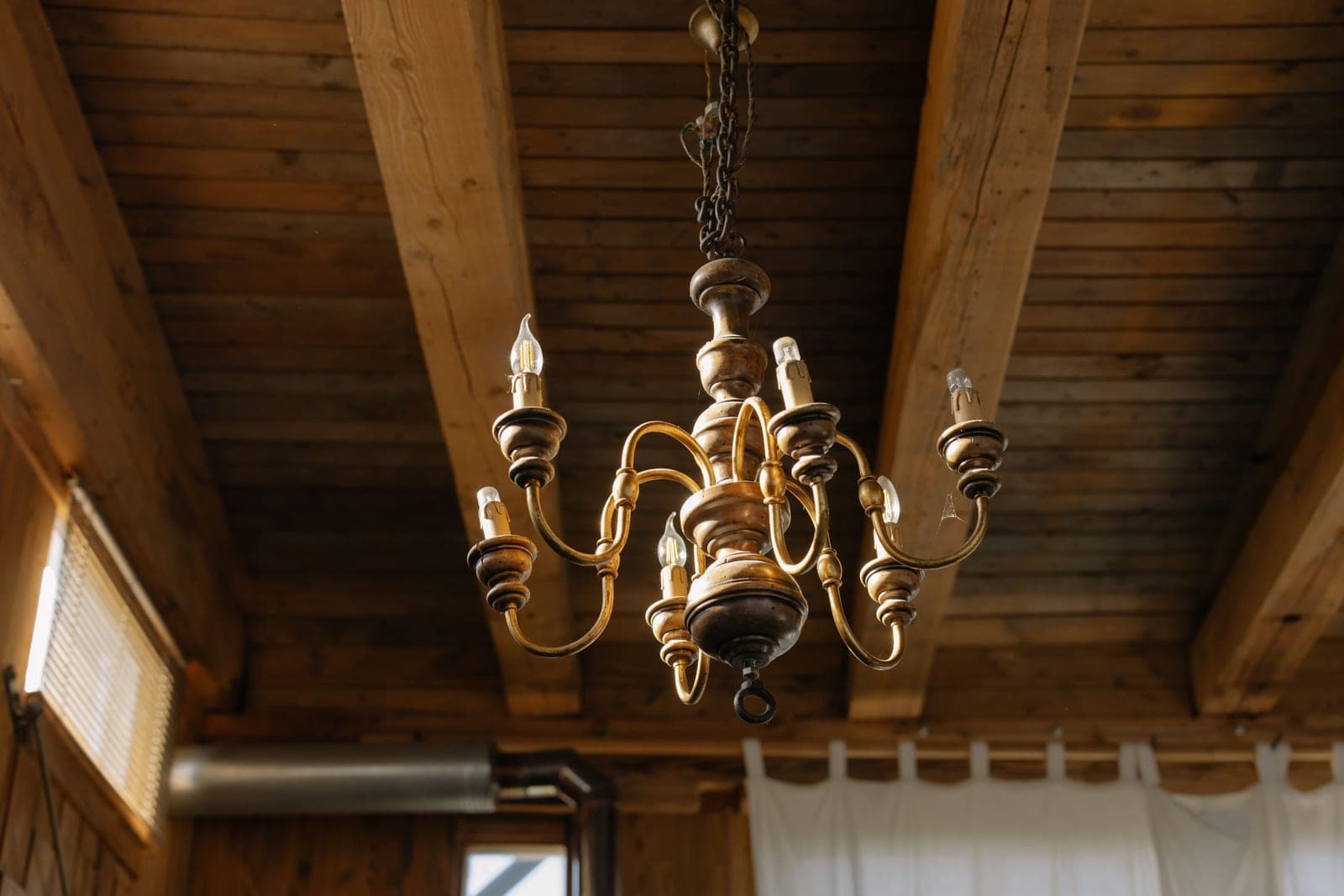
Photographs on this site are licensed stock and are illustrative of the fixture type. We do not own the units we write about.
How this page is funded: the buy links here are Amazon Associates links, and we earn a commission on qualifying purchases at no extra cost to you. We have not been paid to feature anything on this page, we accept no free product, and commission plays no part in the ranking. Full disclosure.
We have not tested these units. Everything below comes from the manufacturer’s own published specifications, or from arithmetic we have shown our working for. Where a figure is not published, we say so instead of estimating one. Read the method.
Quick picks
Efficacy is photons out per joule in. Where a manufacturer publishes it we quote theirs; where they publish photon output and wattage but not efficacy, we divide and label it as ours; where they publish neither, the cell says so rather than guessing. Tap a row for the full write-up.
| # | Product | Best for | Efficacy | Price |
|---|---|---|---|---|
| 1 | 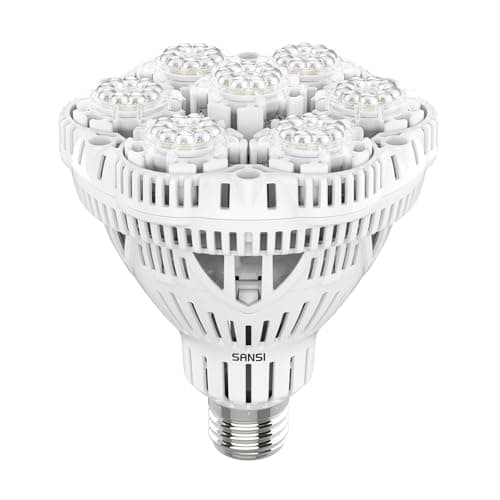 SANSI 36W BR30 Grow Light Bulb The rare grow bulb that publishes both PPF and a PPFD figure with the measurement distance attached, which is the only reason it can be sized honestly. | Placeable by arithmetic | 1.82 umol/J (ours) | |
| 2 | 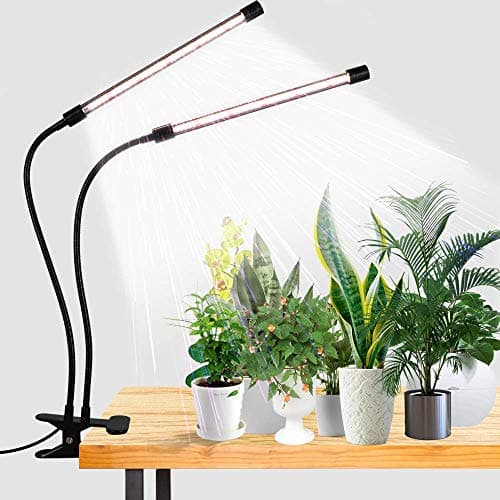 GooingTop Clip Grow Light The cheapest way to put real light on one plant on one desk, and honest about being exactly that — a 10 W clip lamp with a repeating timer. | No socket needed | Not published | |
| 3 | 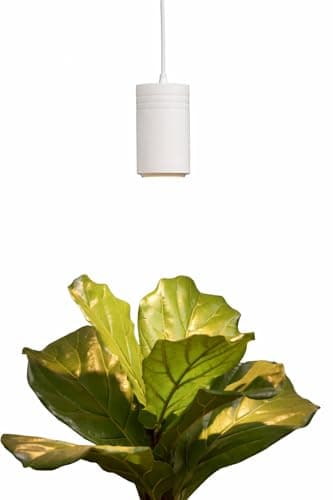 Soltech Aspect Gen 2 The only fixture here you would willingly hang in a living room, and the only one publishing PPFD at three separate distances so it can actually be placed by the numbers. | A plant on display | 1.39 umol/J (ours) |
The reasoning
The snake plant’s reputation is the problem. It is sold as the plant that survives anything, which is true, and people reasonably conclude that light is therefore not a variable worth thinking about. It is — just not in the way it is for a seedling. A snake plant in a dark hallway does not die. It simply stops, for years, and most owners never connect the absence of new growth to the absence of light.
The distinction that matters here: snake plants tolerate low light rather than prefer it. Give one more and it grows faster, throws thicker leaves, and holds its variegation. That is the whole case for a fixture.
µmol/m²/s — University of Minnesota Extension's low-light band, alongside pothos and ZZ. Survival happens below it; growth happens at the top of it.
What the target means in practice
University of Minnesota Extension puts low-light plants at 50 to 150 µmol/m²/s. A snake plant sitting at 60 is being kept; one sitting at 140 is being grown. Neither is dramatic to look at on any given day, which is exactly why the difference goes unnoticed until you compare two plants after a year.
Because the target is low, this is one of the few situations on this site where the risk runs the other way: it is easy to give a snake plant far more light than it wants, at which point you are paying for photons it cannot use. The full table of bands by plant is in PPFD targets by plant type.
The exact distance, computed
SANSI is the only bulb we cover that publishes a PPFD figure with the distance it was measured at — 265.58 µmol/m²/s at 1 ft. That single detail is what makes a lamp placeable on paper rather than by trial.
Published: 265.58 µmol/m²/s at 1 ft.
At 18 in (1.5 ft): 265.58 × (1 ÷ 1.5)² = 118 µmol/m²/s — mid-to-upper low band. This is the setting we would use.
At 2 ft: 265.58 × (1 ÷ 2)² = 66 µmol/m²/s — still inside the band, nearer the floor.
At 1 ft: 265.58 — roughly double the top of the band. Not harmful, but you are running 36 W to deliver light the plant will not convert.
So the answer to “how far away” for a snake plant is roughly 18 to 24 inches from a bulb of this output, which is further than most people place a grow light. The general version of this arithmetic is in how far a grow light should be from plants.
Hours matter more than intensity here
Because the intensity target is modest, photoperiod does most of the work. Iowa State University Extension suggests 12 to 14 hours a day for indoor plants under supplemental light, with 10 as a floor and 16 as a ceiling. For a snake plant, the low end of that is fine.
118 µmol/m²/s at 12 hours a day:
DLI = 118 × 12 × 3600 ÷ 1,000,000 = 5.1 mol/m²/day.
For context, seedlings want about 12 mol/m²/day per University of New Hampshire Extension. A snake plant is asking for well under half that, which is why a single bulb genuinely covers it.
The three fixtures that suit this plant
| Fixture | Published output | Why it suits | The catch |
|---|---|---|---|
| SANSI 36W BR30 | 65.6 µmol/s; 265.58 µmol/m²/s at 1 ft | The only one you can place by arithmetic before buying | Needs a lamp with an E26 socket, and 1.82 µmol/J is modest efficiency |
| GooingTop clip light | About 10 W; no photon data published | Clamps anywhere, built-in 4/8/12 h repeating timer, about $4 of electricity a whole winter | Nobody publishes any output figure, so it cannot be placed by numbers |
| Soltech Aspect Gen 2 | 50 µmol/s; about 50 µmol/m²/s at 1 m | Looks like a light fitting; its published figure lands exactly on the low-band floor | 1.39 µmol/J is the least efficient fixture we cover, and it is a design purchase |
Note what is not on that list: every panel we cover. A 100 W panel over one snake plant is roughly ten times the light the plant will use, and you pay for all of it. If you are lighting a shelf of mixed foliage plants rather than one specimen, that changes — see our houseplant picks.
What it costs
36 W × 12 h ÷ 1000 = 0.432 kWh a day.
0.432 × 30 = 12.96 kWh a month.
At the US residential average of 18.34 cents per kWh: $2.38 a month, or about $14.42 across an October-to-March season.
The clip light, at roughly 10 W, comes in near $4.00 for the entire winter.
Signs you have it wrong
- No new growth for a year or more. The characteristic snake plant failure. It is not dying and it is not growing, and the usual cause is that it is below the band.
- New leaves narrower and floppier than the old ones. The plant is producing tissue on a light budget it cannot support.
- Variegation fading toward plain green on cultivars like ‘Laurentii’. Variegated tissue has less chlorophyll, so those plants are the least tolerant of a light deficit.
- Leaning hard toward the window. Directional growth is the plant telling you where the light is and that there is not enough of it.
One thing that is not a light symptom: soft, mushy leaf bases. That is almost always water, and adding a grow light will not fix it.
The honest summary
A snake plant needs less light than almost anything else you might put under a fixture, and it will forgive you for a long time if you get it wrong. If it sits in a room with a usable window, you probably need nothing at all. If it is in a hallway, an interior office or a north room in January, a single bulb at 18 to 24 inches, on a timer for 12 hours, costs a few dollars a season and turns a plant that is holding on into one that is actually growing.
If the same room also holds plants with real light demands — herbs, succulents, anything fruiting — size for those instead and let the snake plant sit at the edge of the footprint. It will be happier there than they would be.
Every pick in full
SANSI 36W BR30 Grow Light Bulb
Grow bulbPlaceable by arithmetic
The rare grow bulb that publishes both PPF and a PPFD figure with the measurement distance attached, which is the only reason it can be sized honestly.
What SANSI publishes
- Power draw
- 36 W (source)
- PPF (photon output)
- 65.6 umol/s (source)
- PPFD
- 265.58 umol/m2/s at 1 ft (source)
- Spectrum
- 4000 K, 400-780 nm, CRI close to 100 (source)
- Rated life
- 25,000 hours (source)
Our arithmetic
- Efficacy, computed from the published figures: 1.82 umol/J
65.6 umol/s / 36 W = 1.82 umol/J. That is roughly a third less efficient than the panels on this page — the price of a screw-in form factor. - Electricity used at 12 hours a day for 30 days: 12.96 kWh a month
36 W x 12 h x 30 d / 1000 = 12.96 kWh.
What SANSI does not publish
- Beam angle
- Fixture dimensions
Who should skip it
Skip it if you are lighting more than one plant. 65.6 umol/s is a small amount of light spread over a cone — it lights a single specimen, not a shelf.
GooingTop Clip Grow Light
Clip lightNo socket needed
The cheapest way to put real light on one plant on one desk, and honest about being exactly that — a 10 W clip lamp with a repeating timer.
What GooingTop publishes
- Power draw
- About 10 W (source)
- Spectrum
- 6000 K, 74 white plus 10 red LEDs, CRI 95 (source)
- Dimming
- Five brightness levels; repeating 4 / 8 / 12 hour timer (source)
What GooingTop does not publish
- PPF in umol/s
- PPFD at any distance
- Photon efficacy in umol/J
- The manufacturer publishes no spec sheet at all; the figures above come from the retail listing
Who should skip it
Skip it if the plant is more than about a foot across, or if you want any number at all before you buy — nobody publishes photon data for this fixture.
Soltech Aspect Gen 2
PendantA plant on display
The only fixture here you would willingly hang in a living room, and the only one publishing PPFD at three separate distances so it can actually be placed by the numbers.
What Soltech publishes
- Power draw
- 36 W (source)
- PPF (photon output)
- 50 umol/s (source)
- PPFD
- about 50 umol/m2/s at 1 m, 34.9 at 4 ft, 15.5 at 6 ft (source)
- Spectrum
- 3000 K warm white, CRI 98 (source)
- Dimming
- Yes, in-line dimmer 10-100% (source)
- Dimensions
- 3.5 x 3.5 x 6.2 inches (source)
- Rated life
- 50,000 hours (source)
Our arithmetic
- Efficacy, computed from the published figures: 1.39 umol/J
50 umol/s / 36 W = 1.39 umol/J. Roughly half the efficacy of a 2.7 umol/J board — the design premium is paid twice, once at purchase and again every month on the meter.
Who should skip it
Skip it if photons per watt is the metric that matters. At 50 umol/s from 36 W it is the least efficient fixture on this page, and much of the price is industrial design.
Questions people actually ask
+Do snake plants need a grow light?
+How far should a grow light be from a snake plant?
+Can a snake plant get too much light?
+How many hours a day should the light be on?
+Have you tested these lights on a snake plant?
Sources
- University of Minnesota Extension — Lighting for indoor plants and starting seeds — consulted September 2, 2026
- Iowa State University Extension — Important Considerations for Providing Supplemental Light to Indoor Plants — consulted September 2, 2026
- University of New Hampshire Extension — Growing Seedlings Under Lights — consulted September 2, 2026
- SANSI — BR30 36W grow light bulb product page — consulted September 2, 2026
- Soltech — Aspect Gen 2 published specifications — consulted September 2, 2026
- GooingTop clip grow light — retail listing specifications (no manufacturer spec sheet published) — consulted September 2, 2026
- US Energy Information Administration — Electric Power Monthly, Table 5.3 (US residential average, June 2026) — consulted September 2, 2026
Read next
Houseplants
Grow Lights for Spider Plants
The band spider plants want, the hanging-basket distance, and why brown tips are not a light problem.
Top pick
GooingTop Clip Grow Light
Houseplants
Grow Lights for Pothos
When a pothos needs a fixture, the lamp distance that hits the low band, and the variegation exception.
Top pick
SANSI 36W BR30 Grow Light Bulb
Coverage & Sizing
PPFD Targets by Plant Type
Published light bands mapped to common indoor plants, with the DLI each implies.
Top pick
GooingTop Clip Grow Light
Houseplants
The Best Grow Lights for Indoor Plants
Sized to a 3-10 mol/m2/day houseplant target rather than a grow-tent target, with running cost for each.
Top pick
SANSI 36W BR30 Grow Light Bulb
Houseplants
How Much Light Do Houseplants Need in Winter?
Published DLI bands by plant type, and how to work out what your winter window is short by.
Top pick
SANSI 36W BR30 Grow Light Bulb
Coverage & Sizing
How Far Should a Grow Light Be From Plants?
The inverse-square rule, published PPFD-at-distance figures, and a by-plant table.
Top pick
Soltech Aspect Gen 2
Where this sits
This page belongs to Grow Lights for Houseplants and Winter. Every figure on it is either quoted from a named published source or derived in view — the full method is on our methodology page, and how the site is funded is on the affiliate disclosure.