Can You Put a Grow Light Bulb in a Regular Lamp?
Almost always yes, because the thread is the same one your table lamp already takes. The failure cases are heat, weight and a shade that throws your photons at the ceiling.
By Scooter M. — An enthusiast who's genuinely into this. I read the manuals, compile the published specs, and do the math. No lab coat.
Published · How we pick
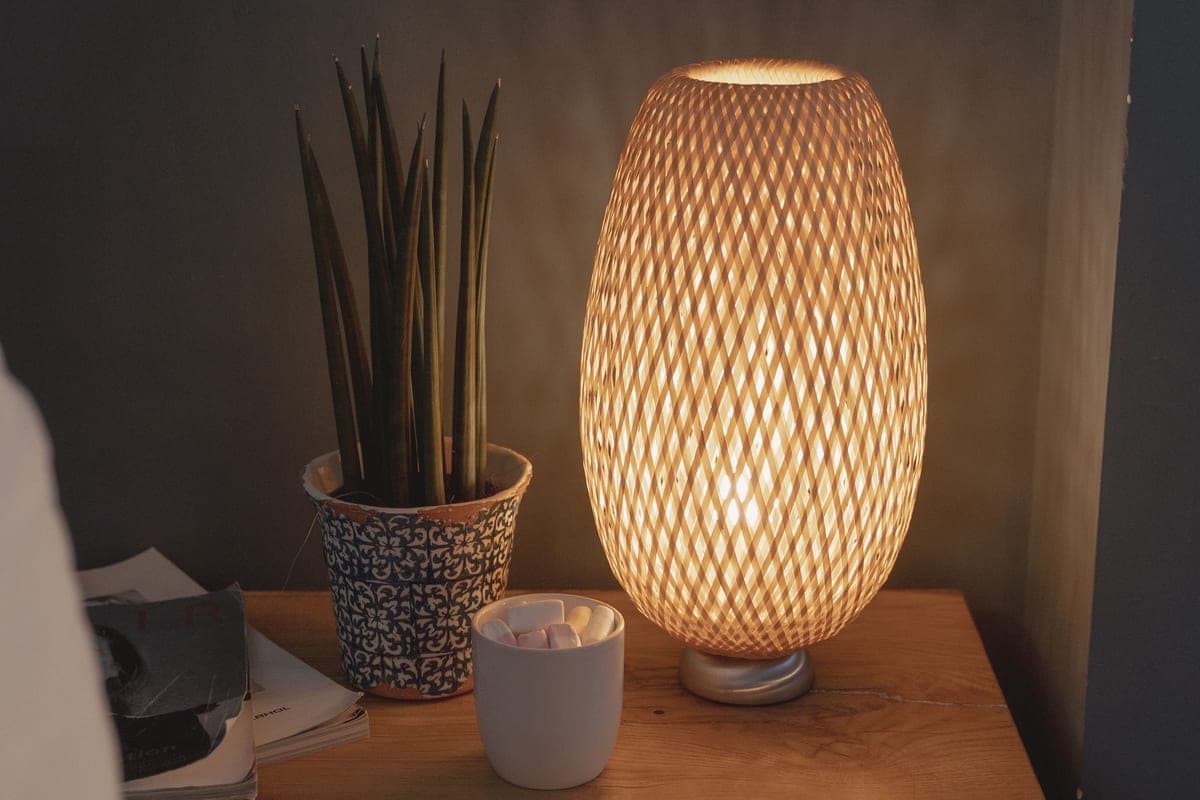
Photographs on this site are licensed stock and are illustrative of the fixture type. We do not own the units we write about.
How this page is funded: the buy links here are Amazon Associates links, and we earn a commission on qualifying purchases at no extra cost to you. We have not been paid to feature anything on this page, we accept no free product, and commission plays no part in the ranking. Full disclosure.
We have not tested these units. Everything below comes from the manufacturer’s own published specifications, or from arithmetic we have shown our working for. Where a figure is not published, we say so instead of estimating one. Read the method.
Quick picks
Efficacy is photons out per joule in. Where a manufacturer publishes it we quote theirs; where they publish photon output and wattage but not efficacy, we divide and label it as ours; where they publish neither, the cell says so rather than guessing. Tap a row for the full write-up.
| # | Product | Best for | Efficacy | Price |
|---|---|---|---|---|
| 1 | 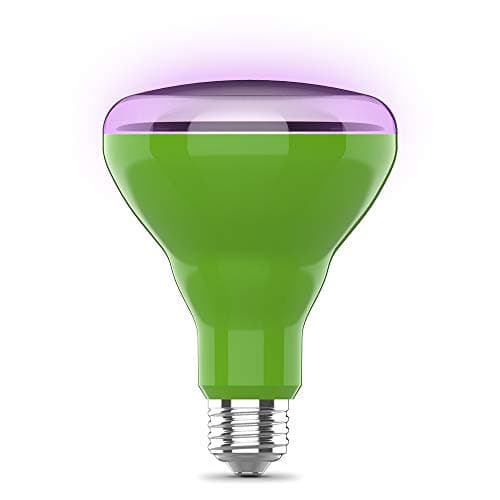 Feit Electric 9W BR30 Grow Bulb The right shape for pointing light at a plant — a reflector flood with a published 110-degree beam — and the one bulb in Feit's range whose own spec page carries no photon figure at all. | A closed or damp fitting | Not published | |
| 2 | 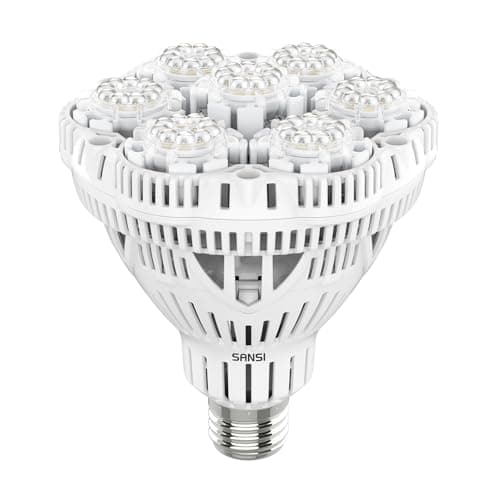 SANSI 36W BR30 Grow Light Bulb The rare grow bulb that publishes both PPF and a PPFD figure with the measurement distance attached, which is the only reason it can be sized honestly. | The most light, open fittings only | 1.82 umol/J (ours) | |
| 3 | 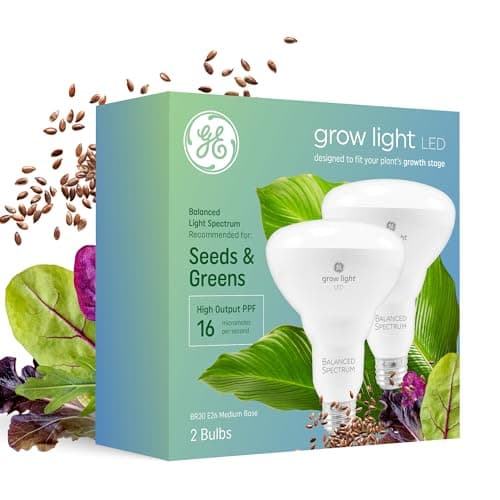 GE Grow Light BR30 Bulb, Seeds and Greens (2-pack) A mainstream-brand grow bulb that prints its photon output on the box: 16 umol/s from 9 W, which is enough for one low- or medium-light plant under a lamp you already own, and not much more. | Two lamps you already own | Not published | |
| 4 | 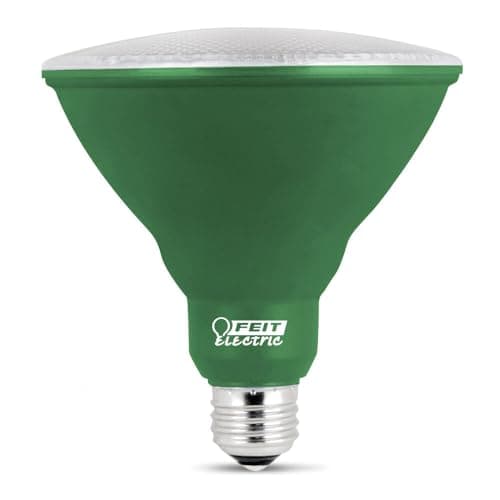 Feit Electric 16W PAR38 Grow Bulb The only bulb in Feit's grow range that publishes both a photon figure and a beam angle, which makes it the only one you can place over a plant by arithmetic instead of by guesswork. | A ceiling can, two feet up | Not published | |
| 5 | 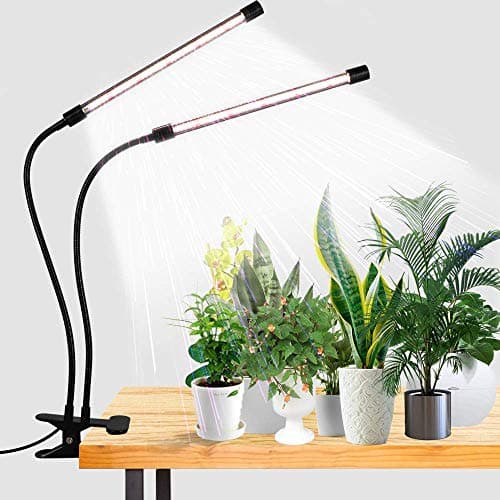 GooingTop Clip Grow Light The cheapest way to put real light on one plant on one desk, and honest about being exactly that — a 10 W clip lamp with a repeating timer. | When there is no lamp at all | Not published |
The reasoning
Yes. Every grow bulb on this site is a standard E26 medium screw base, so it fits the lamp on your desk, the one by the sofa and the fitting in the ceiling. Three things decide whether it works rather than merely fits: whether the fitting is enclosed, whether the lamp can carry a bulb that may weigh a pound, and whether the shade sends the light at the plant or at the ceiling. If your fitting is closed, the Feit Electric 9W BR30 is the one to buy, because it is the only bulb here that publishes a rating for one.
We have not tested these bulbs. Everything below is from each manufacturer’s published specification, with the arithmetic shown where we did any.
The fit itself: E26, and what the number on the box means
Two codes matter and they are both on the box. The base code — E26 in North America, E27 in Europe and the UK — is the screw thread, and every grow bulb we cover uses it. SANSI sells the same bulb as E26 or E27 by region. GE puts it plainly: “Simply install BR30 GE Grow Light Bulbs into any existing E26 medium base fixture.”
The shape code tells you whether it will physically clear your shade, and it is more useful than people realize. As Feit’s own reference chart states, “the letter indicates the shape of the bulb and the number relates to the diameter of the bulb in eighths of an inch”. So the number divided by eight is the width in inches.
A19: 19 ÷ 8 = 2.375 in across — the ordinary household pear shape, which Feit also states as 2 3/8 inches.
BR30: 30 ÷ 8 = 3.75 in across — a bulged reflector, half an inch wider than most people picture.
PAR38: 38 ÷ 8 = 4.75 in across — a floodlight, and wider than many table-lamp harps.
That is a tape-measure check you can do before ordering. It also resolves a small oddity in GE’s own listings, which give a bulb diameter of 94 for the BR30 and 60 for the A19 in a column headed inches. Those are the millimetre figures — a BR30 is 95 mm, an A19 is 60 mm — so the number is right and the unit is not.
Check 1: is the fitting enclosed?
This is the check that actually eliminates products, and almost nobody runs it. An enclosed fitting — a closed ceiling fixture, a recessed can, a glass globe, a lantern — traps heat around the bulb. Most of what a 9 W LED draws leaves as heat, and LED efficacy falls as junction temperature rises, so a bulb in a sealed fitting is both dimmer and shorter-lived than the same bulb in open air.
Manufacturers either publish a rating for this or they do not, and the spread across the five bulbs we cover is wide.
| Bulb | Base | Enclosed fixture | Location rating | Dimmable | Width |
|---|---|---|---|---|---|
| Feit Electric 9W BR30 | E26 | Rated: Yes | Damp | No | 3.7 in |
| Feit Electric 9W A19 | E26 | Rated: Yes | Damp | No | 2.4 in |
| Feit Electric 16W PAR38 | E26 | Rated: Yes | Wet | No | 4.7 in |
| SANSI 36W BR30 | E26 / E27 | Not recommended | Not published | Not stated | BR30, 1 lb |
| GE Grow BR30 | E26 medium | Not published | Not published (indoor) | No | 95 mm |
| GE Grow A19 | E26 medium | Not published | Not published (indoor) | No | 60 mm |
Feit is the only manufacturer here that answers the question. All three of its grow bulbs are listed “enclosed fixture rated: Yes”, the A19 and BR30 are rated for damp locations and the PAR38 for wet ones.
SANSI answers it the other way, and deserves credit for saying so: “For better ventilation and heat dissipation, it is not recommended to be used in tightly closed fixtures.” That is the brightest grow bulb in the category ruling itself out of every closed fitting in your house. GE says nothing at all, which is not a claim that its bulbs are unsuitable — it is a statement about what GE documented, and in a sealed fixture we would choose the bulb that carries the rating rather than assume.
Check 2: can the lamp hold it?
A grow bulb is heavier than the bulb it replaces, because the heat has to go somewhere and the somewhere is a metal or ceramic body. SANSI publishes the figure and the warning in the same breath: “Heavy duty, size of BR30, 1 LB, heavier and wider than ordinary bulb.”
One pound is about four times a standard LED bulb. Our judgment, not a published specification: that rules out most gooseneck lamps, cheap clip-on shades and anything where the socket is held up by a friction joint. A table lamp with a weighted base and a rigid socket is fine; a flexible arm pointed sideways will droop. If the lamp was designed to hold a 40 g bulb, aim the socket downward or choose a 9 W bulb instead, all of which weigh a fraction as much.
Check 3: where is the shade sending the light?
A lampshade is designed to stop light reaching your eyes, which is the opposite of what you now want. The three arrangements that work, in order of how much light survives:
- A bare socket aimed down. Nothing absorbed. An architect or clamp lamp with a metal reflector is the ideal case, because the reflector returns light that would have gone upward.
- An open-bottomed drum or cone shade. Light escapes downward in a cone; what hits the fabric is largely lost. Workable if the plant sits directly beneath.
- A reflector bulb in any shade. A BR30 or PAR38 puts its own beam downward before the shade can interfere, which is why reflector shapes dominate the grow bulb market.
A glass globe or an upward-facing torchiere is the case to avoid entirely: it is both an enclosed fitting and a fixture aimed at the ceiling.
Beam angle decides how wide that cone is, and only two bulbs here publish one — the Feit PAR38 at 40 degrees and the Feit BR30 at 110. Neither SANSI nor GE publishes a beam angle, so with those two you cannot compute the footprint and have to set the height by result.
Check 4: dimmers, smart plugs and timers
Do not put any of these bulbs on a wall dimmer. Feit lists all three as non-dimmable, GE lists both of its grow bulbs as non-dimmable, and SANSI does not state a dimming specification at all. A non-dimmable LED on a dimmer circuit buzzes, flickers, or fails early, and the dimmer may be damaged with it.
What you want instead is a plug-in timer, which costs a few dollars and does the one job that matters for a plant: the same hours every day without you remembering. We argue the case for the external timer over the built-in kind in grow lights with timers. A smart plug works equally well and adds nothing the cheap timer lacks.
How high to hang the lamp
Two of these bulbs publish enough to answer that in advance, which is most of the reason to prefer them.
265.58 µmol/m²/s at 1 ft. Scaled by inverse square: 66 µmol/m²/s at 2 ft, 118 at 18 in, 170 at 15 in.
For a foliage plant in the low band (50 to 150 µmol/m²/s on the University of Minnesota Extension’s scale), 18 to 24 inches. For a flowering houseplant in the medium band, 14 to 16 inches.
About 414 µmol/m²/s at 12 in, and about 103 at 24 in.
So a ceiling can two feet above a plant lands in the low band almost exactly — which is the one arrangement where a 40-degree flood in a closed fitting is the right answer.
With the GE bulbs you are working blind on distance, because no beam angle is published. GE’s own guidance is 6 to 9 inches for the BR30 and 9 inches for the A19, run 18 hours a day. That is closer than we would start, and the plant will tell you: pale, bleached or curling leaves mean raise it.
1. Feit Electric 9W BR30 — a closed or damp fitting
The only bulb here that answers the enclosed-fixture question with a yes, and it is damp-rated as well, with a 110-degree beam that spreads over a plant rather than spotlighting it. 3.7 inches wide, E26, 25,000 hours.
Best for: a closed ceiling fitting, a glass shade, a recessed can, or any room that gets humid.
The downside: Feit publishes a PPF for its A19 and its PAR38 but not for this one, so the bulb we recommend for closed fittings is the one whose output cannot be computed. 9 W is a small amount of light in any case — one plant, not a shelf.
2. SANSI 36W BR30 — the most light, open fittings only
65.6 µmol/s is four times what any 9 W bulb here emits, and it is the only bulb publishing a PPFD with the distance attached. If the fitting is open and the lamp is solid, nothing else in this form factor competes.
Best for: one plant you actually care about, under an open reflector lamp with a heavy base.
The downside: explicitly not recommended for tightly closed fixtures, a pound in weight, no published beam angle, no location rating and no dimming specification. 1.82 µmol/J is also well under the 2.5 µmol/J trade efficacy minimum. It is the best bulb here and the most constrained.
3. GE Grow BR30 — two lamps you already own
A two-pack from a mainstream brand with the photon figure printed on the box: 16 µmol/s per bulb, 9 W each, E26, and explicit marketing about dropping into existing fittings.
Best for: lighting two plants in two ordinary lamps for the price of one takeaway.
The downside: no enclosed-fixture statement, no location rating, no beam angle and non-dimmable. 16 µmol/s is genuinely small: even if every photon landed in one square foot the average would be 172 µmol/m²/s, and in reality a good deal less.
4. Feit Electric 16W PAR38 — a ceiling can, two feet up
Wet-rated and enclosed-rated, with a published 20.0 µmol/s and a 40-degree beam — the only bulb here where you can compute what arrives and then install it in a sealed ceiling fixture.
Best for: a recessed can or closed ceiling fitting two feet or more above the plant, including a bathroom.
The downside: 1.25 µmol/J is the least efficient fixture on this site, and at 4.75 inches across it will not fit many table lamps. You are paying for the ratings and the optics, not for photons per watt.
5. GooingTop clip light — when there is no lamp at all
Not a bulb. It is here because the honest answer to “which lamp should I put this in” is sometimes “none — clip a light to the shelf instead”. About 10 W, five brightness levels, a repeating 4/8/12-hour timer built in, and a clamp that grips a shelf edge or a table top.
Best for: a plant with no socket near it, or a renter who does not want another lamp.
The downside: nobody publishes photon data for it at all — no PPF, no PPFD, no efficacy — so it is the one pick on this page you cannot size. It also lights about a foot of plant and no more.
When a lamp is the wrong answer
A bulb in a lamp lights one plant well. The arithmetic that makes that a ceiling rather than an opinion: the largest grow bulb here emits 65.6 µmol/s, and a seed tray wants roughly 12 mol/m²/day. Over a two-foot square at 16 hours, that needs about 160 µmol/s of delivered output — more than twice what the biggest bulb produces, before any losses.
So if you are reading this because you want to light a shelf, a tray or a collection, the lamp question is the wrong one and a linkable bar or a panel is the right one. For one plant on a side table, the lamp you already own is genuinely the cheapest correct answer in this category.
Every pick in full
Feit Electric 9W BR30 Grow Bulb
Grow bulbA closed or damp fitting
The right shape for pointing light at a plant — a reflector flood with a published 110-degree beam — and the one bulb in Feit's range whose own spec page carries no photon figure at all.
What Feit Electric publishes
- Power draw
- 9 W at 120 V; medium E26 base (source)
- Stated coverage
- 110-degree beam angle; damp-location and enclosed-fixture rated (source)
- Spectrum
- 680 lumens, 3300 K, CRI 80; stated to emit more light at 449 nm blue and 630 nm red than a white LED, with no distribution curve published (source)
- Dimming
- No (source)
- Rated life
- 25,000 hours; 2-year warranty (source)
Our arithmetic
- Electricity at 16 hours a day for 30 days: $0.79 a month
9 W x 16 h x 30 d / 1000 = 4.32 kWh. 4.32 x 18.34 cents = $0.79. Wattage is the only published figure on this bulb that supports any arithmetic at all.
What Feit Electric does not publish
- PPF in umol/s — published for the A19 and the PAR38 in the same range, but absent from this bulb's specification page
- PPFD at any stated distance
- Photon efficacy in umol/J
- A spectral distribution — two peak wavelengths are named, no curve
Who should skip it
Skip it if you want to know the output before it arrives. Feit publishes a photon figure for its A19 and its PAR38 and none for this bulb, so nothing about its light can be verified in advance.
SANSI 36W BR30 Grow Light Bulb
Grow bulbThe most light, open fittings only
The rare grow bulb that publishes both PPF and a PPFD figure with the measurement distance attached, which is the only reason it can be sized honestly.
What SANSI publishes
- Power draw
- 36 W (source)
- PPF (photon output)
- 65.6 umol/s (source)
- PPFD
- 265.58 umol/m2/s at 1 ft (source)
- Spectrum
- 4000 K, 400-780 nm, CRI close to 100 (source)
- Rated life
- 25,000 hours (source)
Our arithmetic
- Efficacy, computed from the published figures: 1.82 umol/J
65.6 umol/s / 36 W = 1.82 umol/J. That is roughly a third less efficient than the panels on this page — the price of a screw-in form factor. - Electricity used at 12 hours a day for 30 days: 12.96 kWh a month
36 W x 12 h x 30 d / 1000 = 12.96 kWh.
What SANSI does not publish
- Beam angle
- Fixture dimensions
Who should skip it
Skip it if you are lighting more than one plant. 65.6 umol/s is a small amount of light spread over a cone — it lights a single specimen, not a shelf.
GE Grow Light BR30 Bulb, Seeds and Greens (2-pack)
Grow bulbTwo lamps you already own
A mainstream-brand grow bulb that prints its photon output on the box: 16 umol/s from 9 W, which is enough for one low- or medium-light plant under a lamp you already own, and not much more.
What GE Lighting publishes
- Power draw
- 9 W per bulb at 120 V; medium E26 base (source)
- PPF (photon output)
- 16 umol/s per bulb (source)
- Spectrum
- 500 lumens, CRI 90; described as full spectrum with blue and red, no spectral distribution published (source)
- Dimming
- No (source)
- Rated life
- Up to 25,000 hours; 3-year warranty (source)
Our arithmetic
- Photon efficacy, computed from the published figures: 1.78 umol/J
16 umol/s / 9 W = 1.78 umol/J. Ours, not GE's. Just below the SANSI 36W BR30 at 1.82 umol/J, which puts it with the better grow bulbs on this site. - The ceiling over one square foot: at most 172 umol/m2/s
1 sq ft = 0.0929 m2. 16 umol/s / 0.0929 m2 = 172 umol/m2/s. That average holds only if every photon the bulb emits lands inside that square foot, so the real figure is lower. GE publishes no beam angle, so the actual spread cannot be computed. - The daily light ceiling at GE's recommended 18 hours: at most 11.2 mol/m2/day
172 umol/m2/s x 18 h x 3600 / 1,000,000 = 11.2 mol/m2/day. Under an assumption that flatters the bulb, that is still short of the roughly 12 mol/m2/day the University of New Hampshire Extension gives for seedlings. - Electricity at 16 hours a day for 30 days: $0.79 a month per bulb
9 W x 16 h x 30 d / 1000 = 4.32 kWh. 4.32 x 18.34 cents = $0.79. At GE's 18 hours: 4.86 kWh = $0.89.
What GE Lighting does not publish
- PPFD at any stated distance
- Beam angle
- Color temperature and spectral distribution
- Photon efficacy in umol/J
Who should skip it
Skip it for a seed tray or a plant that wants bright light. Even if every photon it emits landed inside one square foot, which no bulb manages, the average would top out around 172 umol/m2/s.
Feit Electric 16W PAR38 Grow Bulb
Grow bulbA ceiling can, two feet up
The only bulb in Feit's grow range that publishes both a photon figure and a beam angle, which makes it the only one you can place over a plant by arithmetic instead of by guesswork.
What Feit Electric publishes
- Power draw
- 16 W at 120 V; medium E26 base (source)
- PPF (photon output)
- 20.0 umol/s, printed by Feit as "20.0PAR/PPF" with no unit (source)
- Stated coverage
- 40-degree beam angle; wet-location and enclosed-fixture rated (source)
- Spectrum
- 900 lumens, 3500 K, CRI 80; stated to emit between 454 nm blue and 630 nm red, with no distribution curve published (source)
- Dimming
- No (source)
- Rated life
- 25,000 hours; 2-year warranty (source)
Our arithmetic
- Photon efficacy, computed from the published figures: 1.25 umol/J
20.0 umol/s / 16 W = 1.25 umol/J. Feit publishes no efficacy figure, so this one is ours. Only the SuncoGrow 40 W at 1.21 umol/J is lower on this site; the LED boards run 2.3 to 2.75. - Average PPFD inside its 40-degree beam, by distance: about 414 at 12 in, 184 at 18 in, 103 at 24 in (umol/m2/s)
A 40-degree beam spreads to a radius of distance x tan(20 degrees) = distance x 0.364. At 12 in that is a 0.416 sq ft circle = 0.0387 m2, so 20.0 umol/s / 0.0387 m2 = 517 umol/m2/s, and a 0.8 uniformity factor gives about 414. At 18 in: 0.936 sq ft = 0.0870 m2, 230 before uniformity, about 184 after. At 24 in: 1.665 sq ft = 0.1547 m2, 129 before, about 103 after. This assumes every photon falls inside the stated cone, so treat each figure as the top of the range. - Daily light integral at 18 in, run 16 hours: about 10.6 mol/m2/day
184 umol/m2/s x 16 h x 3600 / 1,000,000 = 10.6 mol/m2/day, a little under the roughly 12 mol/m2/day the University of New Hampshire Extension gives for seedlings. Moving the bulb to 12 in clears it easily. - Electricity at 16 hours a day for 30 days: $1.41 a month
16 W x 16 h x 30 d / 1000 = 7.68 kWh. 7.68 x 18.34 cents = $1.41.
What Feit Electric does not publish
- PPFD at any stated distance
- Photon efficacy in umol/J
- A spectral distribution — two peak wavelengths are named, no curve
- The unit on its own photon figure
Who should skip it
Skip it if photons per watt matter. 20 umol/s from 16 W works out to 1.25 umol/J, the second-lowest figure on this site, so you are paying for the placement data on the meter.
GooingTop Clip Grow Light
Clip lightWhen there is no lamp at all
The cheapest way to put real light on one plant on one desk, and honest about being exactly that — a 10 W clip lamp with a repeating timer.
What GooingTop publishes
- Power draw
- About 10 W (source)
- Spectrum
- 6000 K, 74 white plus 10 red LEDs, CRI 95 (source)
- Dimming
- Five brightness levels; repeating 4 / 8 / 12 hour timer (source)
What GooingTop does not publish
- PPF in umol/s
- PPFD at any distance
- Photon efficacy in umol/J
- The manufacturer publishes no spec sheet at all; the figures above come from the retail listing
Who should skip it
Skip it if the plant is more than about a foot across, or if you want any number at all before you buy — nobody publishes photon data for this fixture.
Questions people actually ask
+Can I put a grow light bulb in any lamp?
+Can a grow light bulb go in an enclosed fixture?
+Can you put a grow light bulb in a ceiling fixture or a recessed can?
+Are grow light bulbs dimmable?
+Will a lampshade block a grow light?
Sources
- SANSI — BR30 36W grow light bulb product page — consulted September 2, 2026
- Feit Electric — BR30 LED Plant Grow Light Bulb, BR30/GROW/LEDG2/BX (specifications) — consulted September 19, 2026
- Feit Electric — 9 W LED Grow Light Bulb, A19/GROW/LEDG2/BX (specifications) — consulted September 19, 2026
- Feit Electric — 16W PAR38 E26 Base LED Plant Grow Light Bulb, PAR38/GROW/LED/BX (specifications) — consulted September 19, 2026
- GE Lighting — GE Grow Light BR30 LED bulb for Seeds and Greens, 16 PPF (specifications) — consulted September 17, 2026
- GE Lighting — GE Grow LED A19 bulb for Seeds and Greens, 16 PPF (specifications) — consulted September 17, 2026
- Feit Electric — Bulb Shapes and Sizes Reference Chart — consulted October 30, 2026
- GooingTop clip grow light — retail listing specifications (no manufacturer spec sheet published) — consulted September 2, 2026
- University of Minnesota Extension — Lighting for indoor plants and starting seeds — consulted September 2, 2026
- University of New Hampshire Extension — Growing Seedlings Under Lights — consulted September 2, 2026
- US Energy Information Administration — Electric Power Monthly, Table 5.3 (US residential average, June 2026) — consulted September 2, 2026
Read next
Reviews
The Best Grow Light Bulbs
Screw-in fixtures for single plants, what the form factor costs, and how to place one.
Top pick
SANSI 36W BR30 Grow Light Bulb
Spectrum & PPFD
Grow Light vs Regular LED Bulb
Household bulbs emit usable light but cannot be sized. Where the line actually falls.
Top pick
SANSI 36W BR30 Grow Light Bulb

Reviews
SANSI 36W BR30 Grow Light Bulb
65.6 µmol/s and a PPFD at a stated 1 ft — enough to place it by arithmetic.
Top pick
SANSI 36W BR30 Grow Light Bulb
Coverage & Sizing
Grow Lights With Timers
Built-in versus external timers, the failure mode nobody mentions, and what to set.
Top pick
GooingTop Clip Grow Light
Reviews
What to Look For in a Grow Light
The six specification checks that decide a grow light purchase, and how all eighteen fixtures we track score against each one.
Top pick
Spider Farmer SF1000
Where this sits
This page belongs to Fixture Reviews and Roundups. Every figure on it is either quoted from a named published source or derived in view — the full method is on our methodology page, and how the site is funded is on the affiliate disclosure.