What to Look For in a Grow Light
Six checks, run in order against the manufacturer's own specification sheet. Most fixtures fail at the first one, and that failure is itself the most useful thing you will learn.
By Scooter M. — An enthusiast who's genuinely into this. I read the manuals, compile the published specs, and do the math. No lab coat.
Published · How we pick
Photographs on this site are licensed stock and are illustrative of the fixture type. We do not own the units we write about.
How this page is funded: the buy links here are Amazon Associates links, and we earn a commission on qualifying purchases at no extra cost to you. We have not been paid to feature anything on this page, we accept no free product, and commission plays no part in the ranking. Full disclosure.
We have not tested these units. Everything below comes from the manufacturer’s own published specifications, or from arithmetic we have shown our working for. Where a figure is not published, we say so instead of estimating one. Read the method.
Quick picks
Efficacy is photons out per joule in. Where a manufacturer publishes it we quote theirs; where they publish photon output and wattage but not efficacy, we divide and label it as ours; where they publish neither, the cell says so rather than guessing. Tap a row for the full write-up.
| # | Product | Best for | Efficacy | Price |
|---|---|---|---|---|
| 1 | 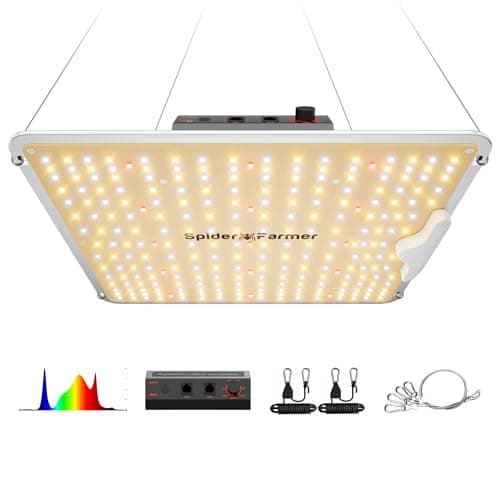 Spider Farmer SF1000 Publishes PPF to two decimal places and an efficacy figure that actually divides out of it. That internal consistency is rarer in this category than it should be. | Two numbers that divide into each other | 2.5 umol/J | |
| 2 | 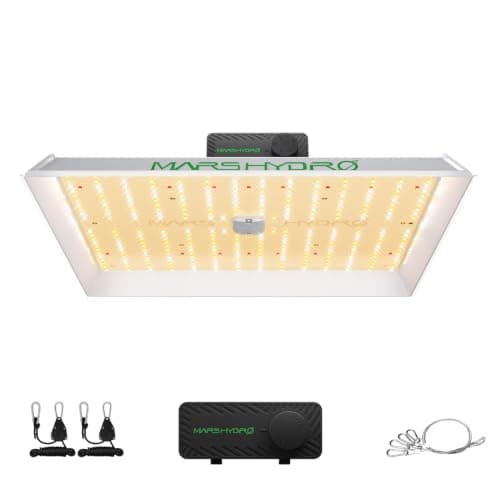 Mars Hydro TS 1000 The most photons of anything on this list, and one of only three fixtures here that publishes both PPF and efficacy so the claim can be checked against itself. | The largest published photon figure | 2.3 umol/J | |
| 3 | 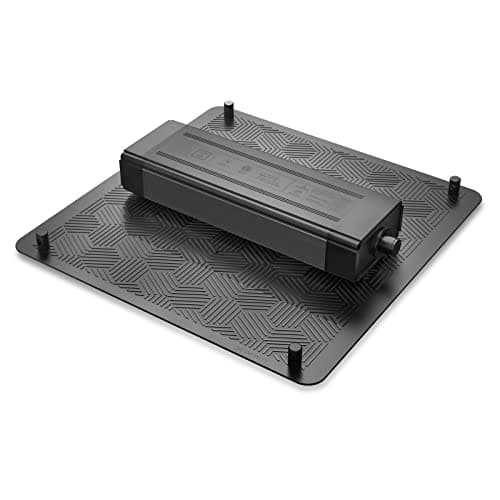 AC Infinity IONBOARD S22 The highest published efficacy of any fixture here at 2.7 umol/J, on Samsung LM301H diodes, with dimming in real 20% steps rather than a vague knob. | The highest efficacy anyone publishes | 2.7 umol/J | |
| 4 | 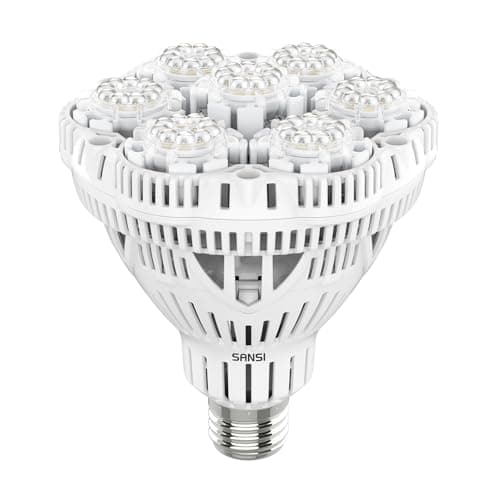 SANSI 36W BR30 Grow Light Bulb The rare grow bulb that publishes both PPF and a PPFD figure with the measurement distance attached, which is the only reason it can be sized honestly. | The cheapest fixture you can place by arithmetic | 1.82 umol/J (ours) | |
| 5 | 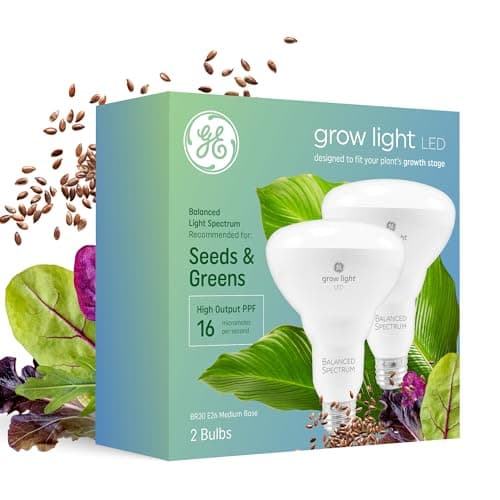 GE Grow Light BR30 Bulb, Seeds and Greens (2-pack) A mainstream-brand grow bulb that prints its photon output on the box: 16 umol/s from 9 W, which is enough for one low- or medium-light plant under a lamp you already own, and not much more. | A photon figure under $25 | Not published |
The reasoning
Run one check and make it this one: the fixture has to publish a photon figure in µmol/s. Everything else on a grow light box is either derived from that number or decorative. Of the eighteen fixtures this site tracks, the Spider Farmer SF1000 is the one we would buy on the strength of its specification sheet alone — it is the only fixture whose two headline figures divide into each other correctly — and it is the right answer for most people lighting an area of about two feet square.
We have not tested any of these fixtures. What follows is a procedure for reading what the manufacturer published, the arithmetic that turns it into an answer, and a scorecard showing how far each of the eighteen gets.
How we judged, before anything was ranked
Six checks, in this order. The order matters: each one is cheap to run and eliminates fixtures that the next check cannot rescue. Nothing here requires a light meter, a review or an opinion — only the specification page and a calculator.
- A photon output figure in µmol/s (PPF).
- An efficacy figure in µmol/J, published or derivable.
- A PPFD figure with the measurement distance attached.
- A coverage claim with a hanging height attached.
- Dimming.
- An honest account of what was left out.
Check 1: a photon figure in µmol/s
Plants respond to the number of photons that land on them, counted in micromoles per second. That figure — PPF, photosynthetic photon flux — is the only one that lets you work out whether a fixture can light your area before you own it.
Three figures routinely stand in for it and none of them substitute. Lumens weight light by human eye sensitivity, which peaks in the green a plant reflects. Watts measure what goes in, not what comes out — the whole point of the next check is the ratio between them. “Equivalent watts” is marketing against a lamp nobody sells any more; we take that one apart in watts vs equivalent watts.
If it is missing: you cannot size the fixture, and no amount of reading will fix that. Ten of our eighteen publish a PPF. Barrina, whose strips are the default seed-starting bar in this category, publishes none for any product in its range, which is the reason this site has a coverage calculator at all.
Check 2: efficacy in µmol/J, and the bar it should clear
Efficacy is photons out divided by joules in — PPF divided by watts. It decides what the fixture costs to run for a given amount of light, and it is the single number that separates a 2026 LED from a 2016 one.
There is an independent benchmark for it, which is the useful part. The DesignLights Consortium maintains a qualified products list for horticultural lighting, and its Version 4.0 requirements, effective 18 April 2025, set a minimum photosynthetic photon efficacy of 2.5 µmol/J— an 8.7% increase on the previous version, measured to ANSI/IES LM-79-19 at an accredited laboratory.
DesignLights Consortium Horticultural Technical Requirements V4.0, effective 18 April 2025. Written for commercial luminaires, not household ones, which is exactly what makes it a useful outside yardstick.
Three of our eighteen clear it: the AC Infinity IONBOARD S22 at a published 2.7 µmol/J, the Spider Farmer SF1000 at exactly 2.5, and the VIVOSUN VS1000 at 2.75 — and the VS1000 no longer appears in Amazon’s catalog, so in practice it is two. That is not a scandal: the DLC bar is written for warehouse-scale luminaires, and a screw-in bulb pays a real penalty for being a bulb. But it does tell you the size of the penalty, which no listing will.
A board at 2.7 µmol/J and a bulb at 1.35 µmol/J produce the same photons for exactly double the electricity.
100 W for 16 hours a day: 100 × 16 × 30 ÷ 1000 = 48 kWh a month, or $8.80 at the US residential average of 18.34 cents. Twice that is $17.60 — about $106 over a six-month winter.
Which is the honest frame: the penalty is real and it is small in absolute terms. We rank by it in the µmol/J table, and it is not the reason to reject a bulb. Lighting one plant with a panel is.
Check 3: a PPFD figure with the distance attached
PPFD is what arrives at the leaf, and it falls off roughly with the square of distance. A PPFD number without the distance it was measured at therefore carries no information at all — it is true at some height, and the manufacturer has not said which.
This is the most common tell in the category. AC Infinity publishes “1098 PPFD” for the IONBOARD S22 with no measurement distance anywhere on the page. We cannot use that figure and we do not try to. Three fixtures of our eighteen do it properly: SANSI at 265.58 µmol/m²/s at 1 ft, Soltech at three separate distances, and the VIVOSUN LumaLight at 521 µmol/m²/s at 12 in.
If it has a distance, you can move it. That is the whole value of the check.
SANSI publishes 265.58 µmol/m²/s at 1 ft. At 2 ft, inverse square gives 265.58 ÷ 2² = 66 µmol/m²/s. At 18 in, 265.58 ÷ 1.5² = 118.
So one bulb at 18 inches sits in the medium band for a flowering houseplant, and the same bulb at two feet sits in the low band for foliage. One published number, two decisions.
Check 4: a coverage claim with a height attached
“Covers 2 × 2 ft” is not a specification until you know from how far away, and at what intensity. Mars Hydro does this well by accident of honesty — it publishes 2.5 × 2.5 ft for vegetative growth and 2.3 × 2.3 ft for flowering, which at least admits that coverage depends on how much light you need. ViparSpectra goes further and attaches the heights: 2.5 ft square at 16 inches, 2 ft square at 10 inches.
A coverage figure with no height is a statement about where the light stops being visible, not where it stops being useful. If that is all you have, ignore it and do the division yourself — what size grow light do I need is that division, worked.
Check 5: dimming
Dimming is the one feature on this list we would pay for, and the reason is arithmetic rather than convenience. Every sizing decision on this site has error bars: published figures carry no tolerance, your area is not the manufacturer’s test area, and plants move. A dimmer is the correction, and it is free after purchase.
It also changes the failure mode. Buy a fixture too small and you are stuck; buy one too large with a dimmer and you turn it down. Eight of our eighteen dim, and every LED board except none of them does — all five boards have a knob or stepped control. No grow bulb we cover is dimmable, and putting one on a wall dimmer is how you get buzz and flicker.
Check 6: what they did not publish
The last check is a reading habit rather than a number. Write down what is absent. A manufacturer that publishes a PPF, an efficacy, a PPFD with a distance and a rated life has told you four things that can be checked against each other; one that publishes a coverage area and a lumen count has told you nothing that can be checked at all.
Our favorite instance: Spider Farmer publishes 249.21 µmol/s and 2.5 µmol/J for a 100 W fixture. 249.21 ÷ 100 = 2.4921, which rounds to the figure they printed. The two numbers were measured, not chosen. That consistency check takes four seconds and almost nothing in this category survives it.
The scorecard, all eighteen fixtures
Every cell below is from the manufacturer’s own specification page. “Ours” marks an efficacy we divided out of two figures they did publish. Blank means they published neither.
| Fixture | PPF in µmol/s | Efficacy µmol/J | Clears 2.5 | PPFD with a distance | Dims |
|---|---|---|---|---|---|
| Mars Hydro TS 1000 | 343 | 2.3 | No | Not published | Yes |
| Spider Farmer SF1000 | 249.21 | 2.5 | Yes | Not published | Yes |
| AC Infinity IONBOARD S22 | Not published | 2.7 | Yes | No — no distance given | Yes |
| ViparSpectra P1000 | Not published | Not published | Unknown | Not published | Yes |
| VIVOSUN VS1000 | Not published | 2.75 | Yes | Not published | Yes |
| VIVOSUN LumaLight 100W | Not published | Not published | Unknown | 521 at 12 in | Yes |
| SANSI 36W BR30 | 65.6 | 1.82 (ours) | No | 265.58 at 1 ft | Not stated |
| Soltech Aspect Gen 2 | 50 | 1.39 (ours) | No | Three distances | Yes |
| Barrina T5 4ft | Not published | Not published | Unknown | Not published | No |
| GooingTop clip light | Not published | Not published | Unknown | Not published | 5 levels |
| SuncoGrow 4ft 40W | 48.42 | 1.21 (ours) | No | Not published | No |
| SuncoGrow 4ft 80W | Not published | Not published | Unknown | Not published | No |
| GE Grow 24in fixture | 72 | 1.80 (ours) | No | Not published | No |
| GE Grow BR30 | 16 per bulb | 1.78 (ours) | No | Not published | No |
| GE Grow A19 | 16 per bulb | 1.78 (ours) | No | Not published | No |
| Feit Electric 16W PAR38 | 20.0 | 1.25 (ours) | No | Not published | No |
| Feit Electric 9W A19 | 14.2 | 1.58 (ours) | No | Not published | No |
| Feit Electric 9W BR30 | Not published | Not published | Unknown | Not published | No |
Ten of eighteen publish a photon figure. Twelve have a knowable efficacy. Three clear 2.5 µmol/J and one of those three is out of stock everywhere. Three publish a PPFD you can move. That is the state of consumer grow light specification in 2026, and it is why a procedure beats a shortlist.
1. Spider Farmer SF1000 — two numbers that divide into each other
Clears checks 1, 2, 4 and 5, and is the only fixture here whose published figures validate one another. 249.21 µmol/s from 100 W, published alongside an efficacy of 2.5 µmol/J, which is what the division gives. It meets the DLC minimum exactly.
Best for: anyone lighting roughly two feet square who wants the specification to be checkable rather than impressive.
The downside: no PPFD at any distance, so you cannot predict what arrives at the leaf without doing the division from PPF and your own area. Spider Farmer also quotes a 2 × 2 ft core and a 3 × 3 ft maximum with no height for either, so check 4 is passed on a technicality.
2. Mars Hydro TS 1000 — the largest published photon figure
343 µmol/s is the most light anyone here publishes, and 150 W is the most electricity. At 2.3 µmol/J it sits below the trade bar, which is the trade-off stated plainly: more photons, slightly worse photons per watt.
Best for: the largest area a single consumer fixture can reasonably cover — a 2.5 ft square, or a wide shelf.
The downside: it misses 2.5 µmol/J, and 150 W run 16 hours a day is 72 kWh a month, about $13.20. It is the most expensive fixture here to run, and the coverage figures split by growth stage in a way that flatters the larger number.
3. AC Infinity IONBOARD S22 — the highest efficacy anyone publishes
2.7 µmol/J, published, clears the DLC minimum with room to spare, and dims in 20% steps. From the efficacy and the wattage you can back out roughly 311 µmol/s, which we label as ours because AC Infinity did not print it.
Best for: long runs — a fixture that will be on twelve hours a day from October to March, where the efficiency compounds.
The downside: it fails checks 1 and 3. No PPF, and a “1098 PPFD” claim with no measurement distance attached, which is unusable. The best-specified fixture here by efficacy is one of the worst-specified by everything else.
4. SANSI 36W BR30 — the cheapest fixture you can place by arithmetic
The only bulb in the category that publishes both a PPF and a PPFD with the distance attached, which is why it appears on more pages of this site than anything else. 65.6 µmol/s, 265.58 µmol/m²/s at 1 ft, 1.82 µmol/J once you divide.
Best for: one plant, in a lamp you already own, where you want to know in advance what height to set.
The downside: 1.82 µmol/J is well under the trade bar, no beam angle is published so the 265.58 figure cannot be turned into a footprint, and SANSI states the bulb weighs a pound and is “not recommended to be used in tightly closed fixtures”. Which lamp it goes in is a real constraint — the fitment checks are here.
5. GE Grow BR30 — a photon figure under $25
Two bulbs, 16 µmol/s each, 9 W each, E26, and a mainstream brand that printed the photon number on the box. That is the whole case, and for the price it is a good one: the cheapest way to own a fixture whose output is a known quantity rather than a claim.
Best for: two ordinary lamps, two plants, and a buyer who wants arithmetic rather than a panel.
The downside: 16 µmol/s is a very small amount of light. Even if every photon landed inside one square foot — which no bulb manages — the average would be 172 µmol/m²/s, and GE publishes no beam angle to check that against. Non-dimmable, and no enclosed-fixture statement anywhere on the page.
Three claims to ignore outright
- “Full spectrum.” No threshold exists for the phrase, so printing it costs a manufacturer nothing. The long version is in what full spectrum actually means.
- Lumens, and anything in lux. Human-eye units. There is no universal conversion to photon units because the ratio depends on the spectrum of the specific fixture.
- “Replaces a 600 W HPS.” A comparison against a lamp with a different spectrum, a different fixture geometry and a thirty-year-old efficiency. Nothing is being measured.
What this procedure does not tell you
Three things, and they are worth naming because the checks above can make a specification sheet feel more complete than it is.
Uniformity. A PPF figure says how many photons leave; it says nothing about whether they land evenly. Two fixtures with identical PPF can produce a bright center and dark corners or an even field, and almost nobody publishes a map. The practical consequence is in bar vs panel coverage.
Whether the numbers are true. We check published figures for internal consistency, which catches carelessness and invention. It does not catch a manufacturer who measured honestly on a unit better than the one in the box. We have not tested these fixtures and we say so on every page.
Longevity. Rated life figures here run from 25,000 to 50,000 hours, and one fixture quotes 36,000 hours to Q90 — the point at which output has dropped a tenth. Those are projections from standardised tests, not observations of the fixture you will own.
The verdict, compressed
If the listing has a PPF in µmol/s and a wattage, you can decide everything else yourself. If it has an efficacy above 2.5 µmol/J you are buying 2026 hardware. If it has a PPFD with a distance you can place it without a meter. If it dims, you can be wrong about your area and recover.
For most people reading this, the SF1000 clears enough of that to be the default, the SANSI bulb is the right answer for one plant, and the fixture to walk away from is the one whose page is a list of adjectives.
Every pick in full
Spider Farmer SF1000
LED panelTwo numbers that divide into each other
Publishes PPF to two decimal places and an efficacy figure that actually divides out of it. That internal consistency is rarer in this category than it should be.
What Spider Farmer publishes
- Power draw
- 100 W +/-5% at 100-277 V AC (source)
- PPF (photon output)
- 249.21 umol/s (source)
- Efficacy
- 2.5 umol/J (source)
- Stated coverage
- 2 x 2 ft core, 3 x 3 ft maximum (source)
- Spectrum
- 650-665 nm, 730-740 nm, 2800-3000 K, 4800-5000 K (source)
- Diodes
- Bridgelux (source)
- Dimming
- Yes, dimming knob (source)
- Dimensions
- 32.5 x 29.0 x 5.9 cm (source)
- Rated life
- 55,000 hours (source)
Our arithmetic
- Does the published efficacy check out against the published PPF?: Yes — 2.49 umol/J computed against 2.5 umol/J published
249.21 umol/s / 100 W = 2.4921 umol/J. The published 2.5 umol/J is that number rounded. Not every brand's two figures agree like this, which is exactly why we divide them. - Average PPFD across its 2 x 2 ft core footprint: about 536 umol/m2/s
2 ft x 2 ft = 4 sq ft = 0.372 m2. 249.21 / 0.372 = 670 umol/m2/s at perfect uniformity; at a 0.8 uniformity factor, about 536 umol/m2/s.
Who should skip it
Skip it if raw output is what you are buying — the TS 1000 delivers 38% more photons per second, at the cost of 50 W more draw.
Mars Hydro TS 1000
LED panelThe largest published photon figure
The most photons of anything on this list, and one of only three fixtures here that publishes both PPF and efficacy so the claim can be checked against itself.
What Mars Hydro publishes
- Power draw
- 150 W +/-5% at 100-277 V AC (source)
- PPF (photon output)
- 343 umol/s (source)
- Efficacy
- 2.3 umol/J (source)
- Stated coverage
- 2.5 x 2.5 ft vegetative, 2.3 x 2.3 ft flowering (source)
- Spectrum
- 660-665 nm, 730-740 nm, 3000 K, 5000 K (source)
- Diodes
- Bridgelux (source)
- Dimming
- Yes, 0-100% dimmer knob (source)
- Dimensions
- 406 x 326 x 50 mm (source)
Our arithmetic
- Average PPFD across its stated 2.5 x 2.5 ft vegetative footprint: about 470 umol/m2/s
2.5 ft x 2.5 ft = 6.25 sq ft = 0.581 m2. 343 umol/s divided by 0.581 m2 = 590 umol/m2/s at perfect uniformity; applying a 0.8 uniformity factor gives about 472 umol/m2/s average. - Electricity used at 14 hours a day for 30 days: 63.0 kWh a month
150 W x 14 h x 30 d / 1000 = 63.0 kWh.
Who should skip it
Skip it if you are lighting a bookshelf. 343 umol/s concentrated into a 2.5 ft square is far more light than a monstera wants, and you pay 150 W to deliver it.
AC Infinity IONBOARD S22
LED panelThe highest efficacy anyone publishes
The highest published efficacy of any fixture here at 2.7 umol/J, on Samsung LM301H diodes, with dimming in real 20% steps rather than a vague knob.
What AC Infinity publishes
- Power draw
- 115 W (source)
- Efficacy
- 2.7 umol/J (source)
- PPFD
- 1098 PPFD (no measurement distance published) (source)
- Stated coverage
- 2 x 2 ft (source)
- Spectrum
- Samsung LM301H, plus 660 nm, 730 nm, 3000 K, 6500 K (source)
- Diodes
- 272 diodes (source)
- Dimming
- Yes, 0-100% in 20% increments (source)
- Dimensions
- 30.0 x 30.0 cm board, 1.1 cm thick (source)
- Rated life
- 50,000 hours (source)
Our arithmetic
- Photon output implied by the published wattage and efficacy: about 311 umol/s
115 W x 2.7 umol/J = 310.5 umol/s. AC Infinity does not print PPF directly, so this is our arithmetic from two figures it does print.
What AC Infinity does not publish
- PPF in umol/s — only efficacy is given, so photon output has to be derived
- The measurement distance for the 1098 PPFD figure, without which the number cannot be compared to anything
Who should skip it
Skip it if you want to place it by the numbers. AC Infinity prints 1098 PPFD with no measurement distance attached, which makes that figure impossible to use or compare.
SANSI 36W BR30 Grow Light Bulb
Grow bulbThe cheapest fixture you can place by arithmetic
The rare grow bulb that publishes both PPF and a PPFD figure with the measurement distance attached, which is the only reason it can be sized honestly.
What SANSI publishes
- Power draw
- 36 W (source)
- PPF (photon output)
- 65.6 umol/s (source)
- PPFD
- 265.58 umol/m2/s at 1 ft (source)
- Spectrum
- 4000 K, 400-780 nm, CRI close to 100 (source)
- Rated life
- 25,000 hours (source)
Our arithmetic
- Efficacy, computed from the published figures: 1.82 umol/J
65.6 umol/s / 36 W = 1.82 umol/J. That is roughly a third less efficient than the panels on this page — the price of a screw-in form factor. - Electricity used at 12 hours a day for 30 days: 12.96 kWh a month
36 W x 12 h x 30 d / 1000 = 12.96 kWh.
What SANSI does not publish
- Beam angle
- Fixture dimensions
Who should skip it
Skip it if you are lighting more than one plant. 65.6 umol/s is a small amount of light spread over a cone — it lights a single specimen, not a shelf.
GE Grow Light BR30 Bulb, Seeds and Greens (2-pack)
Grow bulbA photon figure under $25
A mainstream-brand grow bulb that prints its photon output on the box: 16 umol/s from 9 W, which is enough for one low- or medium-light plant under a lamp you already own, and not much more.
What GE Lighting publishes
- Power draw
- 9 W per bulb at 120 V; medium E26 base (source)
- PPF (photon output)
- 16 umol/s per bulb (source)
- Spectrum
- 500 lumens, CRI 90; described as full spectrum with blue and red, no spectral distribution published (source)
- Dimming
- No (source)
- Rated life
- Up to 25,000 hours; 3-year warranty (source)
Our arithmetic
- Photon efficacy, computed from the published figures: 1.78 umol/J
16 umol/s / 9 W = 1.78 umol/J. Ours, not GE's. Just below the SANSI 36W BR30 at 1.82 umol/J, which puts it with the better grow bulbs on this site. - The ceiling over one square foot: at most 172 umol/m2/s
1 sq ft = 0.0929 m2. 16 umol/s / 0.0929 m2 = 172 umol/m2/s. That average holds only if every photon the bulb emits lands inside that square foot, so the real figure is lower. GE publishes no beam angle, so the actual spread cannot be computed. - The daily light ceiling at GE's recommended 18 hours: at most 11.2 mol/m2/day
172 umol/m2/s x 18 h x 3600 / 1,000,000 = 11.2 mol/m2/day. Under an assumption that flatters the bulb, that is still short of the roughly 12 mol/m2/day the University of New Hampshire Extension gives for seedlings. - Electricity at 16 hours a day for 30 days: $0.79 a month per bulb
9 W x 16 h x 30 d / 1000 = 4.32 kWh. 4.32 x 18.34 cents = $0.79. At GE's 18 hours: 4.86 kWh = $0.89.
What GE Lighting does not publish
- PPFD at any stated distance
- Beam angle
- Color temperature and spectral distribution
- Photon efficacy in umol/J
Who should skip it
Skip it for a seed tray or a plant that wants bright light. Even if every photon it emits landed inside one square foot, which no bulb manages, the average would top out around 172 umol/m2/s.
Questions people actually ask
+What should I look for in a grow light?
+How many µmol/J is a good grow light?
+Is a PPFD figure useful without a distance?
+Are lumens useful for choosing a grow light?
+Do I need a dimmable grow light?
Sources
- DesignLights Consortium — Horticultural Technical Requirements V4.0, effective April 18 2025 — consulted October 30, 2026
- Spider Farmer — SF1000 published specification table — consulted September 2, 2026
- Mars Hydro — TS 1000 published specification table — consulted September 2, 2026
- AC Infinity — IONBOARD S22 published specifications — consulted September 2, 2026
- ViparSpectra — P1000 product page — consulted September 2, 2026
- SANSI — BR30 36W grow light bulb product page — consulted September 2, 2026
- Soltech — Aspect Gen 2 published specifications — consulted September 2, 2026
- Barrina — T5 ML20 4ft 20W product page — consulted September 2, 2026
- Sunco Lighting — SuncoGrow LED Grow Light 4ft 40W product specifications — consulted September 14, 2026
- GE Lighting — GE Grow Light BR30 LED bulb for Seeds and Greens, 16 PPF (specifications) — consulted September 17, 2026
- Feit Electric — 16W PAR38 E26 Base LED Plant Grow Light Bulb, PAR38/GROW/LED/BX (specifications) — consulted September 19, 2026
- VIVOSUN — LumaLight 100W LED Grow Light product specifications — consulted September 27, 2026
- University of Minnesota Extension — Lighting for indoor plants and starting seeds — consulted September 2, 2026
- US Energy Information Administration — Electric Power Monthly, Table 5.3 (US residential average, June 2026) — consulted September 2, 2026
Read next
Reviews
The Best Grow Lights
The main ranking: nine fixtures sorted on published data, with every gap named.
Top pick
Spider Farmer SF1000
Spectrum & PPFD
What “Full Spectrum” Actually Means
The phrase is unregulated and carries no threshold. These are the numbers that replace it.
Top pick
Spider Farmer SF1000
Running Cost
The Most Efficient Grow Lights by µmol/J
Every fixture we cover ranked on published photon efficacy, with derivations shown.

Coverage & Sizing
What Size Grow Light Do I Need?
Size from area and target, not from watts. The sum, plus a lookup table by area.
Top pick
SANSI 36W BR30 Grow Light Bulb
Reviews
Can You Put a Grow Light Bulb in a Regular Lamp?
E26 fitment, which bulbs are rated for a closed fitting, the one that weighs a pound, and why none of them belong on a wall dimmer.
Top pick
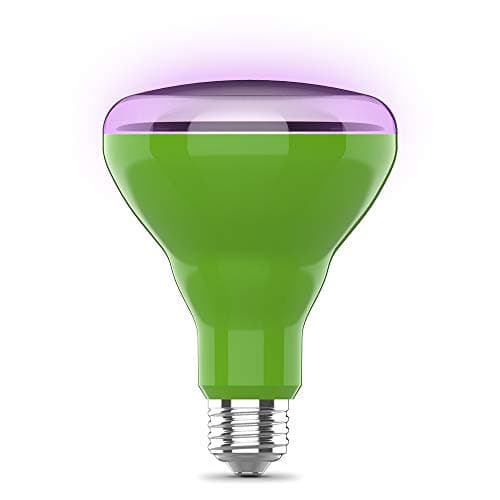
Feit Electric 9W BR30 Grow Bulb
Where this sits
This page belongs to Fixture Reviews and Roundups. Every figure on it is either quoted from a named published source or derived in view — the full method is on our methodology page, and how the site is funded is on the affiliate disclosure.